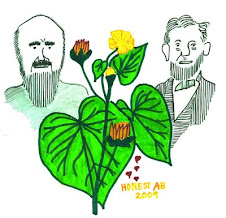
Sunday, September 13, 2026

Calling All Commensals!

I have just posted a video in which Darwin explains that there are three rough categories of ecological interaction between any two species: parasitism, commensalism, and mutualism. Of course, whenever a scientist says “there are three categories” this is almost always an oversimplification—even if a useful one.

In parasitism, the parasite gets most or all of its resources from the host. Obviously, the parasite benefits, and the host is harmed, at least over the long term. A botanical example that is abundant in the forests of Alsace, from which Darwin reports, is mistletoe growing on a tree. The mistletoe roots actually grow into the wood and extract water and minerals from it, thus harming the tree.

In mutualism, both species benefit from the interaction. A botanical example from Alsace is lichens, in which single-celled algae live inside a sandwich of fungus tissue. Both species benefit from this: the algae make food when the weather is moist, and the fungi protect the algae from damage when the weather is dry.

Both parasitism and mutualism are fairly clear-cut. But commensalism? This is when the commensal benefits and the host is unaffected. The example Darwin uses is vines growing on a tree trunk. The vines do not actually put their roots into the tree tissue; the vines just climb on the tree like a trellis. This would seem to be commensalism: the vine benefits from getting its leaves up into the sunshine without having to make its own trunk, while the tree just stands there.

But many times the “host” is negatively affected by the commensal. In the case of the vine and the tree, the host has to bear the extra weight of the vine. A little vine might not have much impact, but a large vine can weigh a lot (see the photo). And while a vigorous tree might be able to bear the extra weight in normal times, the tree could collapse in times of high wind—or even without high wind. In fact, the vine might even shade the tree leaves, reducing the growth of the tree.


When you think about it this way, maybe there is no such thing as commensalism. The best example is the microbes that live in our guts. Some of them are mutualists—they produce waste products that enhance our nutrition by digesting molecules that the human gut cannot—and some of them are parasites under certain conditions. But there may be none of them that are commensals all of the time. We seldom notice the little mites that live in our hair follicles—that is, unless there are too many of them, or we have an allergic response to them.

Vine to tree: Thanks for letting me grow on you.

Tree to vine: I’m not dead yet!

Saturday, September 12, 2026

The Thinking, Walking Biped, part twelve. The Perfect Exercise

Walking is, at least for people like me, the perfect exercise. Just this morning I walked 11 kilometers. Most other kinds of exercise result in strain and injury, especially to joints. Pascal Picq points out in his book (reviewed earlier) that slow, long-distance running and walking is something that humans do much better than any other species, especially the ones like cheetahs that can run much faster but only for short distances. And even older humans, who are no longer athletic in other ways, can run or walk for long distances; geriatric marathon runners are actually quite common, though often unnoticed because they finish last. But they finish.

Walking is slower than running, which means that the walker is less likely than the runner to trip over or step on things in the path or, if so, to sustain injury from them. An injury can take an old body a long time to recuperate from. I have required physical therapy for things that, as a younger man, I would hardly have noticed.

Walking is almost perfectly aerobic. That is, your muscles can keep working for long stretches of time because your circulatory system can provide them with all of the oxygen that they need (that is what aerobic means). And the body can also keep itself cool during long walks.

There are three ways that an object, such as your body, can keep cool even while generating body heat during exercise.

  • The first is through what is called radiant heat transfer. Your body emits invisible light, just off the red end of the spectrum, which is why it is called infra-red. It is, in fact, a kind of energy and to lose this energy means you will cool off. How much energy you lose is not completely under your control. It depends on your environment and how hot you are. Deep space is almost at absolute zero, and when you lose infra-red light into outer space—even into a clear blue sky—it is gone forever. You cannot speed it up or slow it down. This is why you feel a chill if you sleep out in the open, but not if you sleep under a tree or a roof. The tree or roof is not at absolute zero.
  • The second is sensible heat transfer—sensible as in the fact that you can feel it. Your molecules conduct some of their energy to the air, that is, if the air is colder than you are, which is usually the case. You have some control over this. You can alter the amount of surface area you expose to the air by curling into a ball (to hold in the heat) or extending your arms (to release it). There is always an unstirred boundary layer of air next to your skin, especially when that air is trapped inside of fabric. To cool off, wind is your friend.
  • The third is latent heat transfer—from the evaporation of water. Water constantly evaporates from you, especially from your invisible sweat. Your sweat glands allow water to evaporate before it has a chance to become visible on your skin or clothes. People who have defective sweat glands easily overheat. Again, wind is your friend—it not only blows away sensible heat but also water vapor.

You cannot do much about radiant heat. But walking or slow running allows sensible and latent heat to keep you cool. I need the exercise for my body but also to keep my mind active. I will walk all I can for as long as I can. If someday I can only hobble, I will still be healthier for having walked (around 90 kilometers a month) as much as I do.

Friday, September 11, 2026

The Walking, Thinking Biped, part eleven. Social Nature Walking

A lot of us like to walk along in nature and have our own thoughts and insights. As soon as you get even one more person, there is the possibility of having quotidian conversation, not very different from what you would have in an automobile, drive out the appreciation of the natural world. I have frequently had this experience when leading students on hiking field trips. They can walk all day and see almost nothing they will remember.

That is, unless the hike is specifically designed to enhance observation and the ability to integrate with nature. This may be nowhere better seen than in scouting groups. I was, for several years, a Boy Scout. Though I was the one most interested in nature, the others got really good at rock climbing, tying knots, erecting tents, building camp fires, rappelling across creeks, and even the use of Morse code for long distance communication. For us, the Boy Scout Handbook and the Army Field Survival Manual were central texts (which included how to distinguish edible vs. dangerous plants). I was about the only boy who saw the spiritual dimensions of nature, which is why I was chosen to give the Sunday morning sermon at the Boy Scout Camporee in Tulare County about 1968.

There can be an even larger social context. In Europe, especially Germany, hundreds or thousands of people like to go on mass hikes together. The movement is called Volksmarch and its theme song, as far as I can tell, is The Happy Wanderer:

I love to go a-wandering along the mountain track

And as I go I love to sing, my knapsack on my back.

Sometimes sharing a trail with other hikers is not particularly pleasant. While I was hiking in the Black Hills of South Dakota, parents with two adolescent children singing, as they walked, “Ninety-nine bottles of beer on the wall, ninety-nine bottles of beer, take one down, pass it around, ninety-nine bottles of beer.” I’m sure you know or can guess the next ninety-eight verses. I found this incredibly annoying. But then I told myself, the parents are taxpayers just like me, their revenues sustain the National Forest Service, just like mine. Even when we are alone in a forest, we depend on the social network, which sustains the forest.

Thursday, September 10, 2026

Edd's Land: A Novel of Four Cherokee Brothers in Early Oklahoma, a novel by Stan Rice, part one. Edd Making the Best of It

Author Stan Rice has just published the third of three novels (Edd’s Land) in the series Trail of Tears: Novels of Cherokee Identity. Because Kindle has unreliable availability and formatting, the author has also posted a free PDF download. This second novel is about four Cherokee brothers in early Oklahoma.

Here is Rice’s summary from Kindle:

Four mixed-blood Cherokee brothers, and the white swindler who steals their land and oil allotments, greet Oklahoma statehood in different ways. Edd Hicks loses not just his land but his fiancée to Averd Hargrove, a Claremore banker. Edd remains confident and upright, and brings order to his farmland and family. Frank Hicks learns confidence as he plots his dramatic revenge against Hargrove. Lon Hicks leaves his past behind in pursuit of a failed Hollywood career. William Hicks is ill with tuberculosis when he meets the great Oklahoma socialist crusader Kate Barnard. Frank, to the disapproval of his racist family and friends, falls in love and moves in with Bert Hicks, a black woman descended from slaves owned by Frank’s ancestors. Frank nearly gives up on his plan to scalp Hargrove until he sees Hargrove leading a lynch mob against Bert’s brother. The net effect of the vast wealth of the former Cherokee Nation is that Edd’s daughter Nina finally gets enough money back from the United States government to buy a new pair of shoes.

Edd Hicks (a real person) was one of hundreds of Cherokees who received a land allotment in northeastern Oklahoma at the beginning of the twentieth century. He was a self-educated man, he upheld and championed education wherever he lived, which was always in Oklahoma. He was fully aware of the injustices and cruelties committed by the white government of the United States against the Cherokee tribe. This included the Trail of Tears itself, but also the process by which farmland was allotted to Cherokees in Indian Territory by white overseers. Each adult Cherokee was given a certain amount of land, but when all of the allotments were added up, there was a lot of land left over, which was given to white people. In addition, the allotment commission often appointed dishonest guardians or overseers for the Cherokees (see the next essay). Edd knew all of this, but also that there was nothing he could do about it. His solution was simply to get whatever land he was given, and grow food and a family on it.

Edd was an upright man. He was very righteous, without looking down on people who were not as religious as he was, including his brothers. He even forgave the brother (Lonnie; see later essay) who stole money from the family. He was proud to raise all of his own food. On paper he was poor, but his family never went hungry.

Edd’s career did not get off to an easy start. He was looking forward to the twentieth century, in which the Cherokees could finally settle down on their own land. And he was engaged to a beautiful woman, Mary Carter. But then Mary’s disreputable brothers forced an end to this engagement. What was Edd’s response? He just went ahead with his farm, and hoped to find a woman who would be his wife. He did. He made the best of his circumstances, not looking back to the past, and he had to admit that he probably ended up better than he otherwise would have—certainly better than his brothers.

Wednesday, September 9, 2026

Elizabeth’s Exile, a Novel of a Cherokee Refugee, by Stan Rice, part five. What Is Faith?

Author Stan Rice has just published the second of three novels (Elizabeth’s Exile) in the series Trail of Tears: Novels of Cherokee Identity. Because Kindle has unreliable availability and formatting, the author has also posted a free PDF download. This second novel is about a Cherokee woman, Elizabeth Hilderbrand Pettit who, in middle age, walked with a contingent of other Cherokees on the infamous Trail of Tears from the Appalachians to what is now Oklahoma, after losing their land and possessions. As Rice’s novel explains, this was totally illegal, as the law under which Andrew Jackson prosecuted this Trail of Tears was declared unconstitutional by the Supreme Court.


Of course Rice, a botanist and evolution author, would revere Asa Gray, the Harvard botanist who was Charles Darwin’s main defender in America. Gray promoted Darwinism even though he was a conventionally and seriously religious Christian.

And Gray promoted the protection of Black people as far as he could in Boston. While even white Northerners were prejudiced against Blacks (they thought slavery was wrong, but had no particular love for Black people), Gray taught Sunday School for Blacks.

But Rice totally made up the stuff about Asa Gray being a leader in the Underground Railroad, which escorted escaped slaves to freedom. This is perfectly credible—especially since Gray would have had the perfect excuse to be in the borderlands of the Union and the Confederacy, searching for new plants—but it just didn’t happen. This is fiction; there has to be something that is not completely historical. Rice also invented the part about Elizabeth Hilderbrand Pettit being an Underground Railroad leader.

But Rice gives us some insights about the Christian faith in these examples. Elizabeth had to lead some of the slaves blindly in the darkness without any assurance that their rescue would be successful. That is, her journey was based on faith, not on evidence. As the Bible says, we walk by faith, and not by sight. One of Elizabeth’s sections of the novel ends with these words: “This is faith. I walk where I cannot see, leading people I do not know, toward a salvation that may not be there.”

Sunday, September 6, 2026

Darwin and Primeval Forests

I have just posted a new video in which Darwin speculates on primeval forests. He begins by reciting, from imperfect memory, the beginning of Henry Wadsworth Longfellow’s poem Evangeline: something like “This is the forest primeval. The murmuring pines and the hemlocks, in garments green, indistinct in the twilight, stand like druids of eld…” Evangeline begins in Acadia. Well, Longfellow might have thought that the Acadian forest had always been there, but by the time Longfellow published the poem in 1847 geologists had already begun to understand that the entire northern part of the North American landscape had been covered by glaciers until about ten thousand years ago. The Acadian forest was less than ten thousand years old.

Another place many tourists visit is Walden Pond, where Henry David Thoreau lived in nature (actually only a couple of years, and in a forest profoundly altered by human activity). Many may think that the forest at Walden has always been there, but Thoreau would have been the first to tell you that the forest was always changing, especially as hardwoods grew up underneath pines in the process of ecological succession. He studied tree rings and could give you the evidence that the forest was always changing.

Darwin speaks to you in this video from a forest in Alsace in northeastern France. It looks like an ancient forest. The forest itself may look not too different from when the Empress Josephine saw it in the nineteenth century on the way to her mansion in Strasbourg. But none of the trees were there when Josephine saw them.

We know this because the oldest trees are about a century old. When a big old tree dies and falls over, it frequently blocks hiking paths. Municipal workers (the forest belongs to the town of Bischheim) cut away the trunks and move them off the path. The radial cuts reveal tree rings, one ring for each year of growth. The oldest ones on which I have counted the rings were about a hundred years old when they fell.

This means they started growing about the time of World War I. At this time, most of Alsace was a devastated landscape, in which almost all the trees were dead. (World War II did not have such a severe effect on Alsace.) A few lucky seedlings survived near a ballast mining pit (which is now Lake Balastière) and lived until they fell down and I saw them a century later. The forest looks impressive—lots of big beech, linden, and maple trees—but the whole forest grew in a century.

Every forest is in constant flux—old trees dying, young trees taking their place, sometimes trees of the same species, sometimes of a different species. There is perhaps no primeval forest anywhere. Sorry, Longfellow.

Saturday, September 5, 2026

The Thinking, Walking Biped, part ten. Walking and Creativity

Many of the most creative minds have had their greatest inspiration by walking out in nature. There did not have to be an actual correspondence of what the mind saw and the act of creativity; it was simply the inspiration of the mind prompted by the overall beauty of nature. There have probably been more poets who have done this than who have not. It was also a common practice among composers. For example, Antonín Dvořák would walk every morning at dawn while jotting down musical ideas. He did this every morning along the Turkey River when he visited Spillville, Iowa in 1893, and then play the organ at the Catholic church. Gustav Mahler was famous for having a composer’s hut in the Alps away from his summer house during the summer when the opera, which he conducted, was not in session. He did not just hide in this hut, but walked on the surrounding forest trails.


Sometimes there was actual nature imagery in the music, aside, that is, from the thunderstorm in Beethoven’s Pastorale symphony (number 6) or in the second part of the Rossini’s William Tell overture. I am thinking again of Mahler. One time, in his childhood, Mahler had been left in the woods alone by a father who forgot about him. His father ran back to rescue him, only to find little Gustav sitting in rapt wonder at the natural world. The memory of this experience did not leave him. According to one documentary, this memory appears at the very beginning of Mahler’s first symphony, where the offstage trumpets represented distant bird calls and the cuckoo call, starting in measure 25 in the oboe, actually was a cuckoo that he heard.

Many other creative people have walked in nature to get at least a general inspiration: Samuel Taylor Coleridge, William Wordsworth, Charles Dickens, Richard Wagner, Victor Hugo, and even Pierre Curie.

Here is an example of what I am not talking about. The great Roman orator Cicero used the natural world to help him remember his speeches, which he presented without notes. Or so I have read once in a speaker’s handbook long ago. He could remember each portion of his speech, but he sometimes had difficulty remembering which portion would come next. But he was very familiar with his garden walking path. So what he would do was to recite each portion of his speech as he went along the path. Then, while speaking, he would imagine himself walking on the path. Each thing he saw reminded him of which topic was next. This is not an example of walking and creativity, since the topics and the objects did not need to have any real correspondence; it was just Cicero’s memory prop.

An experiment at Stanford in 2014 confirmed that walking enhances creative thinking. This is yet another example of how science confirms what we have known, or think we have known, all along.

Friday, September 4, 2026

The Thinking, Walking Biped, part nine. Other famous walks, of varying quality

Other writers, besides those described in earlier essays, have taken extensive nature walks for a variety of creative purposes. Here are just a few examples.

  • Estwick Evans was a New Hampshire lawyer who started a four thousand mile journey in 1818 which took him to Detroit, which was at the time on the deep frontier. Most of this journey was on foot. His purpose was not primarily to learn about the natural, but about the human, world. He visited many Native and white American settlements. He saw what he expected to see: that the westward expansion of America was, by and large, a good thing for everyone.
  • Philip Freneau was an American poet who did a lot of walking in nature, though not, as far as I can tell, any one single long journey. His principal motivation was to see the Native viewpoint on the natural world.
  • Graham Greene was a British novelist who took a 350-mile trip through Liberia in the early twentieth century, as described in Journey without Maps. But he was not primarily observing Africa. He brought a whole cavalcade of prejudices with him. He had 25 porters, six boxes of food, beds, chairs, and a bathtub. His journey can best be described as imposing itself on Africa. His motivation, he said, was H. Rider Haggard’s She, which was a novel about an almost vanished white African civilization. Greene took an American map that labeled this part of Africa simply as “cannibals.” He wanted to see evidence of white supremacy in Africa, and this is what he saw.

The usual situation, in these journeys, was that the white traveler came with expectations of what he would see, and gathered observations that reinforced them.

Wednesday, September 2, 2026

Elizabeth's Exile, a Novel of a Cherokee Refugee, part four. How Do You Face Disruption and Tragedy?

Author Stan Rice has just published the second of three novels (Elizabeth’s Exile) in the series Trail of Tears: Novels of Cherokee Identity. Because Kindle has unreliable availability and formatting, the author has also posted a free PDF download. This second novel is about a Cherokee woman, Elizabeth Hilderbrand Pettit who, in middle age, walked with a contingent of other Cherokees on the infamous Trail of Tears from the Appalachians to what is now Oklahoma, after losing their land and possessions. As Rice’s novel explains, this was totally illegal, as the law under which Andrew Jackson prosecuted this Trail of Tears was declared unconstitutional by the Supreme Court.


Any event as big as the Trail of Tears cannot be fully presented in a novel. The novel must focus on one or a few people and their experiences. Rice focused on Elizabeth Hilderbrand Pettit, whom he identifies in the author’s notes as his third great grandmother. By focusing on one or a few individuals, we can see the individual disruptions that occurred within the overall Disruption known as the Trail of Tears.

In Elizabeth’s case, the main disruption (aside from losing her home and land) was her husband James, a white man. It turned out that he had misrepresented himself to her when they married: he had a white wife and family just over the border in Mississippi. She sued him (historical fact) and won possession of all property and goods—all of which she lost when she had to get onto the Trail of Tears. In Rice’s novel, James was with her on the entire journey. Though James was probably an evil man, Rice treats him sympathetically as a tragic character who just wants Elizabeth to forgive him, which she never does. Despite this disruption, Elizabeth remains positive and strong on the entire trip.

The same cannot be said of Elizabeth’s daughter Minerva, who came of age on this journey. She is spunky and wise, and seems to be very strong. But then she is violated by a slimy preacher named John Schermerhorn and this, Rice suggests, ruined her ability to trust that anything good could happen in her life. Minerva was—historical fact again—married six times and died at the age of forty. She was married briefly to one of the novel’s main narrators, Lewis Hicks, her second husband, but had a child by her third husband while she was still married to Lewis. Rice uses this story in his novel, but adds in ideas from the Biblical story of David and Bathsheba and Uriah the Hittite.

Rev. John Schermerhorn was a historical figure who was every bit as slimy as Rice portrays him. I think Rice might have had to invent this character, had he not actually existed. He was infamous among all the Cherokee women for trying to hit up on them. They called him Devil Horn. He was the same man who had supervised the Treaty of New Echota in which illegal representatives of the Cherokee tribe signed away their rights to their Appalachian homeland.

Rice includes other historical events such as the murder of the Cherokee leader Doublehead by his fellow Cherokees, as well as the murders of John Ridge and Elias Boudinot. Nobody in the tribe reveres Doublehead, who was also called Babykiller. But to this day some Cherokees despise, and others revere, the efforts of Ridge and Boudinot to protect the Cherokees from white oppression, although their compromises (including the Treaty of New Echota) proved ultimately futile.

Rice also includes Asa Gray, the Harvard botanist. Gray was, in fact, a defender of the rights of free Blacks in the North, but I suspect Rice has invented all the details of Gray being a leader in the Underground Railroad.

Rice ends the novel from the viewpoint of Edd Hicks, one of Minerva Pettit’s grandchildren, who regrets all the oppression in Cherokee history but who has resolved to make the best of whatever situation he is in. He is the focus of the third novel in the series, Edd’s Land, reviewed later in this blog.

Tuesday, September 1, 2026

Elizabeth's Exile, a Novel of a Cherokee Refugee, by Stan Rice, part three. What Was Andrew Jackson Like?

Author Stan Rice has just published the second of three novels (Elizabeth’s Exile) in the series Trail of Tears: Novels of Cherokee Identity. Because Kindle has unreliable availability and formatting, the author has also posted a free PDF download. This second novel is about a Cherokee woman, Elizabeth Hilderbrand Pettit who, in middle age, walked with a contingent of other Cherokees on the infamous Trail of Tears from the Appalachians to what is now Oklahoma, after losing their land and possessions. As Rice’s novel explains, this was totally illegal, as the law under which Andrew Jackson prosecuted this Trail of Tears was declared unconstitutional by the Supreme Court.


 As in any novel written by a Cherokee author, president Andrew Jackson will appear as an evil man. And that is because he was. Rice would have to totally alter the historical background of the novel in order to make Jackson appear even the least bit heroic.

But there are a significant number of white Americans who idolize Andrew Jackson. Their spiritual leader is Donald Trump, who has a Jackson portrait prominently displayed in the
White House.

I then realized something about Rice’s novel. The way he portrayed Andrew Jackson was, in fact, very much as we know Donald Trump to be. Rice was modeling Jackson after Trump, including his anger, his vanity, and his racism—even his facial expressions. Rice even put some of Trump’s words into Jackson’s mouth.

To this day, most Cherokees resent having the face of Andrew Jackson on the twenty dollar bill. When a new series of twenty dollar bills came out a couple of decades ago, Jackson’s face was still on it, but larger. A Cherokee artist told me that this was fine with him; it just made the target a little larger for Cherokee bullets. He was joking of course, because most Cherokees are poor enough that they cannot waste a twenty dollar bill on target practice.

During the Biden Administration, the opportunity came along to have a different face on this bill. The federal government was planning to issue new currency featuring the face of Harriet Tubman, who was one of the driving forces behind the Underground Railroad. She earned her place in American history. But Donald Trump, offended by the thought of having her on American currency, canceled these plans and insisted on keeping Jackson’s face on the currency.

Monday, August 31, 2026

Elizabeth's Exile, a Novel of a Cherokee Refugee, by Stan Rice, part two. What Was the Motivation for the Trail of Tears?

Author Stan Rice has just published the second of three novels (Elizabeth’s Exile) in the series Trail of Tears: Novels of Cherokee Identity. Because Kindle has unreliable availability and formatting, the author has also posted a free PDF download. This second novel is about a Cherokee woman, Elizabeth Hilderbrand Pettit who, in middle age, walked with a contingent of other Cherokees on the infamous Trail of Tears from the Appalachians to what is now Oklahoma, after losing their land and possessions. As Rice’s novel explains, this was totally illegal, as the law under which Andrew Jackson prosecuted this Trail of Tears was declared unconstitutional by the Supreme Court.


As explained in a previous essay, the United States federal government spent a lot of money forcing the Cherokees out of Appalachia and into what is now Oklahoma, while most of the financial and political benefits went to the state of Georgia. Profit may have motivated the Georgians, but if profit was the motivation for the federal government, it was a miserable failure.

The principal reason is that the land now called Oklahoma already belonged to other tribes, mainly the Osage, Caddo, and Comanche. The Cherokees were ordered to move to land already belonging to these other tribes. The Osage, Caddo, and the famously fierce Comanche did not want the Cherokees (and Choctaws, and Chickasaws, and Muskogees) to come. So, at taxpayer expense, the feds had to build forts and supply soldiers to protect the Cherokees from the tribes who already lived there. These forts included Ft. Gibson, Ft. Washita, Ft. Holmes, and Ft. Towson, all in present-day Oklahoma.

It can be argued that the federal government wanted the territory now known as Oklahoma. But this does not explain the Trail of Tears. The federal government could have more cheaply and easily just taken the land from the Comanches. Furthermore, at the time, the land now called Oklahoma was considered practically worthless. They would not have given it to the Cherokees if the soils and forests had been of high quality. Oil was eventually discovered there, but it was too late—the government had already given the land to the Native tribes. This means the federal government had to use other methods, more devious but no less cruel, to take back the Oklahoma land they had given to the Cherokees. This is the main idea of Rice’s third Trail of Tears novel, Edd’s Land, reviewed in a later essay in this blog.

As nearly as I can determine it, after reading Rice’s novel, the federal government was motivated mainly by racism and hatred, and they were willing to spend a lot of taxpayer money to beat the Cherokees into submission.

Saturday, August 29, 2026

Darwin in Old Age

I have just posted a video about what Darwin might have thought about old age. He walked on his thinking-path (the sandwalk) every day that he could even in old age. He was pretty much an invalid when he died, but not as much of an invalid as he would have been had he not walked on his thinking path so often.

First, in the video, Darwin speculates on why walking improved his thinking. I have already summarized this in an earlier essay. Gentle walking increases blood flow to the brain. Also, thinking, like walking, is a series of steps.

Second, in the video, Darwin speculates on why old age evolved. Humans are unique among animals in having decades of post-reproductive life span. One explanation is that natural selection has provided us with whatever we need to be young, but not whatever we need to be old. But if old age is just the dumping ground of bad genes and defective body parts, why hasn’t evolution gotten rid of it?

The more likely reason that humans grow old, rather than just dying, is that old people provide important benefits to their offspring and to their tribe. Old people are repositories of knowledge and wisdom (well, knowledge, anyway) especially before books and AI. Us old people know things that young people haven’t even thought to ask about. Also, old people help to take care of the grandkids while the parents are searching for food or status. This is also the time when old people can pass on a lot of culturally important information to later generations. Finally, old people may not travel very far but they can forage for food near the camp.

Old age doesn’t seem quite so bad when Darwin explains it to you.

Friday, August 28, 2026

The Thinking, Walking Biped, part eight. Famous Nature Walks: Henry David Thoreau

Probably every American student has had to read something by Henry David Thoreau. His literary immortality is thus guaranteed forever. Pretty good for a man who never had a steady job. He published a few books, gave a few talks, and walked for (he says) four hours every day as he lived out his life in Concord, Massachusetts during the middle nineteenth century. He was one of many writers who walked a lot; Thoreau mentions William Wordsworth as a writer who walked. He was a friend of (and, I suspect, a dependent upon) Ralph Waldo Emerson.

Thoreau is most famous for living out in the woods (on Emerson’s land) in a little hut that he built himself, at very little expense near the shore of Walden Pond. In case you think he lived in the hut all of his life, this is not true: he only lived there a couple of years. He just wanted to prove that it could be done.

I thought I would find a well-thought-out explanation of how and why he walked in his essay Walking. Given the essay title, it was not an unreasonable thing to expect. But in this essay, Thoreau actually had very little to say about walking other than that he would start off with no clear destination in mind and usually find himself heading southwest “toward Oregon” (which is not southwest of Concord).

But maybe this is the point. He would start walking with no particular topic to think about or problem on his mind. He would wait until he saw something that made him think, and then he would write about it later. That’s what I do, only I do not have a very good memory, so I make notes on my cell phone to remind me what I was supposed to write about. Thoreau was very observant, although (or because) he did not know what to observe.

He noticed patterns that others overlooked, especially Emerson. Emerson thought in big brush strokes and ignored details (or, in some cases, made them up). It was the details that mattered to Thoreau. As I walk around in French forests, I notice that the wild cherries ripen first, then the wild blackberries a couple of weeks later, and the wild dewberries last of all. Blackberries and dewberries look enough alike that it is easy to mistake one for the other. Thoreau had to notice the seasonal patterns of flowers and fruits, as he was passionate about eating wild fruits, especially huckleberries. I also eat wild fruits on my walks, cherries first in the summer, then blackberries, then dewberries toward autumn. Thoreau said that young people can learn more about the world in a day of huckle-berrying than a year of learning Latin.

One major example of Thoreau’s attention to detail was that many people assumed the pine woods had always been pine woods and the hardwood forests had always been hardwood forests. But Thoreau saw birds in pine trees dropping hardwood seeds onto the ground. Apparently pine woods became hardwood forests, which, when they burned or were cut, reverted to being pine woods. Thoreau may not have been the first to come up with this ecological observation, but he certainly came up with it himself. He even reconstructed the population history of pine woods by counting tree rings.

Thoreau was also a man of scientific faith. That is, he wrote down observations in his voluminous notebooks for which he had no use, but which he thought might be useful to somebody someday. Among his observations were the dates on which various species of wildflowers bloomed in the spring. He was not the first person to keep such records, which we today call phenology; in Japan, some records of cherry blossoms go back for centuries. But Thoreau’s records came in very handy when modern botanists such as Richard Primack and Abe Miller-Rushing compared Thoreau’s data with recent data. The flowers bloom much earlier today than they did in Thoreau’s time, consistent with global warming. Many other scientists, including me, have come up with similar results based on entirely separate sets of plants.

Another thing about Thoreau’s scientific faith. He kept walking because you never know what you might see, and if you are not out walking you might miss it.

And us modern scientists acknowledge the details that Thoreau noticed on his nature walks, even though he did not set out with the intention of noticing them.

Thursday, August 27, 2026

Elizabeth's Exile, a Novel of a Cherokee Refugee, by Stan Rice, part one. Let Their Blood Be Upon Us

Author Stan Rice has just published the second of three novels (Elizabeth’s Exile) in the series Trail of Tears: Novels of Cherokee Identity. Because Kindle has unreliable availability and formatting, the author has also posted a free PDF download. This second novel is about a Cherokee woman, Elizabeth Hilderbrand Pettit who, in middle age, walked with a contingent of other Cherokees on the infamous Trail of Tears from the Appalachians to what is now Oklahoma, after losing their land and possessions. As Rice’s novel explains, this was totally illegal, as the law under which Andrew Jackson prosecuted this Trail of Tears was declared unconstitutional by the Supreme Court.


The Trail of Tears was, indeed, grim, and there was a lot of suffering, something you will also find in Diane Glancy's Pushing the Bear. But Rice makes it clear in this novel that the United States Army, which was in charge of this forced deportation, was trying to make things easier for the Cherokees. They provided horses, wagons, and tents. They even vaccinated all the Cherokees against smallpox, using a procedure that had been developed in Europe only a couple of decades earlier.

It was not the federal troops who were abusive of the Cherokees on the Trail of Tears. It was the citizens and militia of the state of Georgia. It was Georgia that profited from expropriating Cherokee land and fortunes, which included gold mines, agricultural lands, orchards, and livestock, and the federal government that footed the bill for transporting, feeding, and (at least a little bit) caring for the Cherokees. It was the Georgia militia who conducted raids into Tennessee—which was illegal—to grab whatever they could of value.

This was most graphically illustrated by the way the citizens and militia of Georgia grabbed the land and property of Cherokees even before they had left to join the westward march. The Georgians would dig up fresh graves and take jewelry from the corpses. This much is historical fact; Rice did not invent this. The federal troops were wrong, but the Georgians were evil.

In this novel, Chief John Ross denounced the evil of the Georgians. Their response was, “Let their blood be upon us and on our children.” I am fairly sure this did not actually happen, but Rice was making a clear reference to the mob of Jews who called for the crucifixion of Jesus of Nazareth. These are the words that, according to the Bible, they used. Some fundamentalist preachers and churches have said that this is the reason that the Jews were persecuted in the millennia after Jesus’ crucifixion. This cannot possibly be true. But Rice was making an important point. The Georgians were raping and pillaging the Cherokees in 1838. A few decades later, it was the Georgians who were being pillaged by the Union Army in the Civil War.

The Trail of Tears was racially motivated, but race did not matter. Elizabeth was seven-eighths white, but she was forced on the Trail anyway, because of her association with the Cherokee tribe.

Some people at the time made the argument that the Trail of Tears was necessary in order to placate the Southerners so that they would not secede from the Union. I heard a historian make exactly this claim at a Native American symposium at which I gave a presentation. If Andrew Jackson’s successor, Martin Van Buren, had told Georgia they could not take Cherokee lands and goods, they would have seceded right then and there. But history has clearly shown that Georgia was insatiable and giving them what they wanted in 1838 did not placate them in 1861.

The Cherokee leaders—including the man who eventually became Chief, John Ross—fought alongside Andrew Jackson in his war against the Creek tribe in the war of 1812. They naturally assumed Jackson would remember this and look upon the Cherokees as allies, not as enemies. But Jackson did not show any gratitude to the Cherokees.

The point is that if we make compromises today—such as a very old Henry Kissinger suggesting that the Ukraine give up its fight against Russia a couple of years ago, or most famously Neville Chamberlain giving into Hitler’s demands in 1939—in the hopes of placating the powers of evil, it will ultimately prove futile.

Wednesday, August 26, 2026

Nancy's War, The Last Cherokee Warrior Woman, a novel by Stan Rice, part six. Thomas Jefferson and the Origin of Democracy

Author Stan Rice has just published the first of three novels (Nancy's War) in the series Trail of Tears: Novels of Cherokee Identity. Because Kindle has unreliable availability and formatting, the author has also posted a free PDF download. The first novel is about the life and struggles of one of the most famous figures of Cherokee history: Nancy Ward. She is so famous that there is an association of her descendants. She lived at the same time as the “founding fathers” of the United States, and was just as important to the Cherokee Nation (which was not part of the United States) as the founding fathers were to the United States. She started off as a war hero, at exactly the same age as Joan of Arc, then she became a lifelong zealous advocate for peace. All her life, the Cherokee tribe revered her, even when they began to disregard her opinions.


One of the great white admirers of the Cherokees was Thomas Jefferson, long before he was president, long before he wrote and signed the Declaration of Independence, back when he was a student at the College of William and Mary. He heard the Cherokee leader Ostenaco giving a speech to his tribe. He was a surveyor like his father Peter, and Ostenaco had been a frequent guest at his house. Jefferson was deeply impressed by the way Ostenaco commanded the assent of his tribe without the use of force, but just persuasion. If the Cherokee tribe can do this, why can’t European colonists create a democracy in North America?

Is it too much to say that the Cherokees inspired the concept of democracy in the mind of Thomas Jefferson? Jefferson admitted as much in his writings, and Rice champions this viewpoint in his novel. Jefferson really said most of these things that Rice put into the novel. In particular, I found an almost word-for-word excerpt of an 1810 Jefferson letter to Governor Langston online. I am glad this quotation has been saved from historical obscurity. Apparently Rice just made up the part about Henry VIII, who was so fat that Dr. Newton should have taken his mass into account when calculating the orbit of the Earth; “but I digress,” Jefferson ends. Rice got into Jefferson’s mind.

To Nancy Ward, Thomas Jefferson was just Peter Jefferson’s little boy who had grown up and done something or other, she wasn’t sure what.

Tuesday, August 25, 2026

Nancy’s War, The Last Cherokee Warrior Woman, a novel by Stan Rice, part five. The Incredible but True Story of Lydia Russell Bean


Author Stan Rice has just published the first of three novels, Nancy's War, in the series Trail of Tears: Novels of Cherokee Identity. Because Kindle has unreliable availability and formatting, the author has also posted a free PDF download. The first novel is about the life and struggles of one of the most famous figures of Cherokee history: Nancy Ward. She is so famous that there is an association of her descendants. She lived at the same time as the “founding fathers” of the United States, and was just as important to the Cherokee Nation (which was not part of the United States) as the founding fathers were to the United States. She started off as a war hero, at exactly the same age as Joan of Arc, then she became a lifelong zealous advocate for peace. All her life, the Cherokee tribe revered her, even when they began to disregard her opinions.


During a raid on a white outpost, The Canoe, the Cherokee war leader, captured Lydia Bean, the wife of the white leader. The Canoe ordered her burned at the stake. Remember that this bit of savagery—burning prisoners at the stake—is something Europeans had long done, only the Cherokees never did it for religious reasons; to them, heresy was an unknown concept. But Nancy Ward was Lydia’s friend. When Nancy saw Lydia starting to burn up, she ran into the fire and stamped it out, then released Lydia.

This story is so outlandish that it would be unacceptable as fiction. But, apparently, it really happened, according to Cherokee accounts.

This reinforced a lifelong friendship not only between Nancy and Lydia but also between whites and Cherokees. Nancy Ward learned a lot about cows, butter, cheese, and textiles from Lydia, and she passed this knowledge on to the other Cherokees. This friendship, saved from the fire, was one of the main ways in which the Cherokee tribe became more and more culturally white. By the early nineteenth century, the Cherokees were mostly white in all ways but the color of their skin, and even this was not a complete difference. Many of the tribe’s important leaders, such as their Chief John Ross, were partly or largely white; Ross was only one-eighth blood quantum Cherokee. He didn’t even speak Cherokee.

Alas, this friendship and others did not allow the Cherokees to stay in their homeland. The postscript to Rice’s novel is written from the viewpoint of a great-granddaughter of Nancy Ward. Elizabeth Hilderbrand Pettit had to give up her land and migrate on the Trail of Tears with the rest of her tribe in 1838. She looked white, was seven-eighths white, but in the eyes of the United States government she was Cherokee, and was forced from her land. At the end of the novel, she sees her great-grandmother’s spirit animal, the white wolf, who now looks defeated, like a bedraggled dog.