Friday, January 30, 2026

Comrade Corn Cob


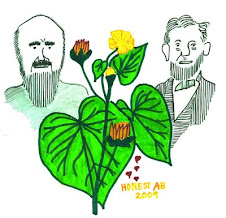
Until his death in 1952, Joseph Stalin was practically God in the Soviet Union. Everything that was believed and everything that was done had to conform to his wishes, even, as I described in another essay, music.

Stalin considered himself the ultimate authority in science, as well. He even had his own theory of genetics that was strikingly different from genetics as understood in the western world, and everywhere (even Russia) today. He copied his theory (Lysenkoism) from Comrade Trofim Lysenko. In this theory, things that happen to a plant or an animal during its life get passed on to the offspring. This would include the ability of crops, such as wheat, to endure cold temperatures if the seeds were frozen in cold temperatures. That is, you can create cold-hardy wheat by freezing the seeds. Millions of Russians and Ukrainians died in famines because of this stupid theory: when they planted frozen wheat seeds, the wheat simply died over the winter. (Wheat is often planted in the fall, then it produces seeds in the late spring.)

Lysenko was a fake scientist if there ever was one anywhere.

undefined

Another Soviet scientist, Nikolai Vavilov, was a real scientist. He studied genetics extensively and traveled the world to find seeds that carried the genetic basis of adaptation. He knew you had to breed cold-hardy wheat, not just freeze the seeds. Vavilov was a geneticist in the modern sense. In return for his scientific beliefs, he was imprisoned, where he died.

Photo noir et blanc, en légère contre-plongée, d’un homme moustachu en costume élégant.

As soon as Stalin died, the Communists felt free, at last, to admit that they had created a “cult of personality” around Stalin, a cult that nearly destroyed the Soviet Union. The new leader, Nikita Kruschchev, was an enthusiastic promoter of agricultural research, after the pattern of Vavilov, not Lysenko. His enthusiasm was so great that he was called “Corn Cob.” When he visited America about 1968, one of his main interests was how Americans grew corn.

Once freed from the Stalin personality cult, conditions in the Soviet Union began to improve a lot, but not enough. The Soviet Union collapsed, and Russia began to enter the modern world of prosperity.

That is, until it entered another period of personality cult, this time centered on Vladimir Putin. Russia’s war of aggression against Ukraine is, as nearly as most of us can tell, just a personal whim of Putin. Maybe in the future Russia will see Putin as an evil dictator, and as destructive to Russia as was Stalin. A lot of pain and suffering remains ahead before that can happen.


Friday, January 23, 2026

Champs d'Avenir: Fields of the Future

This is a little essay I wrote to share with my French class about “fields of the future.”  It was based on an article in Strasbourg Magazine, Oct.-Nov. 2025. I quoted a few lines from the article, but I wrote most of it and cannot guarantee the accuracy of the translation. This article shows that what is considered rare and progressive in America is ordinary and mainstream in France.

First, the English translation:

In America and France, most food production is in big fields which contain only one type of crop. In Alsace, one sees big fields of corn, sunflower, beets, and wheat. The big fields need lots of pesticides and fertilizers. Big machines consume a lot of fuel. In the future, we need organic food (“bio” in French). People want organic food. This is an excellent business opportunity for farmers in Strasbourg and for consumers, especially for school cafeterias.

Ms. Anaïs Meyer planted thousands of crocus bulbs in the soil on the roof of a parking garage near Deux Rives. Crocus flowers are the source of saffron. “I do everything with my own hands; there is no need for watering or pesticide,” she explains. The article does not say, but saffron is a high-value product (very expensive at the store).

Urban agricultural projects at Neuhof, the Cité d’Ill, and at Elsau. Nicolas Burgmann, a gardener, cultivates tomatoes, squashes, carrots, leeks, and beets in Neuhof.

The farmers welcome groups from pre-schools, schools, and retirement homes.

It is the agriculture of the future! According to the mayor of Strasbourg, “The agriculture of tomorrow is growing in Strasbourg.”

In French:

En Amérique et en France, la plupart de la production alimentaire est en grandes champs qui contiennent qu’une type de plante. En Alsace, on voit des grandes champs de maïs, tournesol, betterave, et blé. Les grandes champs ont besoin de beaucoup de pesticides et de l’engrais. Les grosses machines consomment beaucoup de carburant. À l‘avenir, on a besoin de nourriture biologique (bio). Les gens veulent des aliments bio. C’est une excellente opportunité commerciale pour les agriculteurs à Strasbourg et pour les consommateurs, spécialement pour les cantines scolaires.

·         Mme. Anaïs Meyer a planté des milliers bulbes de crocus dans le sol du toit du parking près de Deux Rives. Les fleurs de crocus sont la source de safran. « Je fais tout de mes mains, il n’y a ni arrosage, ni pesticide, » elle explique. L’article ne le dit pas, mais le safran est un produit de grande valeur (c’est très cher dans la supermarché).

·         Projets d’agriculture urbaine au Neuhof, à la Cité d’Ill, et à l’Elsau. Le maraîchère Nicolas Burgmann cultive des tomates, courges, courgettes, carottes, poireaux, et les betteraves en Neuhof.

·         Les fermiers bio accueillent des groups venant de crèches, d’écoles, et d’Ehpad.

C’est l’agriculture de l’avenir ! Selon le maire de Strasbourg, « L’agriculture de demain se cultive à Strasbourg. »

Friday, January 16, 2026

Jardins Familiaux de Strasbourg : Family Gardens of Strasbourg

All around me in Strasbourg I see little gardens that people rent from the city. This is one of the things that make living in Strasbourg so pleasant. This time of the year, the gardens are dormant, but they are full of activity from April to November. I described it in a little article I wrote for my French class.

First, the English translation:

What do you do when you don’t have a house but you want a garden? You could rent a “family garden” from the Strasbourg Eurometropole. [Strasbourg thinks of itself as European, not just French.] In this garden, you can raise plants: a vegetable garden, and flowers. According to strasbourg.eu, our city has 4,800 family gardens. According to jardins-familiaux.org, there are only 13,000 family gardens in France, thus Strasbourg has the most!

These gardens are bits of land for inhabitants of the municipalities to use. The garden requires regular maintenance, maybe once a week. No weeds allowed! Commercial use is prohibited. The demand being much larger than the supply, delays could reach several years to get a garden.

How much does it cost? It depends on whether you want just a plot of land, and pay for all the improvements yourself (51 euros a year), a garden with just a shelter (97 euros a year), or a garden with all the amenities (170 euros a year). [I think I’ve seen some with running water, but many people have cisterns where they collect rainwater.]

If you live in an apartment and you can’t barbecue, rent a garden and invite your friends to a party!

The gardens have to meet criteria such as biodiversity, absence of invasive species, and use of biological pest control.

As for me, I do not want to rent a garden. Too much work for me. I prefer to walk around and watch happy people in their gardens.


The original French:

Que faites-vous quand vous n’avez pas de maison, mais vous aimerez avoir un jardin ? On peut louer un « jardin familial » du Eurométropole de Strasbourg. Dans ce jardin, on peut faire pousser des plantes : un potager, et les fleurs. Selon Strasbourg.eu, notre cité dispose de 4 800 jardins familiaux. Selon jardins-familiaux.org, il n’y a que 13 000 jardins familiaux en France, c’est donc Strasbourg qui a le plus !

Ces jardins sont des parcelles de terrain mises à la disposition des habitants par les municipalités. Le jardin demande un entretien régulier y compris en semaine. Pas de mauvaises herbes ! L’usage commercial est exclu. La demande étant largement supérieure à l’offre, les délais d’obtention d’un jardin peuvent atteindre plusieurs années.

Combien ça coûte ? Selon le website du métropole,

Jardin traditionnel (tous les équipements à la charge du  locataire) :

    loyers : 51 euros/an, caution 100 euros à la signature du contrat,

Jardin semi aménagé (abris de jardin à la charge du locataire) :

    loyers : 97 euros/an, caution 100 euros à la signature du contrat,

Jardin aménagé (jardins équipés par la Ville) :

    loyers : 170 euros/an, caution 200 euros à la signature du contrat.

Si vous habitez dans un appartement et vous ne pouvez pas faire de barbecue à maison, louez-vous un jardin et invitez tous votres amis à une fête !

Les jardins doivent répondre aux critères tels que la biodiversité, l’absence d’espèces invasives, et l’usage de pratiques du biocontrôle.

Moi, je ne veux pas louer un jardin. C’est trop de travail pour moi. Je préfère faire de la randonée et voir les gens heureux dans leurs jardins.

Friday, January 9, 2026

The New Reality of the Scientific Method: Donald Trump Is Always Right

I outlined the scientific method, which is something in which anyone, not just scientists, can participate, in my previous book Scientifically Thinking. But there is a new reality about science, at least in the United States, which has developed since I wrote the book, and which I will now explain.

For many years at Southeastern Oklahoma State University, I taught the Research Methods course for science graduate students, which was pretty much the precursor of my book. I recently found, in some old papers, that I taught a similar course at The King’s College, in my first faculty job. King’s was and is a fundamentalist Christian college. Soon after I left, it also became a fundamentalist Republican college and, today, is probably a fundamentalist Trump college. When I taught the scientific method, I taught it pretty much the standard way, although technology was different back then (no internet). But that was because my department chair, although he was a leading creationist, was open to free scientific inquiry. He believed that open inquiry would lead a person to accept creationism. He did not, unlike almost all other fundamentalists, impose his views on other people.

But here is what research is usually like at fundamentalist institutions. First, instead of reaching a conclusion, you impose one. For example, you will stipulate up front that there can be no evidence that is consistent with evolution. Next, you selectively gather information that agrees with your conclusion. Last, you draw your “conclusion” from the selectively-gathered information. This is the exact opposite of the scientific method.

The result was predictable. The scientific value of creationist research is nil, for two reasons other than the above. First, creationists used this method to defend not only the Bible but their sometimes highly imaginary interpretations of it. Second, their misuse of the scientific method made their work sloppy even when it had nothing to do with evolution. Their habit of mind was that, no matter what they did, they had to be right. I documented these two things in a pair of articles I wrote a long time ago: in 1988 and in 1989.

Today we must add another dimension. Not just in creationist or fundamentalist camps, but in all publicly-funded research, the researchers must begin with the conclusion: they must begin with whatever belief the Republican party holds upon the question. For example, is global warming happening, and are humans contributing to it? The answer, fundamentalists think, must be no, even though the Bible does not mention it. The answer must be no because the fossil fuel industry says it is no. This, then, is the conclusion they reach. Are vaccines effective? Again, the required answer is no. Has gun violence reached epidemic proportions? The answer again must be no. Science, then, becomes just a propaganda arm of the Republican Party.

It has been this way for a long time, to various degrees, starting mainly with the George W. Bush administration. But now, under Donald Trump, there is yet a new version of science. You begin with the conclusion that Donald Trump is always right. Science has now become a propaganda arm of Donald Trump, and of his chosen spokespeople, such as RFK Jr. who says that vaccination is not necessary. The conclusion is that vaccination is not effective, because Donald Trump, who used to champion vaccination, says so.

For example, even under Republican presidents in the past, the website climate.gov existed. As of 2025, that URL redirects to NOAA where global warming is hidden, although at this point they still admit that today’s atmospheric carbon dioxide level (421 ppm) is comparable to the atmospheric level four million years ago, and much higher than any time during 6000 years of human civilization. But they are not allowed to draw the obvious conclusion that the Earth is getting hotter, only that it happens to be hot right now; certainly they do not blame our use of fossil fuels.

I am glad that I taught and wrote about science before Donald Trump became the sole standard of truth. I am not sure, however, that I am safe. My most recent book, Forgotten Landscapes, provides evidence that Native Americans were civilized and had a significant effect on the North American landscape. This is not the picture of Native Americans that Republicans prefer. They want to claim that Natives were savages and did not deserve to keep the land that was taken from them. Republican opposition did not prevent the publication of my book. But what will happen next?