Showing posts with label Noah's flood. Show all posts

Thursday, September 18, 2014

My Fun Evolution Trip Part Ten: The Most Amazing Plant Fossils in the World, part two.

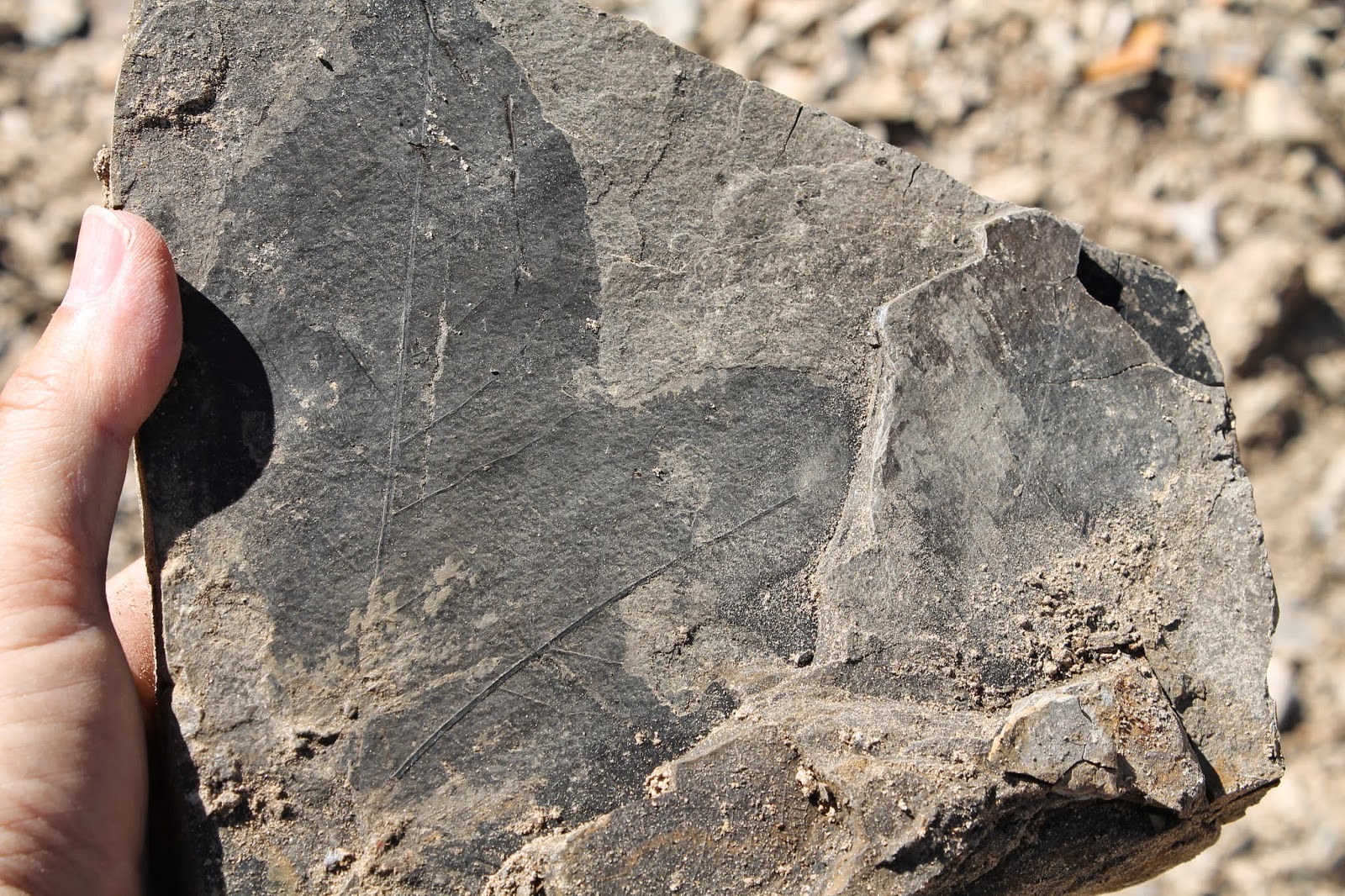
The leaf fossils that I saw at Fossil Bowl (see previous essay) came from a 15-year-old Miocene forest that dominated what is now northern Idaho. These forests closely resembled the rich forests of deciduous and evergreen trees that now characterize parts of China and, to a lesser extent, the eastern US. They were almost totally unlike the modern forests of northern Idaho, which are dominated by conifers such as Douglas fir.

Here are just a few of the fossil leaves that I found. I have used William Rember’s online gallery for identification. My identifications are tentative for several reasons. One is that I might have found some leaves previously undiscovered in this location. Another is that some crucial diagnostic features, such as leaf bases and margins and overall shapes, might be missing. I offer these images for others to help identify.

Bald cypress: Today, Taxodium is found only in swampy areas of North America and Mexico.


Greenbriar: today Smilax is common in much of eastern North America and in Asia.


Beech: This leaf appears to be a false beech Pseudofagus idahoensis; a small poplar leaf (Populus) is in the upper left.


Sycamore: This fossil appears to be Platanus dissecta.


This specimen looks like a red oak (Quercus), perhaps Q. payettensis.


In this image, I believe I recognize a birch (Betula vera) in the lower right, though birch leaves have smaller teeth.


This image reminds me of a mulberry (Morus), which has not been reported from these deposits. Its lobes but not its margins resemble sycamore. The closest match I can find in reported records is a sweetgum, Liquidambar pachyphyllum. In the layer immediately underneath it is a Pseudofagus leaf.


Anyone have a guess about these?


These fossils also tell us an ecological story. First, this was a very diverse forest, with many tree species, resembling forests found today in China and in the southeastern United States. Second, we can say it was predominantly a beech forest, because Pseudofagus was the most common leaf fossil.

And there are some evolutionary themes we can learn from these fossils. First, these leaves fell (over the course of many years, producing many layers) in a forest very different from anything known in the Pacific Northwest today. The climate 15 million years ago was warmer and wetter, which allowed trees to grow that today survive only much further south in Asia and North America where there is more rainfall. The principal reason for this is that, 15 million years ago, the Cascades had not yet formed a rain shadow. The “temperate rainforests” of the Pacific slope more closely resemble the Miocene forests than do the forests of Idaho today. However, even the rich, moist Pacific slope forests of today there are few broadleaf trees, mostly bigleaf maple and tanbark oak. Fossil Bowl preserves a lost forest.

Creationists have an impossible time explaining how a Flood could have collected just these kinds of leaves—bald cypress, sycamore, alder, avocado, elm, etc.—and no others. But some creationists doubtless claim that this is a post-Flood deposit which formed just in the last 4000 years since Noah stepped out of the Ark. But this explanation is no better. Somehow floating rafts of vegetation had to bring just these kinds of plants to what is now Idaho, where they grew into a forest, and then—after the Flood—volcanoes arose and created the rain shadow that now exists. All this in 4000 years. The volcanoes would have to rise pretty fast, faster than they are now. Maybe God speeded things like this up after the Flood. But the Bible does not say this; creationists would have to just make it up.


The thing that is perhaps most interesting to us, and difficult for creationists to explain, is how such a forest is just a little different from those found in southeastern North America and in Asia today. The modern forests have the same genera but not the same species. Even the studies of DNA from chloroplasts of the preserved leaves show that there has been just a little bit of genetic change over the last 15 million years. Modern species of sycamores, for example, do not have leaves like the one in the photo above; modern sycamore species would have evolved just in the last 4000 years at a pace far more rapid than any evolutionary scientist would accept.

Friday, September 5, 2014

My Fun Evolution Trip Part Seven: What is Devil’s Tower?

Announcement: I am starting to post YouTube videos from my summer evolution trip. I just posted the first one, “Darwin falls off a cliff,” about the adventure of science! I will be posting other videos, including ones about Devil’s Tower and about my six earlier blog entries, in upcoming weeks. My thanks to videographer Sonya Ross.

Now, about Devil’s Tower.

Devil’s Tower, in southeastern Wyoming, formed from a massive volcanic intrusion through sedimentary layers. In subsequent millions of years, the sediments eroded away, leaving the hard igneous rock. The crystalline structure of the material produced lava tubes that were roughly square in cross section.


It would seem that no other explanation is possible. Creationists such as the folks at Answers in Genesis give a very vague explanation that does not account for the details. They basically say that all kinds of squishy, explosive, and creepy things were happening as the Flood waters receded, so you shouldn’t be surprised at anything that you might see of a geological nature. And of course God could have always done a miracle, even without mentioning it in the Bible.

But creationists are not the only ones who have alternative explanations for how Devil’s Tower formed. There are also Native American legends about how it formed. Here is one. Seven sisters and a brother were out in the woods, and the brother turned into a bear and chased the sisters. The sisters found a massive tree that spoke to them and invited them to take refuge in its branches. The bear climbed after them, creating the vertical scratch marks in the massive trunk. I guess the bear wandered off somewhere, but what happened to the seven sisters? They became the Big Dipper.

This reminds me of a story from a California native tribe. There were seven husbands and seven wives. The wives were out digging wild onions, and ate them. The husbands hated the smell on their wives’ breath and drove them from the village. The wives found a rope hanging from the sky and climbed up. They became the Little Dipper. The husbands got lonely and went out looking for the wives. They found another rope hanging from the sky, climbed it, and became the Big Dipper. Ever since then, the Big Dipper has been chasing the Little Dipper around the North Star.

Did the native tribes actually believe any of these stories? Maybe they were just stories for children. There remains today a vibrant and humorous Native American storytelling tradition. Or maybe they actually believed them. Or maybe they started out as stories but became religious beliefs. I don’t know. But I do know that native tribes did not burn each other at the stake for the heresy of not believing one of these stories. They would burn each other at the stake for other reasons, but not for religion. (My sixth great grandmother Nanyehi, or Nancy Ward, rescued a white woman from being burned at the stake by her fellow Cherokees.)

Fictional and religious stories serve a purpose: they enhance tribal and community identity. Whether they actually “literally” happened is largely irrelevant. Scientific stories also serve this function. Scientific meetings, such as the Botanical Society of America meeting toward which I was heading, are a great time of friendship. But in addition, scientific stories are designed to be “literally” true. Creationists are religious people who are not satisfied with the community-identity function of stories, and will stop at no stretch of the imagination to try to make their stories sound like science—and will then send you to hell for not believing them “literally.”

Tuesday, August 19, 2014

My Fun Evolution Trip Part Three: The Great Unconformity of the Black Hills

One of the greatest new insights into the history of the Earth was when James Hutton realized that the Earth had to be very old and that geological deposits were recycled over and over again—an idea called uniformitarianism. Hutton was not the first person to think of this but he was the first to pursue the idea in an organized fashion. His complex thoughts were later summarized by John Playfair and extended by Charles Lyell. As the modern paleontologist Michael Benton has explained, uniformitarianism can mean lots of things, some of which (such as uniformity of process) is still accepted by modern scientists, but others of which (such as uniformity of rate) are not. The former means that you can understand the past by studying the processes of the present, rather than invoking random miracles. The latter means that those processes have operated as slowly in the past as they are at present, which is clearly not the case.

Hutton, loving near Edinburgh, Scotland, in the late eighteenth century, looked at the local geological deposits and thought about them. At Siccar Point is an unconformity with nearly vertical Silurian sedimentary layers on the bottom and gently sloping Devonian and Carboniferous sedimentary layers on top, with millions of years of missing history in between. He realized that such sedimentary deposits could not have formed all at once during a global flood. And here’s why.

When the older, lower sedimentary layers formed, they had to be horizontal, due to the law of gravity. But these layers had been turned on their sides. If they were still mud when turned sideways, they would have gone PHHHHHHT! and squished into a big pile. The fact that they retained their layers meant that they had become rock before being turned on their sides. Then other sedimentary layers formed on top of them. This simply could not have happened during a single global Flood of Noah. Of course, creationists then as now could simply invoke miracles. They could say that God squished the lower layers into rock and turned them on their sides in the middle of the Flood. Does the Bible say this? No, they just make it up.

You can go to Scotland and see it for yourself. Sounds to me like a great excuse to go to Scotland. But there are other formations called The Great Unconformity, including the one John Wesley Powell discovered in the Grand Canyon. An unconformity is a geological formation in which a large chunk of time is missing. But there is a really good one (which didn’t make it into the Wikipedia entry) in the Black Hills of South Dakota, which has Precambrian sediments raised at a 70 degree angle on the bottom, and horizontal Cambrian strata on top, with almost two billion years of missing strata.

It is difficult to get directions to find it. So remember this. Find Nemo Road west of Rapid City. There are several ways to get there. Just as soon as this road, as you go west, crosses over the line from Pennington County into Meade County, you will see a bridge over Boxelder Creek. Immediately to your left is the Great Unconformity.


This is what it looks like from Nemo Road:


Even though it is in Black Hills National Forest, there are private landholdings all around, so you need to stay away from people’s yards. You will probably find, as I did, a path worn through the grass by generations of geology students from the South Dakota School of Mines and Wheaton College Science Station. There are other places to see the unconformity, but this is the only place where you can walk right up to it and put your finger on almost two billion years of missing history.


How could this unconformity have formed all at once during a flood? But maybe creationists have another explanation. Maybe the lower Precambrian layers were pre-Flood, which would have given ample time (almost two thousand years) to form the sediments into rock and then push them to their current 70 degree angle, and then the upper sediments were of Flood origin. This approach is not much help, however, because two thousand years is not enough time to have turned all the Precambrian sediments into rock and pushed them over, unless God did a miracle which the Bible conveniently does not mention.


So when you are in the Black Hills, forget about Deadwood and even Mt. Rushmore. The only really interesting thing, to me, about Mt. Rushmore, is the remnant populations of the rare fern Asplenium septentrionale that someone showed me in 1993 but which have apparently died. Go see the Great Unconformity, a hidden treasure—there is not even a road sign to mark the Nemo Road location.

Saturday, May 31, 2014

A Visit to Buffalo National River


My wife and I just got back from a visit to Buffalo National River in Arkansas. It is a beautiful place to see nature at work. We stayed in an old hotel in Harrison, and planned our days in such a way that we could work around the intermittent and unpredictable rains. (I recommend the 1929 Hotel Seville in Harrison as a place that is close to the river but inexpensively elegant in case you have to sit around in the lobby during rain.) We did all of our hiking between rains on May 28. One of the main attractions of Buffalo National River is the green forests—which you cannot have without lots of rain.

Canoeists and kayakers revere the Buffalo National River for its scenic limestone cliffs:


But to an evolutionary ecologist, the river is also a living system. Along the river itself we saw lots of seedlings and re-sprouted saplings of box elder, sycamore, sweetgum, catalpa, birch, and persimmon. I do not know why, but we saw not a single cottonwood. These trees grow in areas disturbed by strong floods. If they get a chance, they grow into forests, at least the boxelders, sycamores, and sweetgums; the catalpas do not live long enough to become canopy trees, and the persimmons spread horizontally by underground stems rather than upward to reach the canopy. In a floodplain forest long undisturbed by floods, we saw very large birches and sweetgums, along with southern red oaks. This photo is of a very tall birch, but it was still leaning halfway over the way it did when it was a riverside sapling.


When we hiked along Mill Creek, we saw some floodplain forests that were almost monospecific stands of box elder:


The riverside forests and the bluff forests were very different. Some species, such as sweetgum, grew in both; but the bluff forests had no box elders. On a bluff, we saw at least one tree species that seemed out of place: a chittamwood tree, which I associate with drier forests. The bluff presumably provided an ecological refuge for this tree, which would not be able to compete with the tall oaks (white, northern red, southern red, and chinkapin) and hickories. Some trees such as pawpaw specialized on open spots on the forest floor. Mesic forests and drier forests have different conditions and different dominant tree species; but because of dry microenvironments, trees more common in drier forests can find a foothold in these mesic forests—this is one reason that mesic forests have such high biodiversity. (We did not, however, see any post oaks.) We recognized 42 flowering plant families; there must have been more. (It’s nice to have a spouse who, though not a professional botanist, loves plant families as much as I do.)

To accommodate search engines that may search for information about these trees, I will list some of the Latin names. Those of you who are not interested in Latin names, please skip to the next paragraph.

Acer negundo (Aceraceae), box elder
Asimina triloba (Annonaceae), pawpaw
Betula nigra (Betulaceae), birch
Catalpa bignonioides (Bignoniaceae), catalpa
Diospyros virginiana (Ebenaceae), persimmon
Liquidambar styraciflua (Altiginaceae), sweetgum
Platanus occidentalis (Platanaceae), sycamore
Quercus alba (Fagaceae), white oak
Quercus falcata (Fagaceae), southern red oak
Quercus muhlenbergii (Fagaceae), chinkapin oak
Quercus rubra (Fagaceae), northern red oak
Sideroxylon lanuginosa (Sapotaceae), chittamwood

We saw more than just plants, of course. It was also the perfect day for this beautiful species of fungus:


On the rainy day we visited Mystic Caverns, which are very beautiful:


And delicate: the oil from even one finger-touch can disrupt mineral deposition. Some of the stalagmites resembled Schmoos from an Al Capp cartoon; in fact these caverns used to be owned and operated by Dogpatch USA, a now bankrupt and vine-engulfed amusement park right across the highway.

The leader was a preacher and handgun instructor who preached us his guns and creationism gospel. He pointed out, quite correctly, that calcite deposits can form quickly; he should know, as he has watched them form. But he also showed us a limestone rock with crinoids in it, and claimed that they could only have come from The Great Flood. He did not consider the possibility that the crinoids were in the limestone parent material upon and around which the calcite deposits formed. I did not ask him any of a thousand possible questions. What would have been the point? Besides, I was the guy who belted out “Deep River,” an old gospel song, in the echo chamber (at the manager’s invitation). This was where the orchestra used to stand in the 1930s when this cavern had a moonshine still in the back and a dance floor. (Presumably some of the people, drinking moonshine, thought they were dancing until somebody stepped on their hands.) I chose to sing Deep River rather than to argue against a creationist. I was, after all, on vacation. Most of the people on the tour were what Mark Twain called Arkansaurians and would not have believed me; the others were young people, including a Japanese couple, who got rained out of their rock climbing plans and presumably already agreed with me. So this was not what one would call a teachable moment.

The Buffalo National River is a beautiful place to visit and to observe the natural world closely.

Tuesday, April 22, 2014

Does Humankind Belong on Earth?

Does Humankind Belong on Earth?

Happy Earth Day. Do we, as destructive humans, have a right to wish the Earth a happy Earth Day?

Is humankind a legitimate part of the natural world, belonging to the Earth’s ecosystems and ecological communities, or is mankind a diseased scab upon the planet? This question is meaningless, because here we are, like it or not. Meaningless, that is, unless you are God and capable of wiping out life on Earth and starting over.

What follows is one blogger’s review of the movie Noah, starring Russell Crowe and Anthony Hopkins and other very good performers. I review it primarily as a writer and as a scientist who thinks about Big Questions. My verdict is that it was better than the original. The reason I say this is that the original Flood story (Genesis 6-8), which is a gigantic epic even more worthy of immortality than the Odyssey, addressed issues of major importance, but left some questions unanswered. The movie filled in the missing issues.

The major point of both the original and the movie is that human evil had defiled the Earth, and the human stain needed to be cleansed away. In the original, God recognizes Noah and his family as uniquely virtuous on the entire face of the Earth. In the movie, Noah recognizes his own sinfulness, and concludes that his job, and that of his family, is to facilitate the rescue of the innocent animals, and then to vanish into obscurity after the job is done. This is why, as he saw it, only his eldest son was married, and this son’s wife was barren.

But then Noah’s wife implores Noah’s mystical, magical, and still-living ancestor Methuselah (played by Anthony Hopkins; who else?) to restore Mrs. Shem’s fertility, and he does. Thus, while the Ark is floating on the face of the waters, Mrs. Shem becomes pregnant. Noah decides that, since his duty is to bring the human blight to an end, he must kill the child if the child is a girl (a boy would just grow old and die without issue). So what does he do? Wouldn’t you like to know!

As a result of his decision, Noah concludes that he has failed God. This is why, in the movie (something left totally unexplained in Genesis), Noah goes off to live in a cave and get drunk. But Mrs. Shem convinces him that in fact he made the right, not the wrong, choice. Noah returns and is reconciled to his wife. It is a supremely touching scene. Mrs. Noah was working in the garden, so that human life might continue on Earth. Noah walks up to her, places his hand on hers, and then begins gardening with her. You will not be surprised to hear what I did when I got home from the movie. My wife was out in the garden planting delicate parsley seedlings. I did with her exactly what Noah did with his wife in the movie. Then I gently, oh so gently, watered the seedlings, seedlings so delicate that too much water would plaster them to the sticky ground.

The ecological theme was clear. Sinful humankind had created an industrial civilization (a sticks-and-stones version of it, at any rate) that had made the Earth a barren wasteland. And Noah had to save biodiversity—all of it, not just the species Noah deemed useful.

The problems that creationists leave unexplained in their literalistic interpretation of the Flood story are similarly left unexplained in the movie. But that’s okay, since it is just a story. It is the creationists that turn it into a problem. It is a story that reveals deep truths, and might be considered truer than literalism.

Even the little touches were good. Hopkins, playing Methuselah, had a craving for berries, and was out grubbing for berries in the forest. He finally found one (judging from the leaves, I’d say it was a bearberry, Arctostaphylos uva-ursi) just as the Flood waters overtook him.


So I invite you to leave doctrinal arguments aside and go see this movie, in which a modern reinterpretation of great fiction addresses some of the most important questions in human history and in the world today.

Friday, June 7, 2013

Oklahoma-Texas Evolution Road Trip, Part Three. Dinosaurs and the Humans Who Are Still Looking for Them


On June 1, the participants in the Road Trip hopped (or, rather, packed themselves) into the van and I drove them down into the heart of Texas, to the town of Glen Rose, just southwest of Ft. Worth. We arrived at the Creation Evidences Museum in time for the monthly sermon of an infamous creationist named Carl Baugh. Baugh is a smooth talker, and cultivates a friendly, calm, and reasonable image. The image of humility may conceal great pride, however: he seems very proud that lots of scholars, including many young-earth creationists, know him and reject his beliefs. Every month you can expect to hear something different and astonishing from Baugh that you will hear nowhere else, even from the Institute for Creation Research or Ken Ham. Every month the world of Baugh and his followers retreats a little further from reality. I could hardly wait to see what this month had in store. The other time I visited, Baugh said that there had been no lava flows on the moon until after the Flood, and that pre-Flood moonlight promoted longevity before the Flood (see here). What would he say this time? (Photo courtesy of Mary K. Johnston.)


The museum included a replica of what Baugh thought Noah’s Ark might look like, and many other displays, including a model of an Acrocanthosaurus head. Acrocanthosaurs seem to chase Mary K. Johnston around; but relax, Mary, can’t you see that this acrocanthosaur eats plants? You can see them hanging from its mouth. That’s what the razor-sharp teeth are for!


Most of Baugh's sermon was devoted to defending the idea that humans and dinosaurs lived together about 4,000 years ago. This idea is no different than what you will find in Ken Ham’s creationist museum in Kentucky. And Baugh defended at length the idea that human footprints and dinosaur footprints occur in the same layer of Cretaceous rock exposed in the bed of the nearby Paluxy River. Again, this is what he has been saying for years. And he admitted that this belief has undergone some challenges. For example, what he had long considered to be a trackway of human footprints turned out to be dinosaur footprints. He admitted that Glen Kuban, who has studied the Paluxy River dinosaur tracks for decades, was right about that. Even John Morris, who leads the Institute for Creation Research in the footprints, as it were, of his father Henry, has withdrawn his support from this assertion. So is this the end for Carl Baugh?

Not on your life. Baugh insisted that giant humans had hopped along and put their footprints in the middle of pre-existing dinosaur footprints, so of course they looked like dinosaur footprints. These were of course giant humans, with strides as great as those of large dinosaurs. They grew big because the intense atmospheric pressure of the pre-Flood Earth buoyed them up. Of course, he could not prove this, and hesitated to say that he could.

In the end, Baugh’s entire belief system rested primarily on just one piece of data: a supposed human footprint overlapping a dinosaur footprint. The slab of rock with these structures can be seen right in his museum. Some of our group took a look at the “human footprint” after the sermon. The dinosaur print was real; there are still hundreds of them in the bed of the Paluxy River. And there are compression lines below them, showing that the dinosaur footprints have not been carved. But the human print looks both too good to be real and artificially cartoonish. Judge for yourself.


I was still waiting for the surprise. Toward the end of the sermon, I got it—something I had not heard Baugh say before. (Not that I am a regular visitor to his sermons.) Baugh said that dinosaurs were still alive. No, you cladists, he didn’t mean birds. He meant the big ones. The likes of Paluxysaurus and Acrocanthosaurus. Where? In some African jungle, I think; he wasn’t clear about this. I’ll have to look it up in the Edgar Rice Burroughs book. Maybe in a parallel time dimension at the other end of a cosmic wormhole. They are waiting to emerge when the Millennium starts. His evidence? He said that the book of Job, written after the Flood, refers to dinosaurs (leviathans and behemoths) in the present tense. After all, medieval European and Chinese tales told of dragons. Are you calling St. George a liar? That settles it.

In a later discussion, our group considered the cult characteristics of Baugh’s followers. He seemed to have a mental list of things to do to make himself credible. He knows most of the audience members by name, therefore Baugh has formed a community of believers. He has also told them that they are a little embattled enclave surrounded by unbelievers, some of them even fellow creationists. While Baugh said that people could disagree with him and still be good people, some audience members muttered that anyone who disagreed with Baugh could not be a good person. And they seemed to be mesmerized by him. I did not notice this at the time, but when I reviewed the brief video I took of Baugh’s sermon (which is out of focus, sorry), Baugh said something like, “Have you ever seen a human footprint stepped on by a dinosaur…” A big scary man in the front row nodded in the affirmative. Wow. I would not want to encounter that big scary man who thought I was a bad person and who was convinced that he had seen dinosaurs. This is the same guy who said that disagreeing with Baugh was like Pharaoh spurning Moses even after the Ten Plagues. It’s not quite as cultlike as Jonestown, but it has all the defining characters of a cult.

Because it is a little cult, I doubt that their attempts at world outreach will amount to much, especially when the 76-year-old Baugh, whose charisma holds the group together, “graduates” to Heaven someday. Of course, if he gets inside the hyperbaric chamber (their next project, though they cannot legally do human experimentation) he might outlive Methuselah. (The hyperbaric chamber is meant to mimic the high air pressure believed to have existed before The Flood.)

Baugh might have thought that everyone who came to hear him, including trip participant Mary K. Johnston, was there to admire him. We did not tell him any differently. (Photo courtesy of Mary K. Johnston.)


We met outside the museum to see Marlyn Clark’s Flood Tank. About 1980, an engineering professor, M. E. Clark, at the University of Illinois, constructed a tank that could pitch and yaw around. If you put water, gravel, sand, and silt into it, they sort into different layers. Clark considered this to be experimental confirmation that The Flood could produce all the fossil layers. I do not know if he threw the family cat into the tank to see if it would fossilize. I don’t think Thelma and Becky would have let him. You see, I knew him and his family a little bit, mostly because he was one of the people at our church who tried to silence me from teaching a class about evolution, which I taught at the request of the church leadership. He was pretty grim but had a good side. He invented some component that is now used in artificial hearts. As he neared the end of his life, he donated his tank to Baugh’s museum. It sits out on the grass, unlabeled; very few people know what it is. We took a group picture in front of it.


Front, left to right: Carl Rutledge; Cora James; Mary K. Johnston; Lindsay Fluker; Sharon Young. Back, left to right: Jim Huff; Wilfred Berlin; Drew Marteny; Fran Stallings; Gordon Stallings; Gordon Eggleton.

I will skip ahead to a final observation. Before we left the Paluxy vicinity and headed into Glen Rose for some barbecue, we stopped at a little rock house where the proprietor sold fossils: ammonite casts, which were probably genuine; trilobites, which looked too good to be real; fragments of crinoid stalks from Morocco, which is famous for fake fossils (as described by Gould in “The Lying Stones of Marrakech”); coprolites, one of which I bought and do not care if it is real; and other things. This was the very rock house in which George Adams had carved fake human footprints in slabs with dinosaur prints in the 1930s. While we were there, who should pop in but Baugh’s understudy Aaron Judkins, whom Baugh had introduced before his sermon. The proprietor gave Aaron a very nicely made clay pitcher. Let me predict what might happen. Judkins might imbed the pitcher in limestone matrix and put it in Baugh’s museum, claiming that it was used by one of the pre-Flood humans. I may be wrong, but I put the world on notice: in the future, if and when I visit this museum, I am going to watch for that pitcher. I asked Judkins if the pitcher was “from around here.” He said it was from pre-Columbian Mexico. For the record, that pitcher is not pre-Flood; it was obtained from the rock shop, free of any matrix, on June 1, 2013.

After we entered Dinosaur Valley State Park and ate our lunches and discussed what we had seen, we went looking for dinosaur tracks (next entry).

Yesterday’s blog entry got a comment, from Prom Limo Service saying what an informative blog it was. It appears that parasites live in the blogosphere just as in the biosphere.

Wednesday, November 7, 2012

Religion vs. Science, the Vast Gulf Part Six: Continents


It is with considerable relief when I say, Congratulations to Barack Obama for winning a second term. I was afraid that Mitt Romney would make devastating cuts to science and education, cuts that would actually not reduce the deficit very much. At the same time, almost exactly half of the voters voted against Barack Obama. His next four years may be even harder than his previous four years.

Now back to our series about the many ways in which science differs from traditional religion.

The Biblical view of the Earth is that orderly dry land is surrounded by chaotic oceans; in fact, one of God’s earliest acts of creation was to set a boundary between land and sea. The landlubber Israelites were frankly afraid of being out on the ocean (so am I). The God of orderliness had created dry land as the place for people to live.

But the Israelites had no idea that the continents moved around. Of course, neither did anybody else. The idea of continental drift was proposed by Alfred Wegener in the early twentieth century, and accepted only decades later by geologists. You cannot fault the Bible for omitting continental drift, unless you believe the Bible to be the outline of all scientific truth, in which case you have to reject continental drift.

But it is a little more complicated than this. Creationists believe that God sent a Flood upon the Earth, saving only Noah and his family (which, they imagine, contained black, white, and oriental daughters-in-law) from which all the people of the Earth are descended. This was such a severe disruption to the stable continents that all sedimentary rocks (of which continents largely consist) and all volcanic and metamorphic layers between them were produced at that time. Where did all the land come from? Not from day three of Genesis 1, but from the big piles of mud left over after the Flood of Noah. The problems with this theory could fill a book, and have filled many books.

But it gets even more complicated than this. Genesis 10:25 said that in the days of Peleg (a mysterious patriarch about whom little is known) the Earth was divided. This was after the Flood. Let us consider the tremendous scientific implications of this verse, if we take it literally. This verse literally says the Earth was divided. The word for “earth” is the same Hebrew word that is used for the entire planet (see here for concordance references). The word for “divided” refers to cutting entirely in half (see here for concordance references). To really take this verse literally, we have to say what one creationist (Walter Brown) once said in a public forum at the University of Illinois: this was when God created the Atlantic Ocean, causing the Eurasian and North American plates to diverge. But the word literally means to split into pieces, thus we must go way beyond continental drift and believe that the entire planet was split in two. One of the halves must be the one we are on, and presumably the other half has been lost. This would mean that, even right after the Flood, Earth was a much bigger planet, which would give it stronger gravitation, which would make birds unable to fly and large animals (as they are currently designed) unable to walk… This quickly leads to absurdity. Therefore, creationists such as the people at Answers in Genesis claim that “earth” in this verse refers to the people of the Earth. They refuse to allow this interpretation for the very same word in reference to the whole Earth being covered by the Flood, or to God creating the whole Earth in Genesis 1. Apparently, creationists have appointed themselves as the official “deciders” of which passages are to be taken as scientifically literal statements and which are more figurative.

It gets even stranger. Something interesting happened during King Solomon’s coronation parade. “And all the people went up after him [King Solomon], playing on pipes, and rejoicing with great joy, so that the earth was split by their noise.” Some translations say that the earth rumbled with their noise, but the actual Hebrew words refer to the Earth itself actually splitting. Most of us would assume this is the figurative equivalent of “ear-splitting,” and some Bible translations take the liberty of translating it, “The earth rumbled with their noise.” But if you base your science on a literal interpretation of the Bible, you have a problem here. Creationists quietly accept the figurative meaning of this verse.

There are whole continents of difference between the ancient religious view of the earth and the modern scientific one.

Thursday, June 7, 2012

Evotour, part four. The Purisima Hills


From Paso Robles (see previous entry) I headed south to Lompoc, which is known mainly as an agricultural center with vast fields of broccoli, artichokes, and flowers; and as the city closest to Vandenberg Air Force Base. My parents and I briefly lived there over thirty years ago. Every afternoon, a strong sea breeze blows in, bringing mist and fog. One time I saw it blowing a refrigerator box down the street. Not every part of coastal California is a tropical wonderland.

My main purpose was to visit the Purisima Hills, north of the city. Although just a few square kilometers in extent, perhaps the largest diatomite deposit in the world is found here. I made a Darwin video there, in which Darwin had been reading Hemingway’s Hills Like White Elephants, and had been expecting to learn something about the hills, but instead it was just about a man and a woman in a bar. But the Purisima Hills are really white, because they consist almost entirely of the shells of dead diatoms that accumulated over hundreds of thousands of years starting about five million years ago. I have not posted the video yet.

The reason this place is of great interest to science educators is that it represents absolute proof that geological deposits could not have been produced by a Flood of Noah. These are not flood deposits. They formed from dead diatoms that accumulated undisturbed in a shallow sea, without the intermixture of very much sand, silt, and clay. Mineral deposits are found nearby, but the diatomite deposits are nearly pure. And they represent more diatoms than could exist at any one time in one place. There is no way a Flood could have produced this, unless God decided to filter out all the diatoms and slop them down in one place, for reasons that are unknown and certainly not found in the Bible. Of course, creationists think that God scooched all the large mammals into some places, all the dinosaurs into other places, to make it look like they lived at different times, just to play with our minds today. But diatoms? What kind of God would play with our minds by scooping billions of diatoms and slapping them down in one location, which ultimately became Lompoc, California? Diatoms float because they produce oil. The diatomite deposits also contain petroleum, which is in this case the transformed product of diatom oil. That’s why there are no side roads on which I could retreat to make my video away from highway noises: all side roads are blocked and posted with serious oil-company no-trespassing signs.

Also at this location is a small population of bishop pines (Pinus muricata). Like Torrey pines near San Diego, the bishop pines grow and produce mature cones, but the cones do not open and release seeds unless a fire burns them. Then the burned forest is immediately replaced by a solid growth of small pines. There was a fire in the Purisima hills about 1964, and another in 1995. These pines (like Torrey pines, Monterey pines, and digger pines) are not only adapted to inevitable fires but capitalize on them.

Not only is the fire cycle an interesting adaptation, but also the pines represent an example of evolutionary radiation. Different species of pines have evolved in different locations in the coastal California hills: Monterey pines south of San Francisco, bishop pines south of them, digger pines throughout the coastal hills, and Torrey pines near San Diego. In addition, the Purisima population of bishop pines are genetically distinct from the main population, which is found over a hundred kilometers north of the Purisima Hills. Speciation at work.

The Santa Ynez Valley, adjacent to the Purisima Hills, is also famous for having the world’s largest species of lichen, Ramalina menziesii. The strong winds bring moisture and minerals to these impressively long lichens that hang from the branches of the Quercus agrifolia coast live oaks. Lichens themselves are a wonderful example of symbiosis, and of symbiogenesis, which are major forces in evolution.


Note: I have posted a video on my YouTube channel that shows the Transit of Venus as the sun sets into the Pacific Ocean. I have also posted a YouTube video about my visit to the San Andreas Fault, described in the previous entry.

Tuesday, April 12, 2011

My Fun Creationist Weekend, Part Seven. The Ghost of Marlyn Clark


It is not with fondness that I remember Dr. M. E. (Marlyn) Clark, who was an engineering professor at the University of Illinois while I was a plant ecology graduate student there. Marlyn was, to put it mildly, grim. He scowled, and looked incapable of smiling. We were both members of Twin City Bible Church in Urbana, although in that large church our paths had not crossed. That is, until I was asked by the Board of Leadership to teach an adult education class about Christian views of creation and evolution in 1982. Having recently left creationism, I presented the theistic evolution side; I invited Clark to present the creationist side. This was a mistake. When he found out that there was another side other than creationism being taught at this church, he and his associates began a campaign of disinformation against me, about which I later heard from student members even of other churches in town. He demanded a sort of trial to be arranged against me at the church, at which I was not allowed to speak. I knew, of course, that Clark and the other creationists (who were militant members of Phyllis Schlafley’s Eagle Forum and strong supporters of bloody terrorist raids by Nicaraguan contras against the Sandinistas), but I expected at least a modicum of fairness from the church leadership. It turns out that, after this trial, the church leadership took no further actions and even insisted that the creationists not cause the class to be cancelled. However excruciating an experience this was for me, it was formative: it was the beginning of my transformation from comfortable Christian evolutionist to passionate Christian anti-creationist. Perhaps I have Marlyn Clark to thank for that. It is regrettable that Clark left this kind of negative memory. He did some fine engineering work with computer models of the human circulatory system; this part of his legacy remains a blessing to many patients with cardiovascular disease.


Then, 29 years later, I encounter him again, posthumously. On March 5, as I left Carl Baugh’s Creation Evidences Museum (see previous entries), I saw Marlyn Clark’s “Wall of Truth.” It was (see bottom photo) a model of geological strata from a creationist “Flood geology” viewpoint. That is, it was an attempt to fit the geological record into a creationist viewpoint. Creationists believe that all fossil deposits were produced during the Flood. Therefore, there could be human artifacts at all levels of the strata, from Paleozoic to Recent. And some creationists believe they have found evidence of this very thing. Clark donated money to build a wall, near the museum entrance, that summarized this evidence: a bowl that was found in a coal deposit, and which he assumed had to be the same age as the coal, as well as the hammer and footprints found elsewhere in Baugh’s museum. One thing you will notice right away about this wall: the putative human evidences are found at different levels. This means that humans had to emerge from their hiding places and run around on hundreds of feet of mud, without sinking in, several times during the Flood, leaving footprints at two different levels, and dropping a hammer at yet another. Whatever the putative evidence of the Wall shows, it does not demonstrate a Flood. The skulls and tusks at the top represent post-Flood australopithecines and mammoths. (The figure looking out over the Wall is a nine-foot-tall statue of Tom Landry. Baugh intends it as an example of what magnificent specimens of humanity the Homo bauanthropus men were, at least from the viewpoint of Texas creationists.)


When I left the deliberately-created psychological delusions of Baugh’s museum (described in earlier entries), and emerged into the fresh air, I thought I had left creationism in general and Marlyn Clark in particular behind. But I got into my car and looked up through my windshield. I saw what looked like a green merry-go-round (see top photo). It was not labeled but I recognized it instantly. It was Marlyn Clark’s Flood Tank. Over thirty years ago, Clark built a merry-go-round that was supposed to prove something or other about Noah’s Flood. It was no ordinary merry-go-round. First, it had the ability to lurch, not just spin. And around its perimeter is a water-tight ring into which water and sediments could be placed. Once the machine is running, you can watch the water slosh around and mix up the sediments. Clark’s hypothesis was that, if there was a worldwide flood, it would not have produced a uniform slurry of sediments (his null hypothesis), but would have made distinct layers (the creationist hypothesis). Of course, you don’t need a giant merry-go-round to prove this. If you mix soil into water, the sand will settle out first, then the silt, then last of all the fine clay. Soil scientists do this with their sedimentation columns all the time. Clark’s machine did in fact produce distinct sediment layers, and he proclaimed the triumph of his theories. Only in the most alternate of alternate realities might one consider an eight-foot-wide merry-go-round to be a realistic simulation of the Earth during a Flood. At the moment, the Noachian merry-go-round is non-functional. But maybe Baugh will set it up outside his museum. I doubt that he would let the kids ride it. But maybe a frog will get buried in the sediments and fossilized. Maybe a giant will leave a footprint.


Don’t miss my new book, Life of Earth: Portrait of a Beautiful, Middle-Aged, Stressed-Out World, just published by Prometheus Books.