Stan Rice’s novel Glass Cathedral deals with big religious questions not in the form of serious debate but in good-natured banter among three of the main characters, Dan (the atheist), Emilio (the evangelical Christian), and Misty (the Christian who has deep and serious doubts about her religion). I have written in my other blog about the religious aspects of this novel.
This is the author’s summary from Amazon:
The
newspaper staff writers of a small desert town assume the strange light in the
sky is merely sunlight refracted by ice crystals: atheist Dan Hardy; the
spiritually-searching Misty Barbour; and even the confirmed Christian editor
Emilio Villanueva. Then the light turns out to be God—maybe. This is enough to
make Misty leave her doubts behind and marry Emilio. Dan, who was hoping to win
Misty’s affection, is skeptical, especially since God showed up on no
photographic images, and everyone in town saw God differently. The government
authorities declare the light was a mass hallucination.
Emilio and Misty raise money to build a glass cathedral in the desert, near the
place they think God appeared. When thousands of people come for the inaugural
celebration, a storm pulls the glasshouse into the sky. Misty gets trampled. At
the end, Emilio and Misty, who is now disabled, conclude that God’s work is to
help people, not to build a cathedral, and even Dan agrees.

What I want to say in this science blog is that Dan arrives at his atheism thoughtfully and at great personal cost.
His interest in science began when, as a boy, he saw a horsehair worm discharged from the anus of a dead cockroach. This got him interested in reading everything he could about biology and ecology, especially parasitism, which earned him the name Buttworm Boy. In a natural world pervaded by evolutionary mercilessness, Dan sees no room for a Creator.
His atheism is challenged when he meets, becomes attracted to, and becomes physically entangled with a Mormon girl, Margaret. Margaret is not an enthusiastic Mormon, but wants Dan to join her to raise nice kids. In this way, Dan discovers that religion does not have to be correct—as Mormonism is clearly contradicted by history—in order to fill a role in a person’s life. This, however, is not enough for him.
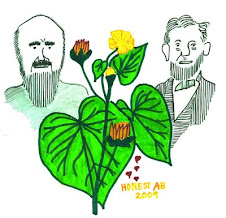
Another main character, Misty, is a dedicated Christian, at least until her comfortable religious world is shattered by the assassination of her fiancé. The main event of the novel—God appearing in the sky out in the California desert, or not—restores her faith. But what is it that brings Misty the Christian and Dan the atheist together for meaningful discourse? It is science, of course. They see, then carefully examine, the desert wildflowers, Dan as a scientist and Misty because Jesus said to consider the lilies of the field. That is, to look closely, carefully, and thoughtfully at them. This is something that very few Christians actually do.
The novel also contains other scientific plot elements. In the glass cathedral that Misty and her husband Emilio build out in the desert, a giant band-o-rama has hundreds of tubas that happen to play the resonant frequency of the building, so that it shatters and blows away like a giant jellyfish in a desert storm.
I think the author has a lively, almost childlike, sense of wonder, at the lilies of the field and the surprises that wait within the laws of physics. I think readers of this blog would enjoy Glass Cathedral.



No comments:
Post a Comment