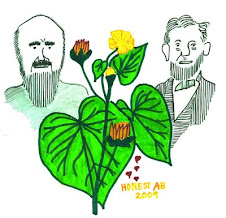
I got my student evaluation comments back from the evolution course that I taught last fall. My goal is to teach evolutionary science, and in the process it is necessary to undermine creationist claims. But I also wish to make it clear that many scientists have religious beliefs, including Christian beliefs, that do not prevent them from accepting evolutionary science. So I teach science from neither a creationist nor an atheistic perspective. The science, of course, is consistent with atheism, but not with creationism. I make it clear to students that I am not trying to make them quit being Christians.
I think I am being successful. I am hitting right in the middle of the religion spectrum. I bothered one atheist in the class (yes, there are a few in Oklahoma) and one creationist.
The atheist wrote, “As an atheist I wish for all my professors to keep their beliefs to themselves and as someone whose way of life is often scorned, I understand how some of my fellow classmates felt. The professor had no bad intentions with the comments, but they should be left out of the classroom as they will offend no matter how they are phrased.”
A creationist wrote, “I have been studying claims that falsify evolution along with studying for this class. If such claims were taught at the end of the semester it might make us learn more in depth on this topic and to think for ourselves. A mark of an educated man is to entertain an idea without accepting it.”
So for those of you who think that Oklahoma is filled with raging fundamentalists who hate anyone who presents evolution…well, maybe you are right, but the raging fundamentalists do not generally attend universities. The fundamentalist university students are generally very cordial. I think I know who the creationist was, and if I am right, she actually earned the highest grade in the class.
The creationist comment ended with, “P.S. Christ loves you.”
Check out the new YouTube video at http://youtu.be/srp6wj1kePk. This week, Darwin hangs out on the corner of South Trenton Avenue and South Trenton Avenue in Tulsa, Oklahoma, and explains the process of evolutionary convergence.
As ever, I want to hear your comments and questions and responses. I do not have an absolutely predetermined list of blog entries, and would be happy to follow a discussion thread that you introduce.
Friday, February 17, 2012


Friday, February 10, 2012
Why Evolution Looks like It Has an Overall Direction
When directional selection occurs, evolution has a direction. It rapidly chooses the winners. But directional selection usually does not last very long. One would not expect evolution to take a consistent, overall direction over the course of millions of years. What it takes to be a winner at one place and time is not what it takes at another.
And yet, in the popular imagination, the idea persists that humans are the “most evolved” species and that evolution pushes “upward” toward a human-like state. Worms are inferior to us because they did not evolve as much. Chimpanzees are inferior to us also, but not as inferior as worms. Ask somebody about evolution, and they will probably either say it is a plot of the Devil or else they will tell you a story that puts humans up at the top of the stairs. Literally. When the publisher was designing the cover to the paperback version of my first Encyclopedia of Evolution, the artist depicted stairs, with monkeys at the bottom and humans at the top. One cannot blame the artist, who merely drew what he or she had been taught to believe. The publisher, not the author, decides the cover images of a book, but this publisher immediately changed the image when I told them that it was scientifically wrong. More recently, an editor rejected a book manuscript because, he said, evolution is an inevitable upward progression, and since my book did not say this, I obviously did not know what evolution was.
This up-the-stairs version of evolution is the one that harmonizes most easily with old creationist views. In the Middle Ages, the natural world was depicted as a scala naturae, or ladder of nature. Rocks were at the bottom, simple organisms above the rocks, mammals and birds above the simpler animals, humans above all other animals, angels above humans, God above angels.
To many early evolutionary scientists, and to many people today, the scala naturae still exists, only God and the angels have been lopped off the top, and evolution has been substituted for creation. This is essentially the pre-Darwinian version of evolution that was proposed by French biologist (inventor of the word biology) Jean Baptiste de Lamarck. Simple organisms were continually forming themselves out of the mud, then modifying themselves into ever more complex forms until they became human, or something like a human.
Scientists today understand that there is no single, upward staircase of evolutionary progress. All species are equally evolved. Worms are very good at being worms. They can make a living in ways that humans cannot. Chimpanzees are very good at being chimpanzees. In some ways, bacteria can be seen as the most successful life form on this planet. There are more bacteria, and more kinds of bacteria, than any other group of organisms. They live in a greater range of conditions, and have persisted for three and a half billion years. The human species, in contrast, can live in only a narrow range of conditions, and has done so for only about 100,000 years, about 0.003 percent as long as bacteria have existed.
There is, however, no denying that life has seemed to make progress. Three and a half billion years ago, only bacteria (and probably viruses as well) existed. By a billion years ago, there were complex cells as well. Five hundred million years ago, almost all life forms lived in the oceans. By four hundred million years ago, some life forms lived on land. Bigger and more complex organisms have evolved over time. An evolutionary story is unfolding. If this isn’t progress, what is?
The reason that evolution seems to lead to progress is that evolution accumulates successes. Bacteria were successful. So also were the more complex cells that evolved from them. Natural selection kept both of them. Plants have been successful. So have animals. Natural selection has kept both of them. The Tree of Life gets bigger and bigger. Also, natural selection capitalizes upon whatever works, whether it is greater complexity or greater simplicity, whether it is life on land or life in the sea. Natural selection capitalizes upon opportunity. Each step toward greater complexity opened up new possibilities. Over evolutionary time, successes and complexities have accumulated. Some of the stories have vanished, such as the saga of the dinosaurs. But most of them are still here, to astonish us today as we behold and study them.
Check out the new YouTube video available at http://youtu.be/SsunNzKrj_s (Channel, StanEvolve). This week it is Charles Darwin explaining that humans, bananas, grapes, and chickens all have a common evolutionary ancestor.
Also remember to submit any comments, especially about topics you would like to discuss.
This entry appears in my book Life of Earth: Portrait of a Beautiful, Middle-Aged, Stressed-Out World, published by Prometheus Books.
Friday, February 3, 2012
Memes Are Everywhere
At the end of 2011, I wrote about the cultural and memetic evolution of the economy. Most of you probably understood what I meant. But I would like to include here a summary of the idea of memetic evolution, which I have extracted from Life of Earth: Portrait of a Beautiful, Middle-Aged, Stressed-Out World, published last year.
Humans exist in a sea of memes. For example, music is memes. Somebody invents a new piece of music, and performs it. A successful set of music memes gets performed by others. Because of memetic selection, there are more copies of Dvořák’s New World Symphony on the market than anything written by Johann Ditters von Dittersdorf. The reason that most folk songs are good is that they have endured centuries of memetic selection. Memetic selection appears to have condemned the deliberately atonal academic music of the twentieth century, such as the works of Anton Webern and Witold Lutosławski, to long-term obscurity. (You’ve never heard of them? That is my point.)
To a certain extent, memetic evolution is arbitrary. But memes, like genes, must correspond to underlying reality. In the case of music, harmonic consonance creates more of a feeling of peace and enjoyment than harmonic dissonance. Consonance results when the vibrations of different notes match one another’s overtone series. Humans desire more than just peace and enjoyment from their music, however, and a certain amount of dissonance is necessary to create a flow of musical events; resolution of a dissonance is part of the story of a piece of music. You cannot change the physical basis of consonance and dissonance any more than you can change the law of gravity. Rhythm is also based on the natural world and may be even more primal than harmony. The powerful drum beats of Japanese taiko and Lakota wacipi music bring back fetal memories of your mother’s heartbeat.
Computer programs are memes. Computer programmers commonly use evolutionary algorithms that consciously imitate natural selection. The program begins with a simple set of instructions, then generates slight variations, tries them out, then retains the ones that work the best. The weasel program is a simple example of an evolutionary algorithm. The computer iterates this process over and over, producing complex results that were designed not by the programmer but by memetic evolution within the computer. Old movies with battle scenes required (and boasted of) “a cast of thousands,” but modern movies often have such large-scale scenes generated by computer programs that use evolutionary algorithms.
Literature is memes. The marketplace is an arena of memetic evolution, as people choose some products over others. Science is memes, as scientists try out hypotheses, retaining and propagating the ones that successfully explain the natural world. Everywhere you look, there are memes, memes, and more memes, all of them evolving.
Check out the new YouTube video available soon on my YouTube Channel (StanEvolve). The video may not be available right away. Also remember to submit any comments, especially about topics you would like to discuss for this blog.
For more information about Life of Earth: Portrait of a Beautiful, Middle-Aged, Stressed-Out World, which has now been published in Chinese as well as English, see my website.
Humans exist in a sea of memes. For example, music is memes. Somebody invents a new piece of music, and performs it. A successful set of music memes gets performed by others. Because of memetic selection, there are more copies of Dvořák’s New World Symphony on the market than anything written by Johann Ditters von Dittersdorf. The reason that most folk songs are good is that they have endured centuries of memetic selection. Memetic selection appears to have condemned the deliberately atonal academic music of the twentieth century, such as the works of Anton Webern and Witold Lutosławski, to long-term obscurity. (You’ve never heard of them? That is my point.)
To a certain extent, memetic evolution is arbitrary. But memes, like genes, must correspond to underlying reality. In the case of music, harmonic consonance creates more of a feeling of peace and enjoyment than harmonic dissonance. Consonance results when the vibrations of different notes match one another’s overtone series. Humans desire more than just peace and enjoyment from their music, however, and a certain amount of dissonance is necessary to create a flow of musical events; resolution of a dissonance is part of the story of a piece of music. You cannot change the physical basis of consonance and dissonance any more than you can change the law of gravity. Rhythm is also based on the natural world and may be even more primal than harmony. The powerful drum beats of Japanese taiko and Lakota wacipi music bring back fetal memories of your mother’s heartbeat.
Computer programs are memes. Computer programmers commonly use evolutionary algorithms that consciously imitate natural selection. The program begins with a simple set of instructions, then generates slight variations, tries them out, then retains the ones that work the best. The weasel program is a simple example of an evolutionary algorithm. The computer iterates this process over and over, producing complex results that were designed not by the programmer but by memetic evolution within the computer. Old movies with battle scenes required (and boasted of) “a cast of thousands,” but modern movies often have such large-scale scenes generated by computer programs that use evolutionary algorithms.
Literature is memes. The marketplace is an arena of memetic evolution, as people choose some products over others. Science is memes, as scientists try out hypotheses, retaining and propagating the ones that successfully explain the natural world. Everywhere you look, there are memes, memes, and more memes, all of them evolving.
Check out the new YouTube video available soon on my YouTube Channel (StanEvolve). The video may not be available right away. Also remember to submit any comments, especially about topics you would like to discuss for this blog.
For more information about Life of Earth: Portrait of a Beautiful, Middle-Aged, Stressed-Out World, which has now been published in Chinese as well as English, see my website.
Thursday, January 26, 2012
In Memory of Lynn Margulis
This essay will also be posted on my website at www.stanleyrice.com.
One of the greatest evolutionary scientists, Lynn Margulis, died last November 22. In this essay I would like to reflect on her contributions to our understanding of the world. Not just of a narrow aspect of science, but the whole world.
Lynn was a child prodigy who began her university studies at age 14. In graduate school, she studied genetics, and married her fellow graduate student, Carl Sagan (who was as creative and large a thinker as she). She was not content to just learn what others said about genetics. She wanted to understand why some traits were inherited only through the mother’s side. These traits appeared to be passed on not through the chromosomes in the nucleus but through the mitochondria, which are tiny energy factories inside of most cells. Some plant traits appeared to be passed on through chloroplasts, the tiny green photosynthesis factories in many plant cells. This meant that mitochondria and chloroplasts had, and used, their own DNA. She wondered why they had that DNA. When she read about the work of some Russian scientists in the early twentieth century, she had her answer. Mitochondria and chloroplasts started off as bacteria, which moved into and took up residence inside of larger cells that already had nuclei. They did not consume the larger cell, nor did it consume them. Instead they formed a permanent partnership, which has been going on for billions of years. Mitochondria and chloroplasts began, she said, by symbiosis—cells living together. The result was the genesis of a new, complex kind of cell. She called this process symbiogenesis.
When Lynn Sagan (later Margulis) wrote her paper, it was rejected fifteen times. She was persistent. Finally it was published. At first her ideas were scorned. But in less than a decade, most biologists were convinced that she was right. When I went to hear her speak, while I was a sophomore at the University of California, Santa Barbara (it was the first scientific seminar I ever attended), she was well received, even though the professor who introduced her made some off-color jokes. At the time, I was a creationist, and I thought that there were only two alternatives to the origin of a complex cell: either gradual evolution, or sudden creation. Lynn Margulis presented a third alternative. Her view was entirely evolutionary, of course; but the host cell and the bacteria had evolved, separately and gradually, then suddenly merged together.
Today Margulis’s view of the origin of mitochondria and chloroplasts is a textbook standard. Scientists are working on an even more amazing example of symbiogenesis: many believe that the nucleus itself is the evolutionary descendant of a bacterium that moved into a larger cell that did not yet have a nucleus. I suspect that this idea would have been too wild even for Lynn in the early days.
In her final years, Lynn was looking for evidence that cilia and “flagella” of complex cells (such as paramecia) were the evolutionary descendants of spirochete bacteria. She had some good circumstantial evidence, but never did find proof.
She was also the principal biological champion of the “Gaia” view of the Earth, a view first proposed by atmospheric scientists James Lovelock. All of the organisms of the Earth form a single network of life. The Earth is therefore not just the home of life, but is alive. Not every component of the Earth is alive, of course; but neither is every component of a cell. A cell has living components, such as mitochondria, and nonliving components, such as water. But nobody would say that a cell is not alive. By the same reasoning, the Earth is alive.
Lynn was pugnacious. She was not afraid of a good scientific debate. And she was not afraid to be wrong. Clearly she was wrong in her assertion that HIV is not an infectious virus. But if she had never taken the risk of being wrong, would she ever have had the insights that changed modern biology?
I had a chance to talk with Lynn Margulis in 2004, as I was preparing my Encyclopedia of Evolution. She was 66 years old at the time, and could have retired comfortably and with renown. But she was still fighting for recognition of yet more of her insights. I mispronounced her name, and she corrected me: the emphasis is on the first syllable, Margulis. She said I would only be allowed to make that mistake once. I didn’t make it again. She enjoyed what I had written in my encyclopedia but was not afraid to point out what she considered errors. When I dedicated Life of Earth to her last year, she left me a phone message saying that the dedication brought tears of happiness to her eyes. She bought copies and left them for students to read at the University of Massachusetts, where she worked. I am glad to have brought a little joy and appreciation into the life of this great scientist.
We can carry on Lynn’s legacy if we continue to think big about the world. When Lynn started, most scientists were trying to decompose the big picture down into component parts. But now, many scientists consider that the interactions of those components are the most important thing. An entire research institute, the Santa Fe Institute, is devoted to understanding complex interactions and emergent properties. Geneticists now know that humans and mice have about the same number of genes, and most of them are the same genes; the big difference between a mouse and a human is not the genes but the interactions among the genes. I like to think that Lynn contributed greatly to this important change in the scientific view of the world.
Announcement: I just posted a new YouTube video on www.youtube.com/StanEvolve. It will be up soon. Darwin comments on…Newt Gingrich?
Also, please send comments about what you would like to discuss, and thanks for the comments received.
One of the greatest evolutionary scientists, Lynn Margulis, died last November 22. In this essay I would like to reflect on her contributions to our understanding of the world. Not just of a narrow aspect of science, but the whole world.
Lynn was a child prodigy who began her university studies at age 14. In graduate school, she studied genetics, and married her fellow graduate student, Carl Sagan (who was as creative and large a thinker as she). She was not content to just learn what others said about genetics. She wanted to understand why some traits were inherited only through the mother’s side. These traits appeared to be passed on not through the chromosomes in the nucleus but through the mitochondria, which are tiny energy factories inside of most cells. Some plant traits appeared to be passed on through chloroplasts, the tiny green photosynthesis factories in many plant cells. This meant that mitochondria and chloroplasts had, and used, their own DNA. She wondered why they had that DNA. When she read about the work of some Russian scientists in the early twentieth century, she had her answer. Mitochondria and chloroplasts started off as bacteria, which moved into and took up residence inside of larger cells that already had nuclei. They did not consume the larger cell, nor did it consume them. Instead they formed a permanent partnership, which has been going on for billions of years. Mitochondria and chloroplasts began, she said, by symbiosis—cells living together. The result was the genesis of a new, complex kind of cell. She called this process symbiogenesis.
When Lynn Sagan (later Margulis) wrote her paper, it was rejected fifteen times. She was persistent. Finally it was published. At first her ideas were scorned. But in less than a decade, most biologists were convinced that she was right. When I went to hear her speak, while I was a sophomore at the University of California, Santa Barbara (it was the first scientific seminar I ever attended), she was well received, even though the professor who introduced her made some off-color jokes. At the time, I was a creationist, and I thought that there were only two alternatives to the origin of a complex cell: either gradual evolution, or sudden creation. Lynn Margulis presented a third alternative. Her view was entirely evolutionary, of course; but the host cell and the bacteria had evolved, separately and gradually, then suddenly merged together.
Today Margulis’s view of the origin of mitochondria and chloroplasts is a textbook standard. Scientists are working on an even more amazing example of symbiogenesis: many believe that the nucleus itself is the evolutionary descendant of a bacterium that moved into a larger cell that did not yet have a nucleus. I suspect that this idea would have been too wild even for Lynn in the early days.
In her final years, Lynn was looking for evidence that cilia and “flagella” of complex cells (such as paramecia) were the evolutionary descendants of spirochete bacteria. She had some good circumstantial evidence, but never did find proof.
She was also the principal biological champion of the “Gaia” view of the Earth, a view first proposed by atmospheric scientists James Lovelock. All of the organisms of the Earth form a single network of life. The Earth is therefore not just the home of life, but is alive. Not every component of the Earth is alive, of course; but neither is every component of a cell. A cell has living components, such as mitochondria, and nonliving components, such as water. But nobody would say that a cell is not alive. By the same reasoning, the Earth is alive.
Lynn was pugnacious. She was not afraid of a good scientific debate. And she was not afraid to be wrong. Clearly she was wrong in her assertion that HIV is not an infectious virus. But if she had never taken the risk of being wrong, would she ever have had the insights that changed modern biology?
I had a chance to talk with Lynn Margulis in 2004, as I was preparing my Encyclopedia of Evolution. She was 66 years old at the time, and could have retired comfortably and with renown. But she was still fighting for recognition of yet more of her insights. I mispronounced her name, and she corrected me: the emphasis is on the first syllable, Margulis. She said I would only be allowed to make that mistake once. I didn’t make it again. She enjoyed what I had written in my encyclopedia but was not afraid to point out what she considered errors. When I dedicated Life of Earth to her last year, she left me a phone message saying that the dedication brought tears of happiness to her eyes. She bought copies and left them for students to read at the University of Massachusetts, where she worked. I am glad to have brought a little joy and appreciation into the life of this great scientist.
We can carry on Lynn’s legacy if we continue to think big about the world. When Lynn started, most scientists were trying to decompose the big picture down into component parts. But now, many scientists consider that the interactions of those components are the most important thing. An entire research institute, the Santa Fe Institute, is devoted to understanding complex interactions and emergent properties. Geneticists now know that humans and mice have about the same number of genes, and most of them are the same genes; the big difference between a mouse and a human is not the genes but the interactions among the genes. I like to think that Lynn contributed greatly to this important change in the scientific view of the world.
Announcement: I just posted a new YouTube video on www.youtube.com/StanEvolve. It will be up soon. Darwin comments on…Newt Gingrich?
Also, please send comments about what you would like to discuss, and thanks for the comments received.
Friday, January 20, 2012
What Would You Do About…
Note: I am posting a new Darwin video on my YouTube channel StanEvolve. It is not showing up on the main channel page, but if you click on videos, you will find it. It is called Charles Darwin and airplanes. It is about the difference between science and religion.
Note: I am now on Twitter @StanEvolve.
In the previous post, I asked for your input of ideas for this blog. Due to a Blogger website error, you may have missed that posting. If you missed it, take a look at it. I really want to know your input.
But I will also be asking your advice about specific situations. To start: please let me know what you think I should do in the situation I describe below.
I wrote a book review for the National Center for Science Education, which was read by a long-term prisoner in California. He wrote a letter to me, laboriously and carefully and intelligently. We began exchanging letters about evolution. He shared some of his questions and observations, and told me about some conversations he had with his fellow prisoners. I could not send any of my books—prisoners cannot receive hardcover books—but I printed out my summary of the Origin of Species for him, as well as the PDF file of Life of Earth.
I began to notice in his letters that he was dedicated to communism. I suggested to him that communism failed in part because it made incorrect assumptions about human nature (capitalism also makes mistakes, but not the same ones). He wrote back and said he was familiar with the Lysenko story (click here for the Wikipedia summary), but that The Great Stalin and The Great Mao were not responsible for the collapse of communism: it was the fault of infiltrators. He was not angry at anything I said, nor am I at anything he said, and our correspondence will probably continue.
But it is clear to me that he is a fundamentalist communist as unaffected by evidence as any fundamentalist creationist. Fundamentalist faith deflects all contrary evidence by making special accommodations; for example, creationists may say that God nudged the organisms around in the Flood to make the fossils end up in an evolutionary order.
So, what would you suggest that I do? Should I mention to my correspondent that he is using the same patterns of thought that fundamentalist creationists use? My inclination is to simply not discuss such matters any further with my correspondent; I am sure other topics will come up from time to time. But if you think I should write to him about it, let me know—and let me know how—in the comment box.
I look forward to your input on this and other things, and your responses to one another, rather than just waiting for it to happen. I have learned much of what I know by simply listening to others. I have the habit of walking right up to clusters of colleagues and just listening. Sometimes I tell them that I just want to listen and learn. Sometimes it is gossip (which, according to some studies, is nearly always good gossip rather than malicious gossip), sometimes it is major scientific or political insights. In fact, I have learned some things from the intelligent prisoner with whom I correspond.
Note: I am now on Twitter @StanEvolve.
In the previous post, I asked for your input of ideas for this blog. Due to a Blogger website error, you may have missed that posting. If you missed it, take a look at it. I really want to know your input.
But I will also be asking your advice about specific situations. To start: please let me know what you think I should do in the situation I describe below.
I wrote a book review for the National Center for Science Education, which was read by a long-term prisoner in California. He wrote a letter to me, laboriously and carefully and intelligently. We began exchanging letters about evolution. He shared some of his questions and observations, and told me about some conversations he had with his fellow prisoners. I could not send any of my books—prisoners cannot receive hardcover books—but I printed out my summary of the Origin of Species for him, as well as the PDF file of Life of Earth.
I began to notice in his letters that he was dedicated to communism. I suggested to him that communism failed in part because it made incorrect assumptions about human nature (capitalism also makes mistakes, but not the same ones). He wrote back and said he was familiar with the Lysenko story (click here for the Wikipedia summary), but that The Great Stalin and The Great Mao were not responsible for the collapse of communism: it was the fault of infiltrators. He was not angry at anything I said, nor am I at anything he said, and our correspondence will probably continue.
But it is clear to me that he is a fundamentalist communist as unaffected by evidence as any fundamentalist creationist. Fundamentalist faith deflects all contrary evidence by making special accommodations; for example, creationists may say that God nudged the organisms around in the Flood to make the fossils end up in an evolutionary order.
So, what would you suggest that I do? Should I mention to my correspondent that he is using the same patterns of thought that fundamentalist creationists use? My inclination is to simply not discuss such matters any further with my correspondent; I am sure other topics will come up from time to time. But if you think I should write to him about it, let me know—and let me know how—in the comment box.
I look forward to your input on this and other things, and your responses to one another, rather than just waiting for it to happen. I have learned much of what I know by simply listening to others. I have the habit of walking right up to clusters of colleagues and just listening. Sometimes I tell them that I just want to listen and learn. Sometimes it is gossip (which, according to some studies, is nearly always good gossip rather than malicious gossip), sometimes it is major scientific or political insights. In fact, I have learned some things from the intelligent prisoner with whom I correspond.
Saturday, January 7, 2012
For This New Year: Your Advice Requested
It appears that Blogger reposted my December 23 entry rather than the one that I submitted. I will try again with this message.
This blog has, in its three years of existence, been primarily an outlet for my ideas: the kind of one-directional flow that feels most comfortable to a university professor. I want to change this beginning in 2012.
I would like to begin directly requesting my readers to give me advice. There is always a comment box option, which several of you have used, but my default (like that of most professors) has been to just talk and then acknowledge those few people who raise their hands. But interaction is the successful way to go. The internet is set up to encourage interaction. That means you! I would like to know what topics you would be interested in hearing about. I will continue to post things that I learn (primarily about evolution) but I will try to remember to always request your responses. I am not running out of my own ideas, but there will be plenty of time and space for yours.
I got to be smart by listening to other people—not just at scientific meetings, but everywhere, such as family reunions; not just from science, but from fiction, and from hearing people’s stories. Sometimes I crash a conversation that is going on in the hallway, and when they look at me I just said I wanted to learn something from them.
Let me know in the comment box (now or in any future comment box) what you would like to see discussed in this blog. Also check my website for news and essays. One news item: The Chinese edition of Life of Earth has just been published. I think you have to be in Taiwan to buy it.
This blog has, in its three years of existence, been primarily an outlet for my ideas: the kind of one-directional flow that feels most comfortable to a university professor. I want to change this beginning in 2012.
I would like to begin directly requesting my readers to give me advice. There is always a comment box option, which several of you have used, but my default (like that of most professors) has been to just talk and then acknowledge those few people who raise their hands. But interaction is the successful way to go. The internet is set up to encourage interaction. That means you! I would like to know what topics you would be interested in hearing about. I will continue to post things that I learn (primarily about evolution) but I will try to remember to always request your responses. I am not running out of my own ideas, but there will be plenty of time and space for yours.
I got to be smart by listening to other people—not just at scientific meetings, but everywhere, such as family reunions; not just from science, but from fiction, and from hearing people’s stories. Sometimes I crash a conversation that is going on in the hallway, and when they look at me I just said I wanted to learn something from them.
Let me know in the comment box (now or in any future comment box) what you would like to see discussed in this blog. Also check my website for news and essays. One news item: The Chinese edition of Life of Earth has just been published. I think you have to be in Taiwan to buy it.
Saturday, December 31, 2011
Natural Selection of Economic Models
We are now closing the year 2011, which has been remarkably like 2010. Continued global warming, continued opposition to the teaching of evolution and global warming, continued economic uncertainty, and another year with a Congress that considers its sole function to be partisan strife.
But one of these years, enormous changes will have to come. As economist Kenneth Boulding pointed out decades ago, and as environmental entrepreneur Paul Gilding has pointed out in his 2011 book The Great Disruption, growth cannot continue forever in a finite world. Gilding says that our current economic system will collapse, since it depends totally on economic growth. It will have to be replaced by an equilibrium economy. Gilding points out that this inevitable transition will not occur smoothly or gradually. At some point, a critical mass of people will realize that, in a finite world in which global warming will disrupt our lives, we have to change. Many of us realize this already; and we are a rapidly growing minority. The change will be disruptive, since entire industries (such as coal and oil) have refused to admit that we are about to collide with natural ecological limits; they will fight to keep people not just using but wasting natural resources. Big corporations will continue to demand government bailouts for their own business mistakes. They preach capitalism but demand socialism. The resulting chaos, in a world with natural disasters and scarce food, will not be pretty. One of these years—it might be 2012—will make 2011 seem like a very uneventful year.
Gilding says that we will emerge from the chaos with a new and sustainable economic system. He says that it is the next stage of human evolution. When I first read this, I assumed that he simply did not know what evolution was. But after I had read more of his book, I could see that he may be right. He did not mean biological evolution. He meant cultural evolution—some memes are propagated more than others. I have written about this process in books. But after reading Gilding’s book, I found a new example of cultural evolution: the economy.
The economy consists of many memes, which include: We have to keep growing to avoid collapse; we have to acquire ever more stuff in order to be happy; since the economy will always grow, we can put ourselves deeply into debt; ecological issues are something that we can take care of someday when we are all rich. These are the old, destructive memes that have brought our economy to the brink of disaster. But there are other economic memes: Our economy can be sustainable; happiness does not require lots of stuff; we can live within our means; we need to fit our economy into ecological limits now. There are millions of people (not enough millions) who believe this second set of memes; and there are hundreds of companies that abide by them. That is, in the world of economic memes, there is diversity.
And then along comes catastrophic natural selection: an economic collapse. If we were all hypnotized by consumerism, then this collapse would mean extinction. However, natural selection will in this case favor the sustainability memes, which already constitute a significant minority of the memetic variation in our population. Yes, there will be an enormous collapse; but many individuals and corporations are at least partly ready for it. There are, for example, hundreds of alternative energy companies ready to fill the void that will be left by the downfall of the petroleum industry.
This sounds like good news. I wish I could believe it, but I believe that political conservatives will prevent us from making enough changes to survive the coming collapse; they will suppress the solutions. The CEOs of financial corporations, for example, want to keep us in debt rather than to let us live without owing them money. Like a bunch of walnut trees suppressing other plant species by poisoning the forest with juglones (a process known as allelopathy), these CEOs are suppressing the sustainability memes. But they cannot wipe them out. At some point, a sustainable world may emerge, by the process of cultural evolution.
On this last day of the year, we sigh in relief that we have not yet fallen into disaster. We look forward to a new year in which, if we are lucky, the memes of sustainability will have a chance to make progress, and in which the collapse will not yet occur. If we are lucky.
Subscribe to:
Posts (Atom)