Showing posts with label botany. Show all posts

Saturday, August 15, 2026

The Thinking, Walking Biped, part six. Famous Nature Walks: Rosseau's Passion for Botany

In his Reveries of a Solitary Walker, Rousseau was depressed nearly all of the time until he was rescued by botany. The study of plant diversity in nature saved him from complete depression. It works for me, and I highly recommend it. Botany is, among many other things, the pursuit that saved Rousseau from insanity.

Rousseau did not just glance at flowers and grass and say, yeah, they are pretty. He looked closely at them. He observed them and thought about them. Above all, he wanted to know what they were. In Walk 2, he describes his joy at seeing Picris hieracioides the hawkweed; Bupleurum falcatum, the hare’s ear; and Cerastium aquaticum, the mouse-eared chickweed. These are all very common weeds, but Rousseau noticed their beauty. Alas, in Walk 2, he slipped back into depression, and these flowers just reminded him of how much of his life he had wasted by not being a botanist. I think.

Rousseau spent the two happiest months of his life on St. Peter’s Island in Lake Bienne in Switzerland. He thought that, on that isolated island, he was free from the condemnation of the government authorities in Berne. In Walk 5, he describes his “botanical fervor.” He was particularly enchanted by the alder-buckthorn (Frangula alnus), the willow-weed (Epilobium ciliatum), and wild thyme. He also mentioned the toothwort (Dentaria), wild cyclamen, the bird’s-nest orchid Neottia nidus-avis (which has no chlorophyll), Laserpitium gallicum, and the lycopodium clubmoss. He ate the very tart berries of the sea buckthorn tree (Hippophae rhamnoides). I tried them, and didn’t like them, but they are raised commercially for cosmetics. He was as happy as a child playing with the exploding capsules of the Himalayan balsam (Impatiens glandulifera). I can attest to the surprising joy of having these capsules explode in my hand, and my grandkids liked it even more. Rousseau briefly returned to childhood happiness. This was his one happiness, aside from sex.

I got lucky. My job (as a university botany professor) required me to spend a lot of time looking at and for plants in natural habitats, and leading students on field trips.

But Rousseau’s stresses could not be completely forgotten, even in paradise on St. Peter’s Island. Actually there were two islands, and Rousseau imagined that, because the big and the powerful always consume and destroy the small and weak in this world, the big island would someday consume the small one. My own experience coincides with Rousseau’s. When I was sitting on a rock in the middle of a rushing stream in Wyoming, in the middle of teaching a field botany course to some of the best students I have ever had, I could not ignore the pain I felt from the office politics back at the university where I worked, where our department chair enjoyed making people feel bad about themselves (according to other people who knew him).

Rousseau would use his botanical ecstasies to launch into thinking about other topics. Walk 6 begins with a wildflower hike near Fontainebleu. He was enjoying doing this good thing—but did it really count as personal goodness if he enjoyed doing good things? He wanted his enemies to suffer—but he could think of no greater suffering to visit upon them than for them to know he was happy in spite of them.

He wished he could know all the plants on Earth. They are, he said, the clothing of the Earth. They are the only spectacles of Nature of which we cannot grow weary. He much preferred the Greek philosopher-botanist Theophrastus, who loved plants for their own sake, over Dioscorides, for whom plants were only valuable because of the medicines they contained.


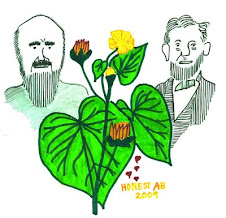
 I find this 1888 line drawing fascinating. Notice the botanist, despite his serious demeanor and despite the shabbiness of his house, is happy explaining a thistle (?) to two fellow seekers of wisdom. One of them is a winsome young woman. The wonders of botany can, in fact, attract a mate—worked for me. But notice also that Karl Marx is listening to him! I didn’t think Karl Marx listened to anyone! Oh, the wonderful things that botany can do!

It turns out that St. Peter’s Island was actually part of Berne, and the authorities made Rousseau leave. He went back to being depressed. But years later, he would look at his herbarium (pressed plant) specimens and relive his erstwhile joys. I have done this also. I could not bring my specimens with me to France, so I left them in university herbaria, as shown in these photos.


These specimens are: Acer macrophyllum, Alnus rhombifolia, Umbellularia californica (all from California), Rumex venosus (Nebraska), and Ipomopsis aggregata (Oklahoma).

“I see only animosity on the faces of men, whereas nature always smiles at me,” Rousseau wrote.

Tuesday, July 21, 2026

Stars in the Daytime: Stories of Disruption, by Stan Rice, story 5. The Old Burrill House

Author Stan Rice has just published another collection of short stories: Stars in the Daytime: Stories of Disruption. Stan Rice is better known as a science writer, and scientific content and themes show up in most of his stories, including those in this collection.

Here is the author’s summary from Amazon: “You cannot see stars in the daytime, but they, like hidden reality, are always there. In these nine stories, Stan Rice asks, what if God appeared in the sky, with a message for Muslims? Can a theme park haunted castle help a young woman escape from genocide? What if an old greenhouse is the site of shifting timelines? What if a hotel burglar is actually a kindly man? What if a man discovers his girlfriend thinks of him as a teddy bear, then needs him? What happens if a demon from hell changes places with a human being on Earth? In one of the stories, Ruth meets Carmen.”


The stories in this collection are: When Pigs Fly; The Haunted Castle; Bleeding Earth (all reviewed earlier); The Book of Ruth (reviewed in my religion blog); The Old Burrill House (reviewed here); The Lord Will Provide: Two Stories of Faith; The Gentleman; Ursa Minor; and You Little Demon (all reviewed in my religion blog later).

This story uses a premise that shows up in a lot of speculative fiction, and Rice employs it at least as well as other examples I have seen: shifting time lines that intersect and allow characters to move between them, from one century to another.

Kent is a graduate student in botany in the 1980s. His experiment is in a greenhouse that has been built into an old house, left to the university, that used to belong to Burrill, a prominent botanist. The house is falling apart, but still has rooms used for storage upstairs from the greenhouse. Kent sees light coming from one of the abandoned rooms, and slips in to investigate. He sees a beautiful woman bathing. He then tries to slip back out, but the portal has closed and he is trapped in the 1890s in a room with Burrill’s daughter Imelda. Kent slips out of the house and comes back to the university, to enroll as one of Burrill’s graduate students. One problem is that, living almost a century later, he knows a lot more science than did Burrill, a fact he must hide.

Imelda falls in love with Kent. Kent has to conceal his knowledge of the shifting timelines, only it turns out Imelda has seen the greenhouse that does not yet exist. Are they both crazy? What is Burrill to do when his daughter wishes to marry Kent? Kent decides to stay in the past with Imelda, but then Imelda gets sick with a bacterial disease that he can cure if he goes back into the future and steals antibiotics. I’ll let you read about whether he succeeds.

Rice writes from the knowledge base of a science teacher. Antibiotics are often made from fungi. They are not magic chemicals. They serve a purpose for the fungi: they kill the bacteria with which the fungi must compete for food. Even in his fiction, Rice is a science teacher.

Friday, July 10, 2026

Parasol or umbrella?

We usually call them umbrellas, without thinking that the word umbrella means “little shade.” When parasols became fashionable among women in the nineteenth century, it was about the only way that they could find any shade. And that is because the nineteenth century was the time in which westerners cut down as many trees as possible, as if they were enemies or impediments created by God just to vex us.

Of course, trees are perhaps the ultimate blessing of creation. The photosynthesis of their leaves puts oxygen into the air, removes carbon dioxide from the air, and create cool shade. The trunks transported massive amounts of water from the soil into the air, creating clouds. The roots held the soil in place. Trees created new soil; their shed leaves were mulch, which held moisture in the soil. You can read all about it in my book Green Planet.

We take parks for granted. Of course every town has at least one. But this is a new way of thinking that westerners did not have until late in the nineteenth century, when Frederick Law Olmsted created the concept and oversaw the creation of municipal parks, starting with Central Park in New York but extending all over America. Europe did it too. As a result, it was not as important to have a parasol as it had been before; to get out of the sun, just duck into the shade of a tree. The new concept created by Olmsted has transformed our world. Think about this next time you park or walk in the shade.

Friday, March 1, 2024

What Was I Thinking? Remembrances of My Dissertation

In 1987, I submitted my Ph.D. thesis, “Environmental Variability and Phenotypic Flexibility in Plants,” at the University of Illinois. What was I thinking? I was dealing with three variables: plants, the growth flexibility of those plants, and the variability of the environment—in this case, of sunlight intensity. I intended to write about all three of these things in this essay, but it quickly got out of hand, so I will just tell you about how I dealt with the complex problem of measuring environmental variability in three habitats: abandoned agricultural fields, tallgrass prairies, and forest floors.

One of the major problems with measuring environmental variability is construct validity—that is, how valid is a way of measuring something so that it is a believable construct of what you claim to be measuring? I explain this concept in my book Scientifically Thinking. There is no single valid way of measuring environmental variability. What I did instead was to measure it three different ways. If these three ways all gave the same results, then they were probably valid, and I could believe the results.

First, I made instantaneous measurements of light (that is, the colors of light that stimulate photosynthesis) with a “quantum sensor” designed to do exactly this thing. The problem is, this kind of light intensity varies from one moment to the next.

So I used a second method. What I really wanted to know was the spatial patchiness of shade caused by leaves. So I made three-dimensional profiles of leaf area in the three habitat types. To do this, I used nine pieces of wood, a string, and a nail. But neither of these methods could prove that variability of sunlight intensity would actually have an effect on plants.


So I used a third method as well. I used phytometers, that is, actual potted plants. I measured the weight of the plants (plus the soil, or course) in lots of different places in the three habitats in the morning and the afternoon. I measured environmental variability as the differences in how much water the plants transpired.

This was how I tackled the problem of construct validity. I measured what I wanted to know three different ways. I was taking a chance. What if the three ways gave three different answers? But I got lucky. All three methods agreed. Chalk one up for construct validity.

I had expected that weedy fields would be the most variable, the forest floor the least variable, and prairies intermediate between them. And this is what I found. I still marvel that it came out that way.

I announced my results triumphantly: weeds had the most phenotypic flexibility and lived in the most variable environment; forest floor plants had the least flexibility, and lived in the least variable environment; and prairie plants and their environment were intermediate. The results all lined up. Despite all of its limitations, this quixotic quest was successful. I believe the results, largely because I took a risk with construct validity, and it paid off. There is no way I could have gotten these results by sheer luck. Here is the plain English summary of my thesis.

A lot of the scientific method is about validity. You have to measure it, and every time you do, you are taking a risk. But if it works, you are closer to understanding the world.

Wednesday, December 6, 2023

Similarities and Differences: The Tenth Message from Fluff the Cottonwood

Fluff the cottonwood here again. My ninth message was the most recent post. I just heard from Stan. He wanted me to tell all of you that he has now finished his permanent relocation to France. You will be hearing directly from him in the near future.

Since Stan is a botanist, one of the first things he did was to start learning European trees. He has not had much direct experience yet, as the leaves were falling when he arrived, and have now all fallen. But he wants to be ready for hiking in the mountains with his French family—the parents, uncles, and cousins on his son-in-law’s side—in the spring. And as usual for this blog he has a message about evolution.

In a photo book about French trees, Stan recognized most of the types of trees, such as maples (érables), alders (aulnes), birches (bouleaux), dogwoods (cornouillers), hornbeams (charmes), hazelnuts (noisetiers), chestnuts (châtagniers; European chestnuts did not die the way American ones did), oaks (chênes), beeches (hêtres), walnuts (noyers), ashes (frênes), sycamores (platanes), willows (saules), lindens (tilleuls), and elms (ormes). But in each case, the genera were the same but the species were different. This is because the deciduous forests of Europeand North America have been separate for millions of years, which sounds like a long time but is only long enough for new species to evolve within the genera that already existed.

The main one Stan told me about was the poplars (peupliers). Down by the river trail near his new apartment, he saw big trees that looked exactly like me. The leaves appeared to be just a little shorter and wider, but otherwise it was a cottonwood. Only in Europe it is called black poplar (peuplier noir). I am Populus deltoides; the European species is Populus nigra. The black poplar leaves look more like mine than do the leaves of another North American species, Populus fremontii, the Fremont cottonwood. I am more genetically related to the European species than I am to the species found in western North America.

Back in America, Stan would normally have launched into a speech about how this is evidence of each species having evolved in its own distinct location, rather than being the remnants of a Flood of Noah. But in France, nobody cares. There are essentially no creationists in France. There are no global warming deniers. Stan will discontinue a lot of what he was writing in America and focus on the positive and interesting things about evolution, botany, and science.