As described previously, I wanted to go to the north coast of France to see the symbiotic Symsagitiffera flatworms. They should be hard to miss: green worms in shallow water against light brown sand. And, at the time H. G. Wells wrote The Science of Life, maybe they were easy to find. But since Wells wrote the book in 1929, world agriculture, including the agriculture of Bretagne in northern France, has undergone a revolution, about which I read in a French book Algues Vertes: L’Histoire Interdite by Inès Léraud and Pierre Van Hove. Released about 2018, it is a non-fiction BD (bande desinée, or comic strip) book.
In 1929, Brittany consisted mostly of small farmers using manual tools and horses, raising small quantities of food mostly for their local communities. Since World War Two, French agriculture has become intensely productive and they now export a lot of food, especially grains and pork. This was a deliberate part of the post-war Marshall Plan to rebuild Europe. But the millions of dollars available to France were not entirely a gift. France was expected to rebuild their agriculture along American lines, using inputs such as intense cultivation, fertilizers, and pesticides. They were to buy these inputs from America, and sell some of their food to America. By the 1980s, most of the Bretagne landscape was corn and hog confinement facilities.
What was there to not like about this? The French were getting rich and helping to feed the world. The authors identified two things in particular that were a negative impact of this intense agriculture.
First, most French were not getting rich from it. The corporate executives of large farms, food processing and distribution companies, and financial corporations were getting very rich, while most farmers got poorer. This was exactly the same thing that was happening in America at that time. The people getting rich included nearly all of the government supervisors, all the way up to several prime ministers and presidents.
Second, a lot of fertilizer was draining into the coastal waters of Brittany, causing massive blooms of green algae, a process known as eutrophication. Some of it was runoff from fertilizer used on cornfields, while much of it was from hog wastes from confinement facilities. The rich executives and government supervisors did not want to reduce the amount of fertilizer in the runoff, because this would eat into their profits. The result was massive piles, sometimes meters in thickness, of the green seaweed Ulva amoricana, known as sea lettuce. The only way to control the green algae was to bulldoze it away and bury it somewhere; or to reduce the use of fertilizer and the production of hog wastes. But this latter solution would reduce the profits of the executives, so it never happened. The massive piles of seaweed were driving away tourists who wanted to see the picturesque north coast of France. But the French government would not, apparently, allow journalists to tell the public about the disgusting piles of seaweed, which would die and rot, and in the process release foul-smelling hydrogen sulfide gas. This link includes a photo.
Occasionally, when the hydrogen sulfide accumulated inside the dry crust of the piles of seaweed, the gas could reach deadly concentrations: to dogs, to wild pigs, and even occasionally to people. In particular, French regional governments would refuse to investigate the deaths, saying that the human victims had heart conditions or were heavy smokers, just as they fell into and suffocated inside of massive piles of seaweed or died right after hauling a truckload of seaweed. Blame the joggers and truck drivers, not the executives. This was the clear viewpoint of the artists, who made the “bad guys” as disgustingly ugly as possible.
The powerful rich insisted that the seaweed was natural (which is true) but refused to address eutrophication, which caused a natural and usually harmless seaweed to form huge piles. Rich people causing pollution that burdens the lives and health of the poor is a story that has been repeated thousands of times in hundreds of places. It is a forbidden story (histoire interdite).
The explosion of Ulva seaweed is getting worse and worse, and some northern French beaches have been closed as a result even in 2026.
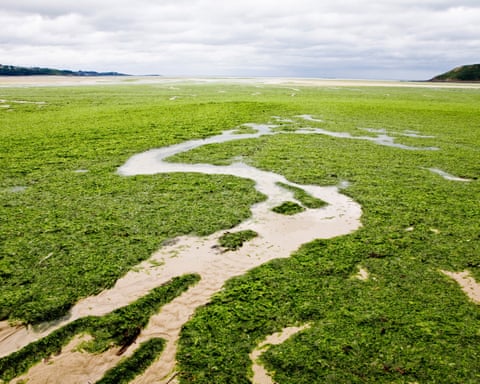
One small consequence, for me, is that if I went to Roscoff to look for green flatworms, I would probably see only massive piles of sea lettuce, especially this year (during a drought) when there is less rain water runoff to dilute the fertilizer. One more thing to strike off of my bucket list because of human pollution.



No comments:
Post a Comment