Showing posts with label Europe. Show all posts

Sunday, December 14, 2025

European Tourists Are Staying Away from America

European tourism to America is in steep decline, averaging about 25 percent for seven major countries. Since I live in France, I was particularly interested in French tourism to America. It has declined by about 20 percent, according to this article in Le Monde. This article is in English, but you can only read the first two paragraphs without a subscription.

The decline in European tourism is almost completely due to the hatred generated by Donald Trump against Europe. It is a pattern all to familiar, when Canadians largely stopped coming to American ski resorts after Trump threatened to annex Canada. He had no serious intention to do so, but he caused billions of dollars in lost revenue just by spouting off his hatred.

The decline has also resulted from safety concerns. Europeans, quite frankly, are afraid of getting shot if they visit America. My son-in-law, when he moved to America to marry my daughter, said he had checked on the figures before coming, and he was fifty times more likely to be shot in America than in France. While this may not appreciably increase a tourist’s risks, everyone keeps hearing about American mass public shootings. They happen almost every weekend. The news on December 14 was of a public shooting at Brown University. The previous week it was Kentucky State University. After this happens enough times, European minds begin linking the thought of visiting America to the fear of getting shot.

And I honestly cannot tell them otherwise. In one of my French classes, we read a passage in which a (fictitious) French woman dreamed of moving to America. I had to say, « Pour quoi est-ce qu’elle aimerait habiter en Amérique ? Les États-Unis ont tant de fusillades!» Why would she want to live in America ? The U.S. has so many shootings!

This is a science blog, so I will make a connection to evolution. Throughout human evolutionary history, migrating to a new location has given immense fitness advantages to many people and to their tribes. There has always been a risk, but the risk has been worth it. But today, visiting another country has risks without much benefit. Natural selection may have favored wanderlust in the past but today it provides no benefit. Why buy a plane ticket to America when you can hop on a train and visit Spain or Italy?

Trump has tried to compensate for the loss of agricultural sales (from his tariffs) by paying farmers. This is a big government approach. His big government ruins business then compensates for it by a socialistic payout. But is Trump going to offer a big payout to the tourism industry in return, not for tariff payments, but merely for the personal pleasure of insulting Europe? Just how many billions of dollars is America willing to lose to pay for Trump’s peevish insults?

I’d better post this pretty soon before we have another mass public shooting.

Friday, July 12, 2024

White Superiority? Not.

I recently posted an essay (July 4), just below about how the Founding Fathers thought they had found a natural basis for government: natural selection leads to democracy. This was a flawed idea, but an advance over all previous European thought about government.

Americans often  make the erroneous, and dangerous, assumption that America became strong because of the cultural, maybe even biological, superiority of immigrant white Europeans over Native Americans. The Europeans beat the Natives, and that is why America is mostly white, or the descendants of slaves or later immigrants, rather than mostly Native Americans.

But it is clear that there is no inherent cultural or biological superiority of Europeans. The reason that European immigrants (mostly from England, France, and Spain) beat the Natives was because the Europeans had guns, and used them to slaughter literally countless Natives. The Europeans also brought diseases.

The evidence for this is, in part, that an earlier European invasion of North America failed as miserably as the 1492 invasion succeeded. I refer to the Viking invasion.

Vikings invaded many places in Europe, and conquered those places, before eventually blending in. In stark contrast, the Vikings who invaded North America had only a foothold (Vinland, in what is now Newfoundland) and soon departed without leaving any descendants. Unlike later invaders, the Vikings had only spears, swords, and other weapons that were not too different from those that the Natives possessed. That is, they were more equally matched with their intended victims. Under these conditions, the Natives easily expelled the Vikings. Why did this happen?

It happened because the Vikings were small and sick. Against the strong, healthy Natives, they didn’t stand a chance.

As I was writing chapter 1 of my forthcoming Forgotten Landscapes (due out in 2025 from Rowman and Littlefield), I found that the evidence of Viking weakness and Native strength was mostly indirect. Direct evidence is hard to come by. I thought it would be easy to prove, from skeletal remains, that Natives were taller than Vikings. Frequently, a less well-nourished population has shorter people. But there is little skeletal evidence for this. It is undeniably true that some Native tribes, with an average height of five feet eight inches, had the tallest people in the world before European contact, based on skeletal remains. But the Vikings were almost as tall. Late medieval Europeans averaged five feet five inches tall. The difference is due mostly to nutrition and disease.

But, to me, the indirect evidence is convincing. Native American tribes had less poverty, therefore better nutrition. They also had better health. They had almost no plagues of disease. For example, they did not have the low-level ergotism, which created constant sickness among poor Europeans, resulting from a fungal toxin in rye bread

There is also the anecdotal evidence. Anecdotal it may be, but it is still a valid test of the hypothesis that Vikings were small and weak. When Richard Fleischer directed the 1958 movie The Vikings, starring Kirk Douglas and Tony Curtis, he wanted to model the Viking ship after an actual archaeological specimen. The actors who played the warrior roles, however, could not fit into the ship. The set designers had to rebuild the ship, leaving more leg room for the actors. The actors were men of ordinary modern build, resulting from ordinary modern nutrition and exercise.

The Viking invasion, without guns and plagues, failed. The later European invasion, with guns and germs, succeeded. Clearly the Europeans were not superior to Native Americans, except for the guns and germs.

=================================

Wednesday, August 3, 2016

What I Learned in the Forests of France: About Biogeography

France, part 4.

On July 14, I went hiking in the Vosges Mountains of eastern France with the Gennetay family of Strasbourg. This was easily one of the greatest days of my life. It is always fun to take a hike with such a happy family (the family of my son-in-law). And it is always exhilarating for a gentleman of a certain age, myself, to be able to hike for seven hours and survive. But in the next two essays I will describe some of the scientific and environmental things I learned on this hike.

First, about biogeography.

The forests of France are just similar enough to those of eastern North America to feel comfortable, but just different enough to feel exotic.


Some of the weedy species were the same, such as yarrow (Achillea millaefolium), mullein (Verbascum thapsus), foxglove (Digitalis purpurea), and cow parsnip (Heracleum sphondylium). The bracken fern (Pteridium aquilinum) and the fireweed (Chamerion angustifolium) live all over the Northern Hemisphere. And one of the tree species, widespread at forest edges, is actually a native of North America, and was introduced to Europe in 1601: the black locust Robinia pseudoacacia.


Bracken fern (Pteridium aquilinum, foreground)


Foxglove (Digitalis purpurea)


Fireweed (Chamerion angustifolium)

But in most cases the forests consisted of the same general types (genera) of trees, but different species. Examples of European trees similar to but not the same species as those in America include the following. I provide scientific names for the European species, and French names.

Pines: Scots pine (Pinus sylvestris) (le pin)
Firs: Picea abies (le sapin)
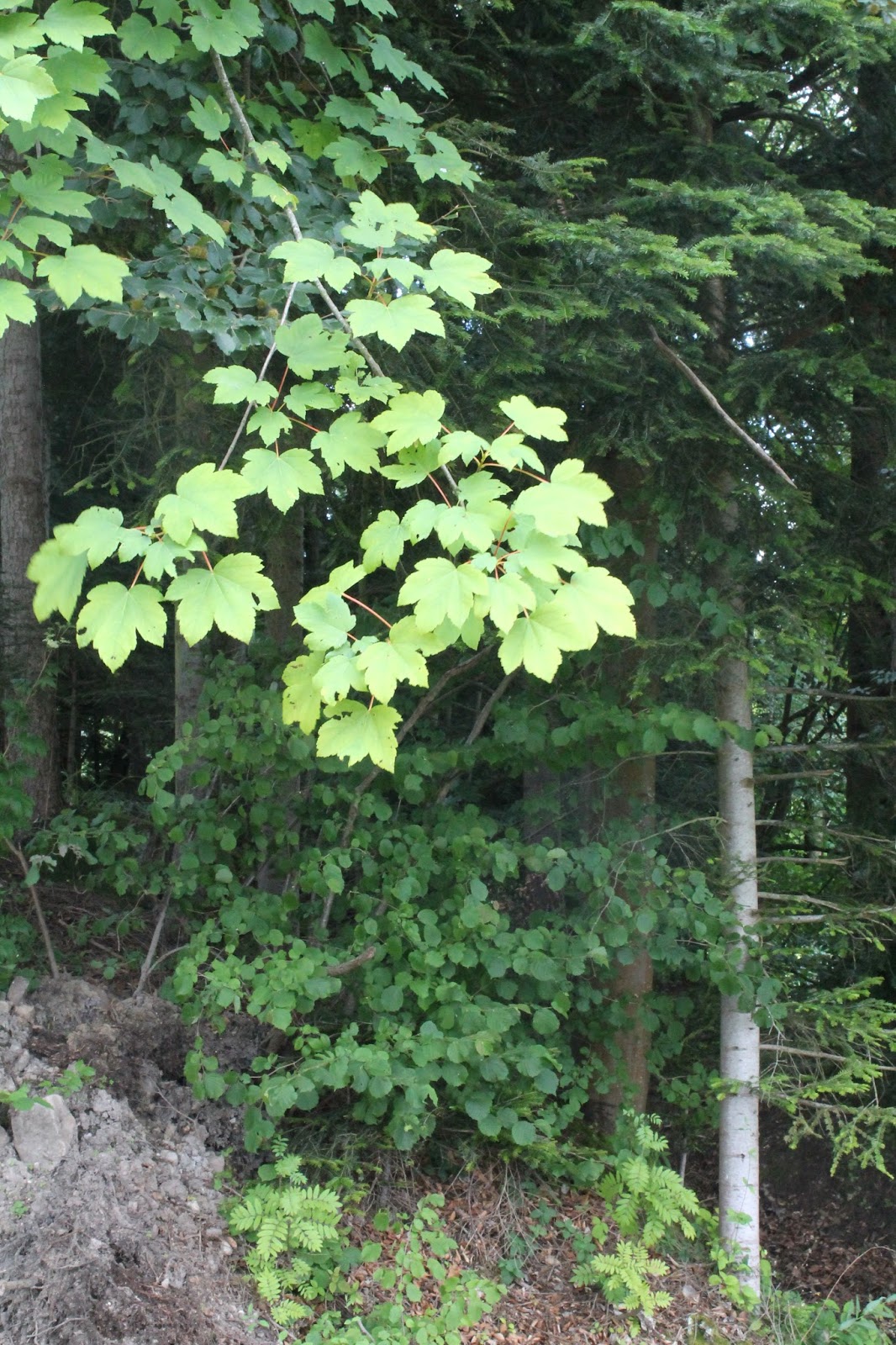
Maples: Acer campestre and A. platanoides (les erables)
Birches: Betula pendula (les bouleaux)
Oaks: principally Quercus petraea (les chênes)


European maples (probably Acer platanoides)


European birches (Betula pendula)

The same was true of the shrubs:

Dogwood (Cornus mas) (le cornouiller mâle)
Hazelnuts (Corylus avellana) (le noisetier)
Elderberry (Sambucus nigra) (les sureaux)
Mountain ash or rowan (Sorbus aucuparia) (le sorbier)


The principal reason that European forests resemble North American forests but not Southern Hemisphere forests is that the Atlantic Ocean began to separate Europe and North America only about 70 million years ago, just long enough for new species but not for new genera to evolve. In contrast, Northern and Southern Hemisphere forests have been separate for about 120 million years; not only do Southern Hemisphere forests have different species, but different genera, of trees and shrubs. Evolution is the reason that the forests of France felt both comfortably familiar and enchantingly different from those I know in North America. I was standing right in the middle of a lesson in biogeography, a field of study largely invented by Darwin’s fellow-discoverer of evolution, Alfred Russel Wallace.

Here are some other interesting biogeographical differences:


But you generally won’t see maples, birches, dogwoods, hazelnuts, or elderberries in Southern Hemisphere forests. You may see trees similar to them, but not the same genera. You will find a few oaks and elderberries in South America and Southeast Asia, and only one maple species out of 128 lives in the Southern Hemisphere.

The forests of France contain no poison ivy or poison oak (genus Toxicodendron). Both Europe and North America have nettles (les orties) but they appear to be more abundant in Europe. European nettle species (Urtica dioica and U. urens) are different from those in North America.
We also saw chestnuts, Castanea sativa. “Sativa” means cultivated. Although these trees grow in the wild, they are the source of edible chestnuts. The sprays of male flowers produce very little nectar but, according to a beekeeper in the family, bees can make it into a particularly pungent kind of honey. This rarely happens, however, since it takes hundreds of flowering trees for the bees to produce just a little bit of honey. In America, most of the native chestnuts (Castanea dentata) have died; a few of them re-sprout before they are old enough to reproduce. This is because of a fungus introduced in the early twentieth century from planted European chestnut trees. Although you can see occasional American chestnut resprouts in the northeastern United States, you will never again see chestnut forests.


Chestnuts (Castanea sativa)


Everybody loved this wonderful hike through the forest; but as a botanist, I experienced a whole extra dimension of enjoyment by seeing the cousins of my plant friends from America.