France, part 4.
On July 14, I went hiking in the Vosges Mountains of eastern
France with the Gennetay family of Strasbourg. This was easily one of the
greatest days of my life. It is always fun to take a hike with such a happy
family (the family of my son-in-law). And it is always exhilarating for a
gentleman of a certain age, myself, to be able to hike for seven hours and
survive. But in the next two essays I will describe some of the scientific and
environmental things I learned on this hike.
First, about biogeography.
The forests of France are just similar enough to those of
eastern North America to feel comfortable, but just different enough to feel
exotic.
Some of the weedy species were the same, such as yarrow (Achillea millaefolium), mullein (Verbascum thapsus), foxglove (Digitalis purpurea), and cow parsnip (Heracleum sphondylium). The bracken
fern (Pteridium aquilinum) and the
fireweed (Chamerion angustifolium)
live all over the Northern Hemisphere. And one of the tree species, widespread
at forest edges, is actually a native of North America, and was introduced to
Europe in 1601: the black locust Robinia
pseudoacacia.

Bracken fern (Pteridium aquilinum, foreground)

Foxglove (Digitalis purpurea)

Fireweed (Chamerion angustifolium)
But in most cases the forests consisted of the same general
types (genera) of trees, but different species. Examples of European trees
similar to but not the same species as those in America include the following.
I provide scientific names for the European species, and French names.
Pines: Scots pine (Pinus
sylvestris) (le pin)
Firs: Picea abies
(le sapin)
Maples: Acer campestre
and A. platanoides (les erables)
Birches: Betula
pendula (les bouleaux)
Oaks: principally Quercus
petraea (les chênes)
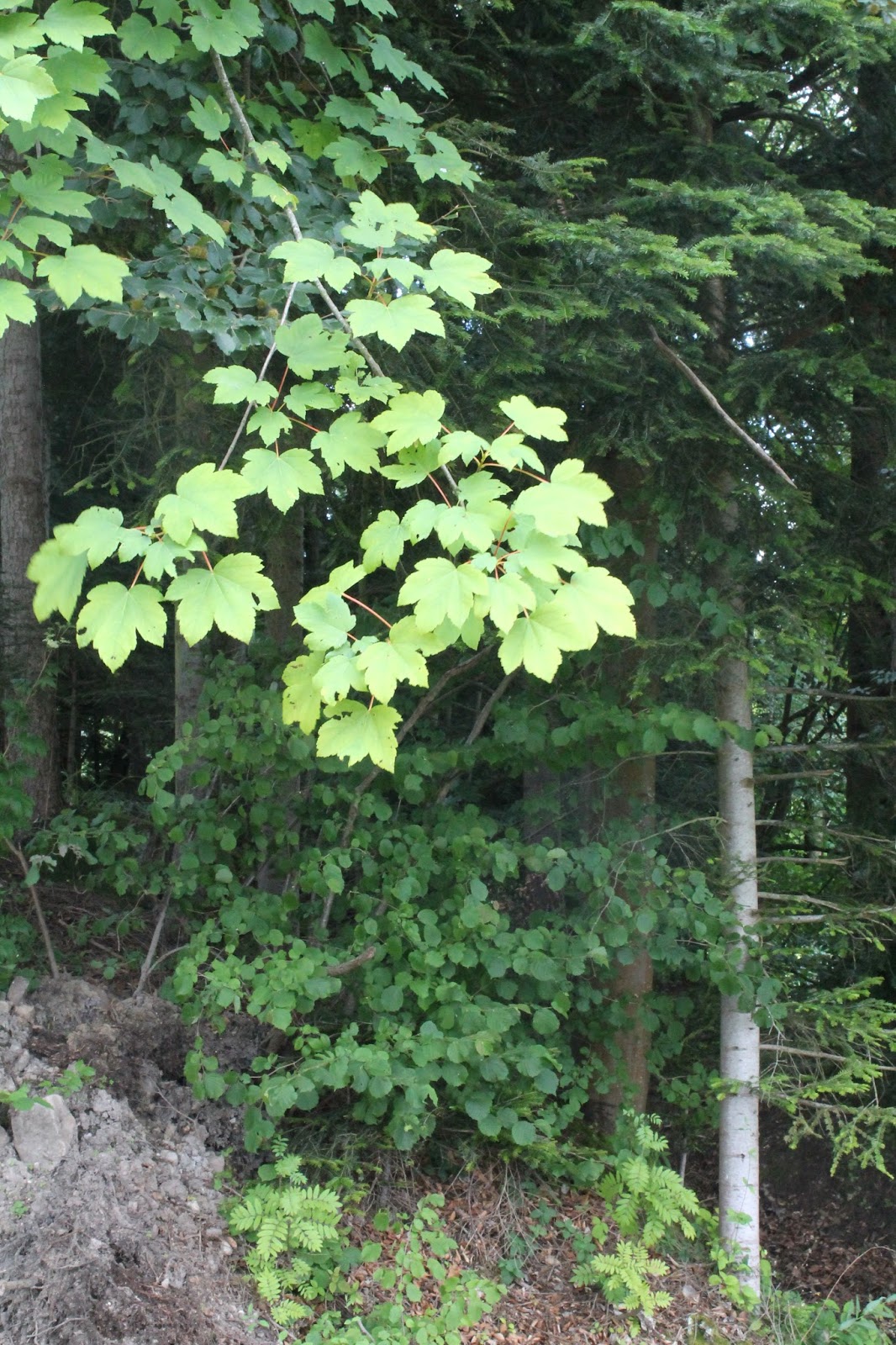

European maples (probably Acer platanoides)

European birches (Betula pendula)
The same was true of the shrubs:
Dogwood (Cornus mas)
(le cornouiller mâle)
Hazelnuts (Corylus
avellana) (le noisetier)
Elderberry (Sambucus
nigra) (les sureaux)
Mountain ash or rowan (Sorbus
aucuparia) (le sorbier)
The principal reason that European forests resemble North
American forests but not Southern Hemisphere forests is that the Atlantic Ocean
began to separate Europe and North America only about 70 million years ago,
just long enough for new species but not for new genera to evolve. In contrast,
Northern and Southern Hemisphere forests have been separate for about 120
million years; not only do Southern Hemisphere forests have different species,
but different genera, of trees and shrubs. Evolution is the reason that the
forests of France felt both comfortably familiar and enchantingly different
from those I know in North America. I was standing right in the middle of a
lesson in biogeography, a field of study largely invented by Darwin’s
fellow-discoverer of evolution, Alfred Russel Wallace.
Here are some other interesting biogeographical differences:
But you generally won’t see maples, birches, dogwoods,
hazelnuts, or elderberries in Southern Hemisphere forests. You may see trees
similar to them, but not the same genera. You will find a few oaks and
elderberries in South America and Southeast Asia, and only one maple species
out of 128 lives in the Southern Hemisphere.
The forests of France contain no poison ivy or poison oak (genus
Toxicodendron). Both Europe and North
America have nettles (les orties) but they appear to be more abundant in
Europe. European nettle species (Urtica
dioica and U. urens) are
different from those in North America.
We also saw chestnuts, Castanea
sativa. “Sativa” means cultivated. Although these trees grow in the wild,
they are the source of edible chestnuts. The sprays of male flowers produce
very little nectar but, according to a beekeeper in the family, bees can make
it into a particularly pungent kind of honey. This rarely happens, however,
since it takes hundreds of flowering trees for the bees to produce just a
little bit of honey. In America, most of the native chestnuts (Castanea dentata) have died; a few of
them re-sprout before they are old enough to reproduce. This is because of a
fungus introduced in the early twentieth century from planted European chestnut
trees. Although you can see occasional American chestnut resprouts in the
northeastern United States, you will never again see chestnut forests.

Chestnuts (Castanea sativa)
Everybody loved this wonderful hike through the forest; but
as a botanist, I experienced a whole extra dimension of enjoyment by seeing the
cousins of my plant friends from America.