Showing posts with label massacre. Show all posts

Friday, April 14, 2023

Fiction Can Make Us More Humane

One of the things that makes humans different from other animals is that we have a uniquely well developed sense of creating and appreciating art. I myself am mediocre at musical composition and art, but I consider myself a good writer. Writing, especially fiction, is an art.

But in some cases art, including fiction, seems like a waste of time that could be more profitably spent in some other way. But art makes us more humane; that is, it increases our capacity for empathy and altruism, both of them extremely important products of evolution and both of them dangerously low in the world. Almost anything we can do to increase our sense of empathy is worth the cost. If my writing helps to increase the sense of empathy in my readers, it was worth doing. Below is an example.

I have been reading recently about how white Americans have slaughtered Natives in gruesome ways, hundreds or thousands of times. This is our white national guilt. We need to face up to this part of our history, even if it makes white people uncomfortable. Here in Oklahoma, it is illegal to teach anything (such as but not limited to history) in such a way as to make anybody (that is, anybody white) feel guilty.

One famous example of a white massacre of Natives is the Sand Creek Massacre in southeastern Colorado. Colonel John Chivington attacked a peaceful party of Cheyenne Natives. A former minister, Chivington justified his massacre by saying “Nits make lice.” He hunted down women and children who fled the camp and mutilated them. His soldiers sliced open a pregnant woman. One soldier sliced the pubic hair from a Cheyenne woman, and it was on display in Denver. The next decade, in the Black Hills, whites bought Sioux scalps for up to $300 apiece. (It was as common for whites to scalp Natives as the other way around.) I will not go into more details, partly because they sicken me. You can read about it in Edward Lazarus’ monumental 1991 book, Black Hills White Justice.
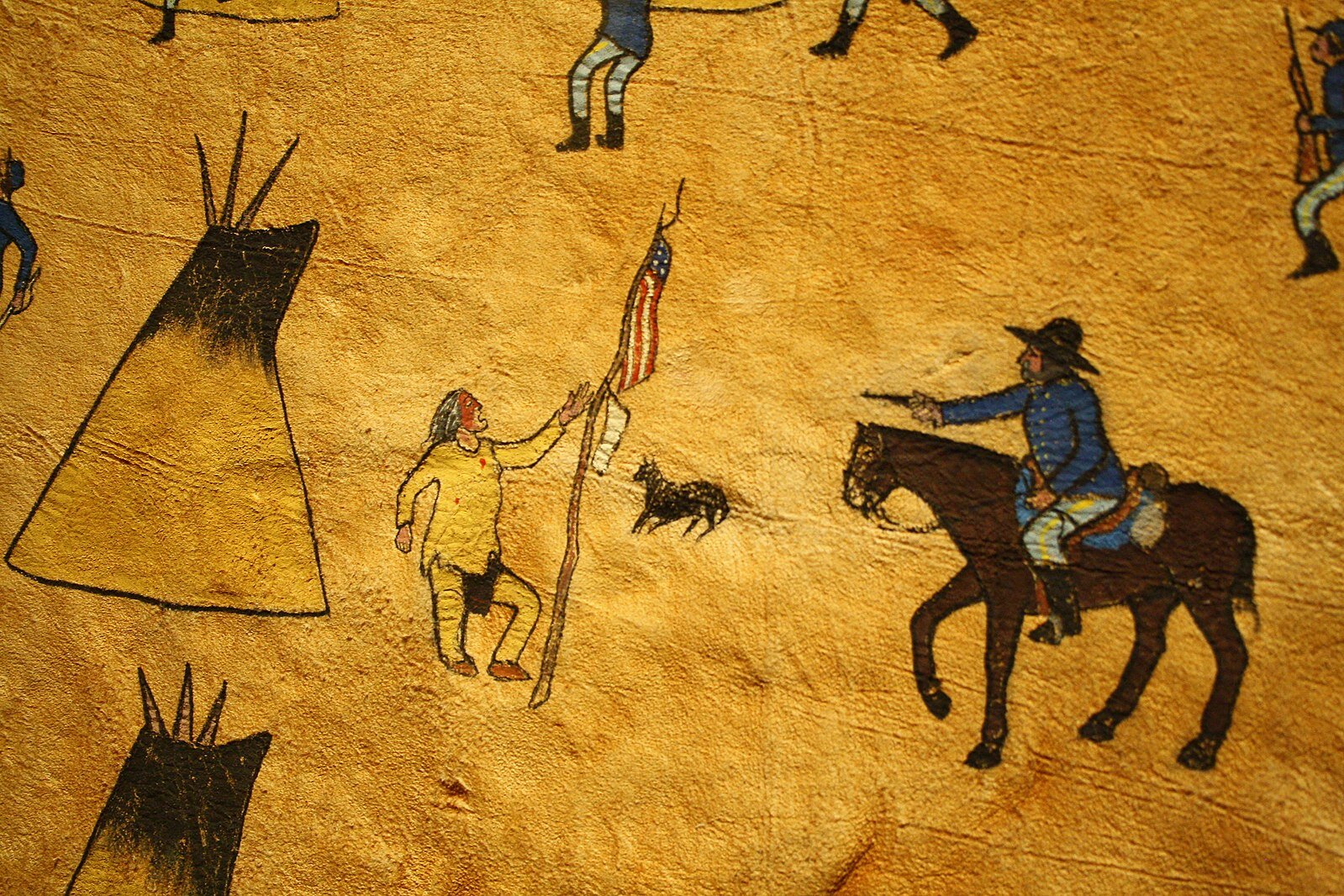
History - Sand Creek Massacre Foundation

This is what happens when powerful men are free to do whatever they please to poor and helpless people. There is no sentiment that can stop them.

At the same time, writers of stories and novels depicted Native Americans as being brave, honorable, noble, and respectful at least to people who were not killing them. An example that comes to mind, of which everyone has heard, is Last of the Mohicans. Painters such as George Catlin lived among them and painted them as real people, with real lives and relationships. While the nineteenth-century fiction about Native Americans seems racist to us today, at the time it stood out as practically the only defense of the humanity of Natives. At the time of the slaughters of Cheyenne and Sioux, “East-river” humanitarians (east of the Missouri River in Dakota Territory) called for peace with, rather than slaughter of, Natives.

Whenever the Natives struck back against the Army that gleefully massacred them, the newspapers (writing what they considered non-fiction) would loudly proclaim the Natives to be savages that deserved extermination. In particular, one editorial proposed a Final Solution for the Natives. He wrote, “It’s high time the sickly sentimentalism about humane treatment and conciliatory measures should be consigned to novel writers. There can be no permanent, lasting peace on the frontier till these devils are exterminated” (emphasis mine). You will find this on page 39 of Lazarus’ book.

This shows how important it is for us writers, especially of fiction, to reveal the humanity of all groups of humans. I mean full humanity, the bad as well as the good. People who read these novels opposed the slaughter of Natives. Without these novels, the humanitarians might have disapproved of the slaughters but would not have felt very much outrage at them. It was not just a matter of legal fairness, good government, or the proper use of human resources. These are human beings we are talking about.

This is an exact Native equivalent of the important role that Uncle Tom’s Cabin played in stirring up the national conscience against slavery.

As a writer, I consider it my responsibility to champion the full humanity and beauty of oppressed peoples.

Sunday, August 23, 2015

The Missionary

I am, at the present time, a science missionary. I teach biology at the college level in rural Oklahoma, which is the hotbed of nearly every anti-science and anti-humane belief you can think of. For example:

  • Evolution. All of my colleagues teach about evolution, but I teach the evolution course at our university. Some of my students believe that if you accept evolutionary science, or even if the Earth is old, there is no point in you even believing in God. Therefore, I am considered, by some, to be an agent of Satan.
  • Global warming. Senator Jim Inhofe cites the Bible as proving that global warming cannot be occurring. Therefore, to teach about global warming—as I do extensively—is to put oneself on the side of Satan, according to some.
  • Environment. I teach about the importance of environmental stewardship, not only to protect nature but to protect the living systems that keep billions of people on Earth alive. This runs slap counter to the fundamentalist Christian belief that Jesus is going to come back and destroy the Earth soon and therefore we should deplete it as quickly as possible.
  • Racial equality. In general biology, and in evolution, I teach about the scientific evidence for the equality of human races. Racial inequality is theoretically conceivable, but is not true. But, I now report from personal experience, there are still violent people in rural Oklahoma who believe passionately in the inferiority of non-white races, and these people have guns.


I could teach these things in some part of the world where people already believe them; I could give them evidence that they could use to see that their beliefs in evolution, global warming, environmental issues, and racial equality are fact-based, not just “politically correct.” For example, were I able to speak French, I could teach such things in France, where nearly everyone, except for the (very minority) nationalist party and (the rare) notorious Islamist extremists, everyone would agree with me. But I have chosen to be a missionary, teaching these things in an environment of hostility and, sometimes, violent hatred. We white Americans have subdued Native Americans (all 500 nations of them), demeaned blacks, and now see the trees as just obstructions to the wrecking ball of progress. And in rural Oklahoma, many people passionately believe that these were, and are still, the right things to do.

I experienced this in a direct way on Friday, August 21, 2015. I stopped at a roadside stand in Tushka, Oklahoma, that was selling Confederate flags. Despite the fact that the stars-and-bars has become an almost toxic symbol in most of the United States, it is in fact the flag of rural Oklahoma. I felt I had to tell the vendor that this symbol was offensive to even most Oklahomans. This is when he started yelling at me and telling me that Tushka, Oklahoma, was not part of the United States but was part of the Confederacy “and damn proud of it.” He bragged that his grandfather fought on the Confederate side of the civil war; I said my great-great-grandfather did also, on the Confederate side, and that I respect him but I do not need to celebrate this particular aspect of his legacy. The man further claimed that the Confederate flag was just offensive to Yankees. I informed him that my family’s roots go back six generations in Oklahoma. The very moment I began talking with him, his friend (whom he identified as a prominent citizen of Tushka) called the sheriff. The sheriff’s deputy immediately showed up and started to get out of the car and let me see his gun. He did not point it at me because by then I was already leaving—if he had pointed his gun, it would have been at my back—and I got away. Apparently he did not consider me worth pursuing, although I am sure my license plate number was recorded and, for anything I yet know to the contrary, there may still be a warrant out for me. I was unarmed and merely stopped to tell the vendor that he was offending many Oklahomans. First Amendment. I was not trying to arouse any violence (as if there was anyone present who might have joined in with me to start a riot had I done so).


I feel, though I cannot prove, that had I been black, law enforcement in that particular place would have tackled me and beat my face into the pavement. This has happened in several places, even places with much less of a Confederate presence than rural Oklahoma.

There are parts, perhaps many parts, of rural Oklahoma that are racist and where racism is supported by law enforcement. These people are a relatively small fraction of the population, but they have guns and they have religious zeal. We all know what even otherwise peaceful people can do when they are high on religion. The Crusaders raped and murdered Constantinople, even though it was (an Orthodox) Christian city; Catholics raped and killed Huguenots in the St. Bartholomew’s Day Massacre; Protestant Pilgrims burned Pequots alive; Orthodox Serbs tortured and killed Muslims in Bosnia-Herzegovina; Islamists have tortured and murdered whole Muslim villages. I don’t think we are anywhere near that point yet—I don’t expect any threats in the near future to my personal safety—in rural Oklahoma, but all the elements are there, just waiting for the spark to start the flame. I am a missionary science educator in rural Oklahoma and am aware of the risks that this entails.

I can tell you that this Confederate champion was wildly angry at someone disagreeing with him in public, someone merely saying he was wrong. He was reacting the same way that North Korea, the same week, reacted to anti-communist messages being broadcast by South Korea. In that case, shots were fired across the no-man’s-land border, and, as of this writing, war between North and South Korea has been narrowly averted. Both North Korean and modern Confederate leaders are equally violently opposed to any public criticism, and weapons are ready to hand in both cases. My position as a scientific missionary in Oklahoma is not as dangerous as would be the position of a Christian missionary in North Korea (one of them was actually arrested), but in both cases the hostility against missionaries is the same.

It is not just uneducated people who hold these beliefs. A student wrote a paper for a class taught by one of my colleagues in which the student openly stated that blacks are inferior to whites and ought to be enslaved. People who believe these things generally do not like to think for themselves, and it turns out this paper was plagiarized from a white supremacist website.


Rural Oklahoma crawls with people who are angry and delusional enough that they could, if they chose, use guns against people who disagree with them about evolution, global warming, environmental issues in general, or racial equality. So far, they have chosen to not do so. But this is their choice. I’m not sure I can trust them to keep making the same choice indefinitely into the future.