Showing posts with label empathy. Show all posts

Friday, April 14, 2023

Fiction Can Make Us More Humane

One of the things that makes humans different from other animals is that we have a uniquely well developed sense of creating and appreciating art. I myself am mediocre at musical composition and art, but I consider myself a good writer. Writing, especially fiction, is an art.

But in some cases art, including fiction, seems like a waste of time that could be more profitably spent in some other way. But art makes us more humane; that is, it increases our capacity for empathy and altruism, both of them extremely important products of evolution and both of them dangerously low in the world. Almost anything we can do to increase our sense of empathy is worth the cost. If my writing helps to increase the sense of empathy in my readers, it was worth doing. Below is an example.

I have been reading recently about how white Americans have slaughtered Natives in gruesome ways, hundreds or thousands of times. This is our white national guilt. We need to face up to this part of our history, even if it makes white people uncomfortable. Here in Oklahoma, it is illegal to teach anything (such as but not limited to history) in such a way as to make anybody (that is, anybody white) feel guilty.

One famous example of a white massacre of Natives is the Sand Creek Massacre in southeastern Colorado. Colonel John Chivington attacked a peaceful party of Cheyenne Natives. A former minister, Chivington justified his massacre by saying “Nits make lice.” He hunted down women and children who fled the camp and mutilated them. His soldiers sliced open a pregnant woman. One soldier sliced the pubic hair from a Cheyenne woman, and it was on display in Denver. The next decade, in the Black Hills, whites bought Sioux scalps for up to $300 apiece. (It was as common for whites to scalp Natives as the other way around.) I will not go into more details, partly because they sicken me. You can read about it in Edward Lazarus’ monumental 1991 book, Black Hills White Justice.
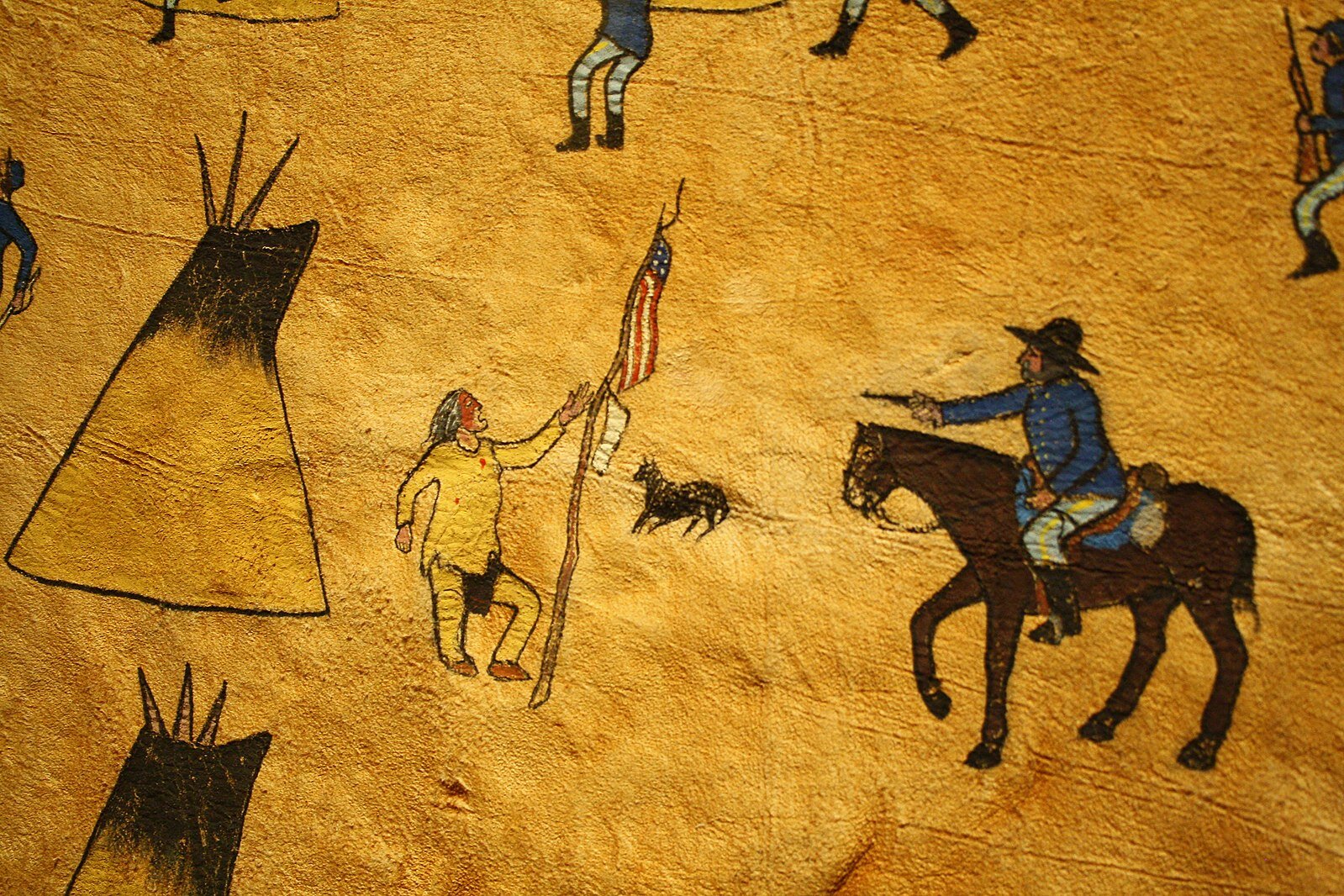
History - Sand Creek Massacre Foundation

This is what happens when powerful men are free to do whatever they please to poor and helpless people. There is no sentiment that can stop them.

At the same time, writers of stories and novels depicted Native Americans as being brave, honorable, noble, and respectful at least to people who were not killing them. An example that comes to mind, of which everyone has heard, is Last of the Mohicans. Painters such as George Catlin lived among them and painted them as real people, with real lives and relationships. While the nineteenth-century fiction about Native Americans seems racist to us today, at the time it stood out as practically the only defense of the humanity of Natives. At the time of the slaughters of Cheyenne and Sioux, “East-river” humanitarians (east of the Missouri River in Dakota Territory) called for peace with, rather than slaughter of, Natives.

Whenever the Natives struck back against the Army that gleefully massacred them, the newspapers (writing what they considered non-fiction) would loudly proclaim the Natives to be savages that deserved extermination. In particular, one editorial proposed a Final Solution for the Natives. He wrote, “It’s high time the sickly sentimentalism about humane treatment and conciliatory measures should be consigned to novel writers. There can be no permanent, lasting peace on the frontier till these devils are exterminated” (emphasis mine). You will find this on page 39 of Lazarus’ book.

This shows how important it is for us writers, especially of fiction, to reveal the humanity of all groups of humans. I mean full humanity, the bad as well as the good. People who read these novels opposed the slaughter of Natives. Without these novels, the humanitarians might have disapproved of the slaughters but would not have felt very much outrage at them. It was not just a matter of legal fairness, good government, or the proper use of human resources. These are human beings we are talking about.

This is an exact Native equivalent of the important role that Uncle Tom’s Cabin played in stirring up the national conscience against slavery.

As a writer, I consider it my responsibility to champion the full humanity and beauty of oppressed peoples.

Tuesday, May 1, 2018

Sexual Selection in Dixie

It is pretty much standard fare in the South to see guys driving big pickups around, very loudly, hoping that the girls will be impressed enough to have sex with them, and maybe give them a half dozen kids or so. I know this happens everywhere, but it is particularly common in the South.


I generally have great esteem for women: their capacity for empathy, and often their intelligence, far exceeds that of men. Boys aren’t born inferior, but as they grow up they learn, especially in the South, that empathy and intelligence make them look less manly and might interfere with their chances to impress and impregnate girls.

But sometimes women can make some stupid choices. When a guy drives a big pickup truck around and makes noise and releases a cloud of fumes thick enough that I could run my Prius on them (just the fumes), what does this prove? It only proves that they can push a gas pedal down. It does not prove that they are skillful drivers (I saw one of them get stuck in a ditch, having assumed that his truck was powerful enough to back out of it at a 45-degree slope), nor does it prove that they are rich (the truck might have been bought on credit). Some women actually fall for it. I mean, if it never worked, then guys might stop doing it; natural selection would certainly operate against it. But it works often enough that the dynamo of sexual selection keeps the Dixie stereotype going. The kids pop out and learn to behave like their parents.

Trucks, guns, beer, and sperm: the male characteristics produced by sexual selection in Dixie. The female characteristics? Telling the males how virile they are and having lots of kids. From this list, only the sperm and the kids make any sense from the evolutionary viewpoint. Sexual selection in Dixie certainly does not produce intelligence or skill which might bring wealth or reduce the burden of social problems. This is why Dixie will remain forever poor. In other cultures in America and in other cultures of the world, intelligence and cooperation are sexually desirable traits. The future belongs to those cultures, whether the progressive culture in America, or the prevailing cultures of Europe, China, and Japan.

Monday, October 23, 2017

Altruism: Don't We Wish

I recently heard an interview with Jonathan Haidt, a professor at New York University. He had some really interesting thoughts; and not just thoughts, but results of his own research. Oh how I wish I could agree with him.

Haidt’s research shows that our political convictions—in particular, being liberals vs. conservatives—is based on psychology rather than reason. Of course, liberals have always “known” this about conservatives: those conservatives are just mean people who want to oppress and victimize other people. And conservatives have always “known” this about liberals: those liberals are just immoral people who want to destroy the moral compass of society. But Haidt has shown that liberal vs. conservative biases may come from the deepest part of our brains. Conservatives have a need for order, while liberals relish diversity. This even shows up in the conservative preference for dots on a screen that move in lock-step with one another, and liberal preference for dots moving independently.

But what do we do with this information? It is here that, I fear, Haidt has gone off on a cloud of wishful thinking. If both liberals and conservatives can just recognize that their beliefs have a psychological basis, then they could start to talk and work things out. This is, as I understand it, Haidt’s gospel, as it were. He also says that our society needs both liberals and conservatives, to keep each other from going overboard.

Alas, there are two problems here.

  • Liberals are much more likely to agree with Haidt on his basic points. Conservatives will usually reject the very premise that psychology has any influence on their beliefs. They believe that they are God’s chosen and that they are as unlikely to be wrong as for God to not exist. The Holy Spirit has made them conservatives. That being the case, a true conservative will consider it unnecessary or even evil to have a meeting of minds with liberals. Haidt reached his conclusion from his liberal background; can he point to even one conservative scholar who has reached the same conclusion from his or her conservative background? Maybe he can, and if so, I’d like to hear about it.
  • Conservatives have a lot more guns piled up, ready to hand, than liberals. How can any parity of discussion be reached when one side is heavily armed and the other side virtually helpless? If you have guns, who needs dialogue?


These are two deadly asymmetries that make discussion impossible between liberals and conservatives, in general. Happily, some individual conservatives and liberals can talk, but this will not happen on a large enough scale to influence the immediate future.

Haidt gave an example of how liberals and conservatives could discuss an issue and perhaps come to a better understanding of one another. The issue: global warming. The liberals could begin a discussion by citing a military general, rather than an environmentalist, who talks about the dangers of global warming. Great idea. Only we climate scientists have already tried this. Defense Secretary Maddis has already said that global warming will cause international conflicts to which the U.S. military must pay close attention. Maddis is not just a conservative, but a hand-picked Trump follower. But the conservative global-warming denialists have either taken no notice or have been hostile toward this prominent conservative. A search of the most prominent denialist website turned up no matches with “Maddis.” The reason is, of course, that the denialists are paid by fossil fuel corporations, or individuals who have gotten rich from them, or foundations started by them.

Haidt also said that, on average, religion makes people more moral. But in order to justify this statement, Haidt had to include, in the term “morality,” those activities that bind the group together, even if it means that the group is hostile toward other groups and causes a great deal of harm to the world in general. I am sure Haidt does not mean to establish a moral equivalence between, say, the United Nations and the Nazis, but I am unclear about how he avoids this equivalence.

This problem is the very same one we encounter when we consider altruism, about which I have often written. Altruistic behavior, encouraged by empathetic feelings, enhances an individual’s evolutionary success within his or her social environment. In ancient times, the social environment was very local. Today, the environment can be the whole world. Natural and cultural selection may favor warm, fuzzy feelings within the group, but may also favor extreme hostility. This hostility can take two forms: the feeling of sweet revenge against cheaters within the group, and extreme hostility toward people outside the group, whether they are cheaters or not. It might be enlightening to think that conservatives draw the line between “us” and “them” more narrowly than do liberals. Haidt may have written about this someplace.

In a related thought, Haidt also said that, according to surveys, conservatives care more about the people around them, while liberals care more about the people of the world. And here is where I have to draw a completely different conclusion from my Oklahoma experiences than Haidt may draw from his New York experiences. The conservatives who live around me in Oklahoma seem to be hostile toward everyone except, maybe, their own families. They dump garbage in their neighbors’ yards and allow their dogs to attack anyone who is out on the street. Many of them fly Confederate flags, which displays their hostility toward even many of their immediate neighbors. And, in this reddest of red states, “Oklahoma is ranked 3rd in the nation for women killed by men in single victim-single offender homicides.” (see data here). Red states are not moral, at home, or in their communities. I wonder if the surveys that Haidt has conducted indicate more about what people like to think about themselves than what they actually do. Prominent conservatives, from Bill O’Reilly on down, proclaim Christian morality while pursuing immoral personal lives.

What I come away with, from Haidt’s statements, is that individual conservatives and liberals might try to understand one another better, after finding some personal common ground. This common ground might be something as strange as a shared adoration for the music of the 1930s country singer Jimmie Rodgers—which I share with a very conservative person I’ve not yet met but if I do I will talk to her about this rather than about politics. But on a national level? I think it is hopeless.


Haidt’s views might be appropriate for a society at equilibrium—that is, one in which liberal and conservative views can mix and respond to one another, reaching some kind of stable balance. But right now, our country is experiencing extreme disequilibrium. This is not true in every country. In France, a country about which I know a little, the conservatives and liberals disagree vividly. But the conservatives do not have stockpiles of guns in France the way they do in America. Even if American conservatives choose not to use these guns, they have the psychological advantage: we all know that they have them.

Monday, October 3, 2016

Just How Different Are Humans from Other Animals?

I want to quote some fine literature. Here is a description of a courtship scene from what sounds like Victorian gentlemen and eligible young ladies:

“Remarkable and exceedingly comical is the difference in eloquence between the eye-play of the wooing male and that of the courted female: the male…casts glowing glances straight into his loved one’s eyes, while she apparently turns her eyes in all directions other than that of her ardent suitor. In reality, of course, she is watching him all the time, and her quick glances of a fraction of a second are quite long enough to make her realize that all his antics are calculated to inspire her admiration; long enough to let ‘him’ know that ‘she’ knows. If she is genuinely not interested, and will not look at him at all, then the young…male gives up his vain efforts as quickly as…any other young fellow. To her swain, now proudly advancing in all his glory, the young…lady finally gives her assent…These movements of both partners symbolize a ritual mating invitation…Married…ladies greet their husbands in the same way…The purely sexual meaning in this ceremony…has been entirely lost and it now only serves to signify the affectionate submission of a wife to her husband…From the moment that the bride-to-be has submitted to her male, she becomes self-possessed and aggressive towards all the other members of the [group], for being, on the average, smaller and weaker than the male, she sands much lower in rank than he as long as she is single.

“The betrothed pair form a heart-felt mutual defence league, each of the partners supporting the other most loyally. This is essential, because they have to contend with the competition of older and higher standing couples…This militant love is fascinating to behold. Constantly in an attitude of maximum display, and hardly ever separated by more than a yard, the two make their way through life. They seem tremendously proud of each other, as they pace ponderously side by side…It is really touching to see how affectionate [they] are with each other. Every delicacy that the male finds is given to his bride…”

“And the most appealing part of their courtship is that their affection increases with the years instead of diminishing…even after many years, the male still [treats] his wife with the same solicitous care, and finds for her the same low tones of love, tremulous with inward emotion, that he whispered in the first spring of his betrothal…”

This beautiful passage is not from a Victorian romance, but from a 1952 essay in King Solomon’s Ring by Konrad Z. Lorenz, one of the most famous ethologists of the twentieth century. He was describing a kind of bird known as the jackdaw. They are similar to crows. Granted, Lorenz is indulging in a little anthropomorphism, but his descriptions are mostly factual and cannot be entirely imaginary. He was, after all, the greatest expert on animal behavior of his generation. He goes on to describe that the interactions of male and female birds involves behaviors and calls that are otherwise infantile—just as human lovers often call each other baby and use baby-talk with one another.

Lorenz was particularly impressed with the way the jackdaws keep up their affection for life. “You may not believe it, but there are other animals in whom—though they may live in life-long marital union—the situation is different: in whom the glowing fires of the first season of love become extinguished by cool habit; with whom the thrilling enchantment of courtship’s phrases entirely disappears as time goes on: and in whose further mutual association all activities of wedlock and family life are performed with the mechanical apathy common to other everyday practices.” He doesn’t say, but I wonder to which long-lived and supposedly monogamous animal species Lorenz may have been referring?

In the process of trying to convince ourselves that we are completely in the image of God, the lords of creation, and wild animals are not, we have had to impose a bias: that animals are stupid. Anyone who has extensively studied animals, especially birds and mammals, knows that they are very intelligent. This includes some highly religious people. But when they get to church they force their minds to believe that wild animals are so far below us that, although they do not deserve to suffer, neither do they deserve any particular dignity.

Everyone has heard about the striking humanness of the behavior of Jane Goodall’s Gombe chimps. But chimps are very similar to humans, while jackdaws are birds. According to a recent article in the Proceedings of the National Academy of Sciences, birds have small brains but these brains are densely packed with neurons, giving them more intelligence than the weight might suggest.

Chimps and bonobos have more “humane” behavior than most of us realize. This episode of a radio program gives a very fascinating and maybe disturbing example. It is about a chimpanzee named Lucy who was raised as a human and never really gave up that identity; and a bonobo named Kanzi who communicates, even with words, in some detail, and has a surprising comprehension of human emotions.

We can also go too far the other direction. I made a Darwin video in which I claimed that cats are not necessarily empathetic. When cats crawl up and purr, they might just be seeking comfort and using you as a mommy-substitute (especially when they start pumping your skin as if it was cat-breasts). Maybe they don’t really care whether you like it or not. Inevitably a few cat-lovers posted comments saying that they were absolutely certain that their cats were empathetic.


I’m not sure what the point is that I am trying to make, except that when we make religious assumptions, they can blind us to observing things that fall outside of those assumptions.

Wednesday, August 5, 2015

Is Human Nature Racist?

Human nature is not innately racist. It is human nature to feel empathy for and behave altruistically toward those in your group, but not necessarily toward those outside your group. Through most of human history, human groups were confined within human races. Kids were raised to be racists because other races were outsiders.

But when kids of different races grow up together, they do not express racial hatred unless their parents or other members of society educate them to do so. Rogers and Hammerstein said in South Pacific something like, You have to be carefully taught to hate, before you are six or seven or eight, to hate all the people your relatives hate…

One of the best places to see this is where I live in Tulsa, Oklahoma. Tulsa was the scene of one of the worst racial incidents in American history, when in 1921 white racists burned down “Black Wall Street” (see also here) which was one of the most affluent black business centers in the country. All that remains today are some metal placards in the sidewalks that indicate which black businesses were burned down. Reportedly, whites flew airplanes over the black Greenwood section of town and threw incendiary material onto the buildings. I interpret this as an act of war by white Americans against black Americans.


In the first photo, visitors from France were with us to see the placards.

And yet today you can find white and black children playing together all over town. Not quite everywhere, but certainly in my neighborhood. In the intervening 92 years, racism has been largely unlearned in Tulsa. Problems remain, of course; last year a white police officer drove to the home of a black man and shot him. It has taken a long time—interracial marriage (“miscegenation”) was illegal in some states until 1967—but the progress has been astonishing. (The miscegenation laws were aimed at blacks and whites, apparently not at GIs bringing home Asian wives.)


These and other events make me suspect that there might be, among the many and diverse elements of human nature, an anti-racist sentiment floating around. It might be simply one aspect of the emotion of love. I do not know what it is. But it came seemingly out of nowhere into the mind and heart of an eleven-year-old boy who should have, by nature and nurture, been racist. If this anti-racist element indeed exists in human nature, we should embrace it and celebrate it.

Thursday, April 10, 2014

Anti-Altruists

See below for the essays about the Oklahoma Academy of Sciences field meeting last weekend.

There are some people—the exact number is hard to determine—who care nothing for their fellow world citizens. Some of them are psychopaths, whose brains make them incapable of empathy, but psychopaths are only part of the problem. There are many others who are anti-altruists even though they may not be clinically psychopathic. One example, and I’m sure you can think of many in your own experience, is the people who left beer bottles and cans on the beach and under the trees at the state park where the Oklahoma Academy of Sciences had its meeting last weekend. They left their litter—some of it dangerous broken glass—not by accident but deliberately. They were sending a message to the rest of us. They wanted to make it perfectly clear that they hate the rest of us and the planet that we share with them.

I’m not talking about careless litterers, of which Oklahoma has a large number. A lot of people put trash in their truck beds and seem totally unaware that this trash can blow out of the truck bed and onto the road. One time, as I drove at full speed down an interstate highway, a plastic door lifted up out of a truck bed and slammed against my car. I wonder if, sometimes, Oklahoma drivers lose furniture out of the backs of their trucks (maybe a couch with Granny still sitting on it). Just yesterday someone lost a truck wheel out of the back of their truck and left it on a busy street. Instead I refer to deliberate litterers. Deliberate litterers are on a par with chimpanzees flinging their shit at people. They are worse than if they were children who never grow up.


What do we do about such people? There is nothing we can do. Laws do not stop them. They will not listen to any appeals to reason much less empathy. All we can do is to tolerate them. All we can do is to clean up after them and hope they don’t shoot us. Empathy is one of the greatest capacities that has evolved in the human species, and we must simply accept that there is a margin of losers who do not possess this most important human trait. We are accustomed to thinking of mutations such as trisomy 21 as a deleterious mutation. But Down’s syndrome people are almost always cheerful and nice. The lack of empathy, socially and perhaps genetically influenced, is a truly bad part of human variation. You may have heard about the psychologist who discovered that he was genetically psychopathic but had grown up training himself to be empathetic. We can only hope that some of the kids who have received anti-altruism in their genes and upbringing may be able to similarly overcome this curse. We continue to offer messages and examples of altruism in the hope that this may, once in a while, occur.

Tuesday, March 2, 2010

Darwin and Disenchantment

Apparently quite a number of people believe that Darwin disenchanted the world. I don’t just mean that he removed all of the supernatural spirits from it, but that he turned it into an impersonal machine. Mutations pop up, natural selection grinds along, producing cactus-machines and cat-machines and little bacterial nanomachines that kill them. It is not just creationists who say this; in fact, creationists say it very little, since to them the world was never enchanted. To creationists, the world is a mere stage for a very brief play prior to God destroying the stage and taking all the actors and actresses to heaven. Without their dogs. It is the philosophical and poetic types who worry that Darwin has removed the magic and wonder of the world.

It had not occurred to me that anyone would think this about evolution. But apparently enough people do that George Levine wrote an entire book (Darwin Loves You) to refute it.

The main answer is that, for Darwin, the natural world was full of beauty and wonder. For him, it was not a machine-like world. He loved everything about it, even the things that looked hideous to some people. A creationist could say that God made barnacles, but would hardly be able to look at one under a microscope without feeling revulsion. Darwin looked at them under a microscope for eight years, and was fascinated by them—although, toward the end, he was getting pretty tired of them as well. In his last research project, Darwin studied the beautiful life of earthworms.

Another problem is the pain and suffering that occurs in the natural world. Some philosophers have tried to deny feelings of empathy and pain in nonhuman animals. This is what Descartes did, and many scientists since his time. But it has clearly been shown that when a mouse observes another mouse in pain, it squirms empathetically—and does so more if the two mice were littermates! There is clearly pain in the natural world.

It is true that the process of natural selection depends upon pain and suffering. But this is not Darwin’s fault. The pain and suffering were there anyway and religious thinkers before Darwin had to come up with an explanation for it. And they tried to do this. First they said that God has subjected us to limitations because our characters can grow only when we cannot have everything we desire, but have to work for it. Fine. But the problem is not limitations but suffering. The problem is that people who work hard have their reward unjustly taken from them. So the religious thinkers next said that God permits suffering because it makes people stronger. What about the people who die before they have a chance to get stronger? Now, the religious thinkers pulled out their big guns. It doesn’t matter what happens here—how many innocent children are killed or enslaved, how many women raped, how many people die of diseases that could be so easily prevented—because when we all get to Heaven everything will be fine.

Darwin had a different solution. He said that the pain and suffering were not caused or prevented by any deity, but was just something that happened. It bothered him. He was a sensitive soul and did not want even an earthworm to suffer. Sort of like St. Francis of Assisi. (See my earlier entry entitled “St. Charles.”) But natural selection, as awful as it sometimes is, is the engine of evolutionary change and has produced the breathtakingly beautiful world of organisms around us.
