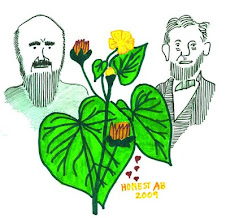
I have just about finished reading Darwin Loves You, by George Levine. I discussed this book in the previous entry (March 2). Some people worry that science disenchants the world and removes its ability to fill us with awe and wonder. Levine focuses on Darwinian evolution. But I think that evolution disenchants the world a lot less than almost any other branch of science. For example, what is love? According to Helen Fisher in Why We Love, love is several things. Initially it is erotic attraction, stimulated in both men and women by testosterone. Then it is a fixation upon one person, being in love, mediated by dopamine. It is physiologically similar to addiction (and hence I consider it funny that the neurotransmitter is called dopamine—it makes you feel like dope or like you are on dope). Finally, it is long-term satisfaction, mediated by oxytocin and vasopressin. A neurological, biochemical explanation of love—if anything can disenchant the world, it is this. But, of course, it has not. No matter how much we know about the chemistry of love or about evolution, we continue to love one another and love the critters of the Earth. We focus our attention on every detail of the person we love, and every detail of biodiversity of the Earth we love. Neither Darwin nor dopamine have changed this.
Some people think that only religion can keep the world from being merely mechanical. The only choices, they believe, are that the universe has a creator or that it is a heartless, cold machine. But my experience contradicts this. I have found that my creationist students are the ones who are the least interested in looking in the microscope, learning about organisms or about ecology—even from a creationist view. They seem to think that God is simply going to destroy the world anyhow, so it is unimportant. It is the other students—the skeptics and the ones who have a more general religious mindset—who are the most interested in, and feel the most awe for, the natural world. I have found that my creationist students are the ones who will not be quiet and listen to the world; they want to fill it with their own voices, or the noise and fumes of their big pickup trucks. Their faith in God means that the world might as well not exist; it is merely a temporary storage box for ego.
In other words, my creationist students seem to think, regarding the natural world (when they think about it at all), “It’s okay to pour oil on it, it’s okay to drive my truck on it, it’s okay to chop it down or dig it up or pave it with concrete—so long as you don’t believe that it evolved!”
Can anything be more disenchanting than this?
Showing posts with label disenchantment. Show all posts
Showing posts with label disenchantment. Show all posts
Wednesday, March 10, 2010


Tuesday, March 2, 2010
Darwin and Disenchantment
Apparently quite a number of people believe that Darwin disenchanted the world. I don’t just mean that he removed all of the supernatural spirits from it, but that he turned it into an impersonal machine. Mutations pop up, natural selection grinds along, producing cactus-machines and cat-machines and little bacterial nanomachines that kill them. It is not just creationists who say this; in fact, creationists say it very little, since to them the world was never enchanted. To creationists, the world is a mere stage for a very brief play prior to God destroying the stage and taking all the actors and actresses to heaven. Without their dogs. It is the philosophical and poetic types who worry that Darwin has removed the magic and wonder of the world.
It had not occurred to me that anyone would think this about evolution. But apparently enough people do that George Levine wrote an entire book (Darwin Loves You) to refute it.
The main answer is that, for Darwin, the natural world was full of beauty and wonder. For him, it was not a machine-like world. He loved everything about it, even the things that looked hideous to some people. A creationist could say that God made barnacles, but would hardly be able to look at one under a microscope without feeling revulsion. Darwin looked at them under a microscope for eight years, and was fascinated by them—although, toward the end, he was getting pretty tired of them as well. In his last research project, Darwin studied the beautiful life of earthworms.
Another problem is the pain and suffering that occurs in the natural world. Some philosophers have tried to deny feelings of empathy and pain in nonhuman animals. This is what Descartes did, and many scientists since his time. But it has clearly been shown that when a mouse observes another mouse in pain, it squirms empathetically—and does so more if the two mice were littermates! There is clearly pain in the natural world.
It is true that the process of natural selection depends upon pain and suffering. But this is not Darwin’s fault. The pain and suffering were there anyway and religious thinkers before Darwin had to come up with an explanation for it. And they tried to do this. First they said that God has subjected us to limitations because our characters can grow only when we cannot have everything we desire, but have to work for it. Fine. But the problem is not limitations but suffering. The problem is that people who work hard have their reward unjustly taken from them. So the religious thinkers next said that God permits suffering because it makes people stronger. What about the people who die before they have a chance to get stronger? Now, the religious thinkers pulled out their big guns. It doesn’t matter what happens here—how many innocent children are killed or enslaved, how many women raped, how many people die of diseases that could be so easily prevented—because when we all get to Heaven everything will be fine.
Darwin had a different solution. He said that the pain and suffering were not caused or prevented by any deity, but was just something that happened. It bothered him. He was a sensitive soul and did not want even an earthworm to suffer. Sort of like St. Francis of Assisi. (See my earlier entry entitled “St. Charles.”) But natural selection, as awful as it sometimes is, is the engine of evolutionary change and has produced the breathtakingly beautiful world of organisms around us.
Subscribe to:
Posts (Atom)