Showing posts with label statistics. Show all posts

Sunday, June 7, 2026

More Evidence, As If We Needed It, of Global Warming, part four

I conducted a sixteen-year study of budburst dates in Oklahoma deciduous trees, and I found that winter buds opened in spring earlier and earlier each year, consistent with global warming. The results were highly significant. I did not, however, have time to publish this study in a scientific journal before I retired. I decided instead to publish it on my website. Here is the link to the article, with illustrations. Please note that the mailing address on the cover page is now obsolete; you may contact me through the website email link (stanriceauthor@gmail.com).

I here address an interesting point about this research, aside from its unsurprising conclusion. And that point is, what do we do with the data?


(This is a photo of the just-opening buds of black hickory. Oaks have lots of bud scales, but hickory just has two big scales for each bud.) 

My statistical analyses indicated quite clearly that all but one of the 22 tree species had earlier budburst over the course of 16 years—an average of about one day earlier each year. But this is an average. Budburst came later in silver maples—but this is because they died in the summer droughts. Pecan trees opened their buds about one day earlier each ten years, whereas sweetgums opened their buds about three and a half days earlier each year. This means the makeup of our forests might change with global warming, since not all tree species will react to it the same way.

Also, it is completely incorrect to assume that global warming means that each year is warmer than the previous year. One year can differ strikingly from the next. What we are looking for is an overall trend. This is obvious from the data presented in my graphs in the paper.

Science must also avoid what is called extrapolation. We cannot simply take this one-day-per-year rate and extend it into the past or the future. Particularly, the future. If, for example, sweetgums opened their buds three and a half days earlier each year (with the average date in my study being February 24 in 2009), this would mean that in 2029 they would open in the middle of winter, about December 19, and back in 1999 they would have opened at the end of March. I was on site in 1999, though I’d not yet begun my measurements. But I know they opened before the end of March. And they cannot open their buds in December unless winter completely vanishes. This is unlikely to happen. At least, not soon.

What this means is that one-day-per-year earlier budburst is what I observed in the study period, but there were earlier times, and may be later times, when this rate did not occur. Extrapolation is invalid, as Mark Twain explained. If the Mississippi River gets 10 miles shorter each year, then at some point, Twain quipped, St. Louis and New Orleans would be next to each other and need a joint board of aldermen. If it gets 10 miles longer each year, then in a few years it would stick out over the Gulf of Mexico (Gulf of America?) like a fishing rod.

Scientists should not extrapolate beyond their data. We can interpolate, within the range of data, but not extrapolate outside of it. All I can say is, this is what happened during my sixteen-year study period. As you can see from the figures in the paper, budburst dates sometimes came earlier (especially 2017) and sometimes later (for example, 2018). It changes every year, but these changes are against a background of earlier budburst, as indicated by the statistical analyses.

Yes, sixteen years in which at least twice a week, during February and March, I walked past each tree and looked for budburst. It sounds like a lot of boring work. But it was not, for me: I came to know each of these trees as an individual, and I looked forward every year to its emergence from dormancy.

As indicated in these four essays, the science of global warming is not just something to argue about—and we are all tired of arguing—but an invitation to the adventure of scientific discovery. We can, by using science, listen to what the trees have been telling us all along.

Friday, May 5, 2023

What I Learned from Robert Ripley

Do you remember the cartoonist Robert Ripley, who ran a series called Believe It Or Not! in newspapers across the country (and probably the world)? He proclaimed random amazing facts (amazing to him, at least) accompanied by his very realistic drawings. Do you remember? If you are younger than me, as you probably are, you don’t. Anyway. I ended up with six paperback books with his cartoons. It is impossible for me to summarize these random pieces of information, but I can see some overall themes. In particular, Ripley’s cartoons give us a glimpse into how our brains work: how we gather information about the world and draw conclusions from it, a topic about which I wrote an entire book, Scientifically Thinking.

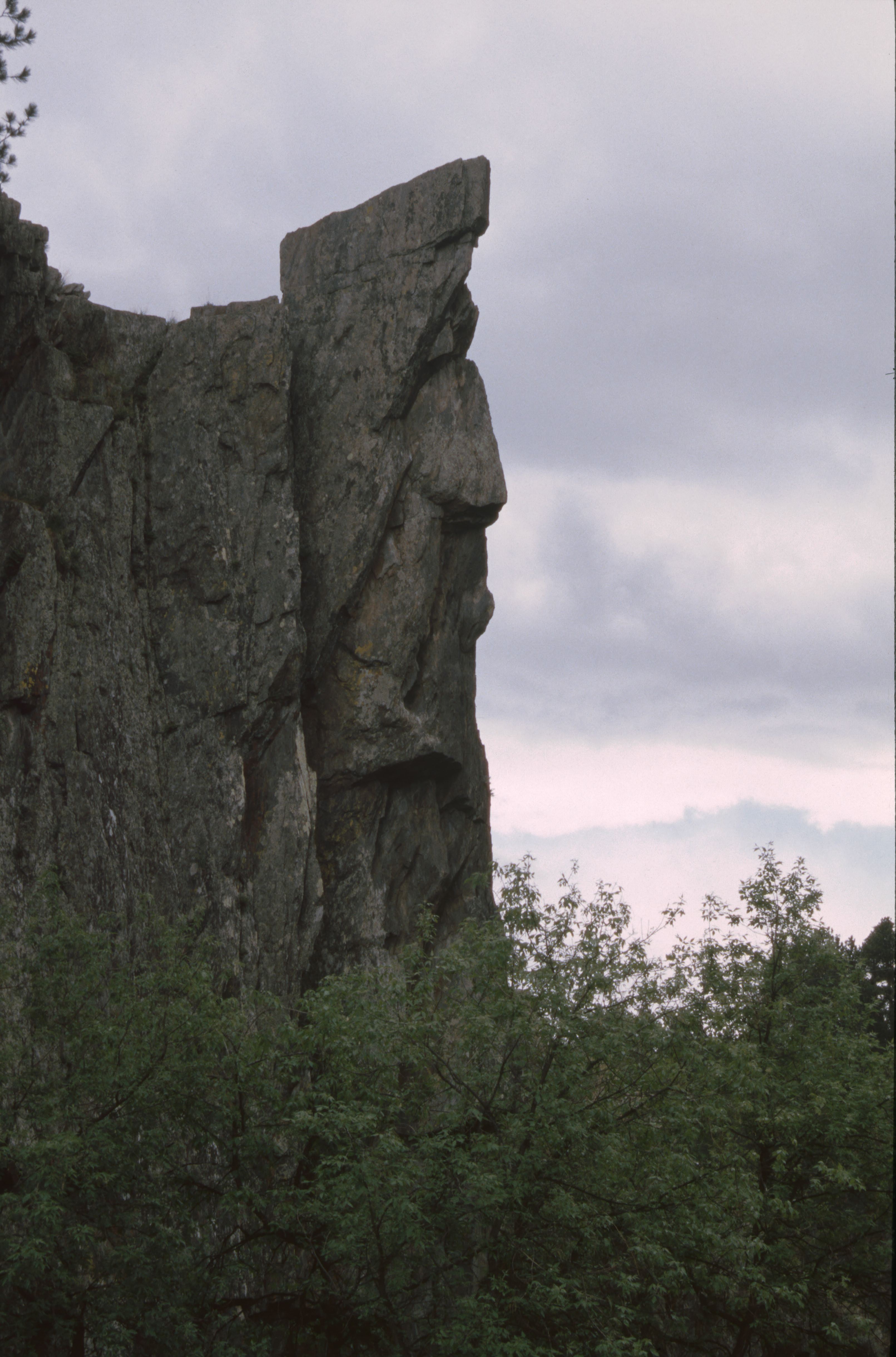
Many of the items in Ripley’s cartoons were completely subjective to the imagination of the observer. This is a trick our brains play on us. For example, a dog had the shape of a three-leaved clover on its back. Of all the dogs in the world, with splotches of color on their coats, it is nearly inevitable that you will find one splotch that looks, to you, like a cloverleaf. Another example was the Canadian map which, when held upside down, looks like a profile of the explorer Jacques Cartier. How close does the resemblance need to be? It depends on how credulous you are. Lots of rock formations looked like lots of different things, the most famous of which was the Great Stone Face in New England. (It recently collapsed.) The list is long, but I could add one more. Along a state highway to the west of Rapid City, South Dakota, there is a cliff that looks like a caricatured face.


It would be a waste of time to read a book that consisted of nothing except such random coincidences of appearance. Fortunately, Ripley’s work consisted of a lot more than this.

Many of the facts Ripley cited were statistical anomalies, things that are almost but not quite impossible. Any one of them is almost impossible, but collectively, there are lots of statistical anomalies happening all around us. He noted that on one day in 1950 there were 78 babies born in Washington, D.C., and they were all female. The odds against this happening are one in two to the 78th power. Enough to make you say gee-whiz but not enough to change your view of the world. What about all the other days and all the other places?

Some of these statistical improbabilities involved human birth defects. Like the man who had two irises in each eyeball, and another who had three tongues, another who had two hearts, and a woman whose breasts were on her back. One man had mirror-image organs inside his body. Ripley’s major example was a child who had a single eye, in the middle of her forehead. This is known as a cyclops mutation. These bits of information are rather creepy, since they show us how the genetic health we take for granted can be so easily disrupted by a little mutation, or a mistake during fetal development.

Some of the examples Ripley cited were things that were only surprising to him but not to anyone else. He reported tree seedlings growing out of gutters on houses. This always happens unless you don’t have trees, or don’t have gutters. He was also amazed that violets would bloom in October.

Other examples were of almost unbelievable human cruelty or stupidity or just strangeness. For example, there was a man who locked his wife inside their house every day for 52 years. There was a Japanese priest who said “Butsu” (their word for Buddha) sixty thousand times every day for thirty years. Voltaire, who could never be accused of being ordinary, drank up to 72 cups of coffee a day. Hawthorne’s story “The Minister’s Black Veil” was apparently based on a real event. Juliette Drouet wrote Victor Hugo twenty thousand love letters.

Some of the supposed facts must have been based on misinformation. A 160-year-old man who fathered a child? When he died, his oldest son was 106, his youngest 3. There are no verified accounts of people living, certainly of being virile, this long. He also said goatsucker birds actually sucked goats.

I will always remember, from the first time I read them until now, some really amazing stories. For example, a Zulu king ordered thousands of his soldiers to march into the sea and drown, just to prove how much power he had over them. Then there is the story of Grimaldi the clown, which I write about briefly in the next essay, which I will post soon.

Life throws at us lots of disconnected bits of information. Our minds seek, or should seek, some generalities in them, for example, that happiness is found in creating a good life, not in power or possessions; and that there is almost no limit to human cruelty.