Showing posts with label spring. Show all posts

Sunday, June 7, 2026

More Evidence, As If We Needed It, of Global Warming, part four

I conducted a sixteen-year study of budburst dates in Oklahoma deciduous trees, and I found that winter buds opened in spring earlier and earlier each year, consistent with global warming. The results were highly significant. I did not, however, have time to publish this study in a scientific journal before I retired. I decided instead to publish it on my website. Here is the link to the article, with illustrations. Please note that the mailing address on the cover page is now obsolete; you may contact me through the website email link (stanriceauthor@gmail.com).

I here address an interesting point about this research, aside from its unsurprising conclusion. And that point is, what do we do with the data?


(This is a photo of the just-opening buds of black hickory. Oaks have lots of bud scales, but hickory just has two big scales for each bud.) 

My statistical analyses indicated quite clearly that all but one of the 22 tree species had earlier budburst over the course of 16 years—an average of about one day earlier each year. But this is an average. Budburst came later in silver maples—but this is because they died in the summer droughts. Pecan trees opened their buds about one day earlier each ten years, whereas sweetgums opened their buds about three and a half days earlier each year. This means the makeup of our forests might change with global warming, since not all tree species will react to it the same way.

Also, it is completely incorrect to assume that global warming means that each year is warmer than the previous year. One year can differ strikingly from the next. What we are looking for is an overall trend. This is obvious from the data presented in my graphs in the paper.

Science must also avoid what is called extrapolation. We cannot simply take this one-day-per-year rate and extend it into the past or the future. Particularly, the future. If, for example, sweetgums opened their buds three and a half days earlier each year (with the average date in my study being February 24 in 2009), this would mean that in 2029 they would open in the middle of winter, about December 19, and back in 1999 they would have opened at the end of March. I was on site in 1999, though I’d not yet begun my measurements. But I know they opened before the end of March. And they cannot open their buds in December unless winter completely vanishes. This is unlikely to happen. At least, not soon.

What this means is that one-day-per-year earlier budburst is what I observed in the study period, but there were earlier times, and may be later times, when this rate did not occur. Extrapolation is invalid, as Mark Twain explained. If the Mississippi River gets 10 miles shorter each year, then at some point, Twain quipped, St. Louis and New Orleans would be next to each other and need a joint board of aldermen. If it gets 10 miles longer each year, then in a few years it would stick out over the Gulf of Mexico (Gulf of America?) like a fishing rod.

Scientists should not extrapolate beyond their data. We can interpolate, within the range of data, but not extrapolate outside of it. All I can say is, this is what happened during my sixteen-year study period. As you can see from the figures in the paper, budburst dates sometimes came earlier (especially 2017) and sometimes later (for example, 2018). It changes every year, but these changes are against a background of earlier budburst, as indicated by the statistical analyses.

Yes, sixteen years in which at least twice a week, during February and March, I walked past each tree and looked for budburst. It sounds like a lot of boring work. But it was not, for me: I came to know each of these trees as an individual, and I looked forward every year to its emergence from dormancy.

As indicated in these four essays, the science of global warming is not just something to argue about—and we are all tired of arguing—but an invitation to the adventure of scientific discovery. We can, by using science, listen to what the trees have been telling us all along.

Tuesday, May 2, 2023

Keep Walking and Keep Your Eyes Open

Today I took a hike on the nearby “mountain” in the fulness of spring. Most of the flowers have finished blooming, but there are millions of fresh green leaves. Over several years, I have seen about 45 species of plants that are common and easily visible this time of year. That is, if I walked everywhere on the mountain today and looked closely, I would have seen about 45 plant species. This does not count down by the river, etc.


But I discovered that, when I stopped and stood in place, and looked for all the plant species I could find, I could see only about nine species (9.2 species, averaged over 10 places). My path took me briefly into an open field, where I was also able to see only 9 plant species from any one location.

The lesson is very simple. You will not be able to see everything from one viewpoint. When I stood still I could see only about one-fifth of the plant species. You have to keep walking and looking in order to see the great majority of plant species. Just one glance will not do it. I try to be observant all the time wherever I go.

It is a happy way to live.

Saturday, April 17, 2021

New Video: Darwin Eats Tree Leaves

In this video, Darwin jumps around in springtime exuberance and eats leaves of a water oak (Quercus nigra). He was inspired to do this by seeing a French video in which a naturalist ran around in the French woodlands and ate young leaves. He smiled really big and talked about how good they were, including oaks, willows, poplars, beeches, etc.

But the French videographer warned his viewers that they should do this only with very young leaves. Older leaves in European forests are full of toxic compounds which, although they will not kill you, at least taste bad. The leaves manufacture these compounds (for example tannins) to discourage animals, especially caterpillars, from eating them.

But it can be expensive for a leaf to defend itself. Every molecule of defensive chemical that the leaf makes has a construction cost in energy and raw materials. These costs could be used to make more leaf area, which is an investment in photosynthesis that will bring in more energy and raw materials. The ideal amount of defense spending for a leaf (or a nation) is zero, but this is not possible in a dangerous world. Therefore, leaves, like nations, economize their defense spending. Leaves make defensive chemicals only when they are needed.

Ever since the work of Paul Feeney fifty years ago, scientists have understood that, in European forests, many herbivorous insects die during the cold winters. Their populations build back up during the warm, wet summers. The forest trees, such as the oaks studied by Feeney, economize their defense spending by producing very few defensive compounds in the spring, then more and more as the summer goes on. In the early spring, therefore, the forest is almost like a big salad bowl, especially for the Frenchman I mentioned earlier. In the video, Darwin decides to eat a young water oak leaf in Oklahoma.

Darwin got a surprise. The leaf was bitter. Then he understood why. In Oklahoma, the winters are not very cold (February 2021 being a significant exception) and many insects can find little crevices to hide in. In Oklahoma in the spring, unlike in Europe, the insects can come out in full force. The young leaves are ready for them, having defended themselves with chemicals. Many of the insects die during the long, hot, dry summers in Oklahoma; that is, their populations die back in the summer, not so much in the winter.

This raises the possibility that tannin concentrations in Oklahoma oaks are high in the spring and lower in the summer. Of course, once the leaf produces tannins, why not just keep them all summer? But it is possible that the tannins can be degraded and the molecules used for something else. I tried to measure this in post oaks (Q. stellata), only to discover that I am not a very good chemist and failed to measure the tannin levels correctly.

I did try a different, creative approach to determining whether the early season oak leaves were more toxic than the late season leaves. I ground up leaves in liquid nitrogen and mixed them up into hornworm chow. You read that correctly. Hornworm chow. It turns out you can buy hornworm eggsand caterpillars, and even chow and growth vials, from Carolina Biological Supply. Wild hornworms usually eat tomato leaves, but these caterpillars eat chow, and, apparently, almost anything you mix into it, like leaf powder. The hornworms grew best on the chow. But they grew bigger and faster when they ate late-season oak leaf powder than early-season powder.

So my advice to Darwin is, if you want to eat tree leaves in the spring, go to Europe.

Saturday, March 21, 2020

Springtime Secrets (Something to Do During the Pandemic)


I am posting this from the midst of the coronavirus pandemic in America. Many of us are down two only two major activities: working online, and taking walks. Like most universities and colleges, the one where I work is closed the rest of the spring semester, and students will complete their classes online. My wife and I take walks out away from other people, and watch all the wonders of nature, even when it is despoiled by human activity. This is what we have always done, but for some people, taking a nature walk might be a new activity. If you are one of those people, let me tell you some of the things you might notice.

Spring has been underway for some time in Oklahoma, where I live and work. But it has only recently been making itself obvious. Spring comes, but not all at once. The first thing to notice as you take your walk is that not all the trees open their buds at the same time. The elms opened their buds over a month ago, and they are now fully displaying their green seeds. Whole forests of elms are blushing a light green right now. This color is due to seeds, not leaves, which are only now beginning to emerge from their own buds.


Meanwhile, other tree species appear to still be dormant. In the photo below, the elms are green but the Kentucky coffee-tree (identifiable by its big seed pods) is still dormant.


Notice, then, that each kind of tree follows its own spring schedule.

The trees also display diversity within each species. The photo below shows two cottonwood trees. One is in full bloom (on the right, with clusters of little reddish flowers), the other is not. In this case, the tree in full bloom is a male tree, while the other one is female. Its greenish flowers will open up a little bit later. Just as male birds migrate before female birds, the male cottonwoods open their buds before the female cottonwoods. In trees, as in animals, the males compete with one another for access to the females even when, as in cottonwoods, it is completely without intelligence.


This is also the time of year that birds begin their social activities. In Oklahoma, mockingbirds and cardinals are already singing.

The final thing to notice is the garbage. Before the leaves open and the grass grows, thousands of pieces of garbage are visible all around the “natural” areas of Tulsa. (We have counted some of them; I do not exaggerate.) March is the best time of the year to see one of the ugly impacts that humans have upon the natural world.

Take a walk. It doesn’t cost anything, and it doesn’t expose you to viruses. You don’t need to download a movie. The natural world around you has plenty to see.


Friday, October 26, 2018

What's Up with the Stupid Magnolias?


What’s Up with the Stupid Magnolias?

In late September, I saw several magnolia trees blooming in Durant, Oklahoma. Magnolias are supposed to bloom in late spring! What’s up with that?

The reason the magnolias bloomed is because they are stupid. Plants are stupid. I say this even though I am a botanist and have devoted my life to studying them. These magnolias, you see, have no idea what time of year it is. They don’t know the difference between May and September.

Yet, they have to bloom at the right time of year, don’t they? Of course they do. They have to bloom at the time that their pollinators are expecting them to bloom, so that the huge white flowers and sultry lemon scent will not be wasted.

But intelligence is expensive. Brains are expensive. Your brain uses twenty percent of your body’s metabolic energy and oxygen. My granddaughter Léna’s brain uses half of her energy and oxygen. That doesn’t make her smarter than you, but it does mean her brain is rapidly growing. Plants simply cannot afford to make brains. For the last billion years, plants and their evolutionary ancestors have relied on more direct stimuli from the environment to tell them when to do things such as reproduce.

To a plant, there is no difference between cold and drought. They do not have temperature sensors. To them, it is cold when the water freezes, and when the water freezes, it diffuses out of the cells and into intercellular spaces, where the ice crystals cannot harm the cell. That is, when it freezes, plant cells become drier. In spring the ice melts and the water diffuses back into the cells.


This summer in Oklahoma had some long periods of hot dry conditions. They were not record-setting, but they were pretty brutal. Then, in late summer and early fall, it rained a lot, and kept raining. Therefore, during mid-summer, the plant cells dried out, and in late summer, they became moist. For anything that the plant knew to the contrary, the summer drought was winter, and the fall rains were spring.

Plant responses to seasons are not the most intelligent ones, but they are economical. Every few years, the magnolia trees waste a few flowers by blooming in the fall; in the ensuing winter, they cannot develop their fruits. But any magnolia would tell you that its way of adjusting to the seasons doesn’t cost as much as your brain does, thank you very much.

Monday, April 3, 2017

Springtime in Oklahoma, or, Will Molly Eat It?

There were plenty of visitors to Robber’s Cave State Park on April 1. This is not one of the state parks that the Oklahoma government, in its desperation to cut everything except oil corporation subsidies and the budgets of the legislature and governor, plans to close. Just a few of the visitors came for the Spring Field Meeting of the Oklahoma Academy of Sciences. Few, but appreciative.

We (faculty and students) were surrounded by nature. Oh, wait, not quite. The forests were mostly shortleaf pine (Pinus echinata) and post oak (Quercus stellata). But the shortleaf pines have nearly all, at least in this part of the state, hybridized with loblolly pines, which have been planted for lumber and pulp production. And every bit of the forest has been affected by human impact, including fire suppression. But it was a nice spring day and we were seeing things that were almost natural. The oaks were just opening their catkins and unfurling a few baby leaves. Post oaks dominate the poor, dry soils of these mountains.

Gloria Caddell, at the University of Central Oklahoma, led the botany field trips.


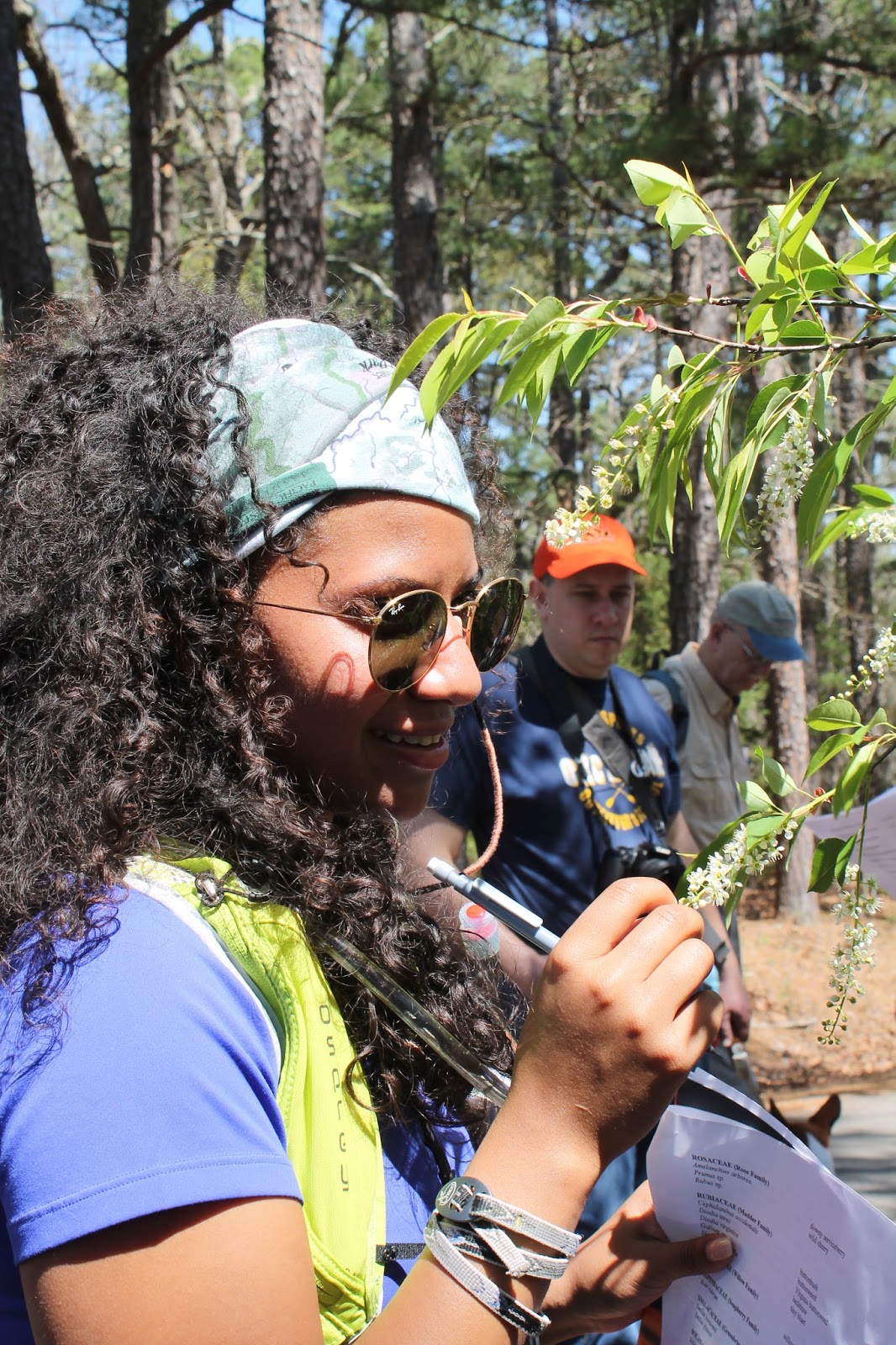
We didn’t even get out of the parking lot before we found plants that were interesting in more than one way. Gloria explained how to distinguish the three species of violets and how to distinguish poison ivy from fragrant sumac. But I explained that you could eat violets. I convinced Molly, a student from my university (Southeastern Oklahoma State University), to try one. After she was finished looking at a black cherry in bloom, I convinced her to eat some fading redbud flowers too. Last of all, I got her to eat some greenbriar buds.


We explored different habitats within the park. Closer to the creek, we found red maple, bur oak, and black oak. At the edge of the water we saw a birch tree with its male and female catkins. The male catkins dangle from the branch behind the female flowers. This arrangement improves the chances that the pollen that comes to the female flowers is from a different tree rather than the same one. We also saw several wildflower species, some spectacular like the plains wild indigo, Baptisia bracteata.

Baptisia is one of the leguminous plants that produce nitrogen-fixing nodules, as mycologist Steve Marek explained. It is always good to have people from different areas of study together on the same field trip.


And, as always, leave it to Gloria to open our eyes to see the tremendous biodiversity of a trampled lawn in a picnic area. As future high school teacher Lainee Sanders discovered, there was not one but two species of buttercups in the picnic area. (The dog appeared to not care about the flowers.)


There were some high school teachers on the trip. Melissa Bates brought high school students from Oklahoma City. They looked closely at little Antennaria flower clusters, perhaps never having realized that there were boy antennarias and girl antennarias growing together.


You never know where you are going to find moss growing. We found some growing on an old glove, sporophytes and all!


Chad King, a botanist at University of Central Oklahoma, gave an evening presentation about dendrochronology. Tree rings are a storehouse of information about all the tree’s experiences, therefore about things such as climate and fire history. He displayed one of his specimens, a very old tree that had had an eventful life.


Almost everything we saw was something that could so easily have been overlooked if we had been hiking fast or jogging. We need these times of slowing down, looking closely, even nibbling, under the guidance of those among us who know a lot about hidden biodiversity.