Showing posts with label Oklahoma Academy of Science. Show all posts

Monday, April 3, 2017

Springtime in Oklahoma, or, Will Molly Eat It?

There were plenty of visitors to Robber’s Cave State Park on April 1. This is not one of the state parks that the Oklahoma government, in its desperation to cut everything except oil corporation subsidies and the budgets of the legislature and governor, plans to close. Just a few of the visitors came for the Spring Field Meeting of the Oklahoma Academy of Sciences. Few, but appreciative.

We (faculty and students) were surrounded by nature. Oh, wait, not quite. The forests were mostly shortleaf pine (Pinus echinata) and post oak (Quercus stellata). But the shortleaf pines have nearly all, at least in this part of the state, hybridized with loblolly pines, which have been planted for lumber and pulp production. And every bit of the forest has been affected by human impact, including fire suppression. But it was a nice spring day and we were seeing things that were almost natural. The oaks were just opening their catkins and unfurling a few baby leaves. Post oaks dominate the poor, dry soils of these mountains.

Gloria Caddell, at the University of Central Oklahoma, led the botany field trips.


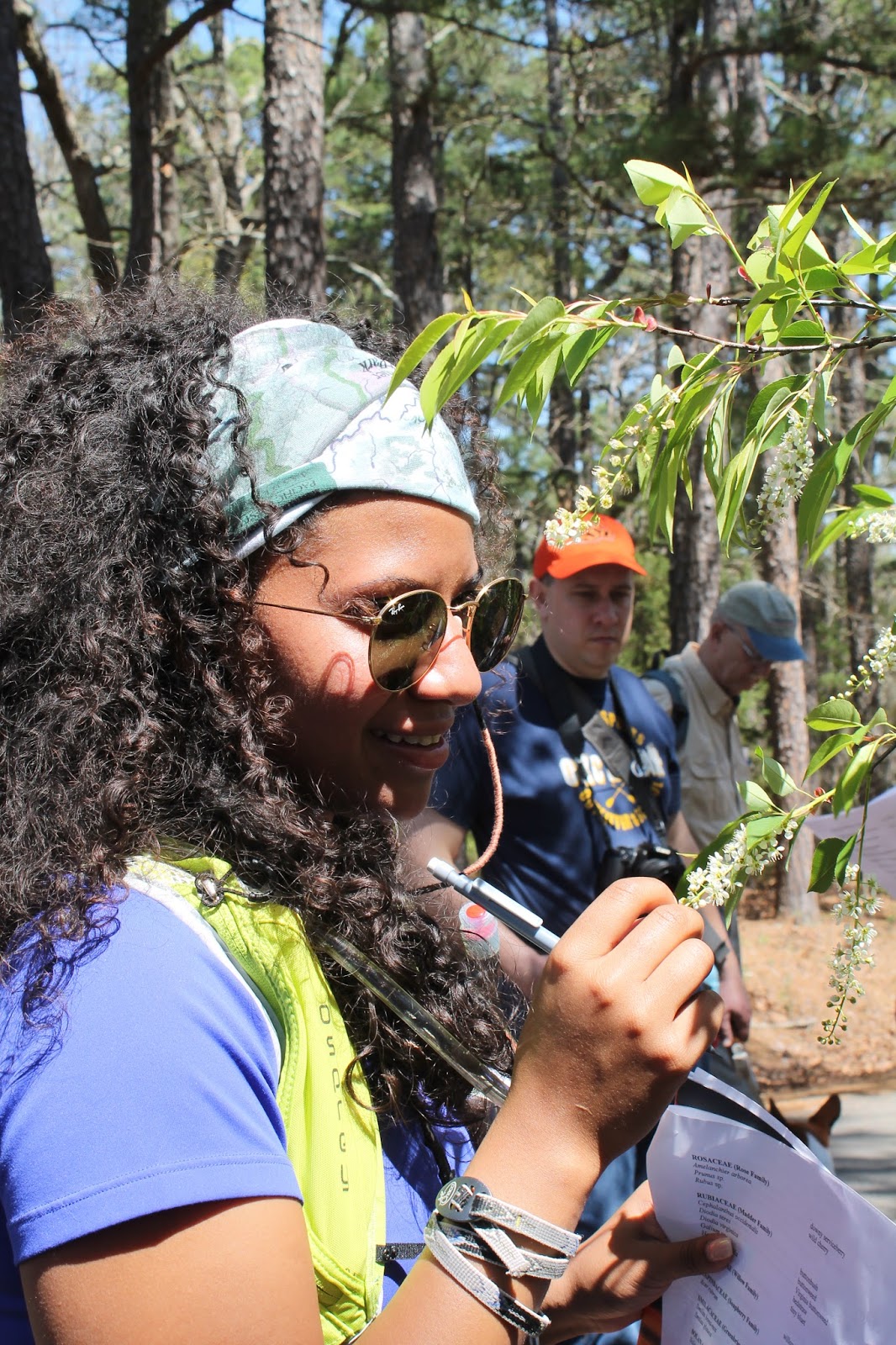
We didn’t even get out of the parking lot before we found plants that were interesting in more than one way. Gloria explained how to distinguish the three species of violets and how to distinguish poison ivy from fragrant sumac. But I explained that you could eat violets. I convinced Molly, a student from my university (Southeastern Oklahoma State University), to try one. After she was finished looking at a black cherry in bloom, I convinced her to eat some fading redbud flowers too. Last of all, I got her to eat some greenbriar buds.


We explored different habitats within the park. Closer to the creek, we found red maple, bur oak, and black oak. At the edge of the water we saw a birch tree with its male and female catkins. The male catkins dangle from the branch behind the female flowers. This arrangement improves the chances that the pollen that comes to the female flowers is from a different tree rather than the same one. We also saw several wildflower species, some spectacular like the plains wild indigo, Baptisia bracteata.

Baptisia is one of the leguminous plants that produce nitrogen-fixing nodules, as mycologist Steve Marek explained. It is always good to have people from different areas of study together on the same field trip.


And, as always, leave it to Gloria to open our eyes to see the tremendous biodiversity of a trampled lawn in a picnic area. As future high school teacher Lainee Sanders discovered, there was not one but two species of buttercups in the picnic area. (The dog appeared to not care about the flowers.)


There were some high school teachers on the trip. Melissa Bates brought high school students from Oklahoma City. They looked closely at little Antennaria flower clusters, perhaps never having realized that there were boy antennarias and girl antennarias growing together.


You never know where you are going to find moss growing. We found some growing on an old glove, sporophytes and all!


Chad King, a botanist at University of Central Oklahoma, gave an evening presentation about dendrochronology. Tree rings are a storehouse of information about all the tree’s experiences, therefore about things such as climate and fire history. He displayed one of his specimens, a very old tree that had had an eventful life.


Almost everything we saw was something that could so easily have been overlooked if we had been hiking fast or jogging. We need these times of slowing down, looking closely, even nibbling, under the guidance of those among us who know a lot about hidden biodiversity.


Sunday, April 10, 2016

Another exploration of science and nature in Oklahoma

The spring field meeting of the Oklahoma Academy of Sciences was at Beaver’s Bend State Park in extreme southeastern Oklahoma, very close to Texas and Arkansas. In addition to the trip leader (botanist Gloria Caddell of the University of Central Oklahoma), myself, and a couple of other professors (Bill Caire and Clark Ovrebo), we had four students: David Batton (Grayson Co. Community College), Taylor Walker and Gokul Mariventhan (Southeastern Oklahoma State University), and Tracy Holshouser (University of Central Oklahoma).


It was a soft, overcast day with fresh light green foliage all around us. The hickory buds were just beginning to open.


On our various botany hikes, we recognized at least fifty species, and there were many more we overlooked. The canopy trees, much taller than in the central Oklahoma forests, were pines, sweetgums, oaks, and hickories. Lots of hophornbeam and sugar maple grew as understory trees. The last spring ephemerals were finishing up. Perhaps the most striking flowers were the Dodecatheon meadia shooting stars.


One of the students, David Batton, works for the Choctaw Nation and is familiar with some plants of cultural importance to his tribe, as they are also to mine (the Cherokee tribe). We found yaupon holly bushes, which many Eastern tribes used to make the “black drink” for ceremonial purposes (we don’t recommend its recreational use; there is a reason it is called Ilex vomitoria), and one bois-d’arc tree, with strong flexible wood that is superior to others for making bows. We also found river cane, the stems of which are useful to many tribes for making arrows and blow darts.

Our visual senses were satiated with beauty but we used our other senses also. Monarda russeliana leaves had the beautiful fragrance associated with the beebalm genus, and on this trip, as on every other, I never fail to get the students to eat the young shoots of Smilax greenbriar.

The students were very observant. One student noticed that several different plant species, including Oxalis violacea and Monarda russeliana, had red pigment on the undersides of the leaves, which helps plants in deep shade absorb more light for photosynthesis. Another student noticed that the bracken fern leaves had a fractal pattern to them.


But the most observant of us was Clark, who showed us that the easily-overlooked whitish scum on decomposing oak logs was not simply fungal hyphae, as I had assumed, but actual microscopic reproductive structures: the perithecia of the ascomycete Biscogniauxia atropunctata. The natural world reveals wonders to anyone who stops to look closely and ask questions.

There were also zoology field trips. Students and faculty visited the Little River National Wildlife Refuge and Red Slough Wildlife Management Area in McCurtain County. They observed 82 species of birds, as well as herps and mammals. Highlights included American Bitterns at Duck Slough, Anhingas at Red Slough, and Prothonotary, Hooded, and Black-and-white Warblers at Little River NWR. Photograph by Chris Butler.


Saturday, November 14, 2015

Intelligent Design, as Explained by Sock Puppets

Intelligent Design, as Explained by Sock Puppets

The 104th  Annual Technical Meeting of the Oklahoma Academy of Sciences has just concluded, and with it my term as president. I am now the Immediate Past President. The president for 2016-2017 will be Terry Conley, a dean at Cameron University. The new president elect, who will become president in 2018, is Adam Ryburn of Oklahoma City University. During Adam’s term I will devolve from being Immediate Past President to being Le Président Ancienne, and then after that I will be Le Président Vieux.

The OAS Technical meetings are an excellent venue to connect with our fellow scientists from around the state. It is also an excellent place for students to present their first research results in a non-threatening environment. Our passion at OAS is to nurture an ongoing culture of science in Oklahoma.

But I need to comment on a student presentation in the Science Communication and Education section. The two students, from Oral Roberts University, gave a presentation that was clearly not research. It was a scripted presentation that was very similar to one given by the science dean at ORU (who was a co-author on this presentation) back in 2012, only this time it was incomprehensible. Perhaps this was because it was redacted from a longer version. But unlike the dean’s presentation back in 2012, this presentation had sock puppets. Well, a PowerPoint slide of sock puppets.

The sock puppets told us that there is an “invisible hand” behind everything in the universe. Evidence? None was presented. Perhaps the sock puppets, and their friend the Pastafarian Flying Spaghetti Monster, are all the evidence you need.

Next, without visible connection to what had come before, the presenters claimed that engineering can come to the rescue to help solve the alienation between social sciences and natural sciences (and they showed a cartoon to this effect). Once again, they did not explain how engineering was supposed to do this.

Then they claimed that the cosmos was obviously designed. Evidence? The evidence was that water says “drink me” and woman says “love me.” (No, really. You can’t make something like this up.) So it was obvious to the presenters, and they assumed it should also be to us, that the purpose of water is to be drunk by humans and maybe other animals. Presumably evaporative cooling of animals and leaves, and erosion of sediments, are not part of water’s purpose. And, of course, the purpose of a woman is to be loved. Does this refer to carnal love by a man? If they were referring to spiritual love, they would have said people say “love me.” But the statement (which they were quoting from a book I had never heard of) gave it a specific gender. Maybe this is not what they meant, but they (and whoever wrote the script) were incredibly naïve to think that their listeners would not make the inference of carnal love (presumably within holy matrimony).

Then they explained the part of the presentation that, in the interest of time, they had to omit. In their presentations to audiences, they present the evidence for evolution and the evidence against evolution and allow the listeners to choose. As anyone who has read this blog or any legitimate books about “creation vs. evolution” must know, it is dishonest to polarize all viewpoints into these two extremes.

But it gets worse. If the presenters were deeply convinced that evolution is utterly evil and creationism utterly true, as appeared to be the case, then they could not possibly present an unbiased assessment of evolution, any more than an atheist can present an unbiased assessment of religion. I could only imagine that they presented something such as “Evolution says that you get ahead by using and subduing other people, survival of the fittest, red in tooth and claw, while creation says you should love other people.” What is a person to think when offered such a choice? If that really is what evolution is about, even I would reject it. (Interestingly, this was merely hours before the Paris terrorist attacks, for which ISIS took credit, and carried out in the name of religion.) I brought this point up during the brief question/answer period afterward. (There was no time for questions, but I was the next presenter and gave up some of my own time for it.) All the students said was that they really tried to present a fair version of evolution.

The presenters also indicated, as nearly as I could understand, that the funding they had received required some kind of assessment at how effective their presentation had been. They presented the results of audience feedback from previous presentations. The audiences had overwhelmingly liked their presentation.

Now, suppose that they had, at this time, conducted a survey of their presentation with our group. They did not, but had they done so, they might have gotten a more positive response than they might otherwise have simply because they told us that previous audiences had liked it. This is almost a textbook definition of bias. That would be like me telling my students, before semester evaluations, “All my other classes for the last 17 years have loved me,” implying, “so if you don’t there’s something wrong with you.” (I don’t do this.)

I asked the presenters who the audiences were who gave them their positive evaluations. They claimed they had given presentations at two previous scientific meetings, and that the other presentations had been to church groups and Bible studies. To me this indicated that the vast majority of their sample was from carefully-selected religious groups. I very much doubt they gave their presentation to any Unitarians, or to mainline denominations (including the twenty-first century Catholic Church) which have, for the most part, made their peace with evolutionary science. If they separated out their presentations to science meetings from the others, would the results have been so positive? Well, I can tell you that if I were them and the feedback from scientists had been positive, I would certainly have said so, and with pride. I doubt that they held this information back due to modesty.

This project was sponsored by Biologos, which claims to defend an evolutionary interpretation of God’s creation. Unlike organizations such as the Discovery Institute, Biologos does not appear to be simply a front for Intelligent Design, which is by no stretch of the imagination evolutionary. ID (as it is known) is top-down, in which a Great Engineer in the Sky designed the world, while evolution is bottom-up. However, Oral Roberts University apparently convinced Biologos to give them a grant in order to promote ID. I very much doubt that Biologos likes the creation/evolution polarization that ORU appears to promote. This presentation would have been better if it were merely old-fashioned ID. As it was, it was merely confusing.

My presentation, following theirs, was about Lee Smolin’s idea of fecund universes, that is, the natural selection of universes. I have written about this previously. I think it offers a truly clever example of natural selection at work on things other than organisms. Ideas, music, technologies (in general, memes) evolve, and do so by natural selection. Computer programmers often use evolutionary computing to design things from the bottom up rather than the top down. Why not universes? The difference between my presentation and the one preceding it was that I admitted there was no evidence, since this universe (sample size = 1) is the only one we know about. The ID proponents never admit that there is no evidence for their beliefs.


OAS encourages student research. But the ORU presentation sounded very much like student indoctrination, the recital of a script that sounded suspiciously like what the ORU science dean had presented before, than research. 

Monday, April 13, 2015

Spring in Oklahoma: Scientists Go Outside

The Oklahoma Academy of Science had its spring field meeting this past weekend at Sequoyah State Park near Muskogee. Fortunately we missed the torrential rains that started falling today. It was gently cool, and softly overcast—which made the green of the new leaves very intense. On Saturday morning and afternoon we had field trips.We saw beautiful and interesting plants. Examples include the mayapple (Podophyllum peltatum in the Berberidaceae):


And spiderwort (Tradescantia ernestiana in the Commelinaceae):


We also saw the mycotrophic orchid Corallorhiza wisteriana. It does not have chlorophyll. It gets its nutrition from decaying wood. But not directly. It is mycotrophic rather than saprophytic because mutualistic fungi absorb the nutrients from rotting wood and provide them to the orchid.


On one of our hikes we visited a nearby Boy Scout camp owned and operated by the family of Andrea Blair, a graduate student at Oklahoma State University Tulsa campus.

We saw a magnificently blooming buckeye (Aesculus glabra in the Hippocastanaceae). But it was on the other side of the creek so I had to wade across to get photos of it. This would have been a simple matter except that the rocks were just the right size to hurt my tender old feet.


Especially in the afternoon, the field trips combined forces to gain a multi-disciplinary view of nature. Liz Bergey of OU found a slime mold. And we all wished for a competent paleontologist when we found abundant fossils near the lake shore. In this photo, you can see many crinoids (a kind of echinoderm, with stalks that look like stacks of coins), corals, and bryozoans (now known as ecoprocts). The bryozoans were of the genus Archimedes and looked more like a fish backbone. That’s what I thought they were at first, but I never saw any “fish ribs” with the “backbones,” which meant I had to be wrong.


On Friday and Saturday evenings, guest speakers provided fascinating presentations. On Friday, Charles Brown of University of Tulsa told us about his over three decades of research into the costs, benefits, and evolution of colony behavior in cliff swallows. You think you’ve had bedbugs? But a single little swallow nest can have hundreds of them. On Saturday, Ron Bonett of University of Tulsa told us about salamanders in Oklahoma, and about the repeated evolution of species in which juveniles become sexually reproductive. In the photo, field meeting organizer Connie Murray (of Tulsa Community College Metro campus) talks with Charles Brown.


Every spring and fall, OAS has wonderful field meetings. There are always lots of interesting things to see, and wonderful people to explore with. My thanks to everyone who made the meeting a success, including our Executive Director David Bass who had to make sure everything happened.
Saturday, December 27, 2014

Science is Alive and Well in Oklahoma, part two.

This is probably the last post for 2014. Normally I would think about how to summarize the past year, but it is not different enough from any other year for me to do so. I suppose, then, it is good to end the year with the second essay about the Oklahoma Academy of Science meeting. Science is alive and well and actively responding to the challenges of the modern world. I focus here on a symposium that was an overview of the present and future scientific challenges in Oklahoma, which are not that different from the ones faced by other states. I posted a version of this essay on the Oklahoma Academy of Science blog.

Among the afternoon activities at the 2014 Technical Meeting of the Oklahoma Academy of Science was a well-attended symposium about science-based issues in Oklahoma. About forty people were in the audience to learn the latest about evolution education, climate change, conservation of natural areas, fracking and earthquakes, and water issues.

It wasn’t just scientists or students in the audience or on the panel. We included speakers from citizens’ groups as well. You didn’t have to be at the symposium very long before you realized how important it is to understand science in order to make the right decisions about these issues, which are among the most important that Oklahoma (and every place else) now face and will continue to face in the future. This is an important fact that, I think, most politicians and perhaps also most members of the press overlook. Fracking, for example, is not something that oil companies have the sole competence to judge. Citizens need access to scientific information. Perhaps even more, they have to know that they need scientific information.

Vic Hutchison, a retired zoology professor from the University of Oklahoma, is the grand old man of evolution education in Oklahoma. He started Oklahomans for Excellence in Science Education (OESE), which may be the most active state-level anti-creationist group in the country. He summarized recent creationism-inspired bills that have come before the Oklahoma legislature and have, thus far, failed, mainly due to the persistent efforts of OESE members. Because OESE focuses on the importance of science, rather than attacking religion, we have been able to convince not just the Democrats but some of the Republican majority as well. A couple of years ago, Vic received an award from the Academy for his many years of work. Such an award is not an annual event but given only for special reasons. OESE leaders will have a hard time even collectively continuing the work that Vic has started.

Monica Deming, a researcher at the Oklahoma Climatological Survey, summarized the scientific evidence of current and future climate change and how it will affect Oklahoma. Oklahoma is facing higher temperatures and droughts in upcoming decades that will have a major effect on the economy. As an employee of a state scientific agency, she did not address any political issues. She didn’t have to. The facts speak for themselves.

Jona Tucker, a project manager for The Nature Conservancy, told about the conservation efforts of the Conservancy, which works with private land owners—conservation problems simply cannot all be solved by the state or federal government. She called on any scientists present to conduct some of our research on Conservancy properties. Nothing proves the usefulness of Nature Conservancy work as well as having scientific research done in areas that the Conservancy has saved, and having this research published.

Amberlee Darold, one of Oklahoma’s two state seismologists (scientists who study earthquakes), explained that Oklahoma has begun to rival California as the earthquake capital of the United States. While from 1882 to 2008, Oklahoma experienced an average of 0.1 earthquakes per year of magnitude 4.0 or greater, there were three per year in 2009 to 2013, and 2014 by itself has had twenty-four such earthquakes—and the year isn’t even over yet. This corresponds precisely with the recent acceleration of new oil extraction techniques. The earthquakes correlate closely with wastewater injection for oil extraction, but not actually with hydraulic fracturing (fracking) itself. A member of the audience, representing the Sierra Club, pointed out that these were not mere numbers, but reflected significant damage to the homes of people who cannot afford to rebuild their damaged homes. Amberlee just presented the science, but it was obvious to all of us that the explosion of earthquakes in Oklahoma represents a cost shared by nearly everyone in the earthquake-damaged regions of Oklahoma that pays for the profit enjoyed by corporations, mainly by its wealthy directors and investors.

Amy Ford is president of Citizens for the Protection of the Arbuckle Simpson Aquifer (CPASA). The Arbuckle-Simpson is a very important aquifer in south-central Oklahoma. Amy told us about the long struggle to prevent this water, upon which several large and many small communities depend for their survival—many thousands of people—from being sold and piped away for the profit of just a handful of land owners. The passionate efforts of this citizens’ group, and its legal work that is funded by private donations, has resulted in laws and policies that now protect this aquifer. CPASA shows that citizens need not be the helpless victims of corporations. (And it helps to have rich donors helping out as well.) Amy emphasized the importance of science in this effort. CPASA had the scientific evidence on its side. When corporate interests challenged them, CPASA invited them to present their scientific evidence—of which they had none. As unlikely as it may have seemed, science won the day against political and economic shouting matches—even if just barely.

The panel participants are important people and I am glad they accepted our invitation to speak. It wasn’t always easy. For example, the governor of Oklahoma appointed Amy Ford to a panel that is evaluating Oklahoma reading and math education standards (and eventually, I assume, science education standards as well). Because at some point she may be confronted by creationists, she had to avoid any appearance of favoritism with OESE, and had to politely leave the room while Vic was talking. In order to have all of these fine people on the same panel, we found a way to work things out.

The presentations generated some lively discussion. Although I had to step in at least once and direct the energies of some audience members in a constructive direction, I believe that the occasional strong feelings were a good thing: it means that these issues matter! Even some inconvenient comments were, in my opinion, welcome (to a point).

Here is a photo (sorry, it is not of the greatest quality) of the panel members. L to R: Amberlee Darrold; Jona Tucker; Amy Ford; Monica Deming; Vic Hutchison.


I think symposia of this nature are going to become a new tradition in OAS. Terry Conley, president-elect of OAS, is already planning a symposium about endangered species, which is an important issue in Oklahoma, where many citizens do not realize that it is an important issue.

I end the year with this thought: in upcoming years, scientists and science activists will continue in their passionate work to make the world a better place for everyone.

Friday, December 19, 2014

Science is Alive and Well in Oklahoma, part one.

I posted the following on the Oklahoma Academy of Sciences blog a few weeks ago, but the rest of you might want to know about this too.

The Oklahoma Academy of Science held its 2014 Technical Meeting at Northeastern Oklahoma State University (Broken Arrow campus) on November 7, preceded by the Executive Council meeting on November 6. As president, I enjoyed watching and occasionally coordinating the good and enthusiastic work of so many students and faculty from around the state. Nobody had to be there. It was sheer enthusiasm for science that made the meeting a success.

I wanted to mention one paper that really got my attention. Lois Ablin, a chemist at Oral Roberts University, talked about advances in “green chemistry,” particularly in student organic chemistry laboratories. I took organic chemistry in 1976 and it has been downhill from there. Back then, we poured toxic chemicals all over the place (including benzene on our hands), and all of them ended up down the drain and probably out in the ocean (I was at UC Santa Barbara). Today, thankfully, we have many rules that preserve personal and environmental safety. One of the easiest ways to reduce the amount of waste produced by student labs is simply to use small-scale reactions. In my day we used whole flasks and beakers of toxic chemicals. But in green chemistry, the same reactions can be performed in small vials, heated in a microwave oven instead of over a burner or in a hot glove. It saves time, too: you can microwave a reaction for eight minutes with the same result that you would get with an hour-and-a-half reflux. Some universities have even gone so far as to carry out reactions on filter paper, rendering fume hoods unnecessary.

There were lots of student posters. This is an time for faculty to see the excellent work done by students at other universities. I barely had time to glance at them and take grainy photos. I got to stop and look at a poster from a student at Cameron University who had studied the stomach contents of a mammoth that had lived in what is now southern Oklahoma during the last ice age (in case you didn’t know there were mammoths here). The mammoth had eaten horsetails.


Bruce Carnes, from the University of Oklahoma Health Sciences Center, gave the luncheon presentation about the evolution of aging. What an interesting topic, especially for people who might have wondered what evolution has to do with medicine. For those who might have thought that aging is simply a problem that can be solved by some magic medical bullet, Bruce (who described himself as a disappointed optimist) had some bad news. Natural selection has indeed produced a human species that is guaranteed, in the absence of intrinsic and extrinsic accidents, to live for about 55 years, which is enough time not only for nearly all reproduction to be completed but for a person in tribal society to discharge their grand-parental duties as well. Fifty-five years, then, is our “warranty period.” After age 55, the body starts to break down in multiple ways. There’s no way to stop it, even though we try very hard to prolong our lives as much as possible. It makes more sense, Bruce indicated, to try to have a healthy old age rather than simply a long one. Once the “expiration date” has passed, a car or a person might keep running for a long time, but will require more and more intervention. Old age is not a problem to be solved but a process to be managed.


In the next entry, I will write about the symposium about science-related issues in the afternoon. It was one of the most exciting things the Oklahoma Academy of Sciences has ever done, I think.

Wednesday, November 5, 2014

Post-Election Apathy

For those of us who have an intense interest in science, and believe an understanding of science to be essential to the future of our nation and the world, the results of yesterday’s elections were discouraging but not unexpected. The elections provided an overwhelming victory to the political party nearly every member of which denies both evolution and global warming. It is clear that there is no hope whatever that America will even go along with, much less lead, the world in science education or in preparing for or reducing the greenhouse effect.

Of course, it would seem that local governments and businesses would understand that we have to prepare for the future rather than denying it. At some point, the economy will have to shift to sustainability. Many corporations are already doing this by investing, for example, in energy efficiency. Many states (not including Oklahoma) and municipalities are already doing what Washington D.C. refuses to do. But the federal government is now in a strong position to push the scales toward greater reliance on coal and oil, regardless of whether alternative energy sources may be a better investment. The federal government will do what is most profitable for coal and oil corporations, not what is most profitable for the economy as a whole. And when the federal government sits its fat butt on the economic scales, it really doesn’t matter what is best for the market. And that fat butt will firmly weigh in on the side of coal and oil and against energy efficiency targets.

Republican victors overwhelmingly talked about ending partisan gridlock and “reaching across the aisle.” But when have they ever done this? You can be sure that there will be utterly no bipartisan work in either house of Congress. Throughout the Obama Administration, Republicans have blocked everything that the Democrats have proposed, even sending the country into budget default for a few hours. Now that the Republicans rule Congress, can we expect anything different? So do not expect Washington to do anything in the next two years. The Obama Administration might accomplish a few things by mandate, as it has been doing, but these will have no long-term significance.

Therefore my entire attention will be focused on trying to do the best job I can do in the roles in which I am a leader. I am absolutely sure that some of my students and readers are better prepared to create a sustainable future. In two days, the Oklahoma Academy of Sciences will meet. This is a group of people—and not a tiny one—who are passionately dedicated to making science work in the public interest. Oklahomans for Excellence in Science Education will continue its work at the state level, even if against impossible odds.


In a way, those of us who understand and love science must continue working the same way the first-century Christians worked. They told others about what they thought was the Gospel (even though this Gospel evolved over time), they continued to meet (even when in secret), and they did so even though they knew they would have no immediate impact on a government run by clinically crazy Caesars in Rome.

Sunday, October 26, 2014

Another World at Black Mesa: Oklahoma Academy of Science field meeting, part three.

After lunch at the fall 2014 field meeting of the Oklahoma Academy of Sciences at Black Mesa State Park in the distant panhandle of Oklahoma (see previous essays), a few of us took headed northwest on dirt roads.

First, at an unmarked spot, we saw a few sauropod dinosaur tracks, almost hidden by mud. Ecologist Chad King demonstrates that the sauropod that made the tracks must have been about the same size as he.


Then we went to see Three Corners, a place where humans have arbitrarily drawn lines on a map, with the result that Oklahoma, Colorado, and New Mexico meet at this spot. Some of us were able to jog through three states in less than ten seconds. In this photo,  OAS executive director David Bass and his assistant Kinsey Tedford look off into the distant and uncertain future of three states.


Then we started on the trail to the top of Black Mesa itself. Before we had gotten very far, Chad demonstrated how to get a tree core out of a juniper, by which we could see that it was far older than you would expect a little tree to be. But, out in the high plains, the way for a tree to survive is to grow very, very slowly.


The trail went on and on and on for two miles parallel to the mesa before making an abrupt turn and climbing up. Most of the rock layers formed from Jurassic sediments, and some of them were quite visibly green. But the top of the mesa is a cap of volcanic rock only about five million years old. Near the top we found some mountain mahogany (Cercocarpus), but we did not find the wafer ash Ptelea that I am quite certain I saw somewhere around here about a decade ago. I stopped at the top of the plateau and admired the view of the juniper-studded hills and the Polanisia flowers, while the others went to the end of the trail, to the highest point. I did not, because I figured that if I was riding the back of the elephant, there was no need to mount the head.


As I returned to the van, I was frequently alone. There was no wind. I could literally hear nothing except the ringing in my ears. This is something most of us can probably not experience anywhere that we live, where we are always near road noise or, at my house in Tulsa, a constant flow of old propeller planes.

For the Saturday evening presentation, Leland Bement of the Oklahoma Archaeological Survey illustrated his research in the Black Mesa area, which has had continuous human occupation at least back to the days of the Clovis culture, when Native Americans made “stone” tools out of dinosaur bones. Since the Santa Fe Trail ran through this area, the caves have not only Native American art but white pioneer inscriptions as well.

What was perhaps most amazing of all to me was the stars. Tired from long hikes, I chose not to go to the star party (regarding which I hope others will write), but I did look at the sky from behind my distant cabin. There is very little light pollution—Black Mesa is almost as isolated from civilization as is Death Valley—and the Milky Way was clearly visible, something I cannot see even from the “small town” of Durant. If you haven’t seen the Milky Way, you have not seen the sky. You are looking into the flat disc of stars that make up our galaxy. There are so many that it looks like a band of milk. (The word “galaxy” comes from the Greek for milk.) Billions of stars! The black splotches are not the absence of stars, but the presence of dark nebular clouds hiding yet more stars. In other directions you can see the relatively few (but absolutely many) stars that surround us in our distant arm of the galaxy. Even the minor stars were bright, so that I was unable to recognize the constellations that I thought I knew. I was totally disoriented. And that, my friends, is the right way to feel when beholding the universe.

I was at first skeptical of driving nine hours each way to go to this meeting, but I was richly rewarded.

Wednesday, October 22, 2014

Another World at Black Mesa: Oklahoma Academy of Science field meeting, part two.

Here is the second of three essays about the Oklahoma Academy of Science field meeting this fall

On Saturday morning, we gathered for our respective field trips at Black Mesa State Park way out in the panhandle of Oklahoma. Many students were required to take some of these field trips. One of them started at the crack of dawn, or even before: Bill Caire of UCO led an excursion to collect mammals from traps. Not to scare any of you campers, but you might as well know. Bill and students found a bear track in the mud in the camp. Black Mesa, way out in the shortgrass prairie, is not where you might expect to find this.

But the rest of us started our trips at 8:00 or 8:30. I went on a local botany hike led by Gloria Caddell of UCO. The bluffs had a lot of shortgrass prairie species, plus a few scrubby trees, mostly netleaf hackberry (Celtis reticulata), soapberries (Sapindus drummondii), one-seed juniper (Juniperus monosperma), and fragrant sumac (Rhus aromatica). We had left most of Oklahoma, with its ubiquitous red cedars (Juniperus virginiana), behind. We also got help from Northeastern State botanist Suneeti Jog.


At least we thought it was going to be a botany hike. But we had not even gotten up onto the bluff before we found a snake failing to hide itself in a cholla cactus. That is, we saw more herps on this trip than did the people on the herpetology trip.


Some of us got into the trip with all of our senses. Of course, we could see the beautiful flowers. We learned that you have to look closely. To see, you have to do more than glance. Gloria identified for us no less than eight species of composites that had yellow ray or disc flowers. But we also got to feel the biota. For example, Grindelia gumweeds actually exude enough gum to make them look like goblets of cream. Of course, it felt gummy. But some of us got to feel three different kinds of pain. First, a tiny plant called Tragia has almost invisible and very nasty stinging hairs. And the beavertail cacti have big thorns—which poked some of us—and the even nastier little hairs, which got in my hand when I ate a cactus fruit, and which got in the lips and tongue of a less fortunate person. And I definitely felt the spiny tip of the yucca leaf that I accidentally and barely touched—it was like getting poked by a sword.


But we also used our senses of taste and smell. The cactus fruits tasted fresh and slightly sweet. And the buffalo gourd’s scientific name is Cucurbita foetidisssima, which means “the most foul,” which some people discovered to be truly the case. And next came a perfect example of how terminology can bias perception. Gloria wanted to know what we thought the fragrant sumac smelled like. Nobody had any really clear idea. But when she told us that one of the plant’s names was skunkbush sumac, of course we all started imagining that, yes, indeed, it smelled like a skunk.


Finally, we could hear the wind in the grass and the tree branches. There you have it—all five senses. Gloria showed us almost as many plants before we got on the nature trail as after; I wonder how many casual visitors think that nature exists only on the other side of the Nature Trail sign!

Friday, October 17, 2014

Another World at Black Mesa: Oklahoma Academy of Science field meeting, part one.

Recent announcement: I have uploaded a video about The Great Unconformity in the Black Hills, one of the best geological evidences of an old earth in North America.

Here is the first of three entries I wrote for the blog of the Oklahoma Academy of Sciences.

On September 19, 2014, hundreds of people hit the road and headed out through the Panhandle of Oklahoma as if being shot through the barrel of a rifle. We came to rest right at the very tip, at Black Mesa State Park. Black Mesa is like a different world, more closely resembling New Mexico than any part of Oklahoma with which most of us are familiar. As we left most of the trees, and even many of the shrubs, behind, we knew that we were also leaving behind comfort and safety. We were exposing ourselves not only to stormy weather (which, despite predictions, did not materialize) and almost desert-like conditions, but also to biological dangers, everything from rattlesnakes to hantavirus. Hantavirus has already claimed lives in the Panhandle. Notice that “Hantavirus” is spray-painted on the board of this house.


What surprised me most about this meeting is that there were over a hundred undergraduate students. As president, I had begun to worry that perhaps OAS was becoming a coterie of old people. But the average age of the people at this meeting must have been about twenty, despite the considerable statistical leverage provided by seasoned individuals such as Craig Clifford, David Bass, and myself. I can only hope this means that science is alive and well in the next generation of Oklahomans. Of course, they will probably all find jobs in other states where the pay is better.

Once we all got settled down in our bunkhouses and tents, we had dinner provided by a caterer who was actually willing to drive all the way out to Black Mesa. I am still amazed that any caterer would be willing to do this.

Our evening program was a presentation by Dr. Anne Weil of OSU.


She teaches anatomy in medical school during the academic year, and does vertebrate paleontology research in summer. She studies dinosaurs and ancient mammals. The land that is now Oklahoma had some truly amazing dinosaurs. She handed around what appeared to be pieces of rock. But they were fossilized dinosaur bone fragments. Even after being told what they were, I could not tell that they were anything other than rocks, except for one, which clearly had fossilized bone tissue in it. She conveyed to us some of the excitement of scientific research, often punctuated with “Yay!” and “Woo!” By using microscopes and isotopes, Anne said, we can ask and answer questions that Cuvier could not even imagine.


In the next entry, I will write about a couple of the field trips in the vicinity of, and up to the top of, Black Mesa, on Saturday, September 20.

Monday, April 7, 2014

Scientists Learning from Nature: Oklahoma Academy of Sciences Field Meeting Spring 2014, part two.

See the entry below for the OAS field meeting, part one.

Since there was such a small number of people at this field meeting, most of the field trip activity involved the whole group at once instead of numerous separate field trips. We took morning and afternoon trips on April 5 at Lake Murray State Park. It was a lot of fun to have everyone together, because wherever we went we could learn about everything all at once (mostly about plants and insects). There is a lot of fascinating conglomerate rock around Lake Murray, and I wished there was a geologist along to tell us about them.

Lake Murray is surrounded by a perfect example of a cross-timbers forest consisting mostly of post oak (Quercus stellata). This species of oak grows slowly on poor dry soil. The cross-timbers forest, found mostly in Oklahoma, is the only kind of forest that post oaks dominate. We also saw blackjack oaks, white ashes, black hickories, and chittamwoods, all of which had leaves that were just beginning to expand. It was beautiful to see how leaves and flowers are neatly packaged into buds. This was a late spring; back in 2012 the leaves of these trees were already fully expanded by this time. Because these forests are open and dry, cactus plants grow in the understory. Among these are Coryptantha missouriensis, a tiny cactus down in the leaf litter, the bright red fruits of which were mature and falling from the stem.


The sporophytes were emerging from the mosses.


Mosses and cacti growing together? The mosses are dormant during the dry summer when the cactuses are fully active. We also visited a transition zone between forest and prairie, where we saw forest edge trees such as chittamwood and persimmon, as well as grasses from tallgrass, midgrass, and shortgrass prairies.

We pretty much knew which plants we would find, but when it comes to animals, you have to wait until you stumble across them. We saw a leaf-footed bug that smelled like almonds, because it produces cyanide as a defense against predators. We saw a large moth almost perfectly camouflaged in the leaf litter, except for the big predator-scaring eyespots.


We saw cottony fluff on a beavertail cactus, produced by cochineal insects as a defense against predators. These insects were the original source of carmine dye, and the skillful use of a knife can reveal the bright crimson color under the fluff. One group of explorers even surprised a nest of shrews.

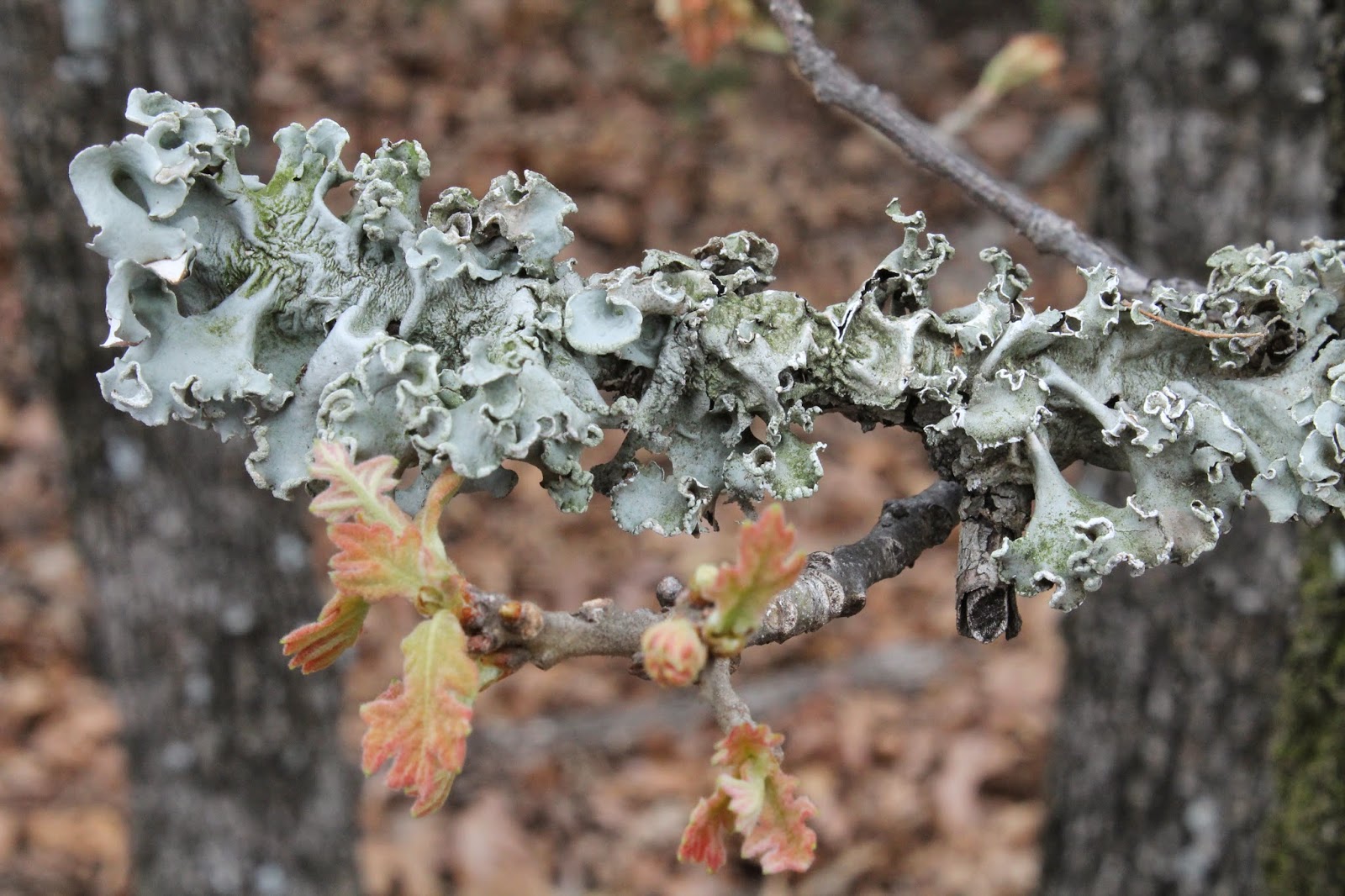
We benefited immensely from the expertise of botanists Gloria Caddell of University of Central Oklahoma (see photo below) and Suneeti Jog (behind the mosses in the photo above) of Northeastern Oklahoma State University and entomologist Ken Hobson of the University of Oklahoma. Mycologist Steve Marek of Oklahoma State University helped us find mushrooms and understand the lichens, which were astonishingly crowded all over the oak branches and bark (see photo below). David Bass of the University of Central Oklahoma looked for aquatic invertebrates, and Michael Shaughnessy of Northeastern Oklahoma State University showed us how to interpret animal tracks. Gregory Plumb of East Central University brought his computer and screen to demonstrate how geographers integrate many kinds of digital information and also brought his telescope for viewing Jupiter. We pretty much searched all of heaven and earth we could find at Lake Murray.


One of the most rewarding aspects of the field trips for me was that six of my students took these trips, and were able to learn from scientists other than me (they already hear plenty of stuff from me). The three morning students were Maryam and Nasim Akhter and Brian Ridgway; the three afternoon students were Bobby Long, Ben Singleton, and Kristin Brooks.


One of the students told me that she had never been out in the woods before. Clearly, for her, the most important part of this trip was just getting out in the forest and noticing how much is in it. And I wanted them to experience nature as fully as possible without compromising safety. I induced them to eat greenbriar shoots, wild mustard, and cactus fruits (which is what the students are doing in the second photo). Some of these students plan to study medicine. Therefore I and Connie Murray, a botanist at Tulsa Community College, talked with them about wild medicinal plants. There were also a few students from other Oklahoma universities.

Also, despite all evidence to the contrary, there is life after being OAS President. We found past president Craig Clifford, of Northeastern Oklahoma State University, lying in a gutter. But he was not there for the usual reasons a man might be in the gutter; like many of us, no posture is too embarrassing to get that perfect photograph.


I believe it was also important that I got to demonstrate what a good ecologically-minded citizen does. A lot of people who come to the lake deliberately leave behind huge numbers of beer cans and bottles, some of them smashed. With help from others, I collected as many of these as I could (not, of course, broken glass) to take back and recycle. The attitude of responsible stewardship, which we all felt, could not contrast more greatly with the deliberate offense that litterers show to nature and to the other humans with whom they live. One of my favorite experiences at Academy meetings is to be among people who care about the Earth and the other humans who share it with us.

Scientists Learning from Nature: Oklahoma Academy of Sciences Field Meeting Spring 2014, part one.

When you get these three elements together, something good is bound to happen: First, the minds of people who know a lot about nature and want to know more; second, the minds of people who care about nature and want to talk about how to protect it; third, a beautiful natural ecological community. Such a convergence occurred this past weekend at the field meeting of the Oklahoma Academy of Science at Lake Murray State Park in southern Oklahoma. I will post two blog entries about this meeting. The first essay is about the two evening presentations.

On Friday, April 4, Jona Tucker from the Nature Conservancy gave a beautifully-prepared presentation about the Arbuckle-Simpson Aquifer, the Blue River, and TNC’s restoration of what had once been a beautiful riverside forest in Oklahoma.

The Oka’ Yanahli Preserve on the Blue River is not what you would think of when you hear The Nature Conservancy’s slogan of “the last great places.” It was until recently a cow pasture where even the very streams had been mashed out of existence, and where a thin layer of trees lined the river. But historical evidence and old maps clearly indicate that it used to be one of those great places. TNC wants to make it back into such a place.

The main impression I got as I listened to Jona’s presentation is that you cannot understand, protect, or manage anything by simply reducing it to its component parts. The Blue River is a perfect example of this. Almost all of its water comes from springs that emerge from the Arbuckle Simpson Aquifer, but you cannot understand either the river or the aquifer merely by knowing how much water flows from one to the other. (Alas, governing bodies often do not even correctly consider the amount of water flow when making decisions about how much aquifer water can be pumped and used.) It is a system that changes over time, as when the river itself changes course. Water flow and quality are affected by the riparian forest along the river. If this forest has been damaged or destroyed, it must be restored before you can have a healthy river. But restoring the river is also a complex system. You cannot just go out and ceremonially plant a tree or two; the beavers will chew them down. So what do you do? You could put up a fence to keep the beavers out. But even this does not work; when the river floods, a fence can be knocked over and crammed with debris. The Conservancy, and two graduate students from the University of Oklahoma, are using fences that can be quickly dismantled if a flood is coming then reassembled after the waters have gone down; and you can only hope the beavers aren’t bright enough to recognize their narrow window of opportunity before and after a flood.

But because the river and aquifer and forests are a system, it is not necessary to replant the entire thing. It is important to get a few trees started, but after that, just keep the cows away and most of the plant and animal species will return. This can be seen at the nearby Blue River Public Hunting and Fishing Area, also on the Blue River, which was pretty much just a pasture until a few decades ago. Now it is lined with, among other things, a healthy population of rare seaside alder trees.

And you have to think of the way the entire natural system of the Blue River interacts with the human system. It doesn’t work for a government (e.g. a court or the Fish and Wildlife Service) to impose rules on land owners, rules with which the land owners may minimally comply (or not). Instead it is important to get the land owners to want to protect and improve their land. Humans can be a positive part of the system. Once when I was studying alder trees along this river, a fisherman asked me about the trees. Then he said that maybe fishermen were causing damage by walking around among the trees. I told him that the fishermen were causing no damage at all, and in fact their license fees maintained the state land, which is where most of these rare alder trees survive. We need for people to feel welcome to do harmless things in the natural world, thereby becoming aware of its beauty and being more likely to support its preservation. I believe the fisherman was delighted to hear that rural Oklahoma has a rare subspecies of tree found nowhere else in the world.

I am definitely proud to have served as Jona’s undergraduate advisor when she majored in botany at Southeastern Oklahoma State University. At the same time, it is clear that nearly everything Jona knows she has taught herself, and most of what she does she has figured out for herself. She is one of our best examples of a student whom we got started on a professional path but who has made most of that path herself. Her work is not necessarily what she was trained to do; a lot of it involves talking with and arranging agreements with land owners. This requires the kind of positive spirit that Jona has, and is something you cannot simply learn by taking a public relations course. For example, it was necessary to consider the public impact of choosing a name for the preserve: they chose a Chickasaw name, Oka’ Yanahli, that recognizes the efforts to bring the river back to what it was like in the nineteenth century when the Chickasaws first arrived, and recognizes rural Oklahoma’s increasing pride in its Native American heritage. Now the only problem is that we might get complacent and expect Jona to do the whole job by herself, which nobody can.

On Saturday, April 5, Matt Bolek of Oklahoma State University described his research into all aspects of the life cycle and ecology of hairworms. We did not have a show of hands to see how many of us scientists even knew what hairworms were, especially since they do not live in humans. They live primarily in insects. They are one of those phyla of animals that people seldom see. But they can be quite surprising. A single large tropical roach can be the host of a 4.3-meter-long hairworm tangled up into what looks like a Gordian knot (after which one of the genera is named). They have amazing adaptations for surviving and dispersing from one host to another. Matt is an active member of a very small worldwide group of hairworm experts.

Small and (to us) obscure organisms are also hard to study. One example of this is the swallow bug. Usually, Valerie O’Brien is at our field meetings, but this weekend she and Charles Brown were marking individual swallow bugs to track their dispersal patterns. That is, each bug has to have its own individual mark distinguishable from the others. Now, how do you mark a swallow bug? I assume it cannot be a radio collar or a GPS transponder. I’ll be interested in finding out how to mark a bug.


In the next entry, I want to tell you about the OAS field trips.