See the entry below for the OAS field meeting, part one.
Since
there was such a small number of people at this field meeting, most of the
field trip activity involved the whole group at once instead of numerous
separate field trips. We took morning and afternoon trips on April 5 at Lake
Murray State Park. It was a lot of fun to have everyone together, because
wherever we went we could learn about everything all at once (mostly about
plants and insects). There is a lot of fascinating conglomerate rock around
Lake Murray, and I wished there was a geologist along to tell us about them.
Lake
Murray is surrounded by a perfect example of a cross-timbers forest consisting
mostly of post oak (Quercus stellata).
This species of oak grows slowly on poor dry soil. The cross-timbers forest,
found mostly in Oklahoma, is the only kind of forest that post oaks dominate.
We also saw blackjack oaks, white ashes, black hickories, and chittamwoods, all
of which had leaves that were just beginning to expand. It was beautiful to see
how leaves and flowers are neatly packaged into buds. This was a late spring;
back in 2012 the leaves of these trees were already fully expanded by this
time. Because these forests are open and dry, cactus plants grow in the
understory. Among these are Coryptantha
missouriensis, a tiny cactus down in the leaf litter, the bright red fruits
of which were mature and falling from the stem.

The sporophytes were
emerging from the mosses.

Mosses and cacti growing together? The mosses
are dormant during the dry summer when the cactuses are fully active. We also
visited a transition zone between forest and prairie, where we saw forest edge
trees such as chittamwood and persimmon, as well as grasses from tallgrass,
midgrass, and shortgrass prairies.
We
pretty much knew which plants we would find, but when it comes to animals, you
have to wait until you stumble across them. We saw a leaf-footed bug that
smelled like almonds, because it produces cyanide as a defense against
predators. We saw a large moth almost perfectly camouflaged in the leaf litter,
except for the big predator-scaring eyespots.

We saw cottony fluff on a
beavertail cactus, produced by cochineal insects as a defense against
predators. These insects were the original source of carmine dye, and the skillful
use of a knife can reveal the bright crimson color under the fluff. One group
of explorers even surprised a nest of shrews.
We
benefited immensely from the expertise of botanists Gloria Caddell of
University of Central Oklahoma (see photo below) and Suneeti Jog
(behind the mosses in the photo above) of Northeastern Oklahoma State
University and entomologist Ken Hobson of the University of Oklahoma.
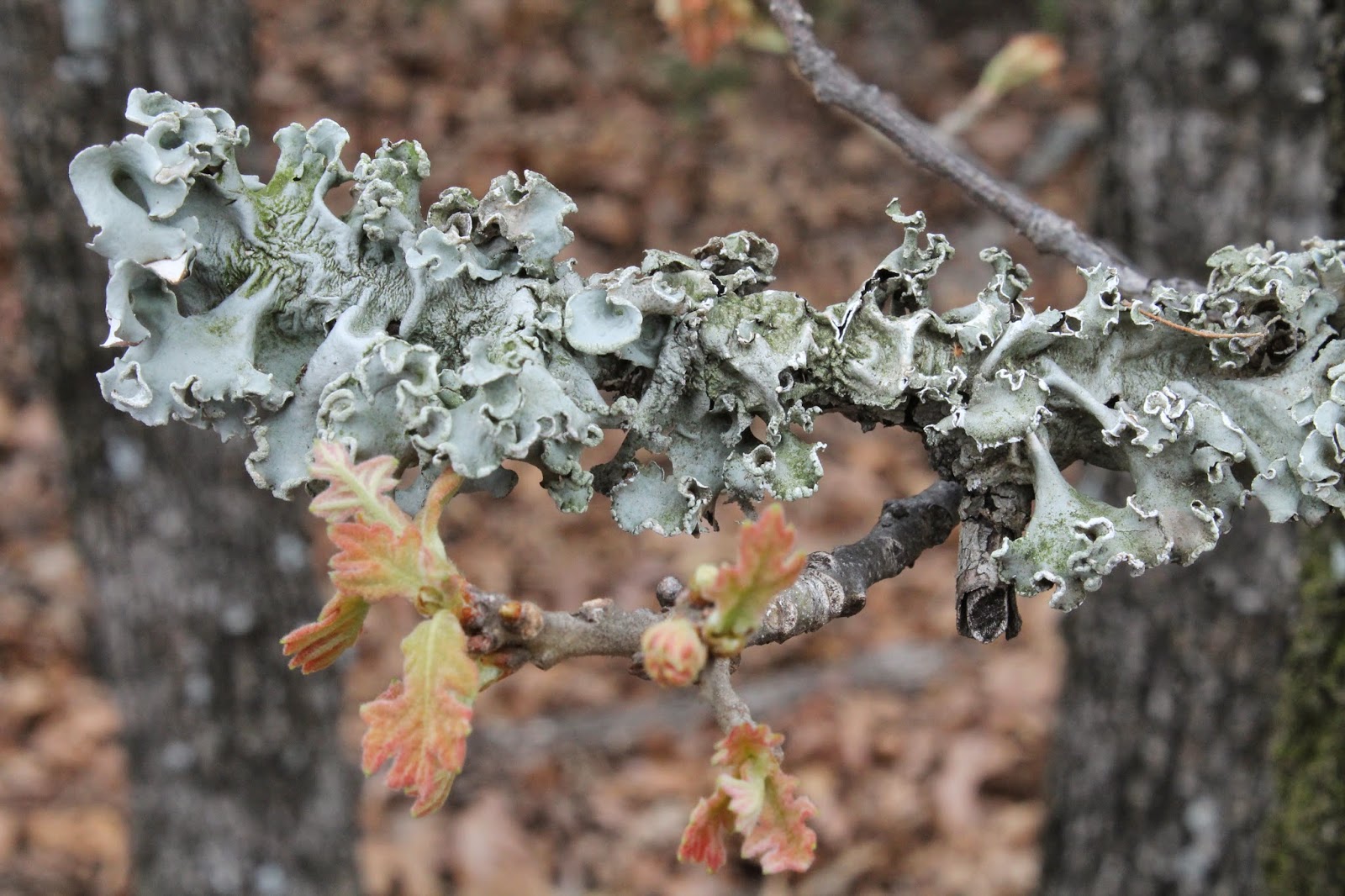
Mycologist Steve Marek of Oklahoma State University helped us find mushrooms
and understand the lichens, which were astonishingly crowded all over the oak
branches and bark (see photo below). David Bass of the University of Central Oklahoma
looked for aquatic invertebrates, and Michael Shaughnessy of Northeastern
Oklahoma State University showed us how to interpret animal tracks. Gregory
Plumb of East Central University brought his computer and screen to demonstrate
how geographers integrate many kinds of digital information and also brought
his telescope for viewing Jupiter. We pretty much searched all of heaven and
earth we could find at Lake Murray.

One
of the most rewarding aspects of the field trips for me was that six of my
students took these trips, and were able to learn from scientists other than me
(they already hear plenty of stuff from me). The three morning students were
Maryam and Nasim Akhter and Brian Ridgway; the three afternoon students were
Bobby Long, Ben Singleton, and Kristin Brooks.


One of the students
told me that she had never been out in the woods before. Clearly, for her, the
most important part of this trip was just getting out in the forest and
noticing how much is in it. And I wanted them to experience nature as fully as
possible without compromising safety. I induced them to eat greenbriar shoots,
wild mustard, and cactus fruits (which is what the students are doing in the
second photo). Some of these students plan to study medicine. Therefore I and
Connie Murray, a botanist at Tulsa Community College, talked with them about
wild medicinal plants. There were also a few students from other Oklahoma
universities.
Also,
despite all evidence to the contrary, there is life after being OAS President.
We found past president Craig Clifford, of Northeastern Oklahoma State
University, lying in a gutter. But he was not there for the usual
reasons a man might be in the gutter; like many of us, no posture is too
embarrassing to get that perfect photograph.

I
believe it was also important that I got to demonstrate what a good
ecologically-minded citizen does. A lot of people who come to the lake
deliberately leave behind huge numbers of beer cans and bottles, some of them
smashed. With help from others, I collected as many of these as I could (not,
of course, broken glass) to take back and recycle. The attitude of responsible
stewardship, which we all felt, could not contrast more greatly with the
deliberate offense that litterers show to nature and to the other humans with whom
they live. One of my favorite experiences at Academy meetings is to be among
people who care about the Earth and the other humans who share it with us.