Showing posts with label biodiversity. Show all posts

Saturday, May 8, 2021

Reforestation: The Miyawaki Method

A popular new method of replanting forests that have been devastated was developed many years ago by a Japanese botanist, Akira Miyawaki (now 93 years old). This method is now being used around the world and is especially popular in the tropical parts of India.


The method is supposedly simple, but of course there are a lot of details. Nevertheless, the basic idea is very simple: plant a thick growth of seedlings of native tree species and let them thin themselves out into a diverse forest. It is the exact opposite of a tree plantation, which consists of a single tree species, each tree spaced out enough that it will probably survive. We have a lot of plantations in Oklahoma, mostly loblolly pines used by Weyerhaeuser Corporation for wood pulp, mostly along State Highway 3 on the east side of the state. Instead, the Miyawaki method is an almost exact replication of natural forest succession, except that it skips the weedy and shrubby stages, going directly to the forest stage. If you use a mixture of native species, they will not only be adapted to local conditions, but will interweave themselves into different layers and roles.

But this is not what I found the most interesting about the method. To me, the most important part was that this method allows nature itself to do the thinning-out of the trees. You know that a lot of them are going to die, but the result will be astonishing.

Plant ecologist K. Yoda found that a thick growth of plants would thin itself out as the bigger plants grew bigger and the smaller ones died. This is hardly surprising in itself. But Yoda found that in a graph in which the average plant weight is a function of density, both on logarithmic scales, the slope of the line was very close to -3/2. The confusing thing about such a graph is that the time axis goes backwards: you have to read the graph from right to left. Or is it backwards? Remember that in Japan they traditionally read right to left. This discovery, like the Miyawaki method, came out of Japan. Here is a recent article about this pattern. Yoda used monocultures (a single species) but it apparently works with polycultures as well.

My message is simple: If you want to restore nature, let nature do it, giving it just a little help.

Tuesday, August 6, 2019

Will We Lose Even the Remembrance of Biodiversity?


And now, time to get really depressed.

In the July 30 essay, I  speculated about the loss of biodiversity in a future world, producing a natural world that may more resemble my Garden of Contemplation than a rainforest. In this essay, I speculate about not just the loss of biodiversity, but the loss of the remembrance of biodiversity.

Dedicated scientists have recorded over a million species of organisms on Earth. You can find many of them on the Encyclopedia of Life website. In Oklahoma, we have a vascular plants database. Most of these species remain unknown to anyone except scientists. Photographs of many of them appear on calendars sent out by conservation organizations, but for most of us, we look at the photos and then forget the species. I tried to keep all of my old conservation calendars, but it was an impossible task. Information in a huge pile of old calendars or Nature Conservancy magazines is as inaccessible as if it were hidden away in a vault. Only a few experts really know the truth about biodiversity. If you put me in a room and told me to list all of the plant species in Oklahoma, of which there are thousands, I would run out at about 300. There might be two people in Oklahoma (Amy and Bruce, that’s you) who might know all of them. And in a rainforest? The fabled acre of rainforest in Peru that has more species of birds than all of Europe? Only a few experts know what those species are. For the rest of us, it is hearsay.

These species are rapidly becoming extinct. And one of the reasons is global climate change, resulting from carbon emissions for which the coal and oil industries are largely responsible. People want solar and wind energy; but the coal and oil industries, and the United States government which they own, do not. Furthermore, the coal and oil industries want to be self-righteous. They want us, and future generations, to admire them, even to love them. Therefore, it is imperative that future generations NOT know about these extinctions for which the corporations are partially responsible.

In my imagination, I foresee a future in which databases of species, many of which will by then be extinct, will be purged. Paper backups—including scientific papers, which few people read even now—can be locked away and kept from public knowledge. The Republican government, by then a dictatorship, can then proclaim to the world, “We are not responsible for the sixth mass extinction. There never was one! The species that you see today are the only ones that were on the Earth before we began releasing energy from fossil fuels. And anyone who accuses us of causing a mass extinction, of destroying God’s creation, is a liar and an enemy of the state! An enemy of God! Anyone who says a mass extinction occurred, show us the data! You cannot! It does not exist! We cannot have harmed God’s creation; we Republicans are God’s people!” I will leave it to you to guess whether such a scenario might ever happen. What is more likely is that biodiversity information will simply be forgotten, even as it sits in digital piles.

A couple of decades ago I wrote a short story set in the Black Hills of South Dakota, where I used to teach field botany in the summer. In the story, what had once been forests of ponderosa pine had eroded into an artificial desert. People lived in walled cities with artificial resources. Except for some wild people called rock bunnies because they jumped from one rock to another. The rock bunnies had found, and hidden, a herbarium that showed that not only pines but many species of wildflowers from lilies to shooting-stars had once lived there, and birches had once grown along clear brooks.


(This photo from 1994 shows a student named Lily holding a lily in a meadow at the top of the Black Hills, here in Wyoming.)

In the story, many of the herbarium specimens had been collected long before by a long-forgotten teacher named Stanley Rice. A military contingent from one of the cities destroyed the herbarium, since the central government wanted everyone to think that the eroded landscape had always been there, and that they had caused no environmental degradation.

To those of you who think this speculation may be extreme: can you prove me wrong? Can you deny that the current Republican leadership, under its charismatic antichrist Donald Trump, create their own “truths”? How is a student in the year 2080 to know that hundreds of thousands of species that they have never seen, and that their government does not acknowledge, exist or existed?

Those of us who are documenting biodiversity—might our work, someday, be considered treasonous?

Tuesday, July 30, 2019

The Garden of Contemplation


At the present time, I have been able to relocate and upload the missing videos from my YouTube channel. Watch this blog for further updates, if necessary.

In a previous essay, I speculated that, a couple of centuries into the future, there may be no truly natural world. Instead, I said, “nature” may consist mostly of areas such as municipal parks.

But perhaps a better example of “nature” in the future is my Garden of Contemplation. This garden is just my back yard in rural Oklahoma. Every evening that I can in May and June, I sit in it, sometimes grilling meat, sometimes just drinking and listening silently, trying to ignore the loud pickup trucks driven up and down the street by men whose entire significance of life consists of making fumes and noise.

My son-in-law made this sketch of my Jardin de Contemplation.


This “garden” is certainly not natural. The original ecosystems where I live were tallgrass prairie and cross-timbers forest. No species from either of these natural ecosystems exists in my “garden.” All the plants are adapted to the moist conditions that have come with urbanization and fire suppression.

Furthermore, it is not really a “garden,” hence the quotation marks. I really do not do very much to it. I let “nature” take its course, for the most part, except:

  • I mow the grass.
  • I pluck up or cut down the seedlings and saplings of trees that squirrels planted too close to the house (water oak, red oak, pecan).
  • I try to force the plants to play nicely with one another. That is, I take action against bullies, mainly by cutting back the most aggressive vines.


All of this, of course, is unnatural, especially my action against bullies. But I have planted very little. It is a managed ecosystem that formed from plants that happened to find themselves associated with one another. Here is a little more detail about it.

  • The largest tree is a huge sycamore (Platanus occidentalis), and the second largest is a water oak (Quercus nigra). A squirrel planted the water oak about 2002, and today it fills a large part of what was once a grassy area. Both are species native to Oklahoma, even if not to my precise location.
  • A male Kentucky coffeetree (Gymnocladus dioicus) has grown near the carport since 2001. Recently, it began spreading clonally, and now there are about five sprouts.
  • A pyracantha (not native) dominates the corner of the fence.
  • I planted a couple of redbuds (Cercis canadensis).
  • A barrier of privet bushes (genus Ligustrum) protects my yard from the stupidity of the road. Privets are not native; indeed, they are one of the dirty dozen of Oklahoma invasives, and if I lived in the country I would feel obligated to cut them down (only to watch them resprout).
  • But it is the vines that celebrate my hands-off approach. Wisteria, from Asia, is very aggressive, but so are the native mustang grapes (Vitis mustangensis) along the side fence; the muscadine grapes (V. rotundifolia) along the alley; the catbriars (Smilax bona-nox); and the snailseed vines (Mennispermum coccineum). All of these vines want to smother my pyracantha and redbuds and even my water oak.
  • Shady microclimates have Geum canadense flowers (not very showy, but quite natural) and Virginia creeper (Parthenocissus quinquefolia).
  • Birds are always planting mulberries (Morus alba) and sugarberries (Celtis laevigata). These trees like to destroy fences, so I spend a lot of time clipping them back. The wind blows in seeds of Asian lacebark elms (Ulmus parvifolia) from across the street.
  • In spring, two species of daffodils, lots of weedy sedges, the hairy species of speedwell (genus Veronica), Hustonia, and both of the Lamium species that real gardeners despise (L. amplexicaule and L. purpureum) fill the yard while the grass is still dormant.


False dandelions (Krigia) fill large areas of my front yard, suppressing grass in the spring. I mow the Krigia like grass, getting milky sap on my flipflops. But I left them as long as I could. The little corner of yellow composite-flowers that opened in the morning stood in contrast to the well-mowed areas around it, and I hope this let people know I deliberately left the Krigia. I also have one of the biggest crape myrtles in town, and a lot of Vinca.


Is this a view of biodiversity in the future? A minimally-managed spot where even the guy who lives there can be surprised at what he finds. And the animal life seems to like it also. Even without a bird-feeder, I get the mimid trifecta (mockingbirds, brown thrashers, catbirds), and cardinals. “Weed” birds such as grackles find my yard too wild and never visit it. As for insects, I have lots of lightning-bugs (lampyrid beetles). The cat is a visitor, not a resident.

It is nothing like natural biodiversity. But there is enough biodiversity that, someday, my granddaughter can explore it and keep asking, What’s this? What’s this? Enough biodiversity, at least, that she will not grow up thinking that a tree is a tree is a tree.

Of course, if civilization collapses—and there are many ways this could happen—then a lot of biodiversity will return in its absence.

Tuesday, June 4, 2019

Requiem for Nature?


In 1999, ecologist John Terborgh, of the Duke University environmental program, published a book, Requiem for Nature, in which he convincingly made the case that few of us wanted to hear: There is no hope for the survival of wild nature or wild biodiversity. The conclusion was similar to that of Diane Ackerman, whose book I reviewed in an earlier essay, only Terborgh shows us the dark side.

In 1999, every indicator showed that the forces of destruction, especially in the tropical rainforest, were accelerating. But Terborgh presented plenty of examples from the United States, as well.

Yes, there were many tropical national parks. But many of these parks were “paper parks,” that is, they existed only as designations on maps. (You could now call them “Google parks.”) Many of them had no guards, some had just one guard. Settlers encroached on the parks. The government could take credit (and possibly receive foreign aid) for protecting nature, without spending anything on it. Many of the parks, far from being located in biodiversity hotspots, were in areas that were unsuitable for agriculture and low in biodiversity: they were the easy ones to “protect”.

Even the parks that were protected suffered from “empty forest syndrome.” The adult trees still stood, but (1) young trees did not germinate to replace them, and (2) many animals were missing, producing an eerie silence. The parks existed, they had a certain area, but they were oddly shaped. In 1989, I visited Jatun Sacha in Ecuador, and it was a skinny corridor of land. As a result, most of the forest in the preserves is very close to human-dominated landscape. The human effects therefore penetrated into the protected area, making it unnatural. The landscape was fragmented. Strange ecological imbalances happen in small parks, and on small islands (such as an explosion of leaf-cutter ant populations) that would not happen in a large protected area.


In this photo, a graduate student from Europe classifies orchids rescued from the branches of rainforest trees that had been cut down. There was no time to do anything else at Jatun Sacha except make records of what was killed.

Terborgh used examples from all over the tropical world, and the story is everywhere the same. There were a few exceptions—some nature preserves on Madagascar were respected and protected by local people—but such examples were rare. Wild nature is threatened even in countries that have “charismatic megafauna” wildlife, in Africa and in Nepal, where tourists spend a lot of money.

Many proposed solutions were not working. One idea that was popular in the 1980s and early 1990s was to support the rubber tappers, who made a sustainable living off of wild rubber trees, without killing them, and without plantations. These were the people championed by the charismatic Chico Mendes, who was assassinated in 1988 by a gunman hired by a large land-owner. But the rubber tappers remained poor, and their product could not compete in the marketplace with commercially-produced rubber. Another failure has been forest protection by edict. When the Thai government, alarmed by the loss of watershed forests, prohibited logging, the price of lumber increased, thus making illegal logging more profitable.

In some cases, land degraded by human activity can recover. The processes of ecological succession are amazing and were among the earliest things that inspired me, as a child, to be interested in nature. But it doesn’t always work. If a tropical forest is cut down, and is then invaded by alang-alang grass (Imperata cylindrica), a cycle of fires can then prevent the forest from ever growing back, that is, in a time frame meaningful to humans.

For many of us, the modern mantra is “sustainable development.” But sustainable development does not require biodiversity. Agroforestry and plantations can be sustainable, even when dominated by just a few species. The conclusion Terborgh reached is that the human future does not depend on biodiversity; humans, and human civilization, can survive just fine without the high levels of biodiversity found in nature. We cannot honestly use “human survival” as a justification for protecting biodiversity. There is no shortcut: we have to save it for its own sake, not ours. “Whether we like it or not, tropical forests are worth more dead than alive,” Terborgh wrote. In strict economic terms, that is—which are the only terms that matter to most governments.

Things have only gotten worse, at rates and in ways that Terborgh did not, apparently, imagine. He wrote, “I am confident that objectivity and popular opinion will eventually prevail in the United States to bring conservation and development into balance.” But even if the Obama Administration might have encouraged this, Donald Trump proclaims loudly that conservation is the enemy of prosperity. Whatever hopeful trends Terborgh saw have been deliberately smashed by people who, perversely, call themselves conservatives. Terborgh called for a redesigning of democracy. Well, we’re getting it: it is being redesigned into a system in which the president can do whatever he wants with no constitutional restraints. I don’t think that’s what Terborgh meant.

The situation can only get worse, as populations increase and conflict over resources escalates.

This does not necessarily mean that the world will go as far as it did in RenĂ© Barjavel’s novel Le Voyageur Imprudent, in which the human species 100,000 years from now evolved into males with claws, with which they had dug away all mountains and valleys and made the Earth into one vast plain, and females as large as mountains, with thousands of teats, from which the males fed. But a few generations from now, the phrase “natural world” may simply mean a municipal park. “I hope I am wrong,” Terborgh wrote, “but if I had to bet, I would wager that the last gorilla will die in a zoo.”

It is not good news, but Terborgh wanted conservationists to be honest about the problems and not pour time and other resources into lost causes.

To find good news, you can only, at best, read about individual success stories. The United States government refused to protect an endangered species of beetle in Oklahoma. So, the Cherokee tribe stepped in and did it. And, as I took a break from reading Terborgh’s bad news, I opened the May 2019 National Geographic and read about Gorongosa National Park in Mozambique, where nature is thriving, full of wildlife, because of the support of local people, 180 of whom it employs. Sometimes human ingenuity can surprise us (this was the same issue that had a long article about Leonardo da Vinci). An isolated example the Gorongosa may be, but what else am I supposed to think about? As a writer, I look for the individual stories. It is too depressing to do otherwise.

Tuesday, August 28, 2018

There Is No Such Thing As a Desert


Or a forest, or a grassland, for that matter. But I think I can illustrate my point most vividly using the example of deserts.

Many different kinds of habitats get lumped together in the category we call “desert.” Unfortunately, once our human minds have created a category, we assume that everything within that category is the same.

The habitats we call “deserts” are very diverse. The most obvious way they differ is that the “deserts” of the different continents are the homes of almost entirely separate sets of species. When you see desert shrubs in California, in the Middle East, and in western Asia, they are not the same species. Leafless, succulent plants in American deserts are usually cactuses, whereas in Africa they are spurges or milkweeds. South Africa has many species of succulent, leafless plants in the Aizoaceae family, different from all the others. The animal inhabitants of the deserts on different continents are also distinct.

But even within one “desert” there is a lot of habitat diversity. Consider the southwestern deserts of North America. The areas that ecologists refer to as the Mojave Desert (e.g., southeastern California) are covered with widely-spaced shrubs. The areas that ecologists call the Sonoran Desert (e.g., in the Phoenix area) has shrubs (but not the same species) and many species of cactus. In fact, the shade cast by acacia bushes is important to the survival of young cactus seedlings. The areas that ecologists call the Chihuahuan Desert (e.g. near Big Bend) has shrubs and succulents (though usually agaves rather than cactuses), but the space between them, unlike the other deserts, is filled with grasses. This makes sense, as this kind of desert intergrades into the high plains grasslands. (No, that’s not where chihuahuas come from.)


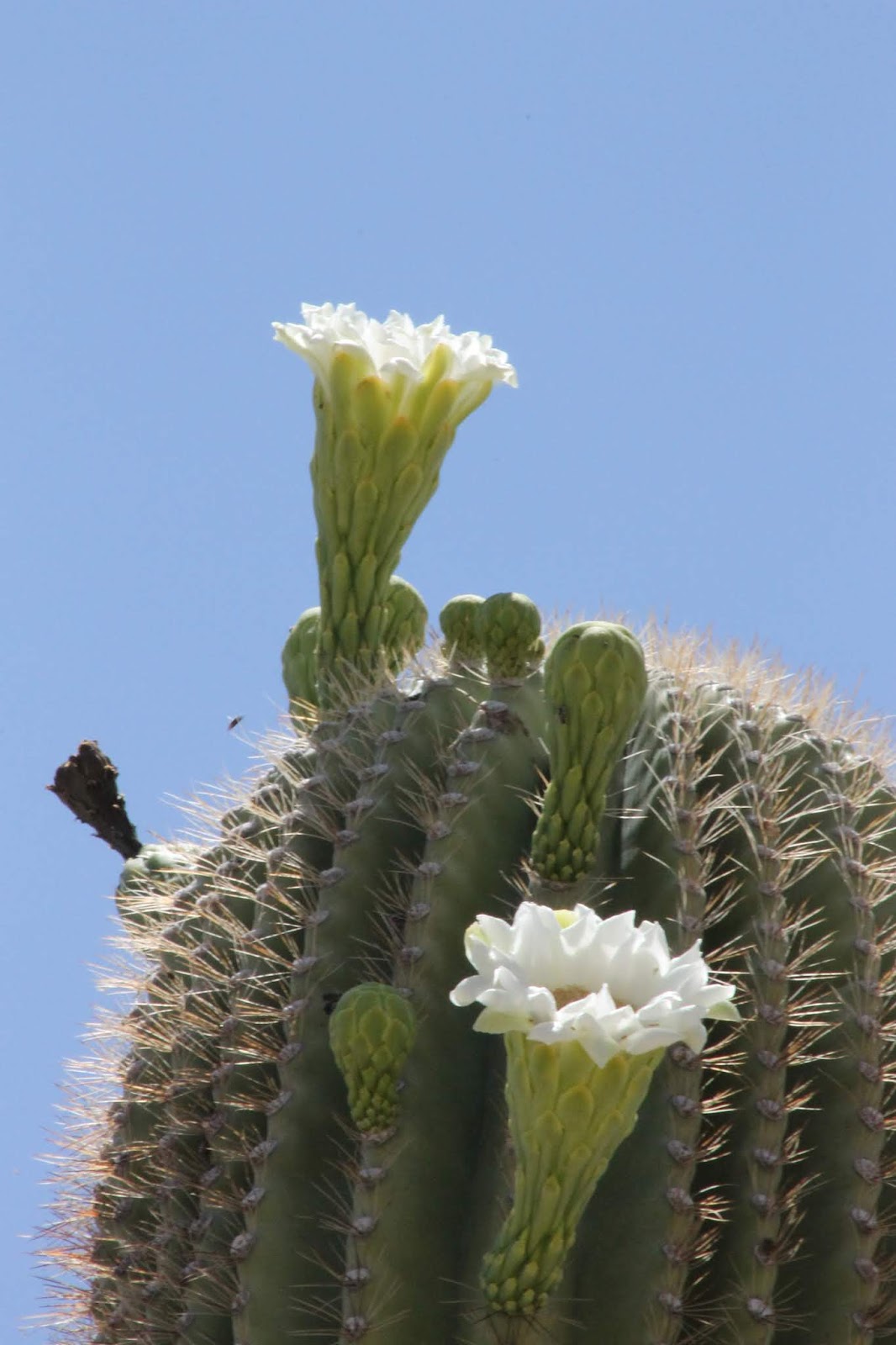
Above: Chihuahuan desert in Big Bend National Park; below, saguaro flowers in the Sonoran desert near Tucson.

But even within one of these subtypes of desert has a lot of habitat diversity. The Chihuahuan Desert grow on the tops of hills as well as on the slopes and lowlands. At the tops of some of these mountains in southern California, Arizona, New Mexico, and Texas, and in northern Mexico, there are some small oak forests. These forests are the remnants of oak lands that used to be widespread in the countryside back when the climate was wetter. As the climate became drier, the forests survived only as little patches on somewhat cooler and wetter hilltops. Most of these oak species are found nowhere else in the world; some of them live only in one forest. If you scan your eyes over the entire Chihuahuan Desert, you might not even notice these forests. Of course, the oak-patch animals are a lot different than those of surrounding desert land. See here for a link to a 2013 blog entry.


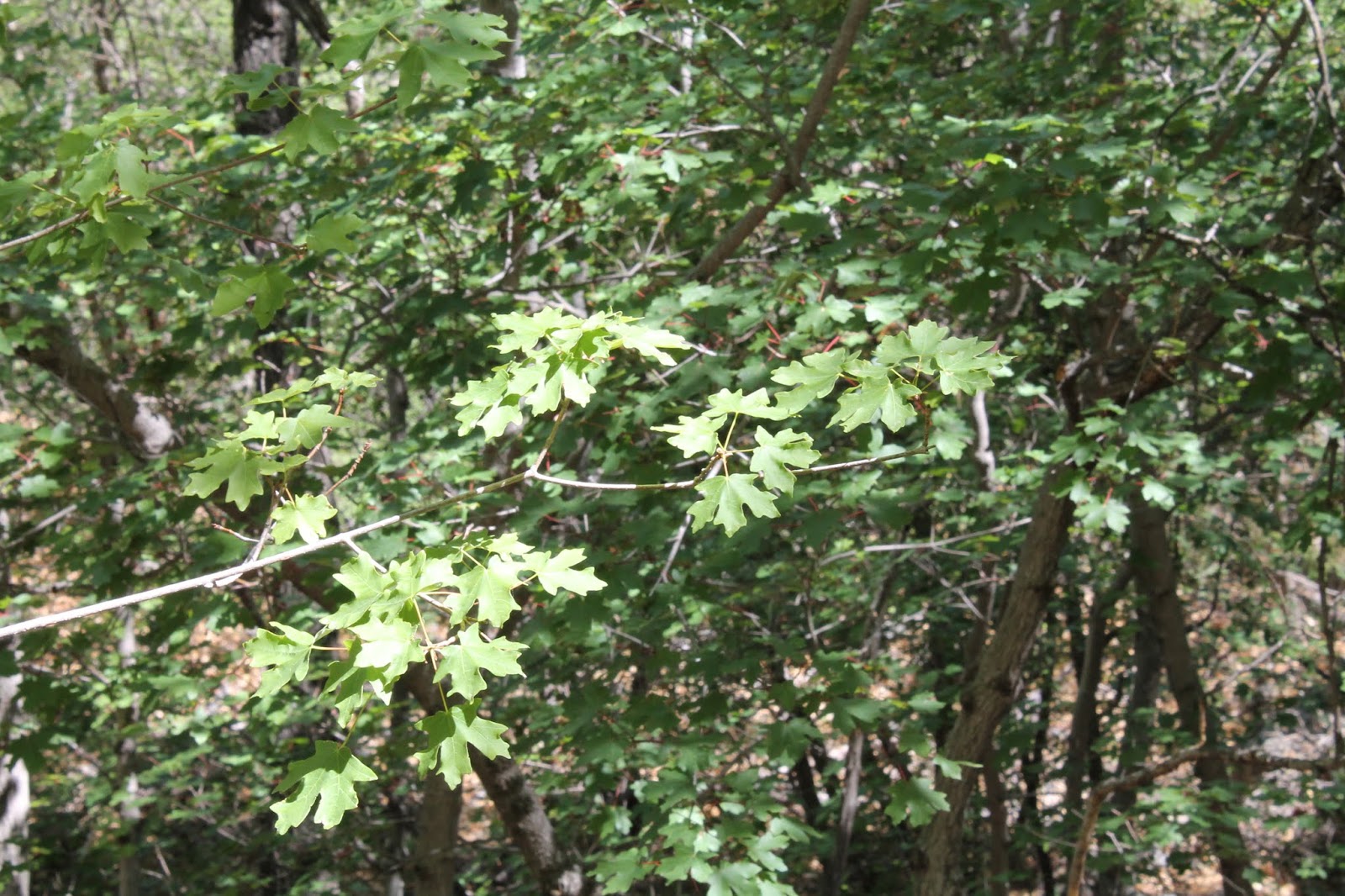
Maple trees in a desert? In Big Bend National Park, maple trees grow in an isolated moist spot near the base of the pinnacles.

Another example is desert arroyos. Arroyos are stream beds that are dry most of the time but which can be filled by flood waters during heavy rain. The soil under the arroyos is usually wetter than in the surrounding desert. Not surprisingly, the species of plants that live there are almost entirely different than those of the surrounding landscape. In southwestern North America, one of the shrubs that grows in arroyos, but not away from them, is the desert willow Chilopsis linearis, which is not really a willow.


An arroyo is the same as the middle eastern wadi, although the species found in wadis are almost completely different from those in arroyos.

All this does not include what scientists sometimes call “polar deserts” in which there is too little snowfall to allow soils to support plant life even during the brief summers.

I find the word “desert” to be a useful category. It is one of the entries in my Encyclopedia of Biodiversity. It refers to a place with too little water to support a thick growth of plants. But I recognize that “desert” is an artificial category that exists only as a way of us making sense of the world. As I explain in my soon-to-be-published ScientificallyThinking, humans tend to lump things into categories, which is find unless we then homogenize everything within the categories.

The human tendency to lump things into categories may seem harmless enough when we lump different habitats into the category “desert.” This makes us overlook much beautiful diversity. But when we start lumping people into racial categories, we start assuming they are all alike, characterized usually by the worst people in each race.

Monday, April 3, 2017

Springtime in Oklahoma, or, Will Molly Eat It?

There were plenty of visitors to Robber’s Cave State Park on April 1. This is not one of the state parks that the Oklahoma government, in its desperation to cut everything except oil corporation subsidies and the budgets of the legislature and governor, plans to close. Just a few of the visitors came for the Spring Field Meeting of the Oklahoma Academy of Sciences. Few, but appreciative.

We (faculty and students) were surrounded by nature. Oh, wait, not quite. The forests were mostly shortleaf pine (Pinus echinata) and post oak (Quercus stellata). But the shortleaf pines have nearly all, at least in this part of the state, hybridized with loblolly pines, which have been planted for lumber and pulp production. And every bit of the forest has been affected by human impact, including fire suppression. But it was a nice spring day and we were seeing things that were almost natural. The oaks were just opening their catkins and unfurling a few baby leaves. Post oaks dominate the poor, dry soils of these mountains.

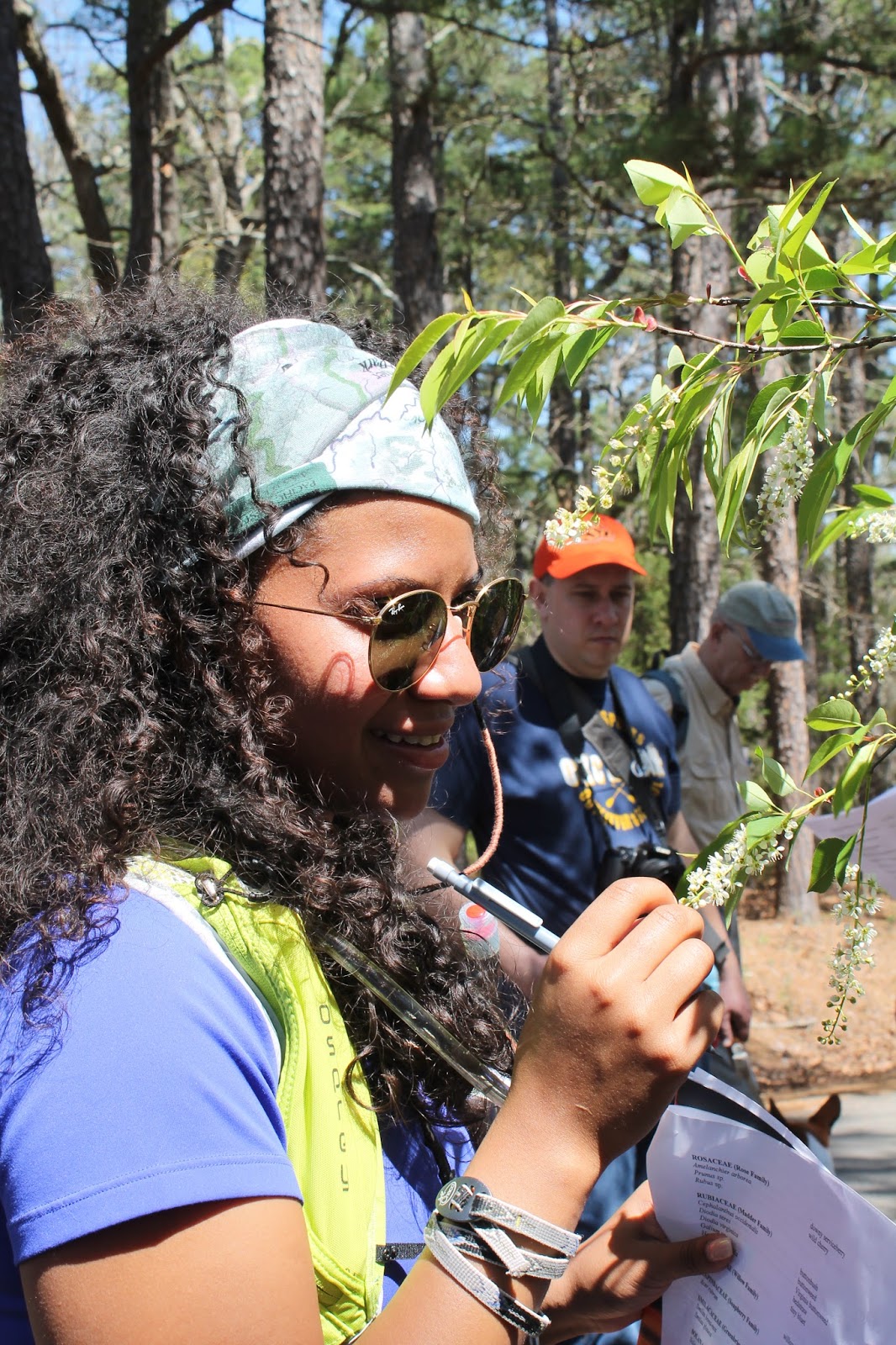
Gloria Caddell, at the University of Central Oklahoma, led the botany field trips.


We didn’t even get out of the parking lot before we found plants that were interesting in more than one way. Gloria explained how to distinguish the three species of violets and how to distinguish poison ivy from fragrant sumac. But I explained that you could eat violets. I convinced Molly, a student from my university (Southeastern Oklahoma State University), to try one. After she was finished looking at a black cherry in bloom, I convinced her to eat some fading redbud flowers too. Last of all, I got her to eat some greenbriar buds.


We explored different habitats within the park. Closer to the creek, we found red maple, bur oak, and black oak. At the edge of the water we saw a birch tree with its male and female catkins. The male catkins dangle from the branch behind the female flowers. This arrangement improves the chances that the pollen that comes to the female flowers is from a different tree rather than the same one. We also saw several wildflower species, some spectacular like the plains wild indigo, Baptisia bracteata.

Baptisia is one of the leguminous plants that produce nitrogen-fixing nodules, as mycologist Steve Marek explained. It is always good to have people from different areas of study together on the same field trip.


And, as always, leave it to Gloria to open our eyes to see the tremendous biodiversity of a trampled lawn in a picnic area. As future high school teacher Lainee Sanders discovered, there was not one but two species of buttercups in the picnic area. (The dog appeared to not care about the flowers.)


There were some high school teachers on the trip. Melissa Bates brought high school students from Oklahoma City. They looked closely at little Antennaria flower clusters, perhaps never having realized that there were boy antennarias and girl antennarias growing together.


You never know where you are going to find moss growing. We found some growing on an old glove, sporophytes and all!


Chad King, a botanist at University of Central Oklahoma, gave an evening presentation about dendrochronology. Tree rings are a storehouse of information about all the tree’s experiences, therefore about things such as climate and fire history. He displayed one of his specimens, a very old tree that had had an eventful life.


Almost everything we saw was something that could so easily have been overlooked if we had been hiking fast or jogging. We need these times of slowing down, looking closely, even nibbling, under the guidance of those among us who know a lot about hidden biodiversity.


Friday, March 3, 2017

Senator Lankford vs. the American Burying Beetle

In an email to his Oklahoma constituents, Oklahoma Senator James Lankford (Republican; are you surprised?) boasted of how honored he was to work with such a morally dignified president as Donald Trump. Then he trotted out a litany of horror stories about Obamacare, which he said Republicans would repeal and replace. The criticisms he made were valid, but at the present time the Republican Health Care Plan is for poor people to go under the bridge and die. Now maybe later they will come up with a plan, and it might even be better than Obamacare, but if you trust them to do this, you will be waiting (perhaps under the bridge) for a long long long time.

And then he railed against all the federal money being spent to save the American burying beetle (Nicrophorus americanus), an endangered species in Oklahoma. (I prefer the French term, menaced species, l’espèce menacĂ© over endangered species.) Burying beetles bury animals and lay their eggs in them.

Lankford seems to think that, if we would just quit trying to save the American burying beetle, our economy would blossom into prosperity for all—at least, for all of the people who are important to Republican Senators. He wants to launch an investigation against all those evil scientists who do not simply adore every word that comes from Trump’s mouth. Of course, the investigation would cost more than the entire American burying beetle program. But he thinks it is worth doing, in order to put those scientists, the very ones who refuse to worship Donald Trump, in our places.


But maybe the beetles will win in the long run. I can just imagine Senator Lankford laying out in a pasture, looking up into Republican heaven, and then falling into a deep sleep, only to awake and find himself, too late, buried in mud (it would take a thousand beetles to do this, but this is all in my imagination anyway) and with beetle grubs devouring him.

Saturday, May 31, 2014

A Visit to Buffalo National River


My wife and I just got back from a visit to Buffalo National River in Arkansas. It is a beautiful place to see nature at work. We stayed in an old hotel in Harrison, and planned our days in such a way that we could work around the intermittent and unpredictable rains. (I recommend the 1929 Hotel Seville in Harrison as a place that is close to the river but inexpensively elegant in case you have to sit around in the lobby during rain.) We did all of our hiking between rains on May 28. One of the main attractions of Buffalo National River is the green forests—which you cannot have without lots of rain.

Canoeists and kayakers revere the Buffalo National River for its scenic limestone cliffs:


But to an evolutionary ecologist, the river is also a living system. Along the river itself we saw lots of seedlings and re-sprouted saplings of box elder, sycamore, sweetgum, catalpa, birch, and persimmon. I do not know why, but we saw not a single cottonwood. These trees grow in areas disturbed by strong floods. If they get a chance, they grow into forests, at least the boxelders, sycamores, and sweetgums; the catalpas do not live long enough to become canopy trees, and the persimmons spread horizontally by underground stems rather than upward to reach the canopy. In a floodplain forest long undisturbed by floods, we saw very large birches and sweetgums, along with southern red oaks. This photo is of a very tall birch, but it was still leaning halfway over the way it did when it was a riverside sapling.


When we hiked along Mill Creek, we saw some floodplain forests that were almost monospecific stands of box elder:


The riverside forests and the bluff forests were very different. Some species, such as sweetgum, grew in both; but the bluff forests had no box elders. On a bluff, we saw at least one tree species that seemed out of place: a chittamwood tree, which I associate with drier forests. The bluff presumably provided an ecological refuge for this tree, which would not be able to compete with the tall oaks (white, northern red, southern red, and chinkapin) and hickories. Some trees such as pawpaw specialized on open spots on the forest floor. Mesic forests and drier forests have different conditions and different dominant tree species; but because of dry microenvironments, trees more common in drier forests can find a foothold in these mesic forests—this is one reason that mesic forests have such high biodiversity. (We did not, however, see any post oaks.) We recognized 42 flowering plant families; there must have been more. (It’s nice to have a spouse who, though not a professional botanist, loves plant families as much as I do.)

To accommodate search engines that may search for information about these trees, I will list some of the Latin names. Those of you who are not interested in Latin names, please skip to the next paragraph.

Acer negundo (Aceraceae), box elder
Asimina triloba (Annonaceae), pawpaw
Betula nigra (Betulaceae), birch
Catalpa bignonioides (Bignoniaceae), catalpa
Diospyros virginiana (Ebenaceae), persimmon
Liquidambar styraciflua (Altiginaceae), sweetgum
Platanus occidentalis (Platanaceae), sycamore
Quercus alba (Fagaceae), white oak
Quercus falcata (Fagaceae), southern red oak
Quercus muhlenbergii (Fagaceae), chinkapin oak
Quercus rubra (Fagaceae), northern red oak
Sideroxylon lanuginosa (Sapotaceae), chittamwood

We saw more than just plants, of course. It was also the perfect day for this beautiful species of fungus:


On the rainy day we visited Mystic Caverns, which are very beautiful:


And delicate: the oil from even one finger-touch can disrupt mineral deposition. Some of the stalagmites resembled Schmoos from an Al Capp cartoon; in fact these caverns used to be owned and operated by Dogpatch USA, a now bankrupt and vine-engulfed amusement park right across the highway.

The leader was a preacher and handgun instructor who preached us his guns and creationism gospel. He pointed out, quite correctly, that calcite deposits can form quickly; he should know, as he has watched them form. But he also showed us a limestone rock with crinoids in it, and claimed that they could only have come from The Great Flood. He did not consider the possibility that the crinoids were in the limestone parent material upon and around which the calcite deposits formed. I did not ask him any of a thousand possible questions. What would have been the point? Besides, I was the guy who belted out “Deep River,” an old gospel song, in the echo chamber (at the manager’s invitation). This was where the orchestra used to stand in the 1930s when this cavern had a moonshine still in the back and a dance floor. (Presumably some of the people, drinking moonshine, thought they were dancing until somebody stepped on their hands.) I chose to sing Deep River rather than to argue against a creationist. I was, after all, on vacation. Most of the people on the tour were what Mark Twain called Arkansaurians and would not have believed me; the others were young people, including a Japanese couple, who got rained out of their rock climbing plans and presumably already agreed with me. So this was not what one would call a teachable moment.

The Buffalo National River is a beautiful place to visit and to observe the natural world closely.

Tuesday, April 22, 2014

Does Humankind Belong on Earth?

Does Humankind Belong on Earth?

Happy Earth Day. Do we, as destructive humans, have a right to wish the Earth a happy Earth Day?

Is humankind a legitimate part of the natural world, belonging to the Earth’s ecosystems and ecological communities, or is mankind a diseased scab upon the planet? This question is meaningless, because here we are, like it or not. Meaningless, that is, unless you are God and capable of wiping out life on Earth and starting over.

What follows is one blogger’s review of the movie Noah, starring Russell Crowe and Anthony Hopkins and other very good performers. I review it primarily as a writer and as a scientist who thinks about Big Questions. My verdict is that it was better than the original. The reason I say this is that the original Flood story (Genesis 6-8), which is a gigantic epic even more worthy of immortality than the Odyssey, addressed issues of major importance, but left some questions unanswered. The movie filled in the missing issues.

The major point of both the original and the movie is that human evil had defiled the Earth, and the human stain needed to be cleansed away. In the original, God recognizes Noah and his family as uniquely virtuous on the entire face of the Earth. In the movie, Noah recognizes his own sinfulness, and concludes that his job, and that of his family, is to facilitate the rescue of the innocent animals, and then to vanish into obscurity after the job is done. This is why, as he saw it, only his eldest son was married, and this son’s wife was barren.

But then Noah’s wife implores Noah’s mystical, magical, and still-living ancestor Methuselah (played by Anthony Hopkins; who else?) to restore Mrs. Shem’s fertility, and he does. Thus, while the Ark is floating on the face of the waters, Mrs. Shem becomes pregnant. Noah decides that, since his duty is to bring the human blight to an end, he must kill the child if the child is a girl (a boy would just grow old and die without issue). So what does he do? Wouldn’t you like to know!

As a result of his decision, Noah concludes that he has failed God. This is why, in the movie (something left totally unexplained in Genesis), Noah goes off to live in a cave and get drunk. But Mrs. Shem convinces him that in fact he made the right, not the wrong, choice. Noah returns and is reconciled to his wife. It is a supremely touching scene. Mrs. Noah was working in the garden, so that human life might continue on Earth. Noah walks up to her, places his hand on hers, and then begins gardening with her. You will not be surprised to hear what I did when I got home from the movie. My wife was out in the garden planting delicate parsley seedlings. I did with her exactly what Noah did with his wife in the movie. Then I gently, oh so gently, watered the seedlings, seedlings so delicate that too much water would plaster them to the sticky ground.

The ecological theme was clear. Sinful humankind had created an industrial civilization (a sticks-and-stones version of it, at any rate) that had made the Earth a barren wasteland. And Noah had to save biodiversity—all of it, not just the species Noah deemed useful.

The problems that creationists leave unexplained in their literalistic interpretation of the Flood story are similarly left unexplained in the movie. But that’s okay, since it is just a story. It is the creationists that turn it into a problem. It is a story that reveals deep truths, and might be considered truer than literalism.

Even the little touches were good. Hopkins, playing Methuselah, had a craving for berries, and was out grubbing for berries in the forest. He finally found one (judging from the leaves, I’d say it was a bearberry, Arctostaphylos uva-ursi) just as the Flood waters overtook him.


So I invite you to leave doctrinal arguments aside and go see this movie, in which a modern reinterpretation of great fiction addresses some of the most important questions in human history and in the world today.