Showing posts with label conservation. Show all posts

Sunday, July 18, 2021

Save the Elephants! Maybe

African elephants are the flagship “charismatic megafauna” of conservation fundraising efforts, perhaps second only to giant pandas. The efforts to save the elephant have included confining them in wildlife reserves and protecting them.

But even well-intentioned human efforts often backfire. By crowding them into wildlife reserves, we have created high population densities for the elephants. Each elephant can run over, chew up, and kill 1500 acacia trees. When confined in a small area, elephants can devastate the acacia trees—upon which they depend for survival. And protecting them from hunting makes these dense populations grow even larger.


The acacias also depend on the elephants. Weevils infest acacia seed pods and can kill practically every seed in them. But if an elephant eats the pods before the weevil grubs hatch, the grubs die and the seeds survive, to sprout on a nutritious dung heap once the elephant is finished with them. But acacias cannot benefit from this vital service of the elephants unless there are not too many elephants.

My point is simple: once we mess up the natural balance, it is very difficult to figure out what to do next.

Monday, March 22, 2021

Green Living: Simple or Complex?

I once considered writing a book about green living. This was back about 1997. There were already lots of books about this, so I don’t know what I was thinking. There are even more such books now, most of them ignored by the majority of Americans, though that may soon change.

Here are some of the ideas I had accumulated. They all seem pretty trivial, but if millions of people do them, they start to add up.

  • Tear paper towels in half (with, not against, the fibers) and just use half. Or buy a kind of paper towels that has short segments.
  • Plan your car trips around town efficiently, without having to backtrack (and preferably with more right turns than stressful left turns). You will use less gas, save time, and experience less stress.
  • If you must install new shingles on your roof, choose as light a color as you can. It may not be cost-effective to replace a roof that is in good shape just to make it reflect more light, and the new roof and its installation might use more energy than you would save, besides the money.
  • Raising and processing chickens uses a lot less fossil fuel energy than beef. Chicken, besides being cheap and better for you, saves the Earth some energy. So, eat more chicken. In general, eat less meat. Use meat to promote your meal, rather than as the basis of it. Some people become vegetarians, but if you don’t, you can at least help out the Earth a little bit. [Warning: In Oklahoma, the State House just passed a resolution (March 2021) calling on everyone to eat as much meat as possible.]
  • Try to seek out situations for quiet contentment. You will be happier, and you will spend less money and use less energy than would a constant pursuit of entertainment.
  • When you print something from a website, copy and paste just the part you want into a word processor. You can adjust the spacing and font this way, rather than printing out all the extra stuff that web pages always have. Best of all, don’t print it at all.

This is just a very short list. The point is that you can think of all kinds of things you can do to reduce your carbon footprint. You don’t need any lists from me. The above list is just meant to provoke your creativity. You can find things that are cheap and easy—the proverbial low-hanging fruit. Make sure it is something you will enjoy doing, and therefore keep doing. Learn to enjoy the flavor of small bits of meat rather than big mouthfuls of it. You might even like it better that way. If you can’t stand jogging, just take a walk. Maybe even walk or bike to work.

Most of all, don’t do something without thinking about it first.

  • Some people think they will become less dependent on fossil fuels, for example the diesel used for transporting food, by raising their own chickens. That’s great, if you know how to do it, but it could quickly become a comedy of errors. Don’t get me started on roosters.
  • Also, I have tried printing double-sided. It usually doesn’t work unless the printer is specially built for this. Instead, I reuse old paper with blank backsides by manual feed. I still have a stack of one-sided sheets left over from previous decades.

By doing any or all of the things on your list, you are making yourself unpatriotic, in the eyes of some. Most corporations want you to waste energy and materials. Oil companies don’t want you to drive less or drive small cars. The hospitality industry does not want you to stay home. Above all, corporations do not want you to stay home and read or write, thus enhancing your critical thinking skills, which will allow you to see through their misleading advertising claims. We have known ever since the late 1950s when Vance Packard wrote The Waste Makers and The Hidden Persuaders that corporations specifically manipulate customers into buying too much, and wasting it.

But the America of the future needs environmental patriotism. Posterity, whom you will never meet, will thank you for it.

Sunday, January 5, 2020

The Secret to John Muir's Success


John Muir hiked around in the Sierra Nevada Mountains and climbed a lot of peaks. He wrote about them also. Many of us think of him as the original and the most powerful voice for conservation in California. He and his associates were successful in saving Yosemite Valley from being turned into a reservoir, but lost the battle for nearby Hetch Hetchy. He could be considered the granddaddy of American conservation. As we face the biggest ecological threats since the Cretaceous Extinction, we should consider how John Muir accomplished what he did.


John Muir did not argue that setting aside wilderness was a good investment for society. He did not base his life on the conviction that we need to save wild biodiversity because it might come in handy for agriculture or forestry, or because trees protect watersheds. Thousands of people since Muir’s time, including me, have made this argument in books. Muir’s enthusiasm was based almost entirely on his love of the forests and mountains. If you read The Mountains of California, Muir’s Swedenborgian ecstasy is unmistakable in every paragraph. He loved the natural world so intensely that his thrill was contagious to everyone who knew him and to all who continue to read his writings.

Muir was the kind of man who would visit one of his friends in a cabin in the mountains; then, when a storm began, instead of staying inside, he would run out into the storm and experience the fulness of its power. He would watch the powerful winds bend the trees, some of them almost to the ground. He claimed it was no less safe to be outside in a storm than inside a cabin. Not only that, but during the storm he climbed the highest nearby peak, and climbed to the top of the tallest tree on that peak! He was the kind of man who would, without very much preparation, decide to go climb a mountain: running, leaping, and grasping onto vertical cliffs. When he found himself stuck in a place where he thought he would surely die, his strength was renewed and he scrambled to the top of the peak. The kind of energy that comes out of people in extremis would pour out of Muir all the time.

Muir did not look; he beheld. One way he did that was by thinking about the processes that were going on behind the scenery. He did not just see glacial lakes; he saw the processes by which glacial lakes were gradually filled with sediment and vegetation, and how lakes connected by streams were different from lakes isolated on the tops of granite peaks.

Muir saw a world that has vanished. He saw Native Americans hunting and foraging in the mountains, before the campaign to exterminate them proved largely successful. The California legislature put a bounty on Indians. Some, such as the Chumash, became extinct as tribes, though their genes live on; others, such as the Yokuts, had at least some cultural continuity. Moreover, the major disturbance that Muir saw was shepherds bringing sheep through the mountains, which damaged the vegetation and trampled the clear water of the lakes. He did not imagine the extent of disturbance that we see today even in the most protected places.

Muir’s writing was not, from my viewpoint as a writer, very good. He used every possible superlative and simile and metaphor for everything from a mountain peak to a dormant brown sedge. My soul feels tuckered-out after reading just a page of his book. And when he started writing about squirrels, watch out! I can do little better than to quote some of his description of the Douglas squirrel:

“He threads the tasseled branches of the pines, stirring their needles like a rustling breeze; now shooting across openings in arrowy lines; now launching in curves, glinting deftly from side to side in sudden zigzags, and swirling in giddy loops and spirals around the knotty trunks...punctuating his most irrepressible outbursts of energy with little dots and dashes of perfect repose. He is...a fiery, sputtering little bolt of life, luxuriating in quick oxygen and in the woods’ best juices...”

Muir made no attempt whatever at scientific accuracy. He just jotted down his observations, and how he felt about them; he had no time for scientific description—he used his time instead to make more observations. Sometimes he even got cause and effect backwards. Consider this passage: “The mountain winds, like the dew and rain, sunshine and snow, are measured and bestowed with love on the forests to develop their strength and beauty.” I think he really meant this; he thought the wind blew as it did because it loved the trees. We usually think of the little trees at timberline to have the shape they do because of their responses to the wind, over evolutionary and physiological time; but to Muir, the winds blew strong because that is what the little timberline trees need. But, you see, he left the scientific description, just as he left the practical values of the trees, to other people. He was too busy being ecstatic.

And it is that ecstasy that made his work successful, and that is why we remember him.

As far as I can determine from his writings, he lived entirely off of tea and bread. I doubt, however, that this was his entire source of physical energy. But the thrill of nature seemed to be his entire source of mental and spiritual energy. Nothing less than this, on our part, can get modern people to save the natural world. People have to love the natural world, which means they have to see us love it. What that means is, if I see you out on a nature trail, I am going to walk up to you and start talking about the plants, and from there, the entire ecosystem. You might think I’m a little crazy, but you might start loving the natural world too.

This does not mean, however, that Muir never performed scientific experiments. The next essay will be about a whimsical experiment that Muir performed on the animals of the forest.

Friday, January 3, 2020

When to Give Up and Trust the Future: My Farewell to the Seaside Alder


As I look into a new decade, I see the imminent approach of retirement. A major focus of my professional work has been to understand, and to save, a rare species of shrub known as the seaside alder (Alnus maritima). My colleagues and I have found that:

  • This species may persist only from clonal resprouts; the seeds, though often abundant, only germinate on wet, sunny gravel, a condition that was common after the last ice age but is now rare.
  • This alder species is less shade-tolerant than other, more abundant alder species in North America.


In the entire world, this species consists only of three subspecies:

  • A maritima var. maritima grows only in small, scattered populations in bogs around the Delmarva Peninsula.
  • A maritima var. georgiensis grows only in a single swamp in northwestern Georgia.
  • A maritima var. oklahomensis grows only in south central Oklahoma along part of the Blue River and a few nearby creeks.


That’s it, for the entire world. Only a few of the populations are protected.


In this photo from the Blue River in Oklahoma, the alder is the right foreground tree.

There are a few of the Delmarva alders in Trap Pond State Park; the others are unprotected. My colleague Phil Gibson and I looked for one population that was documented in the 1970s, only to find that it consisted of just one shrub, in someone’s back yard. We did not tell them about it, lest they cut it down before the much-feared federal government could tell them that they could not.
Most of the Georgia alders are on private land; a few are now, thanks to the work of Catherine Borer, protected by the major utility of the region, which has a large power plant nearby.
Many of the Oklahoma alders are on state wildlife land, and are thus protected.

I did not pursue the option of trying to get the federal government to list this species as endangered. In 2010, I talked with the Southeast district director of the Fish and Wildlife Service. She said this species was already on a list which was the subject of litigation; the plaintiffs thought the FWS was proceeding too slowly. The director told me that, even if the suit was won, they could not work on it until 2016. I decided to try other options.

This species produces antibiotic compounds in its branches. Not being a chemist, I cannot identify these compounds, though I have identified a number of their properties. A small pharmaceutical company in Massachusetts was interested in developing it, but just when the papers were signed and they began their research, Little Pharma was bought up by Big Pharma, which is hostile toward the development of new antibiotics, regardless of how much they are needed. Big Pharma, perhaps only by neglect, killed this line of research.

The Nature Conservancy of Oklahoma attempted to grow some of these alder bushes in a portion of the Blue River that they reclaimed from degradation by cattle. This was the vision of Jona Tucker, who saw this eroded stretch of river and saw a new riparian forest. But deer would eat the little saplings. Only deer fencing—which washed away with every flood—could keep the deer out. The Preserve is still there, but without a thriving population of alders.

I then attempted to get Oklahoma gardeners to plant this species in their wetlands. A few of them did, but not many. One such gardener sold the land and moved, and the fate of what the new owner probably thought was a worthless bush is unknown. Few gardeners have the approximately 10-foot-by-10-foot wet area in the sun that a single bush requires. My former student Sonya Ross has planted several of them on the campus of Southeastern Oklahoma State University. Will they be maintained after I am gone and she is gone also? I have also attempted to get the Tulsa Botanic Garden to plant them extensively to hold down the soil of their new plantings and to educate Tulsans about this important native species. As far as I know, only a few alders have been grown and none planted outdoors.

A botanist in Mississippi recently contacted me for some seeds, which I sent to him.

I cannot save this species single-handedly, nor can my colleagues Phil or Catherine, nor can any one person. I was hoping I could have the salvation of this species be my crowning achievement, but this dream has died. This species enriches the soil by harboring nitrogen-fixing bacteria in its roots, and produces medicinally important compounds in its branches. I am just going to have to trust the future. I know that the pharmaceutical angle will not work. Researchers in Oregon seem to have rediscovered the antibiotic compound, which is found not just in the rare seaside alder but in the incredibly abundant red alder as well; the medicinal angle will not help save the rare species. Maybe the FWS will classify the species as endangered. But it was a low priority under the Obama Administration, and all endangered species are now the personal enemies of Donald Trump. Maybe someday someone will rediscover a few of the shrubs at Trap Pond or along the Blue River or in Mississippi. Maybe someone at Southeastern, decades from now, will remember what these trees are.

Monday, September 24, 2018

Somebody had to invent terraces


Human history has largely been the story of destructive human impact on the natural world. Deforestation is at least as old as civilization and is specifically mentioned in Plato’s dialogue Critias. There is indirect evidence for salt buildup, resulting from irrigation, that damaged the grain fields of Mesopotamia thousands of years ago. Since the explosion of both human technology and population, our impacts have become extensive enough to alter the entire ecosystem of the Earth, ushering in a new geological age, the Anthropocene (the epoch of humans).

Nature will eventually clean up our mess. The problem is that this cleanup can take such a long time that our civilization will not be able to persist while the Earth cleans up our mess. We are like the massive dinosaurs that, at the end of the Cretaceous, required daily masses of food. When the asteroid plunged the world first into a pizza-oven fire and then into darkness caused massive disruption of food chains, life recuperated, but the dinosaurs, who could not persist through this interruption, did not.

Occasionally, however, human cultures have invented technologies that reduced our impact on the Earth. One of the best examples of this is terraces. Agriculture always causes soil erosion, the loss of the very soil on which agriculture depends. But this erosion is greatly reduced by the use of terraces. As the rain water runs downhill, it slows down on each terrace and lets the soil settle before proceeding further down the hill. Sometimes terraces wash away, but they have had the overall effect of reducing erosion. Terrace agriculture, especially of rice, can continue for centuries.


We cannot simply relax and assume that somehow human culture will solve our environmental problems. Terraces reduce soil erosion, but somebody had to invent terraces. Terraces may have been invented over and over in separate locations. It required human creativity and will.

Whoever invented terraces did not do so in order to save the Earth. They did so because they wanted to save their own farmlands from the ravages of erosion. The long-term and widespread effect was to help save the Earth.

Today, one of our biggest challenges is global warming. What can we do about it? We can invent new technologies that allow us to use less energy in order to achieve our goals or find new sources of energy that do not emit carbon dioxide. Human technological creativity has given us a dazzling array of such inventions, from wind generators to LED bulbs to solar power.


But these things do not simply happen. Somebody has to do them. And it requires an initial investment to get the technology started. In modern society this occurs best with government support of invention and application. And many countries are doing a much, much better job of this than the United States. Western European countries, China, and Japan are examples of places where the government invests heavily in new energy technology. Already, the people in these countries are reaping the benefits of these investments. That is, the taxpayers that supported these projects are seeing the benefits of their tax money. In contrast, the American government seems hostile toward alternative energy development. This has been the case for a long time. Most wind generators come from China and Denmark, not because Americans can’t invent good wind generators but because China and European countries have invested in wind generator development. This is part of a general Trump Administration hostility toward science. Republicans see basic scientific research (e.g., into ecology and evolution) as a threat to their beliefs, and they actively oppose applied research into alternative energy as a threat to the oil companies who give them so much money.

It is as if, thousands of years ago, ancient governments actively opposed the adoption of terraces and insisted on the continuation of soil erosion.

Thursday, August 23, 2018

What to Do When the Government Does Nothing Good


What do you do when the various levels of government, which are required by law to protect the environment and its wild species, does nothing? Or, worse yet, if the government actively tries to damage the environment? The environment is what keeps us all alive, yet the federal government, and many other levels of government in America, seem dedicated to demolishing our life support system.

The EPA is the Environmental Protection Agency and one of its jobs is to protect endangered species. Its previous director, Scott Pruitt from my home state of Oklahoma, decided that the EPA had nothing whatsoever to do with environmental protection, and that its purpose was to provide him with a secret telephone and luxury travel. Now he’s back in Oklahoma trying to figure out ways to waste Oklahoma taxpayer money as badly as he wasted federal taxpayer money.

So, what do we do? Just give up? It feels like it sometimes. But, fortunately, there are some large groups of people who really do care about the future and prosperity of humans and nature. One of those is the Cherokee Nation. Just recently, the Cherokee Nation of Oklahoma set aside a portion of the tribe’s park on Sallisaw Creek as a mitigation and protection area for the endangered American burying beetle. The Fish and Wildlife Service (FWS) is supposed to do this but meets resistance from the Trump Administration and from Congress. Instead, all that the Southwest Regional Director of the FWS could do was to happily look on as the Cherokee tribe stepped up to fill in the gap.


"Cherokee Nation Principal Chief Bill John Baker reads an executive order designating a portion of the tribe’s 800-acre park on Sallisaw Creek in Sequoyah County as an American Burying Beetle Conservation and Mitigation Area for the next 10 years as U.S. Fish and Wildlife Service Southwest Regional Director Amy Lueders looks on."

See the article here from the Cherokee tribal website.

Thursday, August 9, 2018

Consumer Cultures, Right and Left


America consists of a mixture of different cultures. More than ever before, these cultures mix but do not blend. Part of this is because many members of the dominant white culture do not want to dilute their firearm-barbecue-bacon-yellow beer-pickup truck culture. Major store chains cater to their strange and often dangerous wishes.

Much of what these “conservatives” consume is for its cultural value only. Take, for example, pickups. They like to say they use their pickups for work. But this is largely untrue. I am collecting data about pickup trucks. I have not analyzed it yet, but it appears that less than twenty percent of the trucks are used for work. Eighty percent of the pickup trucks in Oklahoma have empty truck beds and are not towing anything. They are just for show. It is an expensive practice that depletes our resources and puts lots of extra carbon in our atmosphere.


But conservatives are not the only people who have a subculture. There is also a largely white subculture of liberals who are proud to eat portabella instead of beef, who do not own guns, who drink wine and dark beer, and drive fuel efficient vehicles. There are major store chains that cater to their strange though usually harmless wishes, too.

To see this, all you have to do is to take a stroll through a Whole Foods. Being a member of the liberal subculture, I could easily spend hundreds of dollars on the things that are available there. But if you look at those things critically, you find that very little of it is actually important, and consuming those things is not necessarily making the world better. How is using Mad Hippie Facial Cream ($26 for 2.1 ounces) or Dead Sea bath salts making the world better? My wife and I buy some of their unpackaged bulk items, and a few other things, but we find most of the products at Whole Foods humorous.


One of these packages shows a homeopathic remedy that contains poison ivy extract (Rhus toxicodendron, now Toxicodendron radicans), and a “soup cleanse” book that undoubtedly contains healthy recipes but they will not “cleanse” you of “toxins” any more than any other healthy diet.

Finally, this package is just salt. But the Indian company that sells it makes it sound that salt is part of the freedom movement of Mahatma Gandhi.


One way to make the world better is to consume less, and make more efficient use of what you consume. Don’t drive big pickups around, and don’t waste your money on Mad Hippie Facial Cream. Consume less stuff, and the corporations that cater to conservatives and to liberals will not be very happy with you.

Tuesday, May 16, 2017

A Flicker of Hope for the Future

On May 13, I joined with some volunteers from Up With Trees, a Tulsa organization that plants and maintains trees, mostly on public land in cooperation with the city government. This organization applied to Americorps, the federal entity that coordinates many different volunteer efforts. Americorps approved their application and sent about eight young Americans to help Up With Trees in city-wide tree maintenance activities for three weeks. On May 13, the young people (who received room and board, and a small stipend) helped Up With Trees prune and mulch the trees in a municipal park in the Greenwood district of North Tulsa. It was a perfect spring morning and I could not have been in a better place.


Nor could I have been with better people. These young people came from many places such as Montana, Iowa, Minnesota, Georgia, and New Jersey. Some had just graduated from high school, some from college. Two of the college graduates majored in political science and wanted to have some environmental influence on government policy. Politicians spend their time saying ridiculous things to get people to vote for them, but when work has to be done and done right, they (we hope) rely on their advisors, among whom these two young women may eventually number. One was a child psychology major, who had never heard that there was such a field of study as environmental psychology. A human habitat that includes trees makes people feel better and heal from injuries faster. Planting trees produces measurable social benefits. And then there was the young woman, just out of high school, who wanted to study both engineering and art, because she wanted to produce sculptures that produced energy, for example artistic wind turbines for municipal parks. It is on this kind of creativity that the only hope of our future rests.

Tree work is far from the only thing that the Americorps students are doing. They also help low to moderate income people prepare tax returns and provide activities for school children. Their next stop, after Tulsa, is Ferguson, Missouri, where they will help kids, many of them from families that feel that the dominant white culture is oppressing them. They need to learn positive responses, to help their communities, rather than to create an expensive and dangerous law enforcement problem.

I was glad to spend a relaxing morning with these students, to hear their stories, and to let them know that scholars such as myself take their aspirations seriously and appreciate their devotion to making the world better.

This is the American model of improving our shared public spaces: the federal government allocates money to young people to work for the public good before entering their careers. It is money well spent. The French model, based on my limited observations last summer, is a little different. There, the government uses a great deal of money to hire people to do all the work in shared public spaces. I watched a team of five government employees in Strasbourg cutting away weeds from cracks in sidewalks and streets. I think the American way is probably more cost effective. But there are politicians in America who think that any spending on the public good is a waste of money. These opponents of the shared public good are undermining the future of America. Americorps students are doing a lot of good for not much money. A degenerated park in North Tulsa, or disaffected youth in Ferguson, can be costly problems. If politicians would only look past the economics of campaign donations and see that supporting public service is an inexpensive way to accomplish essential goals.


The students in the Americorps group had many different goals in life, but just one purpose: to make America better.

Tuesday, April 18, 2017

Little Victories: Conversion of a Climate Skeptic (Guest Essay)

I am happy to post a guest essay from my botany student Matt Spears! It is his story of how his father finally came to admit that humans are causing global warming. I think it is interesting that his Dad’s reasons for rejecting global warming previously had more to do with political identity than with an understanding of science. Working against science denialism is an uphill fight but we can be happy for little victories!

(Beginning of guest essay)

My 70 year old father considers himself a conservative.  He calls me a liberal.  I am 31 now, but when I was about 18 years old I began to learn about things that at the time “blew my mind.”  I was learning about things I had never heard from my parents.  I was so excited to share these new ideas with them, but quickly discovered why my parents never talked about these things.  My dad called my new realizations about the world, which included global warming, “horse shit” and no matter what evidence I presented to him I was wrong.  It used to make me so angry.  It seemed like all of our time together consisted of arguments, but I was young, full of energy and very passionate so I persisted until years later when I got tired and gave up trying to get through to him.  I read a study where “permanent” changes were observed in the brains of people who would play violent video games every day.  My dad listens to conservative talk radio and watches FOX “so-called” news every day so I assumed that, for the most part, he has literally been brain washed to only believe what the talking heads of conservative media tell him.

Two weeks ago, while I was at my parents’ house, I saw a flyer about a discussion on climate change that would be held at a popular local bar.  The flyers were passed out at the Rotary group he attends every week.  I couldn’t believe that in my very conservative home town of Sherman, Texas a discussion on climate change was happening outside of a college or university and, most of all, my dad had brought home the flyer.  He agreed to go and met us there at the bar.  Two professors from the environmental science department at Austin College and the head meteorologist at the news station KXII were there to answer questions that those of us in attendance would ask.  It was obvious nearly everybody there already understood global warming, but there were two whom I recognized that did not.  One of those was the owner of the bar who made a short rant about his freedom to do whatever is in the best interest of business.  I just happened to be in the rest room for that and only heard the end.  After a couple of pints I began to chime in with comments and my dad followed.  He didn’t have much to say and was really just there to listen.  The speakers were all very thorough in their explanations of global warming.  It couldn’t have been any clearer to all of us who attended, no matter what our views had been walking in there, that global warming is real and our actions are making it happen at an alarming rate.

So, on the way home I called my mom to tell her all about it.  While we were talking I heard a click like somebody else was on the line.  My mom said it was my dad.  I said “Dad, what do you think?”  He replied “We’re doing it.” That’s all I needed to hear and I guess that’s all he needed to say because he just hung up.  I almost couldn’t believe it after all these years.  I want to gloat and tell him I was right all this time, but I know better.  Now, I hope he realizes that it’s not me who’s full of shit, It’s Bill O’Reilly.


(End of guest essay)

Friday, April 7, 2017

An Environmental Theme in American Literature: The Awakening Land

I recently finished reading Conrad Richter’s trilogy, The Awakening Land, which he finished in 1950. The three novels are about the settlement of Ohio: The Trees, about how pioneers carved out survival in a thick forest; The Fields, about how the pioneer settlements evolved into a little village; and The Town, how the little village became a major city in Ohio. The trilogy followed the life of a woman named Sayward (Saird) Luckett, later Wheeler, who grew up in a cabin but by the end of her life lived in a rich mansion. See a more detailed summary here.

At first, I was disaffected by what seemed to be the author’s approach. Sayward loved to cut trees down and to see others cut them down, for they represented a fearful primordial forest. (The primordial forest at the beginning of the trilogy, with leaves so dense that hardly any light penetrated throughout the forest, never actually existed. There were disturbances before the arrival of pioneers, especially fires set by nature or by the Natives.) Even into the second novel, she was glad to see the trees out of the way. But I should have known to expect something different before the end. Richter lived at a time when conservation awareness was beginning to grow in America. And sure enough, when Sayward was old, she realized that she missed the trees and the peaceful shade that they brought. She planted some trees by her mansion, some of the few trees in the city, and when she was dying she had her bed turned toward the window to see them. She regretted taking the land away from the trees: “Sometimes she wished she could give them back their land, for it was she who had taken it from them.”

Even the choice of the title, The Awakening Land, implied that nature is asleep until humans roust it into usefulness. But perhaps Richter intended this to be irony.

Although beautifully written, the novels seemed primarily episodic. Some of these episodes were funny, and some were beautiful: the chapter “Rosa’s Rainbow” was one of the best short pieces I have read. The only overarching plot of the trilogy was that the forest gave way to human progress. There was no structural conflict to be resolved.


The third novel did have a major plot: the romance that developed over many years between Chancey Wheeler, Sayward’s youngest and sickly son, and the frail, quiet, and thoughtful Rosa Tench. Everybody but them knew that they were half-siblings. Rosa was born from an affair that Portius Wheeler, the father, had with a schoolteacher when he was the master. But the two young people knew only that the adults, for reasons not explained to them, condemned their romance. I found myself hoping that this would reach a satisfactory resolution. Rosa had to live with a poor family and never received recognition or even a single word from the rich Wheeler family. I was hoping they would invite her into their home. This did not happen. The resolution of this plot was gruesome and occurred well before the end of the novel, which, as a direct result of this, I did not want to read. Had I known what would happen, I might not have read it. But it remains a beautiful piece of literature and a testament to the development of the American attitude toward the land, which everyone except, at the end, the main character, assumed was progress.

Friday, March 3, 2017

Senator Lankford vs. the American Burying Beetle

In an email to his Oklahoma constituents, Oklahoma Senator James Lankford (Republican; are you surprised?) boasted of how honored he was to work with such a morally dignified president as Donald Trump. Then he trotted out a litany of horror stories about Obamacare, which he said Republicans would repeal and replace. The criticisms he made were valid, but at the present time the Republican Health Care Plan is for poor people to go under the bridge and die. Now maybe later they will come up with a plan, and it might even be better than Obamacare, but if you trust them to do this, you will be waiting (perhaps under the bridge) for a long long long time.

And then he railed against all the federal money being spent to save the American burying beetle (Nicrophorus americanus), an endangered species in Oklahoma. (I prefer the French term, menaced species, l’espèce menacé over endangered species.) Burying beetles bury animals and lay their eggs in them.

Lankford seems to think that, if we would just quit trying to save the American burying beetle, our economy would blossom into prosperity for all—at least, for all of the people who are important to Republican Senators. He wants to launch an investigation against all those evil scientists who do not simply adore every word that comes from Trump’s mouth. Of course, the investigation would cost more than the entire American burying beetle program. But he thinks it is worth doing, in order to put those scientists, the very ones who refuse to worship Donald Trump, in our places.


But maybe the beetles will win in the long run. I can just imagine Senator Lankford laying out in a pasture, looking up into Republican heaven, and then falling into a deep sleep, only to awake and find himself, too late, buried in mud (it would take a thousand beetles to do this, but this is all in my imagination anyway) and with beetle grubs devouring him.

Tuesday, February 28, 2017

Botany in Congress

Now more than ever before in our history it is incongruous to see a botany bill in Congress (intentional pun). But here it is: a bill that promotes botany, botany education, and plant conservation! The Botanical Sciences and Native PlantMaterials Research, Restoration, and Promotion Act has a Democratic and a Republican sponsor. See here for a summary of the main points of the bill.


Right now, at the university where I teach, I have two students who are beginning research projects with an endangered tree species the bark of which has antibacterial properties. One of them already develops and sells botanical skin care products and wants to develop one that incorporates extracts from this species (without knowing anything about the active ingredient/s). The other is a chemistry major who knows how to conduct research on the active ingredient/s. Despite the depressing overall political climate, I am encouraged by the (what appears to me sudden) interest in botany and conservation among some of my students. This bill, in the unlikely event that it passes, will come too late to help my botany majors with their student loans etc.

Saturday, December 17, 2016

Something We May Never See Again

I discovered a surprising book in my vast library recently: My Wilderness, East to Katahdin, by a certain William O. Douglas. Many of us think of the modern era of environmental awareness as having begun with the 1962 publication of Silent Spring by Rachel Carson. But My Wilderness, published in 1961, has some of the same ideas, though in a less organized form. Rachel Carson organized the concepts into a powerful argument and provided all of the scientific references, but William O. Douglas and probably many others had thought of them earlier.

One of these concepts was the interconnectedness of nature and how modern industrial society can mess everything up by ignoring these connections. One example about which Douglas wrote was the federal government practice, in the 1950s, of dropping poison bait from airplanes to kill off the wolves. But the result was to kill off many other kinds of animals, some of which had kept populations of agricultural pests such as grasshoppers in check. The result was population explosions of insect pests. The answer to this was, of course, more spraying. Another example was the attempt to destroy the sagebrush by herbicides, to encourage the grass to grow for the ranchers to graze their livestock. But wildlife that depended on the sagebrush began to die as a result.

Another concept was the government practice of renting out federal land very, very cheaply to ranchers to graze their livestock. At that point, the ranchers began to act as if the federal land was actually their private land that the government should just let them keep. This continues to happen today, such as the takeover of federal land by the armed Bundy family militia in late 2015. But it is nothing new. Douglas quotes an acquaintance who worked for the federal government (I presume the Bureau of Land Management) who said, “…a permittee who has the right to run sheep on public land pretty soon begins to think he owns the range. Take it away from him, or cut down on the number of sheep or cattle he can graze, or increase the rental, and he hollers as if his property has been confiscated” (page 41). Then as now, ranchers who pretend to be wild west cowboys want to take land that belongs to the taxpayers—that is, as much as to me as to them—and keep it for themselves. This is a practice that they refuse to call socialism.

Douglas was a man who hiked all over the continent. He writes of backpacking in the Wind River Mountains of Wyoming; Zion National Park in Utah; Maroon Bells in Colorado; Baboquivari along the Arizona-Sonora border; Quetico Provincial Park in Canada; The Smoky Mountains; the Everglades; the Chesapeake and Ohio Canal near Washington, D. C.; and the White Mountains, Allagash, and Mt. Katahdin in the northeast United States. He was no stranger to the challenges of survival in the wild. The descriptions in this book are sometimes evocative and help you to feel like you are actually present in a place you will probably never visit. But, although I have no doubt that he saw all of these organisms, his descriptions were usually lists of plants and animals that sound like he copied them out of a guidebook. There were quite a few books of this sort published about the same time, such as The Singing Wilderness by Sigurd Olson, The Near Woods by Millard Davis, and One Day at Teton Marsh by Sally Carrighar. Douglas’s book is highly disorganized, except for each chapter being about his experience in one particular place.

What makes this book unique is the person who wrote it. Who was he? Do the black robes in this portrait give you a hint?


William O. Douglas was, throughout nearly all of the time during which he took the hikes he describes, a Supreme Court justice. He still holds the record of serving the longest on the Supreme Court, almost 37 years, from 1939 to 1975. Aside from Teddy Roosevelt shooting big animals and mistaking it for a love of nature, we have never had—and almost certainly will never again have—a prominent politician who had or will have such a passionate and thorough knowledge of the natural world. Today, with the new “conservative” (vs. conservationist) takeover, it seems that the less you know about science and nature, the more qualified you are for any office, particularly positions in which you are supervising government conservation and scientific activities. But even the few remaining liberals in government seem to think that the Earth is just a stage on which the human drama takes place. Douglas was most famous for writing the “Rights of Rocks” statement. In the Sierra Club v. Morton suit regarding the commercial development of Mineral King, just south of Sequoia National Park in the Sierra Nevada Mountains of California, Douglas wrote, “Contemporary public concern for protecting nature's ecological equilibrium should lead to the conferral of standing upon environmental objects to sue for their own preservation.” That is, trees should be able to sue for their own preservation. Can you imagine any Supreme Court justice, or any other prominent politician, saying anything like this today?

Douglas considered Nature to be a holy place. Thousands of books are published with such a theme, and millions of people believe it, but none of them in such a prominent position as the one Douglas held. Just read these words: “If we make conservation a national cause we can raise generations who will learn that the earth itself is sacred. Once a person breaks through to the level where love of beauty is the ideal, he will worship the rocks and plains that are America. Then he will look on a tuft of grass with awe. For it has the secret of chlorophyll that man hardly comprehends” (page 32).


The survival of human life as we know it on Earth depends on our leaders having this kind of insight. And it will never happen.

Sunday, February 14, 2016

The Good Old Days of Rationing

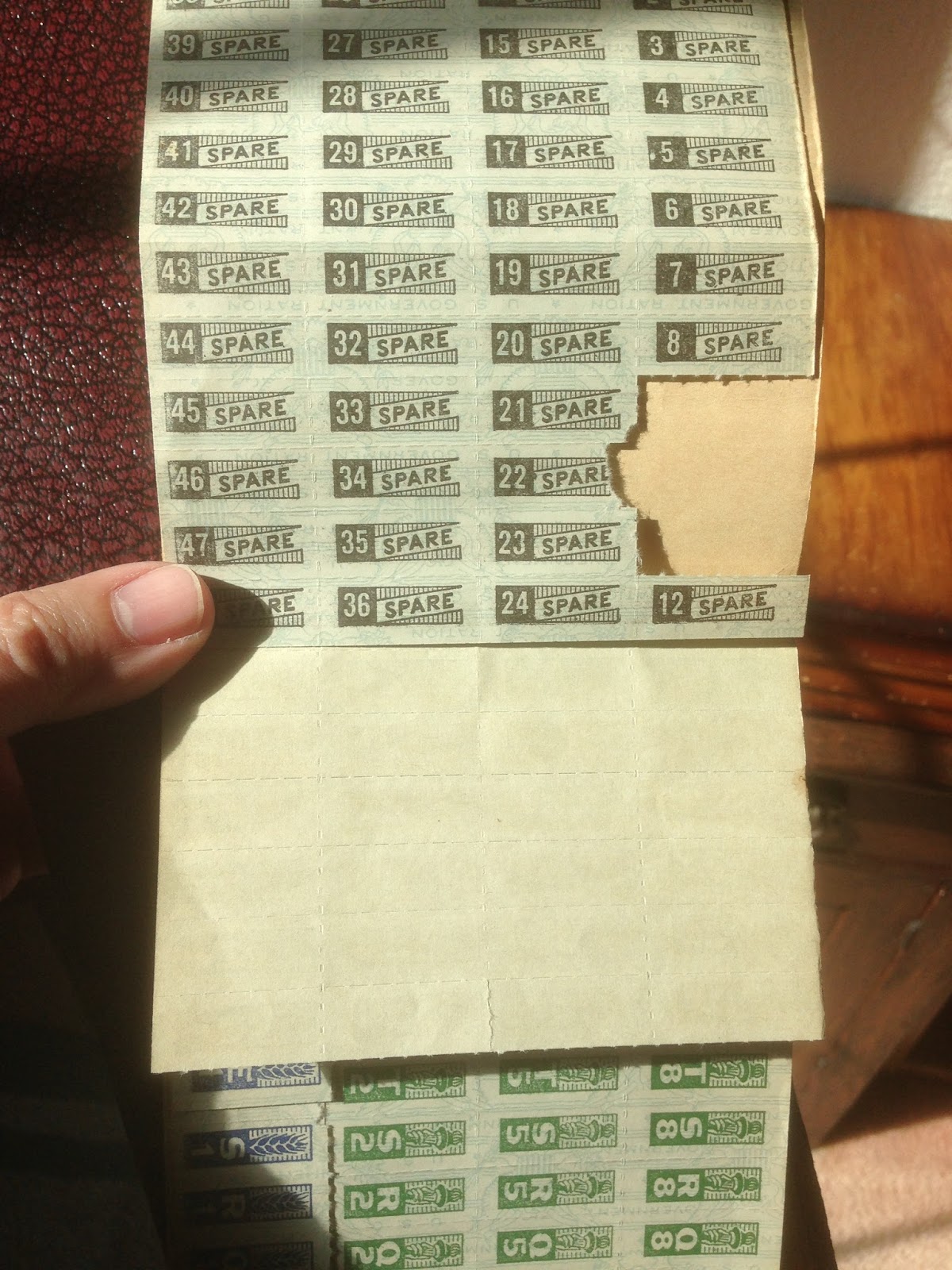
In an old box of family memorabilia, we found my grandparents’ 1943 World War Two ration books.


At the beginning of the Second World War, the Empire of Japan took over the rubber plantations of Southeast Asia. Suddenly, the United States found that all of the rubber we would ever have during the war—the duration of which we could not know—was the rubber that we had in 1941.  In particular, the Armed Forces needed rubber for tires. It became almost impossible for civilians to buy new tires. They did everything they could—including stuffing old newspapers into the tires—to make the old ones last. The government asked for donations of old tires, raincoats, gloves, and garden hoses as sources of rubber.

But the main act the government took to conserve rubber was to lower the speed limit. Starting on October 28, 1942, the Patriotic Speed Limit was 35 miles per hour. Imagine this: driving across the Mojave Desert without air conditioning, at 35 miles per hour. This is what my Mom and Dad had to do when Dad went from basic training at Ft. Sill, Oklahoma, to Camp Roberts, California. Can you imagine America accepting a 35 mph speed limit today?

Actually, we have recently had a conservation-inspired speed limit in the recent past. From 1973 to 1987, the national speed limit was 55 miles per hour. The purpose was to save gasoline, in response to Arab oil embargoes.

Although gasoline conservation was not the main reason for the lower speed limit in 1942, gasoline was in fact rationed: each vehicle could receive only 3-5 gallons per week, and the number on your ration stamp had to match that of the sticker on your windshield.

And don’t even think about buying a car. To get an automobile or appliance, you had to provide written evidence that you really really needed it. Even for typewriters—of which the war effort required a large number.

Meat was also rationed. Each person was limited to two and a half pounds of meat a week. My grandparents lived on a farm and raised their own crops and livestock, so they seldom bought meat, but in cities the meat shortage became very noticeable. In San Diego, Americans flooded into Mexico to buy meat. Then the Mexican government decided to build a big wall to keep out the Americans…wait, that didn’t happen.

The government was very serious about rationing. Each ration stamp book had not only the person’s name but also the age, sex, weight, height, and occupation, so that the person who had the book could be identified as the rightful owner. (Edd Hicks, 64, male, 145 pounds, 5 feet 7, farmer; Stella Hicks, 53, female, 170 pounds, 5 feet 6, housewife.)  And this was the warning label:

WARNING: This book is the property of the United States Government. It is unlawful to sell it to any other person, or to use it or permit anyone else to use it, except to obtain rationed goods in accordance with regulations of the Office of Price Administration. Any person who finds a lost War Ration Book must return it to the War Price Rationing Board which issued it. Persons who violate rationing regulations are subject to $10,000 fine or imprisonment, or both.

Can you imagine anything like this today? An Office of Price Administration? Many Americans would whine and howl, “The government can’t tell me what price to charge for my product! That’s socialism and communism.” The government only barely regulates bank interest rates, which are at a level that no one could have imagined in 1943. And the $10,000 fine (which was probably only used against major profiteers, rather than individuals loaning out a stamp or two to family or friends) was big money in 1943, unlike the fines that the government levies against financial corporations that break the law today—fines that are barely a blip in the profits they make from illegal activities.

Sugar was rationed. Almost the only reason anyone could buy a five-pound bag of sugar was to use for home canning—so that manufactured canned goods could be used for the war effort. This is the message that was on the back of the instructions:

WE MUST GET ALONG WITH LESS SUGAR THIS YEAR BECAUSE—

1. Military needs are high. Each soldier actually consumes twice as much sugar a year as the average civilian now receives.
2. Ships which otherwise might be bringing sugar into the United States are hauling supplies to the battle fronts.
3. Manpower is scarce at sugar refineries and shipping ports.
4. Beet sugar production last year was 500,000 tons short, making the stock of sugar smaller for this year.
5. Last year many people over-applied for canning sugar. We used so much sugar that stocks at the beginning of this year were abnormally low.

DO NOT APPLY FOR MORE SUGAR THAN YOU ACTUALLY NEED FOR HOME CANNING—HELP MAKE OUR WAR SHORT SUGAR SUPPLIES LAST ALL YEAR.

Here is another warning:

VIOLATORS of the Gasoline Rationing Regulations are subject to revocation of rations and criminal prosecution under the laws of the United States (emphasis theirs).


Today, we are not fighting a war against Nazi Germany and the Empire of Japan. But we do face severe challenges. We are fighting smaller wars. We face severe environmental challenges, especially global warming. And we have severe financial challenges as well. It is time for us to all come together and practice creative and joyful frugality. We need to do it for our fellow Americans, our fellow humans in the world, and for the survival of the planet. Many of us are already doing this; each year, more people recycle more things, and energy efficiency becomes more popular. And what should the role of the government be? The government should be the mediator of altruism. The government should level the playing field so that conserving resources is fair for everybody.

But there is a significant and visible minority of people, more in Oklahoma than many other places, who are so pissed off at the thought of conserving resources, and especially that the government might require them to do so for the sake of their fellow citizens, that they drive huge pickup trucks that spew smoke into the air. It is as if they are saying, “This is what I think about the Earth! This is what I think about my fellow human beings! This is what I think about God’s creation!” To them, freedom means the ability to waste the resources of the Earth and to show utter disregard for their fellow humans. If the government were to issue them ration stamps, they would probably get out their guns and start shooting. I believe that if I conserved, these people would come and take whatever I have at gunpoint. I seriously believe this. Not very many people would do this, but enough to submerge us into civil chaos. Had my grandparents, and my father and uncles who were all involved in the war effort, reacted in such a selfish way, the Nazis and the Japanese could have just walked right in and taken us over while we were fighting one another.

We won World War Two largely because of our internal altruism toward one another. I don’t think we have enough of it any more.

Tuesday, July 28, 2015

A Hike in the Santa Fe National Forest, New Mexico

My hike with my daughter and her boyfriend, at about 11,600 feet elevation north of Santa Fe, showed me that I can still push my body to limits that most people my age cannot attain. It felt brutal at the time but almost immediately afterwards the memories were shimmering and beautiful. Here are some of the things we saw.

The trail started off in the douglasfir (Pseudotsuga menziesii) zone and quickly reached the subalpine zone. I didn’t quite make it into the tundra on top of Santa Fe Baldy.


Decades ago, there were large fires, and aspens (Populus tremuloides) quickly filled the spaces. But since there have been, to all appearances, no fires for a long time, the aspens have grown quite large. Each clump of aspen, covering perhaps much of an entire mountainside, is a genetic individual: one tree with hundreds of trunks. These aspens, whether due to age or genetic differences, had tan-colored bark rather than the white bark I have seen so often in the Black Hills. The bark is thin, translucent, and has a layer of green photosynthetic cells under it.


There were many species of subalpine wildflowers. Columbines (Aquilegia) were rare in the shade, and camass lilies (Zigadenus) were more common out in the meadows.


There were lots of mushrooms and mushroom pickers. The pickers were all smart enough to avoid the deadly Amanita:


A huge storm chased us back to the car for the last few hundred feet of our trip.


I have seen montane and subalpine forests in California, Arizona, Nevada, Washington, Montana, South Dakota, Colorado, and Utah; they all have many features in common but each is unique. We cannot save wild places by just fencing off a token forest or two.