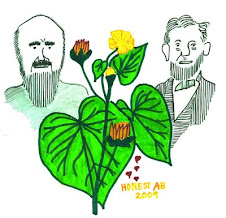
John
Muir hiked around in the Sierra Nevada Mountains and climbed a lot of peaks. He
wrote about them also. Many of us think of him as the original and the most
powerful voice for conservation in California. He and his associates were
successful in saving Yosemite Valley from being turned into a reservoir, but
lost the battle for nearby Hetch Hetchy. He could be considered the granddaddy
of American conservation. As we face the biggest ecological threats since the
Cretaceous Extinction, we should consider how John Muir accomplished what he
did.

John
Muir did not argue that setting aside wilderness was a good investment for
society. He did not base his life on the conviction that we need to save wild
biodiversity because it might come in handy for agriculture or forestry, or
because trees protect watersheds. Thousands of people since Muir’s time,
including me, have made this argument in books. Muir’s enthusiasm was based
almost entirely on his love of the forests and mountains. If you read The
Mountains of California, Muir’s Swedenborgian ecstasy is unmistakable in
every paragraph. He loved the natural world so intensely that his thrill was
contagious to everyone who knew him and to all who continue to read his
writings.
Muir
was the kind of man who would visit one of his friends in a cabin in the
mountains; then, when a storm began, instead of staying inside, he would run
out into the storm and experience the fulness of its power. He would watch the
powerful winds bend the trees, some of them almost to the ground. He claimed it
was no less safe to be outside in a storm than inside a cabin. Not only that,
but during the storm he climbed the highest nearby peak, and climbed to the top
of the tallest tree on that peak! He was the kind of man who would, without
very much preparation, decide to go climb a mountain: running, leaping, and
grasping onto vertical cliffs. When he found himself stuck in a place where he
thought he would surely die, his strength was renewed and he scrambled to the
top of the peak. The kind of energy that comes out of people in extremis
would pour out of Muir all the time.
Muir
did not look; he beheld. One way he did that was by thinking about the
processes that were going on behind the scenery. He did not just see glacial
lakes; he saw the processes by which glacial lakes were gradually filled with
sediment and vegetation, and how lakes connected by streams were different from
lakes isolated on the tops of granite peaks.
Muir
saw a world that has vanished. He saw Native Americans hunting and foraging in
the mountains, before the campaign to exterminate them proved largely
successful. The California legislature put a bounty on Indians. Some, such as
the Chumash, became extinct as tribes, though their genes live on; others, such
as the Yokuts, had at least some cultural continuity. Moreover, the major
disturbance that Muir saw was shepherds bringing sheep through the mountains,
which damaged the vegetation and trampled the clear water of the lakes. He did
not imagine the extent of disturbance that we see today even in the most
protected places.
Muir’s
writing was not, from my viewpoint as a writer, very good. He used every
possible superlative and simile and metaphor for everything from a mountain
peak to a dormant brown sedge. My soul feels tuckered-out after reading just a
page of his book. And when he started writing about squirrels, watch out! I can
do little better than to quote some of his description of the Douglas squirrel:
“He
threads the tasseled branches of the pines, stirring their needles like a
rustling breeze; now shooting across openings in arrowy lines; now launching in
curves, glinting deftly from side to side in sudden zigzags, and swirling in
giddy loops and spirals around the knotty trunks...punctuating his most
irrepressible outbursts of energy with little dots and dashes of perfect
repose. He is...a fiery, sputtering little bolt of life, luxuriating in quick
oxygen and in the woods’ best juices...”
Muir
made no attempt whatever at scientific accuracy. He just jotted down his
observations, and how he felt about them; he had no time for scientific
description—he used his time instead to make more observations. Sometimes he
even got cause and effect backwards. Consider this passage: “The mountain
winds, like the dew and rain, sunshine and snow, are measured and bestowed with
love on the forests to develop their strength and beauty.” I think he
really meant this; he thought the wind blew as it did because it loved the
trees. We usually think of the little trees at timberline to have the shape
they do because of their responses to the wind, over evolutionary and
physiological time; but to Muir, the winds blew strong because that is what the
little timberline trees need. But, you see, he left the scientific description,
just as he left the practical values of the trees, to other people. He was too
busy being ecstatic.
And
it is that ecstasy that made his work successful, and that is why we remember
him.
As
far as I can determine from his writings, he lived entirely off of tea and
bread. I doubt, however, that this was his entire source of physical energy.
But the thrill of nature seemed to be his entire source of mental and spiritual
energy. Nothing less than this, on our part, can get modern people to save the
natural world. People have to love the natural world, which means they have to
see us love it. What that means is, if I see you out on a nature trail, I am
going to walk up to you and start talking about the plants, and from there, the
entire ecosystem. You might think I’m a little crazy, but you might start
loving the natural world too.
This
does not mean, however, that Muir never performed scientific experiments. The
next essay will be about a whimsical experiment that Muir performed on the
animals of the forest.