Showing posts with label forests. Show all posts

Friday, February 13, 2026

European Forests Also Need Control Burns

…but are not getting them. European forests have grown up in thick stands of saplings, just like most American forests. In North America, the Natives kept the forest undergrowth cleared away, which benefited agriculture and hunting, by the controlled use of fire, as I explain in chapter 2 of my recent book Forgotten Landscapes. When European diseases and conquest killed off ninety percent of Native populations in America, the forests shifted from bountiful productivity to being “a forest of sticks” choked by undergrowth.  Native fires were an essential part of what a “natural” forest should be like in North America.

It appears to me that the same is true in Europe. It is likely that the tribal peoples of Europe, before (and after?) Roman conquest, burned their forests just as Native Americans did theirs. The forest preserves we see in America, and in Europe, today are not “natural” but have resulted from fire suppression in recent centuries. This would be true even of the last “virgin forest” in Europe,  Białowieża in Poland.

I explored one of the last fragments of pre-industrial Rhineland forest in France earlier this summer. It is (what passes in Europe for) an extensive forest southeast of Strasbourg. I hiked around on just a portion of its extensive system of trails. Beech trees (Fagus sylvatica) dominated the canopy and its seedlings were abundant on the forest floor. Maples (Acer pseudoplatanus) dominated the forest floor and had some canopy trees, along with two species of linden (Tilia cordata and T. platyphyllos). There were a lot of shrubs, especially the field maple (Acer campestre), dogwood (Cornus mas), hazelnut (Corylus avellana), and hawthorn (Crataegus monogyna).

This forest had been undisturbed for a long time—the beeches were large and tall. But it was not that long ago, perhaps a century and a half, when the forest had been cut down. In a desperate but successful attempt to control the resulting soil erosion, the French government planted conifers (in the lowlands, Norway spruce, and on the hillsides Douglas fir from America) which persist in a few places, remnants of once successful forestry but now ceding their dominance to hardwoods.

It was a peaceful and wonderful place to hike. But it was not natural. In my book I wrote about Native inhabitants being an essential part of the “natural” landscape in America. And it appears that the same is true in Europe. I suspect this is a general pattern. Sam Goldwyn is said to have quipped that wilderness is “where the hand of man has never set foot.” But I think this may not be true not only in America but anywhere else. Humans have always been, ever since we mastered fire, an important factor in the operation of entire landscapes all over the world.

The only alternative to small, frequent fires is large, perhaps equally frequent fires. This is what is happening in America, where the lack of control burns has allowed huge forest fires to get started especially in the west. But the same is true where I now live in France. With increasing frequency, the forests of southern France burn in the hot, dry summers. With global climate change, the forests where I now live in northern France will also burn more frequently. The problem will take care of itself, though not in a way we would like.

Sunday, January 5, 2020

The Secret to John Muir's Success


John Muir hiked around in the Sierra Nevada Mountains and climbed a lot of peaks. He wrote about them also. Many of us think of him as the original and the most powerful voice for conservation in California. He and his associates were successful in saving Yosemite Valley from being turned into a reservoir, but lost the battle for nearby Hetch Hetchy. He could be considered the granddaddy of American conservation. As we face the biggest ecological threats since the Cretaceous Extinction, we should consider how John Muir accomplished what he did.


John Muir did not argue that setting aside wilderness was a good investment for society. He did not base his life on the conviction that we need to save wild biodiversity because it might come in handy for agriculture or forestry, or because trees protect watersheds. Thousands of people since Muir’s time, including me, have made this argument in books. Muir’s enthusiasm was based almost entirely on his love of the forests and mountains. If you read The Mountains of California, Muir’s Swedenborgian ecstasy is unmistakable in every paragraph. He loved the natural world so intensely that his thrill was contagious to everyone who knew him and to all who continue to read his writings.

Muir was the kind of man who would visit one of his friends in a cabin in the mountains; then, when a storm began, instead of staying inside, he would run out into the storm and experience the fulness of its power. He would watch the powerful winds bend the trees, some of them almost to the ground. He claimed it was no less safe to be outside in a storm than inside a cabin. Not only that, but during the storm he climbed the highest nearby peak, and climbed to the top of the tallest tree on that peak! He was the kind of man who would, without very much preparation, decide to go climb a mountain: running, leaping, and grasping onto vertical cliffs. When he found himself stuck in a place where he thought he would surely die, his strength was renewed and he scrambled to the top of the peak. The kind of energy that comes out of people in extremis would pour out of Muir all the time.

Muir did not look; he beheld. One way he did that was by thinking about the processes that were going on behind the scenery. He did not just see glacial lakes; he saw the processes by which glacial lakes were gradually filled with sediment and vegetation, and how lakes connected by streams were different from lakes isolated on the tops of granite peaks.

Muir saw a world that has vanished. He saw Native Americans hunting and foraging in the mountains, before the campaign to exterminate them proved largely successful. The California legislature put a bounty on Indians. Some, such as the Chumash, became extinct as tribes, though their genes live on; others, such as the Yokuts, had at least some cultural continuity. Moreover, the major disturbance that Muir saw was shepherds bringing sheep through the mountains, which damaged the vegetation and trampled the clear water of the lakes. He did not imagine the extent of disturbance that we see today even in the most protected places.

Muir’s writing was not, from my viewpoint as a writer, very good. He used every possible superlative and simile and metaphor for everything from a mountain peak to a dormant brown sedge. My soul feels tuckered-out after reading just a page of his book. And when he started writing about squirrels, watch out! I can do little better than to quote some of his description of the Douglas squirrel:

“He threads the tasseled branches of the pines, stirring their needles like a rustling breeze; now shooting across openings in arrowy lines; now launching in curves, glinting deftly from side to side in sudden zigzags, and swirling in giddy loops and spirals around the knotty trunks...punctuating his most irrepressible outbursts of energy with little dots and dashes of perfect repose. He is...a fiery, sputtering little bolt of life, luxuriating in quick oxygen and in the woods’ best juices...”

Muir made no attempt whatever at scientific accuracy. He just jotted down his observations, and how he felt about them; he had no time for scientific description—he used his time instead to make more observations. Sometimes he even got cause and effect backwards. Consider this passage: “The mountain winds, like the dew and rain, sunshine and snow, are measured and bestowed with love on the forests to develop their strength and beauty.” I think he really meant this; he thought the wind blew as it did because it loved the trees. We usually think of the little trees at timberline to have the shape they do because of their responses to the wind, over evolutionary and physiological time; but to Muir, the winds blew strong because that is what the little timberline trees need. But, you see, he left the scientific description, just as he left the practical values of the trees, to other people. He was too busy being ecstatic.

And it is that ecstasy that made his work successful, and that is why we remember him.

As far as I can determine from his writings, he lived entirely off of tea and bread. I doubt, however, that this was his entire source of physical energy. But the thrill of nature seemed to be his entire source of mental and spiritual energy. Nothing less than this, on our part, can get modern people to save the natural world. People have to love the natural world, which means they have to see us love it. What that means is, if I see you out on a nature trail, I am going to walk up to you and start talking about the plants, and from there, the entire ecosystem. You might think I’m a little crazy, but you might start loving the natural world too.

This does not mean, however, that Muir never performed scientific experiments. The next essay will be about a whimsical experiment that Muir performed on the animals of the forest.

Friday, April 7, 2017

An Environmental Theme in American Literature: The Awakening Land

I recently finished reading Conrad Richter’s trilogy, The Awakening Land, which he finished in 1950. The three novels are about the settlement of Ohio: The Trees, about how pioneers carved out survival in a thick forest; The Fields, about how the pioneer settlements evolved into a little village; and The Town, how the little village became a major city in Ohio. The trilogy followed the life of a woman named Sayward (Saird) Luckett, later Wheeler, who grew up in a cabin but by the end of her life lived in a rich mansion. See a more detailed summary here.

At first, I was disaffected by what seemed to be the author’s approach. Sayward loved to cut trees down and to see others cut them down, for they represented a fearful primordial forest. (The primordial forest at the beginning of the trilogy, with leaves so dense that hardly any light penetrated throughout the forest, never actually existed. There were disturbances before the arrival of pioneers, especially fires set by nature or by the Natives.) Even into the second novel, she was glad to see the trees out of the way. But I should have known to expect something different before the end. Richter lived at a time when conservation awareness was beginning to grow in America. And sure enough, when Sayward was old, she realized that she missed the trees and the peaceful shade that they brought. She planted some trees by her mansion, some of the few trees in the city, and when she was dying she had her bed turned toward the window to see them. She regretted taking the land away from the trees: “Sometimes she wished she could give them back their land, for it was she who had taken it from them.”

Even the choice of the title, The Awakening Land, implied that nature is asleep until humans roust it into usefulness. But perhaps Richter intended this to be irony.

Although beautifully written, the novels seemed primarily episodic. Some of these episodes were funny, and some were beautiful: the chapter “Rosa’s Rainbow” was one of the best short pieces I have read. The only overarching plot of the trilogy was that the forest gave way to human progress. There was no structural conflict to be resolved.


The third novel did have a major plot: the romance that developed over many years between Chancey Wheeler, Sayward’s youngest and sickly son, and the frail, quiet, and thoughtful Rosa Tench. Everybody but them knew that they were half-siblings. Rosa was born from an affair that Portius Wheeler, the father, had with a schoolteacher when he was the master. But the two young people knew only that the adults, for reasons not explained to them, condemned their romance. I found myself hoping that this would reach a satisfactory resolution. Rosa had to live with a poor family and never received recognition or even a single word from the rich Wheeler family. I was hoping they would invite her into their home. This did not happen. The resolution of this plot was gruesome and occurred well before the end of the novel, which, as a direct result of this, I did not want to read. Had I known what would happen, I might not have read it. But it remains a beautiful piece of literature and a testament to the development of the American attitude toward the land, which everyone except, at the end, the main character, assumed was progress.

Monday, April 3, 2017

Springtime in Oklahoma, or, Will Molly Eat It?

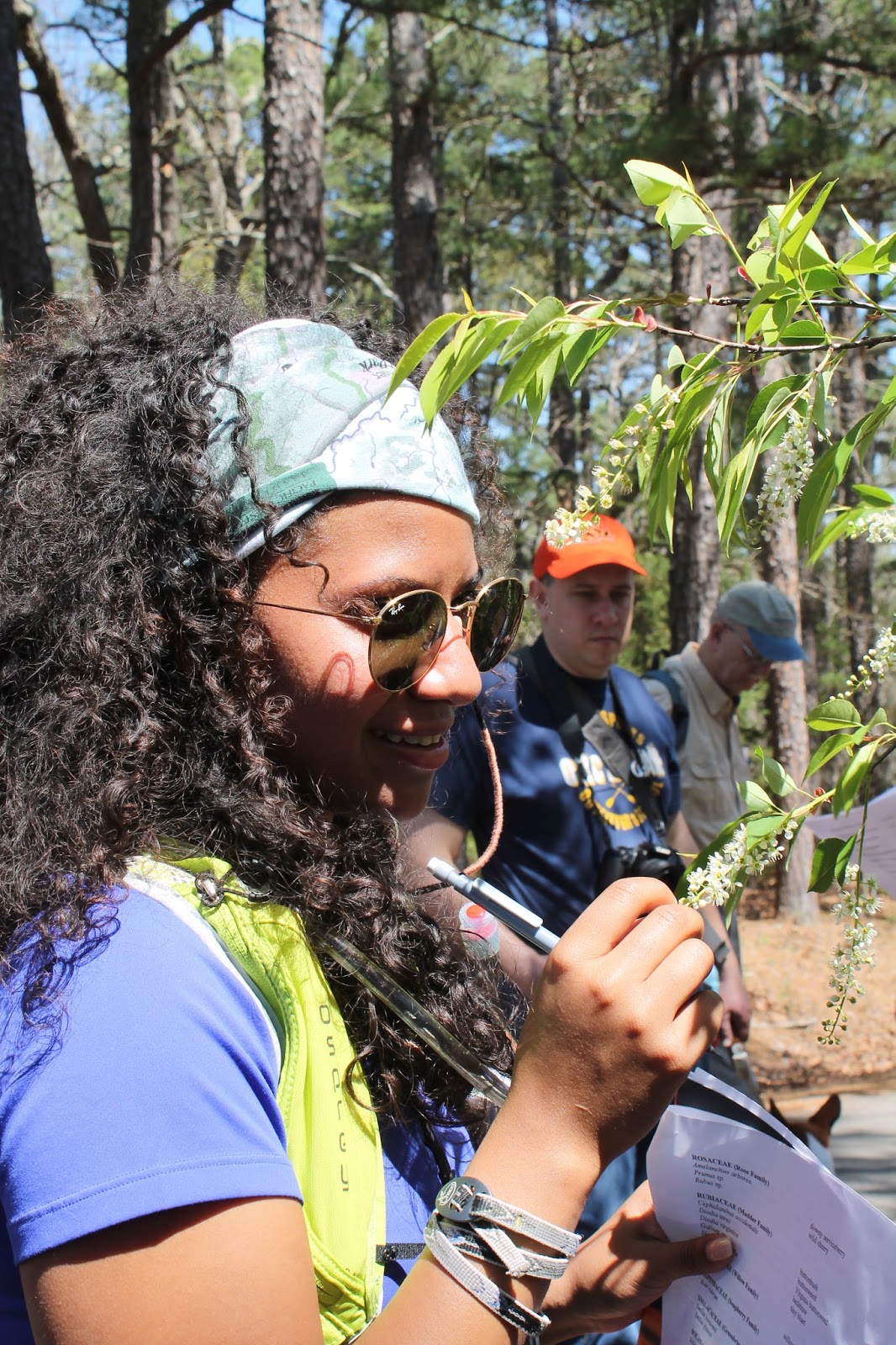
There were plenty of visitors to Robber’s Cave State Park on April 1. This is not one of the state parks that the Oklahoma government, in its desperation to cut everything except oil corporation subsidies and the budgets of the legislature and governor, plans to close. Just a few of the visitors came for the Spring Field Meeting of the Oklahoma Academy of Sciences. Few, but appreciative.

We (faculty and students) were surrounded by nature. Oh, wait, not quite. The forests were mostly shortleaf pine (Pinus echinata) and post oak (Quercus stellata). But the shortleaf pines have nearly all, at least in this part of the state, hybridized with loblolly pines, which have been planted for lumber and pulp production. And every bit of the forest has been affected by human impact, including fire suppression. But it was a nice spring day and we were seeing things that were almost natural. The oaks were just opening their catkins and unfurling a few baby leaves. Post oaks dominate the poor, dry soils of these mountains.

Gloria Caddell, at the University of Central Oklahoma, led the botany field trips.


We didn’t even get out of the parking lot before we found plants that were interesting in more than one way. Gloria explained how to distinguish the three species of violets and how to distinguish poison ivy from fragrant sumac. But I explained that you could eat violets. I convinced Molly, a student from my university (Southeastern Oklahoma State University), to try one. After she was finished looking at a black cherry in bloom, I convinced her to eat some fading redbud flowers too. Last of all, I got her to eat some greenbriar buds.


We explored different habitats within the park. Closer to the creek, we found red maple, bur oak, and black oak. At the edge of the water we saw a birch tree with its male and female catkins. The male catkins dangle from the branch behind the female flowers. This arrangement improves the chances that the pollen that comes to the female flowers is from a different tree rather than the same one. We also saw several wildflower species, some spectacular like the plains wild indigo, Baptisia bracteata.

Baptisia is one of the leguminous plants that produce nitrogen-fixing nodules, as mycologist Steve Marek explained. It is always good to have people from different areas of study together on the same field trip.


And, as always, leave it to Gloria to open our eyes to see the tremendous biodiversity of a trampled lawn in a picnic area. As future high school teacher Lainee Sanders discovered, there was not one but two species of buttercups in the picnic area. (The dog appeared to not care about the flowers.)


There were some high school teachers on the trip. Melissa Bates brought high school students from Oklahoma City. They looked closely at little Antennaria flower clusters, perhaps never having realized that there were boy antennarias and girl antennarias growing together.


You never know where you are going to find moss growing. We found some growing on an old glove, sporophytes and all!


Chad King, a botanist at University of Central Oklahoma, gave an evening presentation about dendrochronology. Tree rings are a storehouse of information about all the tree’s experiences, therefore about things such as climate and fire history. He displayed one of his specimens, a very old tree that had had an eventful life.


Almost everything we saw was something that could so easily have been overlooked if we had been hiking fast or jogging. We need these times of slowing down, looking closely, even nibbling, under the guidance of those among us who know a lot about hidden biodiversity.