Showing posts with label wildflowers. Show all posts

Tuesday, May 26, 2026

Glass Cathedral, a Religious Novel with a Lot of Science

Stan Rice’s novel Glass Cathedral deals with big religious questions not in the form of serious debate but in good-natured banter among three of the main characters, Dan (the atheist), Emilio (the evangelical Christian), and Misty (the Christian who has deep and serious doubts about her religion). I have written in my other blog about the religious aspects of this novel.

This is the author’s summary from Amazon:

The newspaper staff writers of a small desert town assume the strange light in the sky is merely sunlight refracted by ice crystals: atheist Dan Hardy; the spiritually-searching Misty Barbour; and even the confirmed Christian editor Emilio Villanueva. Then the light turns out to be God—maybe. This is enough to make Misty leave her doubts behind and marry Emilio. Dan, who was hoping to win Misty’s affection, is skeptical, especially since God showed up on no photographic images, and everyone in town saw God differently. The government authorities declare the light was a mass hallucination.

Emilio and Misty raise money to build a glass cathedral in the desert, near the place they think God appeared. When thousands of people come for the inaugural celebration, a storm pulls the glasshouse into the sky. Misty gets trampled. At the end, Emilio and Misty, who is now disabled, conclude that God’s work is to help people, not to build a cathedral, and even Dan agrees.


 What I want to say in this science blog is that Dan arrives at his atheism thoughtfully and at great personal cost.

His interest in science began when, as a boy, he saw a horsehair worm discharged from the anus of a dead cockroach. This got him interested in reading everything he could about biology and ecology, especially parasitism, which earned him the name Buttworm Boy. In a natural world pervaded by evolutionary mercilessness, Dan sees no room for a Creator.

His atheism is challenged when he meets, becomes attracted to, and becomes physically entangled with a Mormon girl, Margaret. Margaret is not an enthusiastic Mormon, but wants Dan to join her to raise nice kids. In this way, Dan discovers that religion does not have to be correct—as Mormonism is clearly contradicted by history—in order to fill a role in a person’s life. This, however, is not enough for him.

Another main character, Misty, is a dedicated Christian, at least until her comfortable religious world is shattered by the assassination of her fiancĂ©. The main event of the novel—God appearing in the sky out in the California desert, or not—restores her faith. But what is it that brings Misty the Christian and Dan the atheist together for meaningful discourse? It is science, of course. They see, then carefully examine, the desert wildflowers, Dan as a scientist and Misty because Jesus said to consider the lilies of the field. That is, to look closely, carefully, and thoughtfully at them. This is something that very few Christians actually do.

The novel also contains other scientific plot elements. In the glass cathedral that Misty and her husband Emilio build out in the desert, a giant band-o-rama has hundreds of tubas that happen to play the resonant frequency of the building, so that it shatters and blows away like a giant jellyfish in a desert storm.

I think the author has a lively, almost childlike, sense of wonder, at the lilies of the field and the surprises that wait within the laws of physics. I think readers of this blog would enjoy Glass Cathedral.

Monday, April 3, 2017

Springtime in Oklahoma, or, Will Molly Eat It?

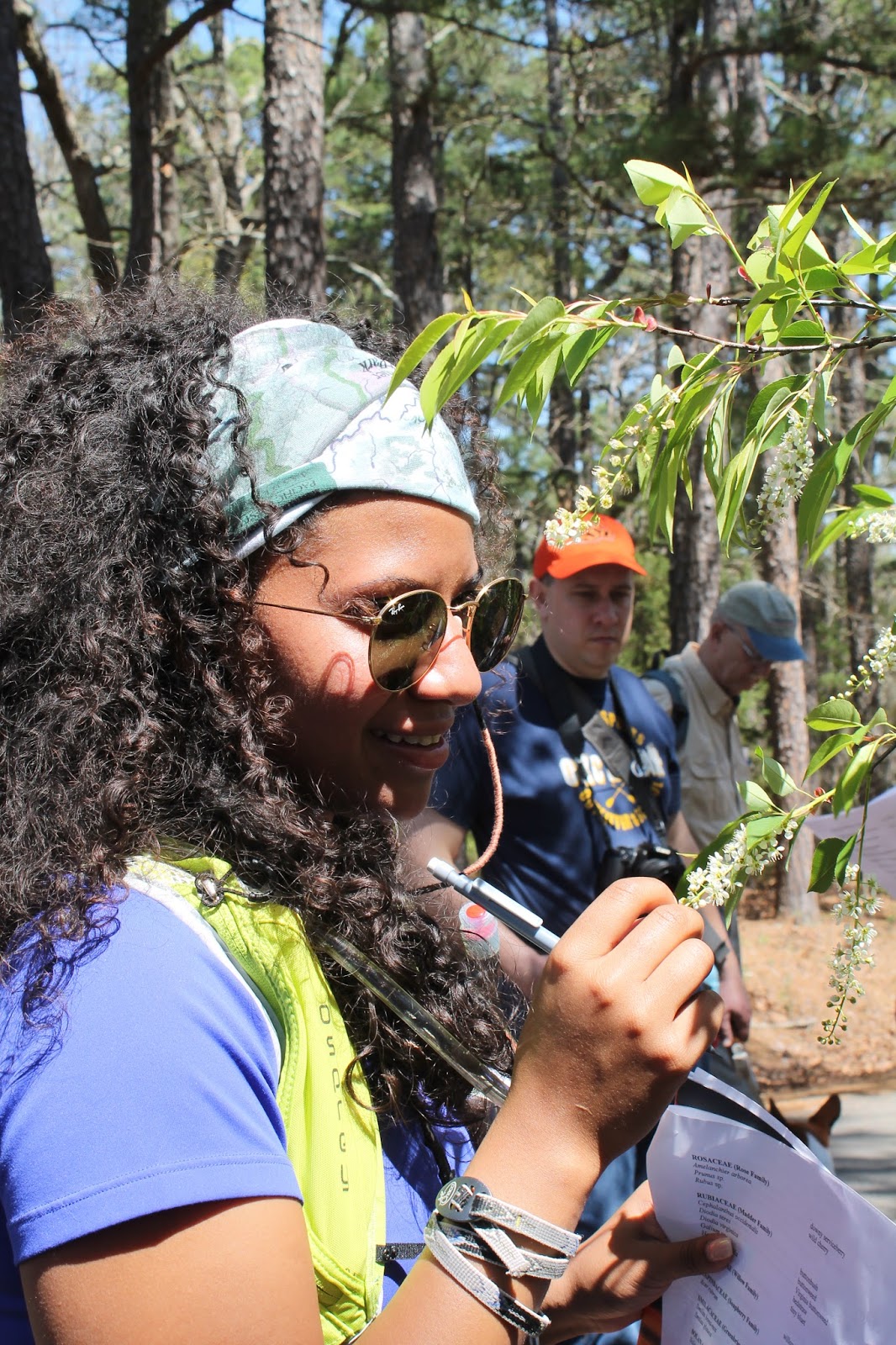
There were plenty of visitors to Robber’s Cave State Park on April 1. This is not one of the state parks that the Oklahoma government, in its desperation to cut everything except oil corporation subsidies and the budgets of the legislature and governor, plans to close. Just a few of the visitors came for the Spring Field Meeting of the Oklahoma Academy of Sciences. Few, but appreciative.

We (faculty and students) were surrounded by nature. Oh, wait, not quite. The forests were mostly shortleaf pine (Pinus echinata) and post oak (Quercus stellata). But the shortleaf pines have nearly all, at least in this part of the state, hybridized with loblolly pines, which have been planted for lumber and pulp production. And every bit of the forest has been affected by human impact, including fire suppression. But it was a nice spring day and we were seeing things that were almost natural. The oaks were just opening their catkins and unfurling a few baby leaves. Post oaks dominate the poor, dry soils of these mountains.

Gloria Caddell, at the University of Central Oklahoma, led the botany field trips.


We didn’t even get out of the parking lot before we found plants that were interesting in more than one way. Gloria explained how to distinguish the three species of violets and how to distinguish poison ivy from fragrant sumac. But I explained that you could eat violets. I convinced Molly, a student from my university (Southeastern Oklahoma State University), to try one. After she was finished looking at a black cherry in bloom, I convinced her to eat some fading redbud flowers too. Last of all, I got her to eat some greenbriar buds.


We explored different habitats within the park. Closer to the creek, we found red maple, bur oak, and black oak. At the edge of the water we saw a birch tree with its male and female catkins. The male catkins dangle from the branch behind the female flowers. This arrangement improves the chances that the pollen that comes to the female flowers is from a different tree rather than the same one. We also saw several wildflower species, some spectacular like the plains wild indigo, Baptisia bracteata.

Baptisia is one of the leguminous plants that produce nitrogen-fixing nodules, as mycologist Steve Marek explained. It is always good to have people from different areas of study together on the same field trip.


And, as always, leave it to Gloria to open our eyes to see the tremendous biodiversity of a trampled lawn in a picnic area. As future high school teacher Lainee Sanders discovered, there was not one but two species of buttercups in the picnic area. (The dog appeared to not care about the flowers.)


There were some high school teachers on the trip. Melissa Bates brought high school students from Oklahoma City. They looked closely at little Antennaria flower clusters, perhaps never having realized that there were boy antennarias and girl antennarias growing together.


You never know where you are going to find moss growing. We found some growing on an old glove, sporophytes and all!


Chad King, a botanist at University of Central Oklahoma, gave an evening presentation about dendrochronology. Tree rings are a storehouse of information about all the tree’s experiences, therefore about things such as climate and fire history. He displayed one of his specimens, a very old tree that had had an eventful life.


Almost everything we saw was something that could so easily have been overlooked if we had been hiking fast or jogging. We need these times of slowing down, looking closely, even nibbling, under the guidance of those among us who know a lot about hidden biodiversity.


Tuesday, May 19, 2015

The Best Time of Year in Oklahoma


May in Oklahoma is the most beautiful time to be outdoors. The summer heat has not yet begun, and all the flowers are open. Sure, you have to go out between rains to see them, and you have to dodge a few tornadoes, but this is the time of year that makes me glad to live in Oklahoma. Come about August and I’m not so sure.

This is why the Oklahoma Native Plant Society chooses mid-May as the time for the annual Wildflower Workshop. On Saturday, May 16, a few dozen wildflower lovers took a field trip to three places in south central Oklahoma.

The first was one of the last remaining native prairies in south central Oklahoma. On U.S. 70 west of Durant, it used to be called Carpenter’s Meadow until it was divided up for “development.” Most people saw it as a green and brown square that was a mere canvas for construction. This includes the huge new Methodist Church. However, two of the church members (Dr. Connie Taylor, botanist, and Dr. Gordon Eggleton, physical scientist, both retired from Southeastern Oklahoma State University) are scientists and they managed to convince the church to not convert every last square meter of the property into turf. It was Connie who led the field trip on this little patch of prairie.


After some light rain, the ground was quite soggy, but this did not keep the native plant enthusiasts from walking all over the prairie to find dozens of plant species such as the green milkweed Asclepias viridis (a milkweed that is beautiful even when the flower is not yet open) and Tephrosia virginica, a legume.


The prize, of course, was the prairie orchid Calopogon oklahomensis.


This patch of prairie is threatened not only by churches and businesses but by fracking as well. Notice the fracking well in the background behind this white larkspur Delphinium carolinianum.


Wet and muddy, we got in a bus and went to Ft. Washita, an old fort that was built by the federal government to protect the Chickasaw tribe, which it had forced out of their homeland and into Oklahoma, from the Caddo tribe which was already in Oklahoma. The rocks were crammed with mollusk fossils, as in photos I have posted previously on this blog. It was not long before we were looking for native plants, even right down in the grass beside the picnic tables. ONPS past president Adam Ryburn is always on the lookout for females; this time, it was females of the buffalo grass Bouteloua (formerly Buchloe) dactyloides.


Unlike most grasses, buffalo grass has separate male and female plants.


Down in a low trough in the turf, in the middle of a cemetery full of unmarked Chickasaw graves, there was what looked like little weedy plantains. But a closer look revealed that they were Ophiglossum adder’s-tongues, which are fernlike plants. I took no photos because the lawn mower had not left much.

Our last stop was at the Blue River in Johnston County. Because the granite underneath has not eroded much, the soil is thin and well-drained, which promotes a profuse growth of wildflowers, and allows the Blue River to be relatively clear and have rapids, unlike the usual lazy Oklahoma river that flows past muddy banks formed from limestone soil. The most noticeable flowers were the yellow Coreopsis lanceolata and the deep red Gaillardia pulchella. Down by the river, however, you can also find some magnificent Tradescantia flowers.


Thin gravelly soil on top of the granite boulders allows small plants to grow that would otherwise be shaded out by larger plants. These include the stonecrop Sedum, a flowering plant; velvety smooth mosses; and thin tangles of clubmosses.


A forest fire had destroyed the whole forest in 2011, but many of the trees and shrubs are growing back as thick clumps. Beautiful fungi were sporulating from the dead wood.


Recent rainfall has sent the Blue River into flood stage. However, seaside alders (Alnus maritima, one of the rarest tree species in the world) bravely held their ground (literally! They create the islands they live on) in the roiling waters.


This portion of the Blue River has not been known to have arrowroot (Sagittaria), but some corms of arrowroot had been washed in by the floodwaters and might start a new population there. Forests recover well from, and thrive in the face of, fires and floods. But the prairies cannot survive when the soil is scraped away and turned into parking lots and fracking fields.

Wednesday, September 10, 2014

My Fun Evolution Trip Part Eight: Tundra and Meadow

I was driving from Bozeman, Montana toward Coeur d’Alene, Idaho, which should have been a relatively short drive. But I looked toward the south of I-90 and saw snowy peaks. And I wanted to hike to the tundra. So I took a highway south from Bozeman to the resort town of Big Sky. I kept driving past all the resorts where people spent a lot of money to do things I consider boring. At the end of the road there was a crowded parking lot for a trail leading to the Lee Metcalf Wilderness and Spanish Peaks. I took a little water, and my camera, and started walking. During the next four and a half hours of vigorous hiking, sometimes running, my body burned about 1500 calories.

For a long ways, I walked through rocky subalpine meadows. Meadows are not the same as tundra, though they intergrade into one another. Meadows are open areas, associated with creeks, surrounded by forests of more or less full sized conifers, while tundra is an open area underlain by permafrost, interspersed with small krummholz trees. They are not the same, but it is understandable to confuse them. (What is not understandable is for Garrison Keillor to describe the tallgrass prairie of Minnesota as tundra.) One of the things tundra and subalpine meadows have in common is that they have a short growing season, and if the wildflowers are to bloom, they have to do it all at once, which just happened to be late July when I and hundreds of others were visiting.

For most of the trail, I was surrounded by meadows, characterized by some of the following plants. If you don’t like lists of plants, just skip ahead, but I include them for search engines to find.

Potentilla
Geraniums (both red G. viscosissimum and white G. richardsoni)
Mertensia bluebells
Balsamroot (Balsamorhiza), with inflorescences like huge sunflowers
Arnica, with smaller inflorescences
Cow parsnip of the genus Heracleum, probably H. sphondylium, introduced from Europe
Yellow columbines (Aquilegia)
Larkspurs (Delphinium)
Bright red Indian paintbrushes (Castilleja)
Prairie smoke (Geum), in fruit
Thalictrum
Forget-me-nots (Myosotis)
Bistort (Persicaria bistorta)

Elderberry (Sambucus)
Just try to imagine all the colors riotously thrown together! These photos will not do full justice.


Meadow flowers, with red geranium in the foreground.


Meadow flowers, with cow parsnip in the foreground.


Indian paintbrush from a subalpine meadow.


Columbine from a subalpine meadow.


Geranium viscosissimum from a subalpine meadow.

Not far from the trail, my fellow hikers and I saw a moose. It was the only moose I have ever seen and may be the only one I ever see.


There were also nutcrackers flying around, and I was delighted to tell the people who were watching them about how nutcrackers plant white pine seeds amidst the rocks.

And then, around one last bend, just before I was about to give up and turn around, I found a flat tundra with an utterly blue lake and patches of July snow. There was almost no overlap in plant species with those in the meadow. There were buttercups, a different species of lupine, lilies, and sedges. They were only about 15 centimeters tall, in contrast to the half meter height of the meadow plants.


Everyone on the trail seemed to be cheerful, and I had wonderful conversations with a large number of them. When I headed back down, I encouraged those who were still headed up that, when they reached the blue lake at the true tundra, they would feel like they were in heaven, if heaven was windy and chilly even in July. “May the forest be with you!” I told them, a phrase also on my T-shirt. I was as happy cheering on my fellow hikers as with the hiking itself.