Showing posts with label World War II. Show all posts

Friday, February 25, 2022

Or Would They?


Obviously, or so we think, most Republicans would not take violent actions to secure permanent control over America. But maybe they would not need to. All they would have to do is sigh, look the other way, and let the extremists within their Party take violent actions.

After all, it is unlikely that most Germans actually shared Hitler’s passion for eradicating the Jews. But especially after Hitler became dictator in 1933, nobody would openly say so. Since there were so many domestic spies, they would not say so privately either. Most, but not all, youth were Hitler Youth. There were 22 assassination attempts on Hitler, not counting the “several” in early World War II. This culture of terror continued in East Germany, as part of the Soviet bloc. A Soviet bloc which, in the last couple of days, it seems that Vladimir Putin wants to re-establish.

During the War, many Germans wished they could get away from Hitler’s command, but by then they were trapped. I read Paul Brickhill’s The Great Escape, which was made into a fantastic movie in the 1960s. The Allied prisoners were constantly digging escape tunnels, and the Nazis were constantly searching for them. But I got the impression that the Nazi commanders weren’t searching very hard. They wanted to look to their superiors as if they were working hard to catch escapees. They tried to crush tunnels, they inserted rods, they implanted microphones, they hired spies to slip into the rafters or under the huts. If they did catch an escapee, this would make them look good to their superiors. But that is all they really wanted. When they did catch an escape tunnel, they just shut it down. The only punishment they gave to the would-be escapee was to put him in the “cooler” for a couple of weeks. One of the Nazi commanders actually told Brickhill, in prison, to not blame them for what the Gestapo did. Brickhill clearly communicated the idea that the Nazi commanders of prison camps didn’t want to do this job.

My uncle was in the European theatre of World War II and told us all a war story which, in retrospect, seems a little embellished. But not completely. He was guarding a group of prisoners at the end of the war. Most of the German soldiers seemed relieved that they had been captured. All except the SS officers. They were absolutely crazy. My uncle could tell that there was one SS officer among the prisoners. He was the one who attacked and tried to kill my uncle in what sounded to me like a kabuki drama. My uncle shot him eight times. When asked to explain to his superior why he had done this, he said, “Seven wasn’t quite enough, and I didn’t have nine bullets.” Anyway, the point was clear: only the crazy SS troops really believed in the Third Reich.

Most Republicans can, when the dictatorship is established, say that we should not blame them for what the extremists have done. And if there is a Judgment at Nuremberg style inquiry after the fall of the Republican dictatorship, only the leaders will be convicted.

Most Republicans do not worship Trump, at least anymore. But would they go along with those who do?

Natural selection favors the fitness of genes in their environments. In humans, natural selection also occurs on the level of ideas within society. Fitness is not an intrinsic value, with either genes or ideas, but have value relative to their environments. This explains some of the literally crazy ideas that people have had under social conditions that legitimized them. Examples include mass acts of violence during religious wars, such as the St. Bartholomew’s Day Massacre. So far, right-wing acts of extreme violence in America have been small and sporadic, like the cashier being shot for asking a customer to wear a mask in Georgia earlier this year.

I believe that Republicans, as a whole, would not take up arms against fellow Americans. But they would not stand up against their powerful Party leaders.

Saturday, June 27, 2020

Taking the Extremists Seriously


Back in 1975, I was a new student at the University of California, Santa Barbara. I wandered through the library, enthralled by the huge number of books. Guided by my interest in Japan, I ended up in the World War Two history section. I found a book by Otto D. Tolischus, Through Japanese Eyes. Written during the war, the book used the words of the leaders of the Japanese Empire to show that they were every bit as bad as the Nazis and deserved no better treatment from us after their inevitable defeat.

But I also found a book entitled, Are Germans Human? I am quite sure I saw this book, though I can find no online record of it. The author answered his own question: “Are Germans human? Probably not.” His reasoning was that Nazi leaders could spend the day committing mass killings, then go home at night and speak lovingly to their caged birds. Could a single human contain such different feelings at the same time?

The frightening thing is that, yes, people can be good at one time and bad another. Germans today are very peaceful and polite, and even during Nazi times most Germans were not true, converted Nazis. But enough of them were that they produced the greatest evil in history. Moreover, the same individual human being can be loving at one moment and bloodthirsty the next.

The brief conclusion I want to draw, following on the last two entries, is that we should not assume that extreme right-wing people are, despite what they say, actually very nice people and could not possibly rise up and damage or destroy society. Paul Harvey would not have been violent, nor would James Miller. But today, thousands of right-wingers openly display threats of violence. We see them wear camouflage, mask their faces, and bring their weapons to protests. We think they could not possibly turn their guns against the rest of us. While this may be true, we must remember that the slightest perceived insult might cause otherwise nice rednecks to take the actions that they say they are ready to take. Even if only, say, ten percent of right-wing extremists become violent, America might be so severely disrupted that it cannot survive in a hostile world.


My point is simple. We should not dismiss the extremists by saying, “Oh, they wouldn’t actually use those weapons.”

Sunday, February 14, 2016

The Good Old Days of Rationing

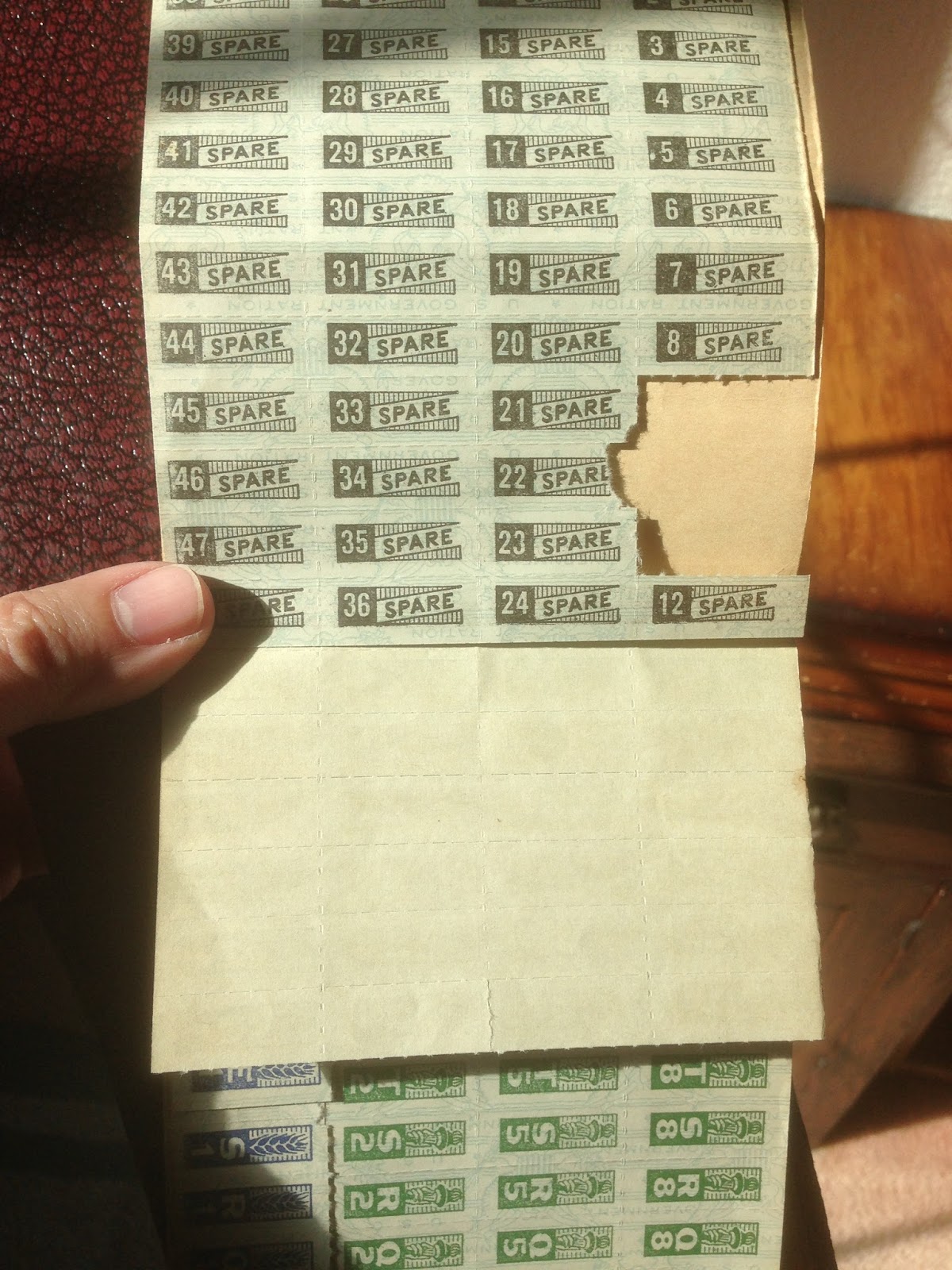
In an old box of family memorabilia, we found my grandparents’ 1943 World War Two ration books.


At the beginning of the Second World War, the Empire of Japan took over the rubber plantations of Southeast Asia. Suddenly, the United States found that all of the rubber we would ever have during the war—the duration of which we could not know—was the rubber that we had in 1941.  In particular, the Armed Forces needed rubber for tires. It became almost impossible for civilians to buy new tires. They did everything they could—including stuffing old newspapers into the tires—to make the old ones last. The government asked for donations of old tires, raincoats, gloves, and garden hoses as sources of rubber.

But the main act the government took to conserve rubber was to lower the speed limit. Starting on October 28, 1942, the Patriotic Speed Limit was 35 miles per hour. Imagine this: driving across the Mojave Desert without air conditioning, at 35 miles per hour. This is what my Mom and Dad had to do when Dad went from basic training at Ft. Sill, Oklahoma, to Camp Roberts, California. Can you imagine America accepting a 35 mph speed limit today?

Actually, we have recently had a conservation-inspired speed limit in the recent past. From 1973 to 1987, the national speed limit was 55 miles per hour. The purpose was to save gasoline, in response to Arab oil embargoes.

Although gasoline conservation was not the main reason for the lower speed limit in 1942, gasoline was in fact rationed: each vehicle could receive only 3-5 gallons per week, and the number on your ration stamp had to match that of the sticker on your windshield.

And don’t even think about buying a car. To get an automobile or appliance, you had to provide written evidence that you really really needed it. Even for typewriters—of which the war effort required a large number.

Meat was also rationed. Each person was limited to two and a half pounds of meat a week. My grandparents lived on a farm and raised their own crops and livestock, so they seldom bought meat, but in cities the meat shortage became very noticeable. In San Diego, Americans flooded into Mexico to buy meat. Then the Mexican government decided to build a big wall to keep out the Americans…wait, that didn’t happen.

The government was very serious about rationing. Each ration stamp book had not only the person’s name but also the age, sex, weight, height, and occupation, so that the person who had the book could be identified as the rightful owner. (Edd Hicks, 64, male, 145 pounds, 5 feet 7, farmer; Stella Hicks, 53, female, 170 pounds, 5 feet 6, housewife.)  And this was the warning label:

WARNING: This book is the property of the United States Government. It is unlawful to sell it to any other person, or to use it or permit anyone else to use it, except to obtain rationed goods in accordance with regulations of the Office of Price Administration. Any person who finds a lost War Ration Book must return it to the War Price Rationing Board which issued it. Persons who violate rationing regulations are subject to $10,000 fine or imprisonment, or both.

Can you imagine anything like this today? An Office of Price Administration? Many Americans would whine and howl, “The government can’t tell me what price to charge for my product! That’s socialism and communism.” The government only barely regulates bank interest rates, which are at a level that no one could have imagined in 1943. And the $10,000 fine (which was probably only used against major profiteers, rather than individuals loaning out a stamp or two to family or friends) was big money in 1943, unlike the fines that the government levies against financial corporations that break the law today—fines that are barely a blip in the profits they make from illegal activities.

Sugar was rationed. Almost the only reason anyone could buy a five-pound bag of sugar was to use for home canning—so that manufactured canned goods could be used for the war effort. This is the message that was on the back of the instructions:

WE MUST GET ALONG WITH LESS SUGAR THIS YEAR BECAUSE—

1. Military needs are high. Each soldier actually consumes twice as much sugar a year as the average civilian now receives.
2. Ships which otherwise might be bringing sugar into the United States are hauling supplies to the battle fronts.
3. Manpower is scarce at sugar refineries and shipping ports.
4. Beet sugar production last year was 500,000 tons short, making the stock of sugar smaller for this year.
5. Last year many people over-applied for canning sugar. We used so much sugar that stocks at the beginning of this year were abnormally low.

DO NOT APPLY FOR MORE SUGAR THAN YOU ACTUALLY NEED FOR HOME CANNING—HELP MAKE OUR WAR SHORT SUGAR SUPPLIES LAST ALL YEAR.

Here is another warning:

VIOLATORS of the Gasoline Rationing Regulations are subject to revocation of rations and criminal prosecution under the laws of the United States (emphasis theirs).


Today, we are not fighting a war against Nazi Germany and the Empire of Japan. But we do face severe challenges. We are fighting smaller wars. We face severe environmental challenges, especially global warming. And we have severe financial challenges as well. It is time for us to all come together and practice creative and joyful frugality. We need to do it for our fellow Americans, our fellow humans in the world, and for the survival of the planet. Many of us are already doing this; each year, more people recycle more things, and energy efficiency becomes more popular. And what should the role of the government be? The government should be the mediator of altruism. The government should level the playing field so that conserving resources is fair for everybody.

But there is a significant and visible minority of people, more in Oklahoma than many other places, who are so pissed off at the thought of conserving resources, and especially that the government might require them to do so for the sake of their fellow citizens, that they drive huge pickup trucks that spew smoke into the air. It is as if they are saying, “This is what I think about the Earth! This is what I think about my fellow human beings! This is what I think about God’s creation!” To them, freedom means the ability to waste the resources of the Earth and to show utter disregard for their fellow humans. If the government were to issue them ration stamps, they would probably get out their guns and start shooting. I believe that if I conserved, these people would come and take whatever I have at gunpoint. I seriously believe this. Not very many people would do this, but enough to submerge us into civil chaos. Had my grandparents, and my father and uncles who were all involved in the war effort, reacted in such a selfish way, the Nazis and the Japanese could have just walked right in and taken us over while we were fighting one another.

We won World War Two largely because of our internal altruism toward one another. I don’t think we have enough of it any more.

Wednesday, August 8, 2012

Evotour, part nine. Races of the Human Species: A Visit to Manzanar


Owens Valley, just east of the central Sierra Nevada, is a place of open, windswept desert scrub. The desert is formed by the rain shadow of the highest of the Sierras, which tower immediately above it. Because there is little rain, and because what little bit of water there is has been mostly claimed by the Los Angeles Department of Water and Power since the early twentieth century, there is little development. The desert sweeps up from the valley to the peaks with hardly any interruption. The beauty is almost heartbreaking. To the east, another range of tall mountains (dominated by White Mountain) rises almost as high as the Sierras.

The slopes of Owens Valley look almost the same today as they did in 1942. This was that year that the United States government, at war with the Empire of Japan, established the War Relocation Administration. Its directive was to relocate all people of Japanese origin from their homes into internment camps. Because they all had to sell their homes at once, the bottom fell out of the market, and they received a pittance for their property. They had to leave everything behind and live in barracks at the internment camps, spread widely over the American west. The thin-walled barracks were cold in the winter and hot in the summer. One of these camps was Manzanar, located near the present day town of Lone Pine. When the war ended in 1945, the Japanese were released, after being given $25 each.

The injustice of this action is well known. The internees were all Japanese Americans, most of them issei (first-generation immigrants) or their nisei (second-generation) children. They were American citizens who lost everything without due process of law. The issei had come to America to become Americans. Hardly any of them had any loyalty to Japan. Whole families were relocated. Because no such action was taken against German or Italian immigrants or their families, the Japanese internment is widely and correctly considered an example of racism. Germans, Italians, and Japanese Americans were related to the people of enemy nations, but only the Japanese were not white.

The Japanese, and the white American soldiers who supervised them, made the best of it. The internees had an amazingly positive attitude. They founded their own newspaper, the Manzanar Free Press. In the first issue of this paper, April 11, 1942, the headline read, “Manzanar Booms into Valley’s Biggest Town.” A small section on the front page read thus: “The citizens of Manzanar wish to express in public their sincere appreciation to General John L. DeWitt and his Chiefs of Staff…for the expedient way in which they have handled the Manzanar situation. The evacuees now located at Manzanar are greatly satisfied with the excellent comforts the general and his staff have provided for them. ‘Can’t be better,’ is the general feeling of the Manzanar citizen. ‘Thank you, General.’” Manzanar was an internment camp, not a concentration camp. Despite the inherent unfairness of the situation, the white rulers appeared to have done their best to keep the internees safe, clean, comfortable, and happy. The mother of a childhood friend graduated from high school in Manzanar. She said that they did not suffer.

What does this have to do with evolution? Quite simply, it is that when altruism evolved in the human species, it facilitated cooperation and friendship within groups but was often fed by antagonism toward other groups, especially if those other groups looked different. Racism is part of the flip side of altruism. And yet, antagonism toward outsiders is something that we can unlearn. Children who are raised in multi-ethnic neighborhoods have no problem forming altruistic bonds with members of other races. One of the biggest transformations in the human species during the past century has been the gradual, uneven, and partially-successful dissolution of racism.

During World War 2, the federal government was reeling with confusion, fighting a war on two fronts, trying to accomplish massive tasks in incredibly short spaces of time. And they got some things wrong. The War Relocation was one of them. They may not have even recognized the racism behind it. They got other things wrong too, such as the firestorms that incinerated thousands of civilians in Germany and Japan, and, of course, the atomic bombs dropped on Hiroshima and Nagasaki. Altruism is instinctual, but the way we use it is determined by culture and by collective decision. The best we can hope for is that we learn from the mistakes of the past.

One of the lessons of Manzanar is that, when sudden social or political disruption occurs, altruism can be one of the first things lost. It can get trampled by confusion and wrath right at the time we need it the most. This is what happened in the former Yugoslavia when the Soviet regime collapsed, and in Rwanda when resources became scarce. I wonder if it could happen in American society today, where many outspoken people, most often of the extreme conservative persuasion, talk as if people who disagree with them are not their fellow citizens or not even worthy of human rights. Are they just talking, or should we believe that when they stockpile weapons they might actually have a use planned for them? All I can do is to preach the gospel of altruism and hope that as many people as possible believe it, so that those who would take extreme measures in a time of crisis will be as few as possible.