Showing posts with label frugality. Show all posts

Saturday, January 15, 2022

People Like Me

If the world were full of people like me, I fantasize, it would be a much more peaceful world. It would be a world in which time and resources were more efficiently used because people would not use them against one another. I enjoy being good. People from my past, some of whom I had completely forgotten, keep re-emerging on social media hunting me down to share their memories of me. I’ve done some not-so-good things as well, but it appears, from my reputation, that the good things have prevailed in my image.

But there is one very real sense in which the world would be a shambles if everyone was like me. You see, I don’t consume very much. I do not take expensive vacations or patronize expensive entertainment. I do not go out to eat very much. I am frugal and I enjoy it. A lot. And my wife is even more frugal and enjoys it even more. The high point of her month is when she shows me the utility bill, which compares the average Tulsan, an energy-conscious Tulsan, and us, and we use less electricity than even those considered to be energy conservationists.

Our French in-laws have a similar view of life. Their idea of a good time is to get together and eat sausages, sauerkraut, and pretzels, or go hiking in the mountains. Their only non-frugal expenditures are on wine and fragrant cheese. Of course, this is because they are French. But just as you will not find me and my wife taking a vacation to Vegas, you won’t find our French relatives going to the Côte d’Azur or Monaco.

As the economy “climbs out of the recession caused by the pandemic,” many sectors (particularly hospitality and entertainment) cry out for us to patronize them. My wife and I are the world’s worst big-time consumers. We were before, and we are even more so now, living as we do in Oklahoma were only a little more than one in three people are vaccinated.


The only way our economy can recover is if a lot of people start wasting money. This is, however, a problem that results from our unrealistically hedonistic economy.

Tuesday, June 7, 2016

Henry David Thoreau, the man

I begin a series of three posts about Henry David Thoreau, adapted from my two encyclopedias. The first is a general biography of this remarkable person, who was an inconvenient man in both his academic and cultural surroundings.  In the second essay, I describe his contributions to modern science (something that is often overlooked). In the third, I share thoughts from a recent biography about him.


Henry David Thoreau is widely revered as a “prophet of environmentalism” because the ideas he wrote and put them into action appear to have been at least a century ahead of their time. He is less often mentioned as one of the leading scientists of early 19th century America. He was an amateur scientist, but laid the groundwork for the ecological study of seed dispersal and ecological succession. He collected data that constitute one of the earliest studies of the adjustment of organisms to changing seasons. His data sets have been used by modern scientists to document climate change that has occurred since his time.

Thoreau went out into a woodlot owned by Emerson (one of the few forest tracts near Concord that had not been cut down) and built a cabin near Walden Pond. The woodlot was not wilderness, but was a second-growth forest, and was less than two miles (a little over two km) from Concord. He started his work on July 4 of that year, intending it as a statement of independence from the pursuit of wealth (which, he said, led most people into “lives of quiet desperation”) just as July 4 marked American independence and just as Concord was the site of the first battle of the Revolutionary War. But he also intended his cabin as an experiment. He kept a journal the rest of his life, some of which he published in the book Walden, or Life in the Woods, which has become the environmental classic of the 19th century. In the journal, and book, he wrote detailed records of how much it cost him to build the cabin, and how he raised or caught much of his own food, going to town only for a few staple food items. He even built the cabin from wood and nails left over from a laborer family’s shanty. He spent only a couple of years in the cabin. He did not intend it as a permanent change in lifestyle, but to demonstrate that it could be done.

Thoreau was also famous for his essay “Resistance to Civil Government,” later known as “On Civil Disobedience,” which was based upon an experience he had in 1846. For six years, he had refused to pay poll taxes because of his opposition to slavery and to the Mexican-American war. Massachusetts had no slaves but profited from goods produced by slaves, and the federal Fugitive Slave Act required all citizens to aid in the capture of slaves who had escaped from the South. He also considered the war to be nothing more than aggression. The Concord tax collector liked Thoreau but was obligated to arrest him. Thoreau was ready to spend a long period of time in jail as a protest, but his aunt paid his taxes and he was released after one night.

Thoreau’s civil disobedience inspired generations of social reformers, such as Russian writer Leo Tolstoy, Indian leader Mahatma Ghandi, and American reformer Martin Luther King, Jr. But his insistence that frugal living (what today would be called “having a small ecological footprint”) is not only possible but enjoyable contributed to his modern reputation as the prophet of environmentalism. Since the most ancient times, prophets have predicted disastrous outcomes to the way most people in their society lived; called for repentance from that way; and themselves lived in a way that was a constant reminder of the way of repentance. This is exactly what Henry David Thoreau did. Like all prophets, Thoreau was an inconvenient man. Though by no means a hermit (he went to town every couple of days even during his cabin phase), he was always separated from the normal crowd: when in town, he observed people as might an anthropologist from another planet. His presence was a prophetic denouncement of materialistic society. Thoreau was particularly vivid (and virtually alone) in his criticism of people who did not take care of their land. Thoreau wrote that Flint’s Pond (also near Concord) was named after an “unclean and stupid” farmer who laid its shores bare, loved a shiny dollar more than a shiny pond, reflecting “his own brazen face,” “regarded even the wild ducks…as trespassers…” “…who never saw it, who never bathed in it, who never loved it, who never protected it, who never spoke a good word for it, nor thanked God that He had made it…who exhausted the land around it…he would carry his God to market…whose fields bear no crops, whose meadows no flowers, whose trees no fruits, but dollars.” Thoreau defended biodiversity against an agricultural mindset that, then as now, reduced a farm or a woodlot to its economic value, and evaluated every plot of land on Earth, however different each was from the other, according to just one scale of value.

The most famous Thoreau quote, which reflects his important insights into the environment and science, was “…in wildness is the preservation of the world,” often misquoted as “wilderness.” To Thoreau, wildness could be found in a well-managed woodlot as easily as in the Maine woods that he visited as a young man.

Thoreau was inspired by the writings of scientists who closely observed the world during their travels, particularly American botanist William Bartram who traveled among the Cherokees of the Appalachians in the late 18th century, and Charles Darwin’s Voyage of the Beagle. Thoreau strongly believed in the complete connectedness of humans and nature (“Am I not partly leaves and vegetable mold myself?”) but did not fully understand it until he read Darwin’s Origin of Species shortly before his death. Previous to this, he had believed, as a transcendentalist, that all of nature reflected spiritual patterns. He was very serious when he observed leaf-like patterns in thawing clay and said that it was the same natural law that produced the shapes of real leaves and also of human internal organs. The Earth had a body, but its organs were on the outside: “What is man but a mass of thawing clay?” When he saw a mouse girdling a pine tree (chewing a ring of bark), he thought it was the Earth’s way of thinning out the pines. Darwin’s Origin of Species undermined Thoreau’s faith, and Thoreau spent his last years making scientific observations with few transcendentalist insights.

Without Ralph Waldo Emerson, there would have been no remembrance of Thoreau. It was Emerson’s woodlot in which Thoreau briefly lived. Emerson popularized Thoreau after the latter’s death. But they were very different. Emerson would write long flowery-tongued passages about things, whether about the world of nature or the breathlessness of love, which he had not closely observed. To Thoreau, nature was a living world from which to learn; to Emerson, it was a canvas upon which to paint his grand ideas. For example, Emerson said that “savage” languages were simple and consisted mostly of nouns. Had he even bothered to ask anyone who had learned Native American languages—and there were plenty in his scholarly circle—he would have known this was wrong. But Thoreau was fascinated by what he could learn from Native Americans. (His last words were “moose” and “Indian.”)

Thoreau caught pneumonia when he was in the woods counting tree rings. He was only 44 years old when he died on May 6, 1862.

Sunday, February 14, 2016

The Good Old Days of Rationing

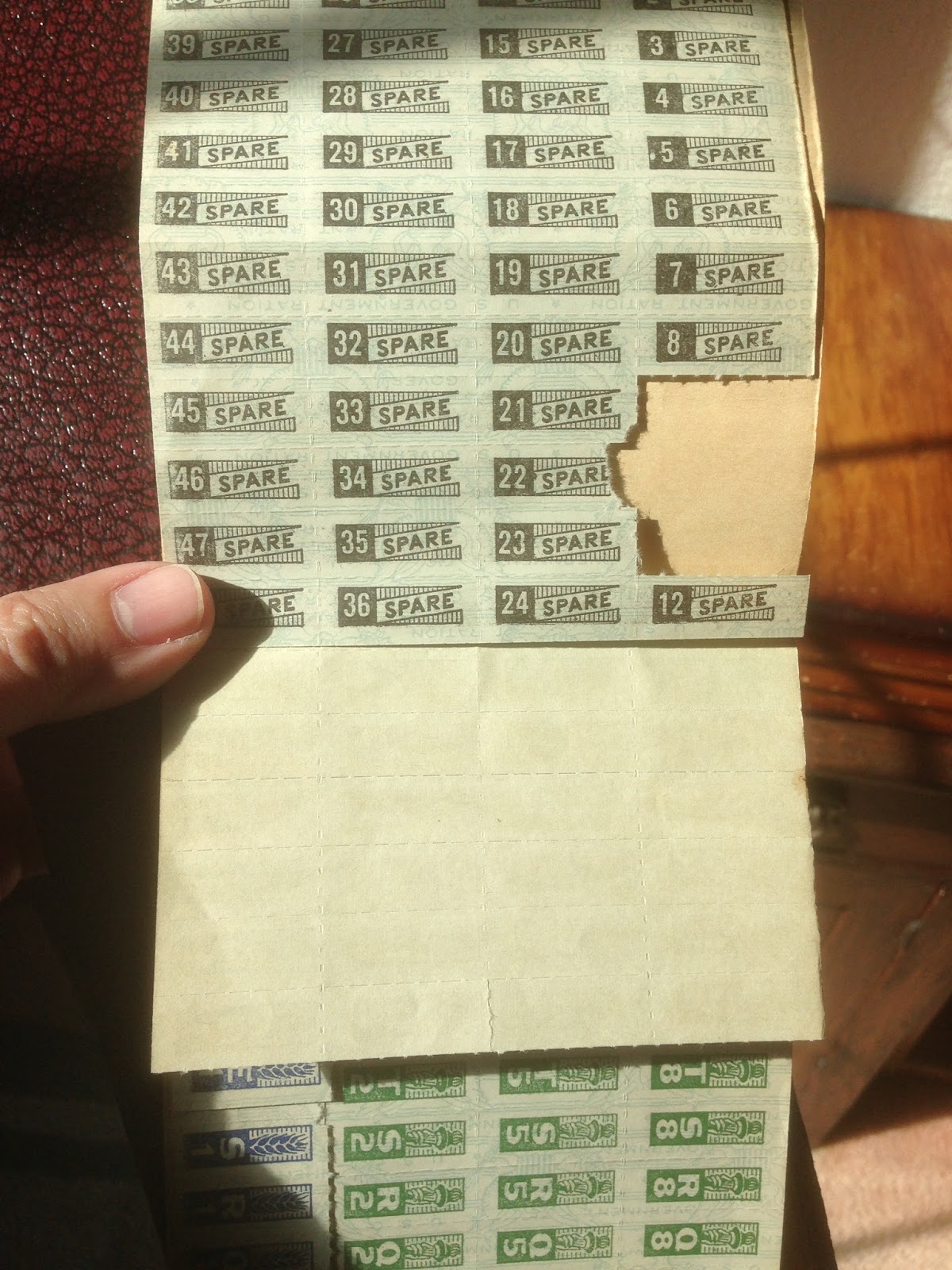
In an old box of family memorabilia, we found my grandparents’ 1943 World War Two ration books.


At the beginning of the Second World War, the Empire of Japan took over the rubber plantations of Southeast Asia. Suddenly, the United States found that all of the rubber we would ever have during the war—the duration of which we could not know—was the rubber that we had in 1941.  In particular, the Armed Forces needed rubber for tires. It became almost impossible for civilians to buy new tires. They did everything they could—including stuffing old newspapers into the tires—to make the old ones last. The government asked for donations of old tires, raincoats, gloves, and garden hoses as sources of rubber.

But the main act the government took to conserve rubber was to lower the speed limit. Starting on October 28, 1942, the Patriotic Speed Limit was 35 miles per hour. Imagine this: driving across the Mojave Desert without air conditioning, at 35 miles per hour. This is what my Mom and Dad had to do when Dad went from basic training at Ft. Sill, Oklahoma, to Camp Roberts, California. Can you imagine America accepting a 35 mph speed limit today?

Actually, we have recently had a conservation-inspired speed limit in the recent past. From 1973 to 1987, the national speed limit was 55 miles per hour. The purpose was to save gasoline, in response to Arab oil embargoes.

Although gasoline conservation was not the main reason for the lower speed limit in 1942, gasoline was in fact rationed: each vehicle could receive only 3-5 gallons per week, and the number on your ration stamp had to match that of the sticker on your windshield.

And don’t even think about buying a car. To get an automobile or appliance, you had to provide written evidence that you really really needed it. Even for typewriters—of which the war effort required a large number.

Meat was also rationed. Each person was limited to two and a half pounds of meat a week. My grandparents lived on a farm and raised their own crops and livestock, so they seldom bought meat, but in cities the meat shortage became very noticeable. In San Diego, Americans flooded into Mexico to buy meat. Then the Mexican government decided to build a big wall to keep out the Americans…wait, that didn’t happen.

The government was very serious about rationing. Each ration stamp book had not only the person’s name but also the age, sex, weight, height, and occupation, so that the person who had the book could be identified as the rightful owner. (Edd Hicks, 64, male, 145 pounds, 5 feet 7, farmer; Stella Hicks, 53, female, 170 pounds, 5 feet 6, housewife.)  And this was the warning label:

WARNING: This book is the property of the United States Government. It is unlawful to sell it to any other person, or to use it or permit anyone else to use it, except to obtain rationed goods in accordance with regulations of the Office of Price Administration. Any person who finds a lost War Ration Book must return it to the War Price Rationing Board which issued it. Persons who violate rationing regulations are subject to $10,000 fine or imprisonment, or both.

Can you imagine anything like this today? An Office of Price Administration? Many Americans would whine and howl, “The government can’t tell me what price to charge for my product! That’s socialism and communism.” The government only barely regulates bank interest rates, which are at a level that no one could have imagined in 1943. And the $10,000 fine (which was probably only used against major profiteers, rather than individuals loaning out a stamp or two to family or friends) was big money in 1943, unlike the fines that the government levies against financial corporations that break the law today—fines that are barely a blip in the profits they make from illegal activities.

Sugar was rationed. Almost the only reason anyone could buy a five-pound bag of sugar was to use for home canning—so that manufactured canned goods could be used for the war effort. This is the message that was on the back of the instructions:

WE MUST GET ALONG WITH LESS SUGAR THIS YEAR BECAUSE—

1. Military needs are high. Each soldier actually consumes twice as much sugar a year as the average civilian now receives.
2. Ships which otherwise might be bringing sugar into the United States are hauling supplies to the battle fronts.
3. Manpower is scarce at sugar refineries and shipping ports.
4. Beet sugar production last year was 500,000 tons short, making the stock of sugar smaller for this year.
5. Last year many people over-applied for canning sugar. We used so much sugar that stocks at the beginning of this year were abnormally low.

DO NOT APPLY FOR MORE SUGAR THAN YOU ACTUALLY NEED FOR HOME CANNING—HELP MAKE OUR WAR SHORT SUGAR SUPPLIES LAST ALL YEAR.

Here is another warning:

VIOLATORS of the Gasoline Rationing Regulations are subject to revocation of rations and criminal prosecution under the laws of the United States (emphasis theirs).


Today, we are not fighting a war against Nazi Germany and the Empire of Japan. But we do face severe challenges. We are fighting smaller wars. We face severe environmental challenges, especially global warming. And we have severe financial challenges as well. It is time for us to all come together and practice creative and joyful frugality. We need to do it for our fellow Americans, our fellow humans in the world, and for the survival of the planet. Many of us are already doing this; each year, more people recycle more things, and energy efficiency becomes more popular. And what should the role of the government be? The government should be the mediator of altruism. The government should level the playing field so that conserving resources is fair for everybody.

But there is a significant and visible minority of people, more in Oklahoma than many other places, who are so pissed off at the thought of conserving resources, and especially that the government might require them to do so for the sake of their fellow citizens, that they drive huge pickup trucks that spew smoke into the air. It is as if they are saying, “This is what I think about the Earth! This is what I think about my fellow human beings! This is what I think about God’s creation!” To them, freedom means the ability to waste the resources of the Earth and to show utter disregard for their fellow humans. If the government were to issue them ration stamps, they would probably get out their guns and start shooting. I believe that if I conserved, these people would come and take whatever I have at gunpoint. I seriously believe this. Not very many people would do this, but enough to submerge us into civil chaos. Had my grandparents, and my father and uncles who were all involved in the war effort, reacted in such a selfish way, the Nazis and the Japanese could have just walked right in and taken us over while we were fighting one another.

We won World War Two largely because of our internal altruism toward one another. I don’t think we have enough of it any more.

Tuesday, August 5, 2014

Frugality and the Market


I just returned from a long and wonderful journey through ten states. I saw a lot of ecology and evolution and I want to tell you all about it in upcoming essays. Meanwhile I will post this general essay until I can get the new ones written. On this long journey, I ate out a lot. I was more frugal than most travelers but less frugal than I am when at home. Which leads to the topic of this essay.

I am almost off the charts for being frugal in my use of energy and my consumption of processed materials. I am not a Scrooge; I actually enjoy frugality—I greatly enjoy the few things I spend money on, as well as the free things like taking a walk with my wife.

For example, I just do not eat out very often. Sometimes, as I noted in a recent blog essay, my frugality has made me a target for people who, perhaps with religious motivations, want to disrespect me for the carefulness with which I treat what they consider to be God’s creation.

But when I do eat out, I like having variety to choose from. I will admit that I have a hard time telling Cheesecake Factory apart from Applebee’s, but I wouldn’t want my only choice to be sushi—even though I love the new sushi restaurant in Tulsa (Sushi House, on Lewis near 71st) very much.

If everyone lived like me, however, the bottom would drop out of the restaurant business. Tulsa would have a couple of sushi places, a Japanese steakhouse, Marley’s Pizzeria, India Palace, and that’s about it. The very diversity of market experiences that I enjoy depends on people living the way I think they shouldn’t.

I’m not too worried. If America goes frugal (which is about as likely as the sun going supernova next year), the loss of market diversity would be a small price to pay for the promotion of a healthy local economy full of farmer’s markets, ecological sustainability, and personal financial responsibility. I find fast food establishments to be useful on rare occasions, but if they all closed up I wouldn’t be too upset. Meanwhile I will continue to enjoy, on rare but memorable occasions, the diversity of restaurant food that is made possible by people who are too busy eating out to read this blog.

Sunday, July 14, 2013

Natural Selection for Efficiency


At the moment, I am able to post essays from a different location than what I normally use. My usual location remains unworkable. I now resume my usual series of essays.

In a previous essay I wrote about how our economic system is (almost) forcing us to waste resources. In nature, sexual selection often favors wastefulness (think of colorful bird feathers and flowers), and in the human species, social and sexual selection can favor conspicuous consumption. However, this always occurs within the broader picture of natural selection favoring efficiency.

One example is the evolution of CAM, which is a type of photosynthesis found in many succulent plants. The leaves of most plants absorb carbon dioxide and make it almost directly into carbohydrates such as sugar during the daytime. But CAM plants absorb carbon dioxide at night, make it into acid, store up the acid, then use the acid as a source of carbon dioxide from which to make sugar in the day. Carbon fixation therefore occurs in two phases: the night shift, and the day shift. And, like a factory that might need to hire two sets of employees rather than just one, this system is more expensive than just making sugar during the day shift. In fact, the night shift consists of an almost completely separate set of enzyme reactions from the day shift.

Under cool, moist, or shady conditions, CAM would be clearly wasteful. As my educational mentor from grad school days said, CAM plants don’t have it made in the shade. But CAM plants grow in desert conditions. In order to absorb carbon dioxide during the day, a plant has to have its pores open, and when it does so, it loses water vapor. In a cool, moist, or shady environment, this is not much of a problem. But out in the desert, it might cause the plant to lose too much water. For succulent plants it is more efficient to open their pores at night, when it is cooler, and store it up in the form of acid. The wasted energy is more than compensated by the water that is saved.

Here is an analogous situation. Suppose you have a factory that has to shut down on hot days. But even when the factory is shut, you still have to pay the workers. Is it cost-effective to pay a night shift of factory workers so that the factory can stay open in the summer? It depends. If the factory is in Minnesota, probably not. But in the desert, such a factory would be closed from May through September. Not surprisingly, CAM plants are more common in the desert than in Minnesota.

It seems obvious that CAM photosynthesis has evolved and become common in conjunction with the spread of deserts in the late Neogene period. And it has evolved more than once, as existing enzymes have been reassigned to new functions. However, it appears that CAM may have first evolved as an adaptation to low carbon dioxide availability rather than to hot, dry conditions. How else to explain CAM in primitive aquatic plants such as Iosetes? (See the article by Jon Keeley.) A similar adaptation, C4 photosynthesis, may have first evolved in grasses not because of hot conditions but because of low levels of carbon dioxide during glacial periods especially in tropical highlands. CAM and C4 photosynthesis may have begun as an adaptation to low carbon dioxide availability, and they later proved useful in hot, dry conditions. (I did not explain C4 in this brief entry because it’s more complex.)

Everywhere you look in the world, natural selection has favored efficiency. In many cases, after the needs of efficiency have been met, sexual and social selection have favored wastefulness. But in our society right now, we continue our binge of wastefulness even when we are not meeting the basic needs of efficiency.

We may have to learn not just efficiency but extreme frugality in the decades ahead of us. Of course, it is possible that the very rich, and people with lots of guns, might not have to do this, but then there’s the rest of us. Stories from the past tell us that much human creativity has been employed in the invention of new forms of frugality. I grew up hearing stories about how Native Americans used every part of the bison (in contrast to white Americans, who would shoot a buffalo, cut out the tongue to eat, and let the rest rot), and my Dad telling me that a World War II soldier could clean up, shave, and brush his teeth using one helmet-ful of water. Storing runoff water from the roof in cisterns is a practice thousands of years old. The thrifty Scots did not waste anything from sheep; hence the invention of haggis, which (in its original form) was a combination of oatmeal and sheep lung and other organ tissue and which is reportedly a food item.

We can only hope that, when called upon to do so in the years ahead, we humans can display the kind of creativity in our cultural evolution that CAM and C4 plants have displayed in their biological evolution. Sexual and cultural selection can favor wasteful displays, but only if there is a surplus of energy, materials, and opportunities, however slight, left over from the demands of natural selection. A big colorful male bird that starves is just a dead bird.