Showing posts with label adaptation. Show all posts

Tuesday, December 21, 2021

Adaptive Stories: Another Message from Fluff the Cottonwood Tree

This is Fluff the cottonwood tree (she/her/hers). I think this is my sixth message that Stan has agreed to post for me on his blog. I live about a half block away from his house in Oklahoma.

Adaptation is the process or the outcome of evolution in which populations become more successful in their habitats. If you want a more detailed discussion of adaptation, read about it in Stan’s Encyclopedia of Evolution. But you get the point.

Adaptations sometimes seem obvious. For example, leaves are flat because this allows the green cells inside them to absorb more light and allows them to absorb the yummy carbon dioxide more quickly. For such adaptations as these, it is easy to figure out the reason for the adaptation.

But other characteristics are more difficult to explain. Look at this photo of cottonwood leaves. Aren’t they beautiful? I have now shed all of my leaves for the winter, but about three months from now I will grow thousands of new ones.
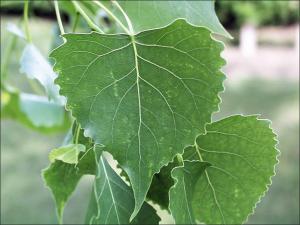
Notice the teeth along the edges of my leaves. Truly artistic! I’m not bragging, but do you humans have anything this beautiful about your bodies?

But are these teeth an adaptation? Stan insists that they are. Toothed leaves, said Stan, are better in cooler climates, and he showed me a website that made this very point. But there are plenty of exceptions to this pattern. Maybe this is just an adaptive story, insightful but not necessarily true. Maybe trees of the genus Populus, including me, just have a genetic tendency to have toothed leaves, and we also happen to live north of the tropics. These two facts may not be connected at all.

An even better example of an adaptive story is about fluttering leaves. My leaves, as those of all cottonwoods, poplars and aspens, flutter in the wind, creating a delightful shimmering sensation. All leaves move in the wind, producing a sound called susurrus (one of Stan’s favorite words), but my leaves and those of my evolutionary relatives don’t just rustle in the wind; they almost twinkle. Some aspens are called quaking aspens, or trembling aspens, because of this most obvious and beautiful characteristic. This occurs because our leaf petioles are flat rather than round.

Botanists like Stan say that this fluttering movement increases the rate at which carbon dioxide gets into our leaves. Sorry, Stan, but that is almost certainly just an adaptive story. Of course, fluttering leaves absorb more carbon dioxide; and almost any fast-growing plant benefits from having lots of carbon dioxide. Why, then, is it just us members of the genus Populus that have this characteristics? Why don’t sycamores, which like us grow along rivers, have fluttery leaves? There are some that live only a few meters away from me.

To tell the difference between an adaptive story and a scientific explanation, you need to not only explain the advantage of the characteristic, but why you don’t see all organisms that live under the same conditions with that characteristic.

Cottonwood leaves flutter, and as a result we have more photosynthesis. But other trees achieve the same result in different ways. There is no answer to the question of why my leaves flutter in the wind more than those of sycamore trees. Meanwhile, just look at my leaves and admire them.

Friday, October 26, 2018

What's Up with the Stupid Magnolias?


What’s Up with the Stupid Magnolias?

In late September, I saw several magnolia trees blooming in Durant, Oklahoma. Magnolias are supposed to bloom in late spring! What’s up with that?

The reason the magnolias bloomed is because they are stupid. Plants are stupid. I say this even though I am a botanist and have devoted my life to studying them. These magnolias, you see, have no idea what time of year it is. They don’t know the difference between May and September.

Yet, they have to bloom at the right time of year, don’t they? Of course they do. They have to bloom at the time that their pollinators are expecting them to bloom, so that the huge white flowers and sultry lemon scent will not be wasted.

But intelligence is expensive. Brains are expensive. Your brain uses twenty percent of your body’s metabolic energy and oxygen. My granddaughter Léna’s brain uses half of her energy and oxygen. That doesn’t make her smarter than you, but it does mean her brain is rapidly growing. Plants simply cannot afford to make brains. For the last billion years, plants and their evolutionary ancestors have relied on more direct stimuli from the environment to tell them when to do things such as reproduce.

To a plant, there is no difference between cold and drought. They do not have temperature sensors. To them, it is cold when the water freezes, and when the water freezes, it diffuses out of the cells and into intercellular spaces, where the ice crystals cannot harm the cell. That is, when it freezes, plant cells become drier. In spring the ice melts and the water diffuses back into the cells.


This summer in Oklahoma had some long periods of hot dry conditions. They were not record-setting, but they were pretty brutal. Then, in late summer and early fall, it rained a lot, and kept raining. Therefore, during mid-summer, the plant cells dried out, and in late summer, they became moist. For anything that the plant knew to the contrary, the summer drought was winter, and the fall rains were spring.

Plant responses to seasons are not the most intelligent ones, but they are economical. Every few years, the magnolia trees waste a few flowers by blooming in the fall; in the ensuing winter, they cannot develop their fruits. But any magnolia would tell you that its way of adjusting to the seasons doesn’t cost as much as your brain does, thank you very much.

Friday, May 12, 2017

Hagfishes

I just posted a Darwin video about hagfishes. They are disgusting but also are beautiful examples of evolutionary adaptation. Let creationists work on that one.

Wednesday, January 11, 2017

Evolution: Using the Hand You Are Dealt

A mistake common among both “creationists” and “evolutionists” is that their preferred mode of origin produces perfection: an adaptation, whether created or evolved, is the best possible solution to the challenges of existence. The exceptions to this view are so numerous that I believe no one could list all of them. I just wanted to tell you about a recently-published example.

Those of us who are enchanted by the beauty of photosynthesis, all the way from the deep emerald color of chlorophyll a to the utter transformation of Earth that photosynthesis has wrought in the last three billion years, are tempted to think that it is a perfect process. I can hardly contain my enthusiasm for photosynthesis. But, for all of its elegance and global importance, photosynthesis has several flaws. One is that the light-absorption reactions consist, for no good reason other than evolutionary history, of two cycles rather than just one. Somewhere back in time two different bacterial systems merged together into the chloroplast photosynthetic system that covers the Earth today so much that large parts of the planet appear green from outer space. I suspect that, had a Designer made photosynthesis, this Designer might have made a single, efficient cycle rather than smooshing to previous cycles together. But perhaps the most noteworthy limitation of photosynthesis is rubisco.

Meet rubisco. You gotta love it. About half of the water-soluble protein in a leaf is rubisco. It is an enzyme that removes carbon dioxide from the air and fixes (attaches) it to other molecules, which will ultimately become sugar. This is the major short-term process that removes carbon dioxide from the air and almost the only process that creates food upon which all the food chains on Earth depend. That is, rubisco is a carboxylase. But it is also an oxygenase. Oxygen molecules can get into rubisco and crowd out the carbon dioxide molecules. This starts a whole cascade of reactions called photorespiration. Rubisco does not react very much with oxygen, but oxygen is over 5000 times as common in the air as carbon dioxide, so it turns out that photorespiration significantly inhibits photosynthesis—by as much as one-quarter. If only rubisco were not such an inefficient carboxylase, the world would be a lot greener—probably over 30 percent greener. Forests would probably grow 30 percent more biomass, although deserts and tundra, limited by water and temperature, might not look very different. Most physiologists consider rubisco to be the rate limiting step in photosynthesis, the slow guy that holds everything else up. Come to think of it, this is probably why there is so much rubisco. Each molecule is so slow that chloroplasts have to make a whole lot of them just to get the job done.

But rubisco is not the only game in town. There are apparently at least five other carboxylases that are found in cells. That is, the genes for them already exist, but are not used in the most common form of photosynthesis. And they are all more efficient than rubisco.

Thomas Schwander and his colleagues in Germany have devised an artificial pathway of carbon fixation that they call the CETCH pathway (read about it here and here). While it would be difficult to insert the enzymes of this pathway into living plant cells (in vivo), they are working on a commercially viable industrial system that removes excess carbon dioxide from the air and makes them into organic molecules. This system is not just a little bit more efficient than a system based on rubisco; it is thirty-seven times more efficient!

A Designer would have built photosynthesis on something like the CETCH pathway; or, who knows, maybe something even more efficient that the Designer would be able to think of. But evolution uses whatever hand of cards it is dealt. At the time and place when the prevalent modern form of photosynthesis evolved, rubisco was ready and available to be conscripted for that job. And today the natural world is pretty much stuck with it.


Photosynthesis is no different from any other biological process in being the result of an evolutionary pathway that consists of lucky adaptations. Your DNA is not as efficient as it could be. It is filled with dead genes and dead viruses and repeated elements from nucleotide duplication that went a little crazy. Your DNA is not like an orderly house or office. It is like an attic, or the offices of some of my professorly colleagues, in which piles of papers totter in corners and occasionally fall over but in which they can eventually find the papers they need. And almost all the food in the world (unless you live at volcanoes at the bottom of the sea) comes from photosynthesis, which could be a lot more efficient if only it had not been designed by the brainless process of evolution.

Friday, May 1, 2015

Darwin at a Class Reunion

Happy May Day! Workers of the World Unite—not for communism, but to make the world better in whatever way we can.

I have just posted a video in which I, in the persona of Charles Darwin, am briefly addressing the 40th reunion of our high school class. Lindsay (California) High School, Class of ’75! I made the video expressly for people who were not there and who might be wondering why I would post what seems to be a personal video on my science YouTube channel. I explain the reasoning in the video, but the sound quality leaves something to be desired (echoes from the walls) so I will write a brief essay on the same subject (not a word-for-word transcript; I want to improve on my words).

I begin by asking the question, What adaptation makes humans unique? There are many adaptations that are very highly developed in humans, compared to other animals. The one that first comes to mind is intelligence. We are clearly the most intelligent animal species on the planet (sorry to those of you who still think dolphins are smarter). But what kind of intelligence? Our brains have evolved a particular kind of intelligence. We do have logical intelligence; we can apply our brains to figure out problems logically, but we have to work at it. But the kind of intelligence that comes intuitively and easily to our brains is social intelligence. In high school, I had the reputation of being very intelligent, in the logical sense, but I was surrounded by a lot of peers who had tremendous social intelligence. And I here claim that social intelligence, in which my classmates were at least as good as I was, is humankind’s greatest adaptation.

One kind of social intelligence is what I call horizontal culture: a network of interconnections among animals in which they can help each other out. You mess with one of us, you mess with all of us! This takes a lot of brain power, in order to keep track of each individual and what kind of person each one is. Humans are really, really good at this kind of intelligence. But then, so are dogs and wolves and meerkats and prairie dogs. Ever been in a wolf pack? Neither have I, but we can imagine what it is like. You mess with one of them, you mess with all of them. Humans are really good, but not unique, at having highly-developed horizontal culture.

Another kind of social intelligence is what I call vertical culture, and this is the thing that humans do perhaps better than any other animal species. We can remember—for decades—what our friends are like. Forty years can pass, and we can practically take up where we left off as if no time has passed at all! When I went to my class reunion, I had literally not seen any of those old friends for four decades. (The only ones I had contacted in the meantime were not at the reunion.) Yet there we were, filling each other in on the news of our lives, with cultural bonds undiminished over time. The memories of the time we spent in band, or in Japan during sister-city exchanges, or in Jim Kliegl’s plays, were still fresh.

Perhaps the most unique feature of human vertical culture is we remember our friends and loved ones who have died. Carolyn, who organized the reunion (thanks forever for that!), set up a little memorial for our friends who had died. Does any other species of animal do this? I have read that elephants remember their dead. If you play back a recording of a beloved elephant that has died, the other members of the herd will display actions and sounds that seem, to us, like grief. But we humans are much better at this than elephants. Our social intelligence allows us to not just remember those who have gone before but lots of things about them. And to love them forever.

Our old Spanish teacher, Jesse Guerrero, told us, regarding the invitation to join our reunion, “I needed this.” Social bonds over time are as necessary to our brains as is food and oxygen. All of us at the reunion, not just Jesse, need this. And all of the rest of the readers of this blog.


My reunion was not just enjoyable but it gave me a deep satisfaction to participate in this deeply satisfying and uniquely human experience.

Tuesday, September 2, 2014

My Fun Evolution Trip Part Six: Adaptations and Stories

We saw a couple of really interesting plant adaptations in the Black Hills. The first is the white buttercup, which filled some of the shallow ponds of Little Spearfish Creek.


The underwater leaves were finely dissected, which increases their surface area for absorbing dissolved carbon dioxide. Terrestrial leaves could also absorb more carbon dioxide this way but would lose too much water, which is not a problem for an aquatic plant. The flowers, however, float on top of the water where insects can find and pollinate them.


Another set of adaptations is represented by the quaking aspen, Populus tremuloides. When you see a whole clump of aspens, perhaps covering several acres, it may be a single genetic individual that has spread by underground stems. All of the aboveground stems are the same height. The resulting genetic uniformity has its risks: diseases can spread rapidly not only because of the genetic monoculture but because of whichever underground connections may remain intact. But the connections help to stabilize the massive clone: the stems (ramets) growing in favorable locations can help to support the ramets growing in unfavorable locations, very much like the phalanx of an army. Many plants have this adaptation, but aspens are famous because they have such massive clonal growth.

Other aspen adaptations sound more like just-so stories. The first is the ability of their leaves (as well as those of cottonwoods, which are in the same genus) to quake in the slightest breath of wind. They do this because of their flat petioles. The standard explanation is that this allows the leaves to absorb more carbon dioxide. I am confident that this is true, but I can only ask why, if quaking is such a wonderful adaptation, that more plants do not employ it?

The second is a nearly unique bark adaptation. The bark looks greenish and is capable of carrying out photosynthesis. Underneath a tight white layer of tissue, there is an intensely green layer, at least in the Black Hills populations. Apparently the photosynthesis in this layer is less inhibited by cold temperatures than in leaves and might benefit the tree in early spring or late autumn. I could not readily find references about what aspens might do with the sugar their bark produces; perhaps they load it directly into the adjacent phloem and send it down to the roots and underground stems. Apparently this layer was actively producing sugar, for an ant quickly found the shallow wound that I made in the bark.


I do not doubt the value of the adaptation, but once again I ask, if it is such a great adaptation, why don’t other trees have it? Of course, many young stems do have it. We cut down a mulberry tree in our yard, which was inconveniently disturbing the foundation of our house, and hundreds of thick green stems immediately sprouted back. Even older mulberry stems have a green layer—but not, to my knowledge, the trunks, as in aspen.

I would think that green trunks, like quaking leaves, would be easy to evolve, and should be more common, if our facile adaptive just-so stories were entirely correct. It appears to me that a few plants have evolved great adaptations within evolutionary constraints.


Sunday, July 14, 2013

Natural Selection for Efficiency


At the moment, I am able to post essays from a different location than what I normally use. My usual location remains unworkable. I now resume my usual series of essays.

In a previous essay I wrote about how our economic system is (almost) forcing us to waste resources. In nature, sexual selection often favors wastefulness (think of colorful bird feathers and flowers), and in the human species, social and sexual selection can favor conspicuous consumption. However, this always occurs within the broader picture of natural selection favoring efficiency.

One example is the evolution of CAM, which is a type of photosynthesis found in many succulent plants. The leaves of most plants absorb carbon dioxide and make it almost directly into carbohydrates such as sugar during the daytime. But CAM plants absorb carbon dioxide at night, make it into acid, store up the acid, then use the acid as a source of carbon dioxide from which to make sugar in the day. Carbon fixation therefore occurs in two phases: the night shift, and the day shift. And, like a factory that might need to hire two sets of employees rather than just one, this system is more expensive than just making sugar during the day shift. In fact, the night shift consists of an almost completely separate set of enzyme reactions from the day shift.

Under cool, moist, or shady conditions, CAM would be clearly wasteful. As my educational mentor from grad school days said, CAM plants don’t have it made in the shade. But CAM plants grow in desert conditions. In order to absorb carbon dioxide during the day, a plant has to have its pores open, and when it does so, it loses water vapor. In a cool, moist, or shady environment, this is not much of a problem. But out in the desert, it might cause the plant to lose too much water. For succulent plants it is more efficient to open their pores at night, when it is cooler, and store it up in the form of acid. The wasted energy is more than compensated by the water that is saved.

Here is an analogous situation. Suppose you have a factory that has to shut down on hot days. But even when the factory is shut, you still have to pay the workers. Is it cost-effective to pay a night shift of factory workers so that the factory can stay open in the summer? It depends. If the factory is in Minnesota, probably not. But in the desert, such a factory would be closed from May through September. Not surprisingly, CAM plants are more common in the desert than in Minnesota.

It seems obvious that CAM photosynthesis has evolved and become common in conjunction with the spread of deserts in the late Neogene period. And it has evolved more than once, as existing enzymes have been reassigned to new functions. However, it appears that CAM may have first evolved as an adaptation to low carbon dioxide availability rather than to hot, dry conditions. How else to explain CAM in primitive aquatic plants such as Iosetes? (See the article by Jon Keeley.) A similar adaptation, C4 photosynthesis, may have first evolved in grasses not because of hot conditions but because of low levels of carbon dioxide during glacial periods especially in tropical highlands. CAM and C4 photosynthesis may have begun as an adaptation to low carbon dioxide availability, and they later proved useful in hot, dry conditions. (I did not explain C4 in this brief entry because it’s more complex.)

Everywhere you look in the world, natural selection has favored efficiency. In many cases, after the needs of efficiency have been met, sexual and social selection have favored wastefulness. But in our society right now, we continue our binge of wastefulness even when we are not meeting the basic needs of efficiency.

We may have to learn not just efficiency but extreme frugality in the decades ahead of us. Of course, it is possible that the very rich, and people with lots of guns, might not have to do this, but then there’s the rest of us. Stories from the past tell us that much human creativity has been employed in the invention of new forms of frugality. I grew up hearing stories about how Native Americans used every part of the bison (in contrast to white Americans, who would shoot a buffalo, cut out the tongue to eat, and let the rest rot), and my Dad telling me that a World War II soldier could clean up, shave, and brush his teeth using one helmet-ful of water. Storing runoff water from the roof in cisterns is a practice thousands of years old. The thrifty Scots did not waste anything from sheep; hence the invention of haggis, which (in its original form) was a combination of oatmeal and sheep lung and other organ tissue and which is reportedly a food item.

We can only hope that, when called upon to do so in the years ahead, we humans can display the kind of creativity in our cultural evolution that CAM and C4 plants have displayed in their biological evolution. Sexual and cultural selection can favor wasteful displays, but only if there is a surplus of energy, materials, and opportunities, however slight, left over from the demands of natural selection. A big colorful male bird that starves is just a dead bird.

Saturday, October 6, 2012

Oklahoma Evolution Workshop, Part Four

The evolution workshop for Oklahoma teachers continued after lunch. I had the first session. I began by advertising my own website, where you can find essays and photographs, as well as copies of scholarly articles  I have written. It has links to my YouTube channel and to this evolution blog.

Then I began with the story of the Ghosts of Evolution. (I have a recent YouTube video where Darwin discusses this subject.) I held up a big, sticky, green fruit of Maclura pomifera, known as bois d'arc, Osage orange, or horse-apple. The native range of this tree includes Oklahoma. I modeled the kind of questions that they can ask their students. Why do some plants produce juicy sweet fruits? Animals eat them, swallowing the seeds and transporting them to a new location. This is useful to the plant only if the animal swallows undamaged seeds, as we do with strawberry or kiwi seeds, or as raccoons do with persimmon seeds. With their finicky fingers, some raccoons could pick out the persimmon seeds, but this would waste valuable time, during which other raccoons would eat up all the fruits. The concept that students might grasp is coevolution. In this case, juicy fruits evolved in response to animals that eat them and disperse their seeds.

But what eats big, sticky bois d'arc fruits? In Oklahoma, someone will always say, horses. In other parts of the country, nobody may have any idea. But modern horses are not native to North America. There were native horses in North America at the end of the last ice age, but they have become extinct. Perhaps at the end of the last ice age, there were large animals (horses, mammoths, mastodons, gomphotheres, etc.) that ate bois d'arc fruits, but today, there are no native animals that eat them. Thousands of years ago, there was a coevolutionary waltz between bois d'arcs and gomphotheres; today, the bois d'arc is doing a waltz with no partner.

We went outside, into the cold wind. The temperature has dropped 50 degrees in two days. If you want to get kids outside and still teach them about evolution, just take them to an oak tree and ask them what they know about oak trees. The wood is strong. The trees live a long time. Acorns are large, as are the seedlings that emerge from them. Now, think about what kind of environment would benefit trees that have these characteristics. In an old, stable forest, large seeds and large seedlings would be better able to compete with the dense populations of plants that are already there. They invest for the long term in strong wood. Then take the kids to a cottonwood tree. Cottonwoods produce cheap wood and do not live very long. Their seeds are numerous and small. These characteristics make sense for trees that live near rivers, where they have a lot of water but also face a great risk of being destroyed in a flood. It would make no sense for a cottonwood to invest in wood that will last for centuries, since a cottonwood tree would probably get killed in a century or less. This may help students to understand that evolution does not always produce the same "superior" set of adaptations; the "superior" traits for a tree in an old, stable forest are different from those in a young, frequently-disturbed, floodplain forest.

Then Dr. Cecil Lewis had a second session, this time devoted to his specialty: the evolutionary and medical genetics of humans. He explained how population genetics works. A large, old population that has been large for a long time may have a great deal of genetic variation, including a lot of rare variants. Large populations can lose genetic variation if they become small--that is, they go through a population bottleneck. Small populations can lose genetic variation just by chance. If the population then grows rapidly, it retains the genetic makeup that it had while it was small. That is, a newly-large population will have no more genetic variability than it did when it was small. If you find a population that is large but has low genetic variability, this probably means that there was a recent genetic bottleneck. This appears to have happened in the human species. The entire human species, all seven billion of us, has the same amount of genetic variation that one would expect from a mammal population with only twenty thousand individuals. This suggests that (perhaps 70,000 years ago) our species had a brush with extinction--there may have been, at that time, only about twenty thousand of us.

You can make a closer examination of the genetics of human groups. The greatest genetic variation is in Africa. The genetic variation in the Middle East is a subset of African genes. The genetic variation in Europe is a subset of Middle Eastern genes; Asians are a separate subset. North American native genetic variation is a subset of Asian genes; South American native genetic variation is a subset of North American native genes. Each time a migration occurs, only a subset of people leave home, therefore some genes get left behind. Human genes, therefore, are an invisible record of the pattern of human migrations during the last 200,000 years.

Some human genetic patterns have resulted from natural selection. Lewis gave an example: the ALDH2-2 gene, the gene that codes for alcohol dehydrogenase. One variant of this gene is much more common in Asians than in anyone else. The Asian variant is the reason that Asians generally have a lower tolerance of alcohol than other people. However, since refiend alcohol is a recent invention, the Asian variant of the gene was probably selected by exposure to pathogens.

Saturday, August 25, 2012

Evotour, part ten. Among the Ancients


I went to Sequoia Park to feel small; I went to the Ancient Bristlecone Pine Reserve to feel young. These bristlecone pine trees (Pinus longeava) are the champions of a type of survival in which organisms live in hostile environments, are just barely alive, grow slowly, but stay alive for a long time. At least, they are the multicellular champions; there are apparently some bacteria that live miles down into the crust of the Earth and metabolize atoms and inorganic molecules and divide once a century. But you will never see them. But you can walk right up to a bristlecone pine that was 2000 years old when Jesus was born, and 1000 years old when Moses fled into the wilderness.

Sequoia trees (see earlier essay) grow quickly when they are young. Bristlecone pines, however, grow slowly from the very start. The park ranger at the reserve showed me a 10-cm-tall eight-year-old bristlecone seedling.

Of course, not all of the bristlecones are over 4000 years old. They represent a whole range of ages, though mostly measured in centuries or millennia. The park personnel do not identify which trees are the oldest, because they do not want humans taking home little souvenirs of the ancient world.

The trees are barely, but very much, alive. Find me a piece of intact 4000-year-old wood that is not inside of a bristlecone pine tree. Of course, their dry, often cold environment helps to preserve them; it is not a place fungi would prosper. But through the ancient trunks there are still xylem rays—with living cells and cell membranes and active transport—that are alive and preserve the wood.

There is a price to pay for rapid metabolism, the kind us mammals have. Our intelligence consumes a lot of food and oxygen, as does our movement and warm blood. That price is a short life. But none of us would trade places with the bristlecones. Disregarding for the moment the Tolkeinian vision of Ents, trees (especially the slowest growing ones) have no awareness or memory of their environments; no wisdom. The idea of a long-lived human (a Methuselah, for example) is a biological fantasy. But as humans we do have some advantages. We live far longer than do other mammals with similar metabolism, and not just because of recent medical advances. We start to fall apart after age 30, which was when most prehistoric people died, but amazingly enough our minds do not fall apart right away. Many of us actually grow more wise and intelligent as we get older, until senescence at last gets us.

I came neither to envy nor to gloat over the bristlecones. I came to humbly experience the possibility of an almost completely different kind of life than my own.

Sunday, May 27, 2012

Evotour, part two. The Southwest Desert


Immediately after seeing the eclipse of the Sun, I headed to Petrified Forest National Park. Even though it was over 100 degrees, I still found it utterly captivating. This is a place that offers a wonderful way of looking into the evolutionary past.

The Petrified Forest today is desert, with only the skimpiest cover of shrubs and grasses, but over 200 million years ago, during the Triassic Period, it was a flooded forest dominated by Araucarioxylon arizonicum trees. The climate today is entirely different from what it was 200 million years ago. Entire petrified trunks are strewn over the ground, having eroded from the ancient sediments. Under wet, anaerobic conditions, the trunks decomposed slowly enough that silicate minerals diffused in and replaced the organic molecules, with the result that the trunks, which are now rocks, retain much of the original structure, including easily-visible wood grain. In the cross-sectional fractures, the ring structure of the wood can still be seen, though not in enough detail to study individual rings. Along with the silicon, minerals such as copper and iron have created astonishing colors. This is one of the best places to observe the effects of the processes of fossilization.

The presence of these fossilized tree trunks provides strong evidence for the long evolutionary history of the world. Creationists claim that petrified wood can be produced rapidly, and that the Petrified Forest could have been produced during a single Flood of Noah. They claim that this is just a Flood deposit. But all of the plant fossils in the Petrified Forest vicinity represent extinct forms of conifers, not just Araucarioxylon but also Woodworthia arizonica and Schilderia adamanica. Smaller plant fossils include clubmosses, ferns, cycads, and ginkgoes. Note that there are no modern conifers (such as pines) and no hardwood trees or flowers. How could Noah’s Flood waters have selectively picked out just conifers, clubmosses, ferns, cycads, and ginkgoes, and excluded all the hardwoods and flowering plants? The only reasonable explanation (without invoking a special miracle of which the Bible gives no hint) is that this deposit comes from a time in Earth history when hardwoods and flowers had not yet evolved.

There is a similar pattern in the animal fossils. Vertebrate fossils include crocodile-like phytosaurs, large Buettneria amphibians, and early dinosaurs. These deposits come from a time in Earth history when larger dinosaurs, mammals, and birds had not yet evolved. A Flood could not have picked out just the amphibians and small dinosaurs, and excluded all the large dinosaurs, mammals, and birds.

The next day I visited the Sonoran Desert. Most of this desert is behind fences and inaccessible from highways. But I managed to find a Maricopa County park south of Phoenix in which I could walk among the saguaros and other desert plants. Even though it was so hot that my video camera flashed a heat warning, I was utterly fascinated by this location. It is a showcase of evolutionary creativity. All of the plants were adapted to hot, dry desert conditions, but each of them in different ways. Most noticeable are the saguaros, which have spines (that keep animals from consuming their tissues to get water) and have a special kind of photosynthesis in which they store acid during the cool night and keep their pores closed during the day, when they manufacture sugar (this is known as CAM photosynthesis). But there are also the palo verde bushes. Palo verde means green stem, and these small trees have green stems rather than green leaves. There were also creosote bushes, which had small leaves, but the leaves gave off an unmistakable creosote scent. The volatile chemicals that create the scent actually provide heat stabilization to photosynthesis. Finally, there were black crusts on the soil surface, which are the resting phase of microscopic algae that come to life during rains and only during rains. The spring ephemeral wildflowers, which have adapted to the desert by growing like crazy for just a few brief weeks after the winter rains, were already gone. Evolutionary adaptations take many different forms, precisely because each group of organisms finds its own path of adaptation.

As a matter of fact, CAM photosynthesis has evolved many times, in different families of succulent plants. This is another fascinating evolutionary story. The enzymes involved in CAM did not evolve from scratch; they already existed and were used by these plants’ ancestors for a different function. Evolution borrowed them and repurposed them for this special kind of photosynthesis, and did so several different times in different parts of the world.

I apologize for the fact that two of the photographic images are on their sides, but Blogger insists on orienting them in that manner and there is no way I can change it. I saved the files in vertical orientation. Guess that's what you get for having a free blog from Google. I hope to post YouTube videos about the eclipse and the desert soon.

Maybe I stayed a little too long out in the Petrified Forest and the Sonoran Desert, because after I arrived in La Jolla to visit my sister, I experienced the temporary symptoms of recovery from heat prostration. But it was a fascinating exploration of evolution, one that I hope you will be able to experience someday yourselves.

Note: Someone posted a comment on a previous entry, but when I click on it, my computer goes into an unresponsive mode. I have not read the comment but I suspect that someone has inserted a virus. Beware!  Update: The problem was apparently a computer glitch caused by Google. The comment was not a virus.

Wednesday, March 31, 2010

There are adaptations and there are adaptations

Natural and sexual selection produce adaptations. It seems so obvious to us now that Darwin has explained it to us.

But it turns out to not be so simple. Natural and sexual selection may act directly upon certain traits, and indirectly upon others; the trait may have been a side-effect of the real story of natural selection. Stephen Jay Gould and Richard Lewontin realized this as they looked at the spaces between the arches of a cathedral, and the artwork contained therein. The artwork was constrained by the spaces. The design of the cathedral was focused on the arches; the spaces between them, or spandrels, were a side effect. Later, Gould and Elizabeth Vrba expanded this concept. Some evolutionary changes occurred, like artwork in spandrels, within necessary constraints. Other evolutionary changes in traits resulted from natural selection acting on other traits; they called these changes exaptations rather than adaptations.

Some characteristics of organisms are, like spandrels, structurally inevitable. Consider the patterns of allometry. Large trees must have relatively thick trunks, and large animals must have relatively thick legs. An animal that is twice as large as another in all linear dimensions would weigh eight times as much but have legs only four times as strong; to make up for this, the legs must be more than twice as thick. They have to be the square root of eight times as thick. There is no choice in the matter. Natural selection may have made the animal larger, an adaptation; but the thicker legs are an exaptation.

One humorous example of an exaptation (three exaptations walked into a bar…) is the human chin. Why do we have chins, and chimps do not? Some scientists have really used their imagination on this one. They imagined that the chin served as a way of expressing threat gestures. No kidding; I read that. (Post a comment to tell us your favorite story about why humans have chins.) But it turns out that the human chin is not an adaptation at all; it is an exaptation. One of the major characteristics of human evolution has been neoteny, the retention of juvenile characteristics into adulthood. Neoteny affected the growth patterns of the bones of the skull; in addition, natural selection favored jaws and teeth suitable for an omnivorous diet in human ancestors. The chin was a side-effect of these different facial bone and jaw growth patterns. The chin was probably not, itself, selected for anything; natural selection acted upon neoteny, not directly upon the chin.

Sometimes a feature can evolve for one reason and then turn out to be useful for another. Here are a couple of examples. Today, birds use feathers primarily for flight. But the earliest birds (according to fossils discovered in 2009) did not use feathers for flight; they had down feathers, which held in body heat. Once they had feathers, natural selection could act upon the feathers to make them into flight feathers. Another example is one of the most famous evolution just-so stories, the neck of the giraffe. What a weird adaptation. Giraffes have to spread their legs awkwardly just to drink from a pond. (Three giraffes walk into a bar…) To most observers, it would appear obvious that long necks are an adaptation that allows giraffes to feed at the tops of trees. But if this is so, why do female giraffes have shorter necks than male giraffes, and why are giraffes so frequently observed actually bending down to eat leaves? Careful observations have shown that males with longer necks prevail in battles with one another, and that females choose the males with longer necks. Long necks apparently evolved by competition for mates. Now that giraffes have long necks, they can use them for eating leaves from treetops, but that is not the original reason that long necks evolved in these animals.

Creationists could come up with their own version of exaptation. They could say that God created sex so that humans could make babies. But once sex existed, it could be used just for fun. Sexual fun is an exaptation, or sexaptation, or ecstatic-taptation. But I am not aware that any creationists have made this argument.

Adapted from the entry “Adaptation” in Encyclopedia of Evolution (Facts on File, 2006).

Thursday, March 25, 2010

Imperfection

The previous entry, about death, brings up an important point about evolution: imperfection. Imperfection is one of the most important ways in which an evolutionary view of the world differs from a creationist one.

An all-powerful God ought to have created a perfect world. This God is supposed to have given humans free will and the ability to choose evil; therefore one might not expect any human utopias. But the natural world is also pervaded by imperfection. The only explanation creationists have for this is that God cursed the whole natural world during Adam’s fall—something that is simply not found in the Bible; it is something creationists just made up. I guess they think God gives them permission to just make stuff up and then proclaim it in God’s name. Stephen Jay Gould was particularly active in pointing out that imperfections are much better evidence for evolution than perfections.

The idea that organisms are perfectly adapted to their environments predates evolutionary theory. This idea was central to natural theology, in which the perfect fit of organism and environment was considered evidence of divine creation. English theologian William Paley, in his famous 1802 book Natural Theology, used perfect adaptation of organisms as evidence that a Supreme Being had created them. At the time Paley wrote his book there was no credible evolutionary theory that could challenge this view.

Natural theology is wrong in one particularly important way. Scientific investigation has found numerous examples of adaptation that are far from being a perfect fit between organism and environment. One example (Gould’s favorite) is the digestive system of the panda. The immediate ancestors of pandas were carnivores, but pandas are herbivores, living exclusively on leaves. Pandas have intestines that are better suited to a carnivore. In well-adapted herbivores, such as sheep, the intestines are up to 35 times as long as the body, while in well-adapted carnivores, the intestines are much shorter, only four to seven times as long as the body. With the help of bacteria, longer intestines allow herbivores more time to digest coarse plant materials, such as cellulose. Meat, in contrast, requires less digestive breakdown. Pandas have intestines that are in the carnivore, not the herbivore, range. The panda’s digestive system is, therefore, not well adapted to its function. Modern evolutionary scientists would attribute this to the recent evolutionary shift from meat to leaves in the diet of the panda’s ancestors: there has not been time for better adaptation in this case. A natural theologian, in contrast, would have a difficult time explaining this example of imperfection. Stephen Jay Gould used the sixth digit, or thumb, of the panda as another example of the imperfection of adaptation produced by the ongoing process of evolution rather than by the Supreme Being invoked by natural theology.

Another example of an imperfect adaptation is pain. The function of pain is to alert an animal to danger or possible damage. Victims of some kinds of strokes, and of leprosy, lose much of their ability to feel pain, and cannot feel the damage that they may do to their extremities. Healthy individuals feel pain and avoid movements that would damage their extremities. Excessive and prolonged pain, however, serves no useful purpose, and much of modern medicine is devoted to the control of excessive pain. Pain is therefore an adaptation, but an imperfect one—a fact to which all of us can attest. Those of us who experience little pain empathize with those who experience much, and if we were in charge the way God supposedly is, we would alleviate some of this pain.

The world is only as good as it has to be for organisms to win in the game of natural selection. It is not perfect, nor is there any evolutionary way for it to be. But at least evolutionists do not have to come up with an excuse for how a God of Infinite Love could allow pervasive and painful imperfections to mar the Creation.

Adapted from the entry “Adaptation” in Encyclopedia of Evolution (Facts on File, 2006, 2007).

Friday, March 19, 2010

Darwin and Death

No wonder creationists think that the world is not very old. How could it be, if death is not an integral part of its operation? If plants grew but never died, they would bury the Earth. If animals ate and procreated, but never died, the world would be covered with them. Elephants would be like lemmings and lemmings would be like bacteria. A world without death (which is what the Garden of Eden supposedly was) could not have been designed to last very long. To creationists, death was a curse brought on by the sin of Adam.

To scientists, however, death is the process upon which ecology operates. And evolution too. Evolution has given each organism a built-in process of senescence, which is a gradual shutting-down of the body, which ends in death. Organisms are built to grow up, reproduce, then gradually shut down and die. Death is not a mistake. It has been produced by natural selection.

If an animal lives long enough, it will eventually get killed by an accident, or will get cancer from a mutation caused by—now get this—oxygen. But now consider natural selection. Since accidents and cancer will kill old animals, natural selection does not reward mutations that confer a benefit on old animals. In fact, natural selection favors animals that take risks and pour their resources into reproduction, even though it kills them. Natural selection favors animals that do not hold back for the future, but spend their lives now on reproduction.

The evidence for this is that senescence is genetically programmed. Rather than provide the molecular details of it, let me mention some evolutionary evidence. In animals as diverse as fishes and opossums, populations that live in the presence of predators have shorter life spans than those that live in the absence of predators. If there are predators present, it is better for the opossums to have their offspring as soon as possible, for if they wait, they might be eaten. If predators are absent, the animals can wait a little longer to reproduce, grow a little bit larger first, which allows them to reproduce more. The ideal evolutionary lifespan of an animal depends on the circumstances in which its species has evolved, and is usually pretty short.

Death is not an aberration or mistake. It is not something God inflicted on the world when Eve took a bit of the apple (or, in a creationist movie filmed in southern California, the avocado). It is the product of natural selection. This does not make us any happier as individuals. But at least we can see it as part of a natural world that makes sense.

Monday, February 22, 2010

Amateurs on Islands


A lot of new species have evolved on islands. Sometimes these are metaphorical islands, such as spots of tundra at the tops of mountain peaks, separated from other such spots of tundra by figurative oceans of forest and plain. But usually they are literal islands. I refer not to islands that are actually chunks of continent which, like New Caledonia, carry with them entire floras and faunas. I am talking about new islands that have arisen out of the sea, whether from Darwinian coral atolls or from volcanoes. I have visited such islands: Hawaii, like hundreds of millions of other people, and the Galapagos Islands, like hundreds of thousands of other people. I got up close to some of the Galapagos inhabitants, such as a giant tortoise that I kissed (see the photo).

Islands are evolutionary laboratories, where populations can “try out” new adaptations in isolation from mainland populations. But island evolution is a lot more than just isolation. The populations of plants and animals on islands experience very different conditions from those on the mainland. In many cases this is because the animals and plants that happen to arrive on islands can “try out” new adaptations, and be amateurs. These amateurs would be soundly defeated by experts—but the experts, for whatever reason, did not arrive on the island.

One example is the woodpecker finch, one of Darwin’s finches on the Galapagos islands. This species (Cactospiza pallidus) uses sticks to pry into holes in trees and pry out insects. They do a mediocre job of it, compared to woodpeckers. But the Galapagos islands have no woodpeckers, so the woodpecker finch is able to be successful in this ecological niche.

Another example is the tree-sized sunflowers on St. Helena, and other such species on some of the California channel islands. Sunflowers, like other members of its plant family, are herbaceous plants. Their stems are not built for supporting a lot of weight, which is one reason they never grow very big. If any population of sunflowers on the mainland “tried out” growing as tall as a tree, the expert trees with strong wood (such as oaks) would shade them into extinction. But the seeds that arrived on these islands were of herbaceous plants; there were no trees to compete with the large herbaceous plants, which have evolved into trees (small ones).

If the world was one big habitat, the expert species would rule. There would be lots of species but not much room for newcomers. Because of islands, there are spaces for newcomers, like coffee house performers not having to take on Hollywood. And once in a while, new talent emerges from such islands and changes the world.