Showing posts with label photosynthesis. Show all posts

Tuesday, December 21, 2021

Adaptive Stories: Another Message from Fluff the Cottonwood Tree

This is Fluff the cottonwood tree (she/her/hers). I think this is my sixth message that Stan has agreed to post for me on his blog. I live about a half block away from his house in Oklahoma.

Adaptation is the process or the outcome of evolution in which populations become more successful in their habitats. If you want a more detailed discussion of adaptation, read about it in Stan’s Encyclopedia of Evolution. But you get the point.

Adaptations sometimes seem obvious. For example, leaves are flat because this allows the green cells inside them to absorb more light and allows them to absorb the yummy carbon dioxide more quickly. For such adaptations as these, it is easy to figure out the reason for the adaptation.

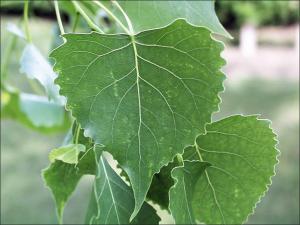
But other characteristics are more difficult to explain. Look at this photo of cottonwood leaves. Aren’t they beautiful? I have now shed all of my leaves for the winter, but about three months from now I will grow thousands of new ones.

Notice the teeth along the edges of my leaves. Truly artistic! I’m not bragging, but do you humans have anything this beautiful about your bodies?

But are these teeth an adaptation? Stan insists that they are. Toothed leaves, said Stan, are better in cooler climates, and he showed me a website that made this very point. But there are plenty of exceptions to this pattern. Maybe this is just an adaptive story, insightful but not necessarily true. Maybe trees of the genus Populus, including me, just have a genetic tendency to have toothed leaves, and we also happen to live north of the tropics. These two facts may not be connected at all.

An even better example of an adaptive story is about fluttering leaves. My leaves, as those of all cottonwoods, poplars and aspens, flutter in the wind, creating a delightful shimmering sensation. All leaves move in the wind, producing a sound called susurrus (one of Stan’s favorite words), but my leaves and those of my evolutionary relatives don’t just rustle in the wind; they almost twinkle. Some aspens are called quaking aspens, or trembling aspens, because of this most obvious and beautiful characteristic. This occurs because our leaf petioles are flat rather than round.

Botanists like Stan say that this fluttering movement increases the rate at which carbon dioxide gets into our leaves. Sorry, Stan, but that is almost certainly just an adaptive story. Of course, fluttering leaves absorb more carbon dioxide; and almost any fast-growing plant benefits from having lots of carbon dioxide. Why, then, is it just us members of the genus Populus that have this characteristics? Why don’t sycamores, which like us grow along rivers, have fluttery leaves? There are some that live only a few meters away from me.

To tell the difference between an adaptive story and a scientific explanation, you need to not only explain the advantage of the characteristic, but why you don’t see all organisms that live under the same conditions with that characteristic.

Cottonwood leaves flutter, and as a result we have more photosynthesis. But other trees achieve the same result in different ways. There is no answer to the question of why my leaves flutter in the wind more than those of sycamore trees. Meanwhile, just look at my leaves and admire them.

Tuesday, June 29, 2021

True Protein, Fake Protein

An important question in scientific thinking is, how do you know which measurements to trust? Let me give an example regarding protein. I just posted a video about this.

For photosynthesis, leaves require both chlorophyll (to absorb the light) and an enzyme called rubisco (to absorb the carbon dioxide). All leaves require both, but a leaf down in the shade requires more chlorophyll, and a leaf out in full sun requires more rubisco. If a scientist is interested in measuring the amount of rubisco, it would seem to be easy enough: just measure the amount of carbon dioxide that the leaf absorbs.

But carbon absorption varies from moment to moment, based on temperature, light, and amount of carbon available to the leaf. What many scientists really want to know is, how much carbon absorption capacity does a leaf have? That is, how much has the leaf invested in carbon uptake? We expect leaves in full sunlight conditions to invest more in carbon uptake—that is, to make more rubisco. That’s what we really want to measure.


But measuring the amount of rubisco is difficult and expensive. Is there a simpler, and still valid, way of measuring rubisco indirectly? The measurement has to have construct validity—that is, it must give a realistic idea of how much rubisco is in the leaf.

It turns out that there is such a measurement. Instead of picking rubisco out from among the thousands of proteins in the leaf, just measure the total amount of protein. Total protein content is a valid estimate of rubisco content because, as it turns out, rubisco constitutes one quarter of all the protein in the leaf. It stands out from all the others. Total protein content is a realistic stand-in for rubisco content.

But even measuring protein is a complex process. There is an even simpler way. Most of the nitrogen in a leaf is inside of proteins. There are a few other kinds of nitrogen-containing molecules, such as DNA, but they are very rare in comparison. Thus, measuring the amount of nitrogen in a leaf is a pretty good stand-in for the amount of rubisco.

Measuring the nitrogen content of leaf tissue is fairly simple—not quite simple enough to do in your garage, but it doesn’t require a fancy lab. The Kjeldahl technique was developed over 100 years ago. You put the tissue in strong sulfuric acid, which pretty must blasts the organic molecules to smithereens. One of these smithereens is ammonia. Most of the nitrogen in the leaf ends up in the ammonia, which can be easily measured by titration. Thousands of articles have been published in which investigators measured rubisco in leaves indirectly by the Kjeldahl technique.

But the method is open to manipulation. It is a good measure of protein only if most of the nitrogen in the sample comes from protein. For a leaf, this is a good assumption. For milk, it is a good assumption. That is, unless a milk producer wants to lie about how much protein is in the milk. This is what happened in China in 2008. Milk producers tried to pass off low-protein milk as high-protein milk by adding melamine, which contains nitrogen atoms. Maybe nobody would ever have noticed, but Chinese babies started dying from kidney failure.

I suppose it is possible for botanists to adulterate their leaf tissue with melamine to bump up the estimate of rubisco content. But who would do that? The milk producers thought they could save millions of yuan by adulterating the milk. But, although crime pays, botany doesn’t. The cardinal rule of credibility in science, as in anything else, is to follow the money.

I give other examples of construct validity, and its everyday importance, in my book Scientifically Thinking.

Wednesday, February 3, 2021

Energy Storage: A Big Step in Evolution

Life on Earth has a nearly unlimited source of energy: sunlight. The light reactions of photosynthesis transduce sunlight energy (absorbed by beautiful green chlorophyll) into electricity. This would be plenty of energy for any life form. But here is the problem: as soon as the sun sets, or even becomes dim, the organism would have to go into suspended animation. The solution to this problem: store the light and electrical energy in a chemical form. Photosynthesis in chloroplasts puts sunlight energy into sugar, which can be stored and used whenever needed.

Cellular respiration in mitochondria releases chemical energy from sugar in lots of little steps, and makes it available for the cell’s chemical reactions. It does so quietly and invisibly, with an almost 50 percent efficiency. This is much better than even the most fuel-efficient vehicles.

It is easy to overlook just how much energy there is in a teaspoon of sugar. In order to appreciate it, you can release the energy all at once. It produces a very dramatic fizzle. It is not a bomb, but still impressive. It must be done in a fume hood or outside.

  • Grind up the sugar. Do not use powdered sugar, since it is not just sugar ground into a powder.
  • Grind up some potassium chlorate. This provides oxygen, but no energy, to the reaction.
  • Mix the two powders in a plastic weigh boat or other disposable, non-flammable container.
  • Pour in a little concentrated sulfuric acid.
  • Then get out of the way.

The resulting reaction is zero percent efficient. All of the energy comes from the sugar, none from the oxidizing agent or the acid. And it all goes into light, heat, and noise.

I made a Darwin video that shows the process. Enjoy!

It is this huge amount of efficiently-stored energy that makes life possible.

Saturday, July 6, 2019

Silent Struggle of the Leaves!


I have posted another video in a series, The Hidden Lives of Plants. This inaugural video is the Silent Struggle of the Leaves! The URL is here.

Join me out in a peaceful forest. Actually, it is not peaceful; there are silent struggles going on. I don’t just mean spiders eating insects down where you cannot see them. Animals are not the only organisms that hunt, hide, fight, and feast. The plants do so also, slowly and silently.

Plants deploy their leaf area in order to get sunlight for photosynthesis, which is how they make their food. Natural selection rewards the plants that do this the best. But these are not necessarily the plants that make the most leaf tissue or leaf area. Leaves have to pay for themselves; they must produce enough food to make up for their construction and maintenance costs. Any plant that produces too much leaf material would risk losing the game of natural selection as surely as a plant that produces too little.


That is, the silent arena for struggle in a forest is not so much a battlefield as it is a marketplace.

I am working on a book, tentatively entitled Silent Struggle: The Hidden World of Plants. Watch for it!

Wednesday, December 19, 2018

Plants Will Save the World! Or Not


An old acquaintance of mine (well, no older than I am) responded to a message that I had posted on Facebook, in which I said I had my students do a project in which they increased their health and reduced their carbon footprints. My friend wanted to know why anyone would want to reduce their carbon footprint. Plants need carbon dioxide, so if we put as much carbon into the air as possible, we are feeding the plants, right? He was puzzled that I, as a botanist, did not seem to understand this.

He even had a scientific source for his views. He referred to the work of Sylvan Wittwer, a horticulturalist whose research showed that plants grow better in higher carbon dioxide. From this, Wittwer concluded that rising carbon dioxide levels in the air was a good thing.

In the narrow sense, Wittwer was right. Back in graduate school, I worked on experiments with Fakhri Bazzaz (University of Illinois, later Harvard) that proved this very thing. They were greenhouse experiments. But later outdoor experiments, using Free Air Carbon Enrichment (FACE) reached similar conclusions. What happened is that, at first, plants grow more when they have more carbon, but then the growth enhancement slows down. Just one example of this is a 2006 article by Stephen Long and Donald Ort, from the University of Illinois where I got my Ph.D. Unfortunately, I cannot provide the full text, since it is available only to members of AAAS. But you can read the abstract. Here is a photo of one such experiment. It was led by my fellow graduate student from Illinois in the 1980s, Rick Lindroth.


The problem with saying that plants will grow more and cleanse the air of excess carbon is that plants need lots of things other than carbon dioxide in order to grow. They need light, which on this planet is usually abundant. But they also need soil with water and nutrients. A lot of places on Earth have droughts and soil erosion, and in those places the plants cannot make use of any extra carbon dioxide. Most of all, plants need to not be destroyed if they are to grow and absorb carbon dioxide. A lot of forest and grassland is being destroyed. Forests grow back, but we are destroying them faster than they can grow back. Apparently the plants grew quite well in Wittwer’s greenhouses, but in the great outdoors, they frequently do not.

The results are clear. Carbon dioxide levels have been increasing. When measurements began in the 1950s, carbon dioxide levels were less than 300 parts per million. Today, they exceed 400. These numbers sound small but carbon dioxide is very good at holding in the atmospheric heat. Carbon dioxide is the main reason that Venus is hotter than Mercury despite being further from the sun.

If plants are going to save the world, why are they not doing so now? They seem to be totally incapable of absorbing the surplus carbon dioxide we have already put in the air. If plants are going to save the world, when are they going to start?

Plants need carbon, and we need water. But you can’t make us healthier by drowning us in water. You can’t make plants grow more by gassing them with carbon, except sometimes in a greenhouse.

Another problem is bias. Wittwer helped to start two major think tanks. One of these is the Greening Earth Society, which is sponsored by the Western Fuels Association. The other was the Center for the Study of Carbon Dioxide and Global Change, which does not reveal its funding sources but IRS records showed that at least one source was ExxonMobil. The very purpose of these think tanks is to convince people, mainly politicians, that global warming is nothing to worry about and we should use as much oil as possible right now. They fund only research that is consistent with this view.

Having bias does not mean that you are a liar. We all have biases, as I explain in Chapter 13 of my new book, Scientifically Thinking. But there is certainly pressure for scientists whose work is funded by oil companies to reach conclusions those companies would like. You would have to be nearly superhuman in your fairmindedness if your funding sources did not influence your conclusions.

One would think that the Center for the Study of Carbon Dioxide and Global Change would gleefully promote the conservation and replanting of forests and grasslands, in order to get them to grow back faster and absorb more carbon dioxide. I asked the lead scientist of that organization if his organization promoted conservation and reforestation. He answered that taking a stand one way or the other on reforestation was outside the mission of his organization. I took this to mean that his oil donors did not want him to say that we should save and replant forests, even if he personally believed it. Your funding sources not only influence your conclusions but limit what you can say. This man struck me as being honest, as honest as he was permitted to be.

My own research shows that buds of deciduous trees in Oklahoma have opened earlier in the spring by about one to three days per year over the last dozen years. This is associated with one component of global warming. Earlier budburst is not necessarily a bad thing, but it is a sign of global warming. This graph shows the earlier budburst dates in four major species of deciduous trees. Lower numbers on the y axis mean earlier budburst.


Budburst did not occur earlier each year, but over the twelve year period, the odds of this result occurring by chance were (by statistical analysis) less than one in ten thousand.

I have received no funding for this research, not from science agencies, nor from environmental groups, nor from oil companies.

So, what is my bias? Of course I have one. But it is not what you might think. I am a botanist. I love love love plants, starting with the green chlorophyll that absorbs sunlight all the way up to the whole organism and the whole forest.


In the photo on the top, green chlorophyll glows red because it absorbs visible white light but emits red light by fluorescence. The photo on the bottom is a water oak leaf, which is a photosynthetic factory filled with veins that deliver water and take away precious sugar.

I would love to be able to tell everyone, plants will save the world! They will scrub the excess carbon out of the air. Unfortunately, I have to dejectedly accept the conclusion that they will not. This is the conclusion I reached in Chapter 3 of my earlier book, Green Planet. The subtitle of that book shows clearly that I really hoped that plants would rescue us from the greenhouse effect: How Plants Keep the Earth Alive.

It is with a heavy heart that I must report to you that the research conducted by a handful of oil-funded scientists is incorrect, and global warming is real, getting worse, and very dangerous.
Wednesday, January 11, 2017

Evolution: Using the Hand You Are Dealt

A mistake common among both “creationists” and “evolutionists” is that their preferred mode of origin produces perfection: an adaptation, whether created or evolved, is the best possible solution to the challenges of existence. The exceptions to this view are so numerous that I believe no one could list all of them. I just wanted to tell you about a recently-published example.

Those of us who are enchanted by the beauty of photosynthesis, all the way from the deep emerald color of chlorophyll a to the utter transformation of Earth that photosynthesis has wrought in the last three billion years, are tempted to think that it is a perfect process. I can hardly contain my enthusiasm for photosynthesis. But, for all of its elegance and global importance, photosynthesis has several flaws. One is that the light-absorption reactions consist, for no good reason other than evolutionary history, of two cycles rather than just one. Somewhere back in time two different bacterial systems merged together into the chloroplast photosynthetic system that covers the Earth today so much that large parts of the planet appear green from outer space. I suspect that, had a Designer made photosynthesis, this Designer might have made a single, efficient cycle rather than smooshing to previous cycles together. But perhaps the most noteworthy limitation of photosynthesis is rubisco.

Meet rubisco. You gotta love it. About half of the water-soluble protein in a leaf is rubisco. It is an enzyme that removes carbon dioxide from the air and fixes (attaches) it to other molecules, which will ultimately become sugar. This is the major short-term process that removes carbon dioxide from the air and almost the only process that creates food upon which all the food chains on Earth depend. That is, rubisco is a carboxylase. But it is also an oxygenase. Oxygen molecules can get into rubisco and crowd out the carbon dioxide molecules. This starts a whole cascade of reactions called photorespiration. Rubisco does not react very much with oxygen, but oxygen is over 5000 times as common in the air as carbon dioxide, so it turns out that photorespiration significantly inhibits photosynthesis—by as much as one-quarter. If only rubisco were not such an inefficient carboxylase, the world would be a lot greener—probably over 30 percent greener. Forests would probably grow 30 percent more biomass, although deserts and tundra, limited by water and temperature, might not look very different. Most physiologists consider rubisco to be the rate limiting step in photosynthesis, the slow guy that holds everything else up. Come to think of it, this is probably why there is so much rubisco. Each molecule is so slow that chloroplasts have to make a whole lot of them just to get the job done.

But rubisco is not the only game in town. There are apparently at least five other carboxylases that are found in cells. That is, the genes for them already exist, but are not used in the most common form of photosynthesis. And they are all more efficient than rubisco.

Thomas Schwander and his colleagues in Germany have devised an artificial pathway of carbon fixation that they call the CETCH pathway (read about it here and here). While it would be difficult to insert the enzymes of this pathway into living plant cells (in vivo), they are working on a commercially viable industrial system that removes excess carbon dioxide from the air and makes them into organic molecules. This system is not just a little bit more efficient than a system based on rubisco; it is thirty-seven times more efficient!

A Designer would have built photosynthesis on something like the CETCH pathway; or, who knows, maybe something even more efficient that the Designer would be able to think of. But evolution uses whatever hand of cards it is dealt. At the time and place when the prevalent modern form of photosynthesis evolved, rubisco was ready and available to be conscripted for that job. And today the natural world is pretty much stuck with it.


Photosynthesis is no different from any other biological process in being the result of an evolutionary pathway that consists of lucky adaptations. Your DNA is not as efficient as it could be. It is filled with dead genes and dead viruses and repeated elements from nucleotide duplication that went a little crazy. Your DNA is not like an orderly house or office. It is like an attic, or the offices of some of my professorly colleagues, in which piles of papers totter in corners and occasionally fall over but in which they can eventually find the papers they need. And almost all the food in the world (unless you live at volcanoes at the bottom of the sea) comes from photosynthesis, which could be a lot more efficient if only it had not been designed by the brainless process of evolution.

Thursday, March 20, 2014

Competitive Photosynthesis

Announcement: See the earlier blog post about the Second Annual Oklahoma Evolution Road Trip! Full information, and registration, are available at the website of the Oklahoma Science Teachers Association. Bob Melton will soon post one revision: the Saturday afternoon trip will not visit the fossil site out on Highway 51. It takes too long to get there and the parking along a busy highway seems inadequate to me. My wife and I went out to check on Redbud Valley yesterday, and she helped me find even more fossils there than I had known about.

Warning: If you go to a Chinese buffet and have one of those steamed mussels, do not open up the body. Just pretend the whole thing looks like that nice grayish muscle tissue. If you open the body up, you will see a bunch of organs, most of which are digestive and some, I assume, reproductive. A knowledge of biology only makes the experience worse. Tastes good, though. Now for the essay.

Like many botany instructors, I use variegated coleus as a way of demonstrating that photosynthesis occurs only in green tissue. The leaves of variegated coleus have sections that are green, or red, or white, or both red and green. The procedure is simple. You use a double boiler and ethanol to remove chlorophyll and anthocyanin from a leaf, then use iodine solution to stain the starch. Starch is present only in the green parts of the leaf. (The ethanol boiling process is itself a source of pleasure, I might add.) A variegated coleus leaf is sort of like a field trial with two experimental conditions (chlorophyll vs. anthocyanin), a control (the white part), and an interaction (red overlaps green).

Variegated coleus grows well in gardens and greenhouses and homes, even though approximately half the leaf area is non-photosynthetic. It only recently occurred to me that this ought to seem strange. Why would a plant produce non-photosynthetic leaf area, unless it is modified for some other function? The answer is obvious: variegated coleus is an example of a mutant form that would not survive in the wild.

But why would it not survive in the wild? The plant grows perfectly well. But a plant that produces twice as much leaf area as it “needs” would be unable to survive in the wild because of competition with other plants. That is, if plants produced only as much leaf area as they needed to keep themselves alive, the world would have only about half as much leaf area as it does. Forests and grasslands would look very shabby, and noticeably less green. Even from outer space, our planet would look a lot less green if it were not for the extra leaf area that plants produce in order to compete with other plants. This is what I mean by “competitive photosynthesis,” which might otherwise sound like a new Olympic sport. (The sportscaster would say, Look, there goes a carbon dioxide molecule now…it made it into a glucose molecule! There goes a water molecule, and here comes the oxygen!)

This is not a new idea, but it is a good one to stop and think about. A long time ago Garrett Hardin pointed out that if it were not for competition, all plants would be crusty green goo. Why do any plants grow up into the air? The sun is 93 million miles away, so a 300-foot-tall tree is not significantly closer to the sun than is a one-foot-tall shrub. But the tree’s leaves are closer to the sun than the shrub’s leaves. It is like the old saying, if you and another person are running from a bear, you don’t have to outrun the bear, just outrun the other person. This is competition, the basis of natural selection and evolution. Hardin called it “in praise of waste.”


A natural world without competition would be much less interesting, at least much less green. Competition is a good thing. In our economic system, however, it has gotten out of hand. Big money crushes small business, and anyone who chooses to serve humankind rather is doomed to a life of near-poverty. I say this as a college professor, husband of a librarian, and father of a school teacher. We public servants work hard and well, harder and better than many people richer than we are. Competition is good, but so is altruism. In our species, we need to lay a greater claim on altruism.

Sunday, July 14, 2013

Natural Selection for Efficiency


At the moment, I am able to post essays from a different location than what I normally use. My usual location remains unworkable. I now resume my usual series of essays.

In a previous essay I wrote about how our economic system is (almost) forcing us to waste resources. In nature, sexual selection often favors wastefulness (think of colorful bird feathers and flowers), and in the human species, social and sexual selection can favor conspicuous consumption. However, this always occurs within the broader picture of natural selection favoring efficiency.

One example is the evolution of CAM, which is a type of photosynthesis found in many succulent plants. The leaves of most plants absorb carbon dioxide and make it almost directly into carbohydrates such as sugar during the daytime. But CAM plants absorb carbon dioxide at night, make it into acid, store up the acid, then use the acid as a source of carbon dioxide from which to make sugar in the day. Carbon fixation therefore occurs in two phases: the night shift, and the day shift. And, like a factory that might need to hire two sets of employees rather than just one, this system is more expensive than just making sugar during the day shift. In fact, the night shift consists of an almost completely separate set of enzyme reactions from the day shift.

Under cool, moist, or shady conditions, CAM would be clearly wasteful. As my educational mentor from grad school days said, CAM plants don’t have it made in the shade. But CAM plants grow in desert conditions. In order to absorb carbon dioxide during the day, a plant has to have its pores open, and when it does so, it loses water vapor. In a cool, moist, or shady environment, this is not much of a problem. But out in the desert, it might cause the plant to lose too much water. For succulent plants it is more efficient to open their pores at night, when it is cooler, and store it up in the form of acid. The wasted energy is more than compensated by the water that is saved.

Here is an analogous situation. Suppose you have a factory that has to shut down on hot days. But even when the factory is shut, you still have to pay the workers. Is it cost-effective to pay a night shift of factory workers so that the factory can stay open in the summer? It depends. If the factory is in Minnesota, probably not. But in the desert, such a factory would be closed from May through September. Not surprisingly, CAM plants are more common in the desert than in Minnesota.

It seems obvious that CAM photosynthesis has evolved and become common in conjunction with the spread of deserts in the late Neogene period. And it has evolved more than once, as existing enzymes have been reassigned to new functions. However, it appears that CAM may have first evolved as an adaptation to low carbon dioxide availability rather than to hot, dry conditions. How else to explain CAM in primitive aquatic plants such as Iosetes? (See the article by Jon Keeley.) A similar adaptation, C4 photosynthesis, may have first evolved in grasses not because of hot conditions but because of low levels of carbon dioxide during glacial periods especially in tropical highlands. CAM and C4 photosynthesis may have begun as an adaptation to low carbon dioxide availability, and they later proved useful in hot, dry conditions. (I did not explain C4 in this brief entry because it’s more complex.)

Everywhere you look in the world, natural selection has favored efficiency. In many cases, after the needs of efficiency have been met, sexual and social selection have favored wastefulness. But in our society right now, we continue our binge of wastefulness even when we are not meeting the basic needs of efficiency.

We may have to learn not just efficiency but extreme frugality in the decades ahead of us. Of course, it is possible that the very rich, and people with lots of guns, might not have to do this, but then there’s the rest of us. Stories from the past tell us that much human creativity has been employed in the invention of new forms of frugality. I grew up hearing stories about how Native Americans used every part of the bison (in contrast to white Americans, who would shoot a buffalo, cut out the tongue to eat, and let the rest rot), and my Dad telling me that a World War II soldier could clean up, shave, and brush his teeth using one helmet-ful of water. Storing runoff water from the roof in cisterns is a practice thousands of years old. The thrifty Scots did not waste anything from sheep; hence the invention of haggis, which (in its original form) was a combination of oatmeal and sheep lung and other organ tissue and which is reportedly a food item.

We can only hope that, when called upon to do so in the years ahead, we humans can display the kind of creativity in our cultural evolution that CAM and C4 plants have displayed in their biological evolution. Sexual and cultural selection can favor wasteful displays, but only if there is a surplus of energy, materials, and opportunities, however slight, left over from the demands of natural selection. A big colorful male bird that starves is just a dead bird.