Showing posts with label carbon dioxide. Show all posts

Tuesday, October 21, 2025

Yet Another Reason for Conservatives to Hate Global Warming Science

Most scientists, particularly those whose research has established the science of global warming, tend to be on the political left. They have been disproportionately targeted for the termination of federal government positions and funding, under the anti-global-warming leadership of Donald Trump. The outspoken advocacy of global warming science by former Vice President Al Gore particularly motivated conservatives to hate global warming science.

Well, I just ran across a new reason for conservatives to hate global warming science. The possibility of global warming was first discovered by a woman scientist.

And no ordinary woman scientist. She was a vocal advocate of women’s rights, and signed the Seneca Falls Convention of 1848. She trespassed into the male territory of science and invention, and then she wanted to vote, too.


Eunice Newton Foote’s experimental demonstration of the possibility of global warming was very simple, and would today be considered simplistic, but it was valid. She took glass cylinders, used an air pump to remove the air, then put air into one cylinder, hydrogen gas into another, and carbon dioxide gas into a third. She had thermometers in the cylinders. (The actual experiment was a little more complicated.) When they had reached temperature equilibrium, she placed them in bright sunlight. The glass trapped the heat of the sun inside the cylinders—that is why it is called the greenhouse effect. The cylinder with carbon dioxide got much hotter than the others, reaching 125 degrees F. This cylinder also took longer than the others to cool off after being removed from the sun. She concluded not only that carbon dioxide held solar heat very well (actually, the infra-red radiation from objects that had warmed in the sun, and, further, that at times when the Earth’s atmosphere had more carbon dioxide—whether in the past or the future—the climate would have been or would be warmer. Years before John Tyndall, and a half century before Svante Arrhenius, who usually get the credit for the discovery of global warming, Eunice Newton Foote had it figured out. Her research, though it remained obscure, did get published. It was presented to the major American scientific society in 1856, though she avoided notoriety by having a man present it for her.

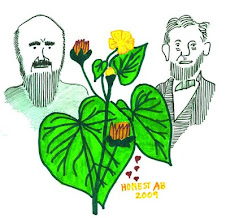
This graphic shows Foote, two of her glass jars, and the sun.

It was difficult, in the nineteenth century, for a woman to publish her own scientific findings, but some, including Eunice Newton Foote, managed to do so. It was legally impossible for a woman inventor to patent her own inventions, because she did not have the legal right to defend her patents from infringement in court. This is why Eunice Newton Foote, like other woman inventors, patented her inventions under her husband’s name. Fortunately Eunice had a supportive husband who was happy to promote her work.

Science, and the world, are better when women are given creative freedom. Most modern conservatives believe this, but they disapprove strongly of modern women who take Foote’s role in modern society.


Friday, March 14, 2025

A Modest Proposal: How Trump and Musk Can Save the World from Global Warming

The only truly effective way to reduce the amount of carbon dioxide in the atmosphere is for all of us to quit producing so much of it: buying less, traveling less. This is my personal solution. But never in all of human history have a large group of people ever cut back on consumption and waste, except recently in the European Union, and then only mildly.

Big-thinking engineers have offered high-tech, expensive, and risky solutions generally called geoengineering, that is, engineering the entire Earth. Two examples are huge carbon-absorption towers and spewing reflective particles into the stratosphere.

The huge towers would collectively breathe in the entire atmosphere, sponge the excess carbon dioxide out of it (leaving only what plants need for photosynthesis), and then exhale the neutralized atmosphere. Such towers, even if there could possibly be enough energy to run them, would have to be huge and incredibly numerous. Proponents of this type of geoengineering are not too clear about what to do with the waste products of these towers. The cost of this kind of project would start in the hundreds of billions of dollars and could reach a trillion.

The other solution would be to inject hundreds of millions of tons of sulfur dioxide into the stratosphere, where it would produce a suspended white haze that would reduce the amount of sunlight reaching Earth’s surface. The particles could be released from a fleet of special aircraft. The everlasting gloom might be a small price to pay for release from global warming. This solution would actually not remove carbon from the atmosphere. No one is sure if the toxic particles might settle and pollute the entire planet. Once again, the cost would start at hundreds of billions of dollars and could reach a trillion.

The Trump II administration would clearly be unwilling to spend this kind of money to solve a problem they refuse to admit exists—global warming.

Unless.

If these geoengineering schemes could be proposed by companies owned by Elon Musk, then Trump would be willing to demand a trillion dollars for them, and Congress would not dare to say no. No amount of money is too much for the federal government to give to Musk. He already owns Space-X. All he would need to do is to produce another hundred thousand aircraft to release the sulfur.

Right now, Musk’s companies are losing money, largely because of the overwhelmingly negative image of Musk Himself. There may not be anything wrong with Teslas, as cars, but when half the world starts calling them Swasticars then the company will start to fail. But Musk’s rockets keep exploding also. So it is possible that Musk’s companies would be unable to competently carry out these geoengineering projects.

But that doesn’t matter. Musk does not need to build cars or rockets that actually work. His market is Donald Trump. Donald Trump can get Musk a trillion dollars of federal money, no problem. The cars and rockets themselves do not matter.

And if one of Musk’s aircrafts explodes, it is no matter, since this too would add reflective particles to the stratosphere.

What could possibly go wrong?

Conservative Christians already worship Donald Trump. Any arguments, in this blog or anywhere else, that addresses any other aspect of Christianity other than the Donald are a waste of time. These geoengineering projects would, moreover, demonstrate that the efforts of conservative Christians to worship Trump would prove to have been correct, for, in this way, Musk and Trump could literally save the world.

Friday, January 20, 2023

Testing a Hypothesis: Sometimes It's Your Only Choice

Plants are dynamic beings that respond continuously to their environments. (Continuous means without interruption, while continual means at recurring intervals.) That is, plants adjust their growth, and even their movements, all the time, day and night, all year.

One fascinating example is called nyctinasty. This is where a plant raises its leaves up, or opens its leaflets, during the day, and lowers the leaves or closes the leaflets at night. Makes sense. During the day they need the light for photosynthesis, and at night they don’t.

Problem is, most plants don’t bother opening and closing, or raising and lowering, their green surfaces. The leaves face the sky in the day, but at night, most plants just leave them where they are. Only a few plants raise and lower, or open and close, their leaves. Examples include the velvetleaf Abutilon theophrasti and many members of the bean family, including the mimosa tree Albizzia julibrissin. This photo shows mimosa leaves folding up for the night, even before sunset. Each mimosa leaf consists of leaflets, each of which has lots of little pinnules. It is, as you can see, the pinnules that close up, and they do so by moving upward.


Why should a plant fold up its leaves at night? Nobody knows, but there is plenty of speculation. Some think it protects the leaves from nighttime rain; others say it hides them from bugs. The most likely reason is that the night sky can be very cold, any time of year, even if the air is not. This could cause the leaves to get too cold during the spring (or fall, but autumn leaves have little value to a deciduous plant that is going to drop them anyway). This was Darwin’s idea, and (working with his son Francis) he made the observations to support (but not to prove) it. Of course, this doesn’t explain why the other plants don’t do this.

This is what mimosas do during under regular conditions: they raise their pinnules each sunset and lower them each sunrise. They do so by the alternate swelling and shriveling of little sacs called pulvini (singular pulvinus). But what I wanted to know was, is the pulvinus on the top side of the pinnule stalk, in which case the pulvinus swells to push the pinnule down, and the pinnule moves up when the pulvinus shrivels; or is it on the bottom of the stalk, in which case it pushes the pinnule down when it swells, and the pinnule moves up when the pulvinus shrivels. The swelling of the pulvinus requires energy; the shriveling does not. Therefore, I wondered, does the pulvinus push the pinnule up at dawn, or does it push it down at sunset?

I looked in the scientific literature and all over the web, and (at least in 2018) could not find an answer to this simple question. So, in desperation, I decided to test a hypothesis myself. And I did so without any fancy equipment or a research grant.

Nyctinasty is not the only process that can make a pulvinus shrivel. Drought can also make a pulvinus shrivel, just as it can make every other cell or structure in a plant shrivel.

There happened to be a drought going on in Tulsa, where I live, in summer 2018. So I went looking for a mimosa tree that was experiencing drought. I had to go up on Turkey Mountain (which is a hill and has no turkeys) to find one. As you can see from the photo, a mimosa leaf experiencing drought during the day raises its pinnules before they start to curl up. This means that the pulvini must be on the top of the pinnule stalks. The pinnules lift up because of tension in the cellulose fibers in the cell walls, unless pulvini push them down.


I wanted to know the answer to the question, but I found enjoyment in answering the question in a way that anyone can do, even without a laboratory.

Another question that you might wonder about is this. After you exercise, of course, you breathe faster, and this helps your body to get rid of carbon dioxide that has built up in your blood. But does each breath have more carbon dioxide? To answer this question, all you need to do is to blow bubbles in slightly basic water. The water should contain some phenolphthalein, which turns pink under basic conditions, and turns clear in acid conditions. If each breath has more carbon dioxide (which becomes carbonic acid in water), then the phenolphthalein should turn clear sooner when you blow bubbles in the water right after exercising than when you blow bubbles in the water while rested. You can answer this physiological question, about lungs and carbon dioxide, without any equipment other than two glass jars, a couple of straws, and a little phenolphthalein. (You can’t just walk into the drug store for phenolphthalein, but it is not a controlled substance. You get it from science education supply companies.) If you can’t afford a carbon dioxide measuring device, you can test the hypothesis in a cheap and easy fashion.

These are actually experiments. In the case of the mimosa, it is a natural experiment: nature imposed the drought on the plants. In the case of breathing, the experiment compares the treatment (breath after exercise) against the control (breath while resting).

And it’s fun, too. Students like it. If you are an elementary school teacher, you can do the bubble experiment in your class.

There are probably lots and lots of questions that you wonder about and for which you cannot find an answer. Rather than to give up, try finding the answer by some simple observation or experiment.

Wednesday, December 19, 2018

Plants Will Save the World! Or Not


An old acquaintance of mine (well, no older than I am) responded to a message that I had posted on Facebook, in which I said I had my students do a project in which they increased their health and reduced their carbon footprints. My friend wanted to know why anyone would want to reduce their carbon footprint. Plants need carbon dioxide, so if we put as much carbon into the air as possible, we are feeding the plants, right? He was puzzled that I, as a botanist, did not seem to understand this.

He even had a scientific source for his views. He referred to the work of Sylvan Wittwer, a horticulturalist whose research showed that plants grow better in higher carbon dioxide. From this, Wittwer concluded that rising carbon dioxide levels in the air was a good thing.

In the narrow sense, Wittwer was right. Back in graduate school, I worked on experiments with Fakhri Bazzaz (University of Illinois, later Harvard) that proved this very thing. They were greenhouse experiments. But later outdoor experiments, using Free Air Carbon Enrichment (FACE) reached similar conclusions. What happened is that, at first, plants grow more when they have more carbon, but then the growth enhancement slows down. Just one example of this is a 2006 article by Stephen Long and Donald Ort, from the University of Illinois where I got my Ph.D. Unfortunately, I cannot provide the full text, since it is available only to members of AAAS. But you can read the abstract. Here is a photo of one such experiment. It was led by my fellow graduate student from Illinois in the 1980s, Rick Lindroth.


The problem with saying that plants will grow more and cleanse the air of excess carbon is that plants need lots of things other than carbon dioxide in order to grow. They need light, which on this planet is usually abundant. But they also need soil with water and nutrients. A lot of places on Earth have droughts and soil erosion, and in those places the plants cannot make use of any extra carbon dioxide. Most of all, plants need to not be destroyed if they are to grow and absorb carbon dioxide. A lot of forest and grassland is being destroyed. Forests grow back, but we are destroying them faster than they can grow back. Apparently the plants grew quite well in Wittwer’s greenhouses, but in the great outdoors, they frequently do not.

The results are clear. Carbon dioxide levels have been increasing. When measurements began in the 1950s, carbon dioxide levels were less than 300 parts per million. Today, they exceed 400. These numbers sound small but carbon dioxide is very good at holding in the atmospheric heat. Carbon dioxide is the main reason that Venus is hotter than Mercury despite being further from the sun.

If plants are going to save the world, why are they not doing so now? They seem to be totally incapable of absorbing the surplus carbon dioxide we have already put in the air. If plants are going to save the world, when are they going to start?

Plants need carbon, and we need water. But you can’t make us healthier by drowning us in water. You can’t make plants grow more by gassing them with carbon, except sometimes in a greenhouse.

Another problem is bias. Wittwer helped to start two major think tanks. One of these is the Greening Earth Society, which is sponsored by the Western Fuels Association. The other was the Center for the Study of Carbon Dioxide and Global Change, which does not reveal its funding sources but IRS records showed that at least one source was ExxonMobil. The very purpose of these think tanks is to convince people, mainly politicians, that global warming is nothing to worry about and we should use as much oil as possible right now. They fund only research that is consistent with this view.

Having bias does not mean that you are a liar. We all have biases, as I explain in Chapter 13 of my new book, Scientifically Thinking. But there is certainly pressure for scientists whose work is funded by oil companies to reach conclusions those companies would like. You would have to be nearly superhuman in your fairmindedness if your funding sources did not influence your conclusions.

One would think that the Center for the Study of Carbon Dioxide and Global Change would gleefully promote the conservation and replanting of forests and grasslands, in order to get them to grow back faster and absorb more carbon dioxide. I asked the lead scientist of that organization if his organization promoted conservation and reforestation. He answered that taking a stand one way or the other on reforestation was outside the mission of his organization. I took this to mean that his oil donors did not want him to say that we should save and replant forests, even if he personally believed it. Your funding sources not only influence your conclusions but limit what you can say. This man struck me as being honest, as honest as he was permitted to be.

My own research shows that buds of deciduous trees in Oklahoma have opened earlier in the spring by about one to three days per year over the last dozen years. This is associated with one component of global warming. Earlier budburst is not necessarily a bad thing, but it is a sign of global warming. This graph shows the earlier budburst dates in four major species of deciduous trees. Lower numbers on the y axis mean earlier budburst.


Budburst did not occur earlier each year, but over the twelve year period, the odds of this result occurring by chance were (by statistical analysis) less than one in ten thousand.

I have received no funding for this research, not from science agencies, nor from environmental groups, nor from oil companies.

So, what is my bias? Of course I have one. But it is not what you might think. I am a botanist. I love love love plants, starting with the green chlorophyll that absorbs sunlight all the way up to the whole organism and the whole forest.


In the photo on the top, green chlorophyll glows red because it absorbs visible white light but emits red light by fluorescence. The photo on the bottom is a water oak leaf, which is a photosynthetic factory filled with veins that deliver water and take away precious sugar.

I would love to be able to tell everyone, plants will save the world! They will scrub the excess carbon out of the air. Unfortunately, I have to dejectedly accept the conclusion that they will not. This is the conclusion I reached in Chapter 3 of my earlier book, Green Planet. The subtitle of that book shows clearly that I really hoped that plants would rescue us from the greenhouse effect: How Plants Keep the Earth Alive.

It is with a heavy heart that I must report to you that the research conducted by a handful of oil-funded scientists is incorrect, and global warming is real, getting worse, and very dangerous.

Saturday, July 8, 2017

Is There Any Hope for the Climate Future?

As I have previously written (see the Real Ecology Manifesto at this permalink), I believe that there is no hope for the world to avoid climate catastrophe, from which the human species will survive, but human societies will not; and from which the Earth, even though minus many of its species, will recover. Nevertheless, I also believe that we need to live in such a way that, as individuals, we do the best work we can at avoiding this catastrophe. That is, even if there is no hope, we can feel that we have lived in the right way (and we can stand before God, if there is one, in the knowledge that we have done the best we could).

We cannot do this if we know our actions to be utterly futile. But what if I am wrong, and there is hope? Or, what if the good things we do will reduce the intensity of the inevitable catastrophe? What we need is some good news, even if the news is not good enough for us to be fully optimistic. But this news has to be factual, not just a fleeting hope.

The Citizens’ Climate Lobby (which consists of citizens who want to effect federal-level policies that will reduce the risk of climate catastrophe, and who know that the apostrophe belongs at the end of the word citizens’) had an online national meeting today, in which Drew Jones, the co-founder of Climate Interactive, gave us some reasons to be optimistic. I happen to believe these reasons are not good enough, but they are verifiably true. I hope that I am wrong in my cynicism, and if I am, these will be the reasons. Here are some of them.

  • While Trump has pulled America out of the international climate accords, many cities and states have declared their intention to follow the Paris guidelines. More than half of Americans live in cities or states (or both) that have declared their willingness to cooperate with the rest of the people in the world by reducing carbon emissions.
  • World carbon emissions have actually stabilized in the last three years, after decades of not only increasing but accelerating. In 2013, global carbon emissions increased by 2.0 percent over 2012; by 1.1 percent in 2014 over 2013; and actually decreased by 0.1 percent in 2015, compared to 2014, in a report prepared by the Netherlands for the European Union. It is not enough to just stop increasing our carbon emissions, but this leveling-off of carbon emissions has happened seldom since records have been kept. Meanwhile, global atmospheric carbon dioxide levels (not the same thing as carbon emissions) continue to increase, from 405 ppm in 2015, to 409 ppm in 2016, to 413 ppm in April of this year.
  • As of today, the Climate Solutions caucus in the U. S. Congress, in which members of both parties agree to do something to reduce carbon emissions, has 24 Democratic and 24 Republican members. (Anyone who joins needs to partner with a member of the other party.) Of course, these few Republicans are easily ignored by the leadership of their party. (John Huntsman said “Call me crazy, but I believe what the scientists say about evolution and global warming.” Guess what. His party called him crazy!) But at least a few responsible Republicans exist!
  • China’s use of coal has declined slightly.
  • The Paris Agreement still has 194 signatories even after the United States has pulled out.
  • Perhaps the most important point is that long-term social change looks impossible until it happens. For example, state bans on interracial marriage seemed like they would never be lifted until the 1967 Loving v. Virginia case, in which the Supreme Court handed down a unanimous decision that interracial marriage must be permitted. If you were a black person in South Africa in 1985, it might have seemed that apartheid would never end, but within a decade it ended. A social consensus that we must do something about global climate change is building, and could quickly become the norm. As Gandhi said, “First they will laugh at you then they will ignore you then they will fight you then you will win.”


I must point out, though, that social change doesn’t always work. As explained by Peter Watson in The Great Divide, a quixotic attempt to summarize all of world prehistory and history, human sacrifice used to be the norm in all known prehistoric societies. In the Old World, in separate locations, human sacrifice was replaced by animal sacrifice and finally by the elimination of physical sacrifice, as religious awareness grew. In the New World, however, human sacrifice grew at a dizzying pace, so that the Aztecs carried out entire wars just to get sacrificial victims; they captured tens of thousands of victims each year, cut their hearts out, threw the hearts in a bowl, tumbled the bodies down the pyramid steps, and made stew out of the bodies. There was a brief attempt by one Mayan leader, Topiltzin Quetzalcoatl, starting about 968 CE, to bring the vicious cycle of human sacrifice to an end. But he failed. Human sacrifice ended only with the conquest of the Aztecs by the equally brutal Spaniards—brutal, but at least they didn’t carry out human sacrifice.

I will add one of my own to Drew’s list. The other major economies of the world recognize that Trump’s refusal to cooperate on climate issues makes America an outsider. Some of the G20 nations now refer to the group as the G19 + 1. It is possible that international pressure will make enough people rethink their position and at least cooperate with the rest of the leading nations of the world. This is extremely unlikely; I think America will cooperate with the rest of the world only if forced to do so. But, again, I hope I am wrong.

What will NOT happen is that Christian Americans will suddenly feel the Spirit of God calling them to show love to their fellow humans and to God’s Creation by preventing climate catastrophe. Some Christian Americans feel this way; most do not, and are in fact furious at their fellow Christians who do. To wait for this to happen would be like waiting for a decomposing bone to turn back into a cow.


Join with me in trying to make the world a better place for everyone, even if this effort fails, and just in case it succeeds!

Sunday, November 17, 2013

The Second Worst Idea in the World


I suspect that the second worst idea in the world is to attempt to control global warming by means of geoengineering.

I sometimes think about geoengineering when I walk to work. (Don’t you?) I see the trees around me, just beginning to senesce for autumn, and I think about the (to me) incalculable tons of carbon dioxide that they remove from the air, much of which they store long-term in wood and roots. They do it for free. But geoengineers have a different solution. It is to build “artificial trees” that cost a lot of money. These “trees” are basically carbon dioxide filters on top of poles.

According to a 2009 article, “Each synthetic tree could capture up to 10 tons of CO2 a day, which is thousands of times more than a real tree. Each tree would cost around $24,400, and a forest of 100,000 of them could be constructed within the next couple of decades using existing technologies.” Doesn’t this sound exciting? Only $2.4 billion. Of course, real trees are free, unless you insist on planting certain trees in certain places. The article continues, “The trees would have a special synthetic filter that absorbs carbon dioxide. When the filters had absorbed their load of CO2 they would be replaced with new filters and the old ones would be stored in empty gas and oil reservoirs, such as depleted oil wells in the North Sea.” It occurred to me that the $24,000 price tag did not include removing and storing old filters, and replacing them with new ones. And you can’t just drop something down into a North Sea oil well. This sounds to me like someone wanting to sell huge expensive devices and using the environmental playing-card as a way to sell them.

The only thing that may be worse than this type of geoengineering is to launch hundreds of thousands of mirrors into space, between the Earth and the Sun, to cast a partial shadow on the Earth. There is a reason that the price tag for this geoengineering solution is generally not mentioned.

As I explained in my book Green Planet, trees do lots of things that keep the Earth alive. A tree produces oxygen, absorbs carbon dioxide, creates cool shade, reduces floods, recharges ground water, holds down and enriches the soil, and many other things. An artificial tree does only one of those things.

Geoengineering scenarios sound like something from the old Outer Limits TV shows. It also sounds like the kind of solution that a Democrat would come up with: a big, expensive government solution. Except that it was the Republican president George W. Bush that, according to this article, promoted the idea of space mirrors.

I prefer “no-regrets” solutions over geoengineering solutions. If we allow trees to grow, and maybe plant some extra ones, we will have good results; this has been assured by hundreds of millions of years of evolution. If it turns out global warming is not a problem, the trees will perform other valuable services. No regrets. But if it turns out that global warming is not a problem (a virtual impossibility), then we will have wasted billions if not trillions on geoengineering fiascos. Lots of regrets.


Of course, the worst idea is to go along with the Republican Party and pretend that global warming is not occurring.