I
discovered a surprising book in my vast library recently: My Wilderness, East to Katahdin, by a certain William O. Douglas.
Many of us think of the modern era of environmental awareness as having begun
with the 1962 publication of Silent
Spring by Rachel Carson. But My Wilderness, published in 1961, has some of
the same ideas, though in a less organized form. Rachel Carson organized the
concepts into a powerful argument and provided all of the scientific
references, but William O. Douglas and probably many others had thought of them
earlier.
One
of these concepts was the interconnectedness of nature and how modern
industrial society can mess everything up by ignoring these connections. One
example about which Douglas wrote was the federal government practice, in the
1950s, of dropping poison bait from airplanes to kill off the wolves. But the
result was to kill off many other kinds of animals, some of which had kept
populations of agricultural pests such as grasshoppers in check. The result was
population explosions of insect pests. The answer to this was, of course, more
spraying. Another example was the attempt to destroy the sagebrush by
herbicides, to encourage the grass to grow for the ranchers to graze their
livestock. But wildlife that depended on the sagebrush began to die as a
result.
Another
concept was the government practice of renting out federal land very, very
cheaply to ranchers to graze their livestock. At that point, the ranchers began
to act as if the federal land was actually their private land that the
government should just let them keep. This continues to happen today, such as
the takeover of federal land by the armed Bundy family militia in late 2015.
But it is nothing new. Douglas quotes an acquaintance who worked for the
federal government (I presume the Bureau of Land Management) who said, “…a
permittee who has the right to run sheep on public land pretty soon begins to
think he owns the range. Take it away from him, or cut down on the number of
sheep or cattle he can graze, or increase the rental, and he hollers as if his
property has been confiscated” (page 41). Then as now, ranchers who pretend to
be wild west cowboys want to take land that belongs to the taxpayers—that is,
as much as to me as to them—and keep it for themselves. This is a practice that
they refuse to call socialism.
Douglas
was a man who hiked all over the continent. He writes of backpacking in the
Wind River Mountains of Wyoming; Zion National Park in Utah; Maroon Bells in
Colorado; Baboquivari along the Arizona-Sonora border; Quetico Provincial Park
in Canada; The Smoky Mountains; the Everglades; the Chesapeake and Ohio Canal
near Washington, D. C.; and the White Mountains, Allagash, and Mt. Katahdin in
the northeast United States. He was no stranger to the challenges of survival
in the wild. The descriptions in this book are sometimes evocative and help you
to feel like you are actually present in a place you will probably never visit.
But, although I have no doubt that he saw all of these organisms, his
descriptions were usually lists of plants and animals that sound like he copied
them out of a guidebook. There were quite a few books of this sort published
about the same time, such as The Singing
Wilderness by Sigurd Olson, The Near
Woods by Millard Davis, and One Day
at Teton Marsh by Sally Carrighar. Douglas’s book is highly disorganized,
except for each chapter being about his experience in one particular place.
What
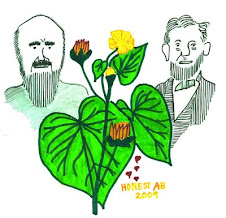
makes this book unique is the person who wrote it. Who was he? Do the black
robes in this portrait give you a hint?

William
O. Douglas was, throughout nearly all of the time during which he took the
hikes he describes, a Supreme Court justice. He still holds the record of
serving the longest on the Supreme Court, almost 37 years, from 1939 to 1975. Aside
from Teddy Roosevelt shooting big animals and mistaking it for a love of
nature, we have never had—and almost certainly will never again have—a prominent
politician who had or will have such a passionate and thorough knowledge of the
natural world. Today, with the new “conservative” (vs. conservationist)
takeover, it seems that the less you
know about science and nature, the more
qualified you are for any office, particularly positions in which you are
supervising government conservation and scientific activities. But even the few
remaining liberals in government seem to think that the Earth is just a stage
on which the human drama takes place. Douglas was most famous for writing the “Rights
of Rocks” statement. In the Sierra Club v. Morton suit regarding the commercial
development of Mineral King, just south of Sequoia National Park in the Sierra
Nevada Mountains of California, Douglas wrote, “Contemporary public concern for protecting nature's
ecological equilibrium should lead to the conferral of standing upon
environmental objects to sue for their own preservation.” That is, trees
should be able to sue for their own preservation. Can you imagine any Supreme Court
justice, or any other prominent politician, saying anything like this today?
Douglas considered Nature to be a holy place.
Thousands of books are published with such a theme, and millions of people
believe it, but none of them in such a prominent position as the one Douglas
held. Just read these words: “If we make conservation a national cause we can
raise generations who will learn that the earth itself is sacred. Once a person
breaks through to the level where love of beauty is the ideal, he will worship
the rocks and plains that are America. Then he will look on a tuft of grass
with awe. For it has the secret of chlorophyll that man hardly comprehends”
(page 32).
The
survival of human life as we know it on Earth depends on our leaders having
this kind of insight. And it will never happen.