Or a
forest, or a grassland, for that matter. But I think I can illustrate my point
most vividly using the example of deserts.
Many
different kinds of habitats get lumped together in the category we call
“desert.” Unfortunately, once our human minds have created a category, we
assume that everything within that category is the same.
The
habitats we call “deserts” are very diverse. The most obvious way they differ
is that the “deserts” of the different continents are the homes of almost
entirely separate sets of species. When you see desert shrubs in California, in
the Middle East, and in western Asia, they are not the same species. Leafless,
succulent plants in American deserts are usually cactuses, whereas in Africa
they are spurges or milkweeds. South Africa has many species of succulent,
leafless plants in the Aizoaceae family, different from all the others. The
animal inhabitants of the deserts on different continents are also distinct.
But even
within one “desert” there is a lot of habitat diversity. Consider the
southwestern deserts of North America. The areas that ecologists refer to as
the Mojave Desert (e.g., southeastern California) are covered with
widely-spaced shrubs. The areas that ecologists call the Sonoran Desert (e.g.,
in the Phoenix area) has shrubs (but not the same species) and many species of
cactus. In fact, the shade cast by acacia bushes is important to the survival
of young cactus seedlings. The areas that ecologists call the Chihuahuan Desert
(e.g. near Big Bend) has shrubs and succulents (though usually agaves rather
than cactuses), but the space between them, unlike the other deserts, is filled
with grasses. This makes sense, as this kind of desert intergrades into the
high plains grasslands. (No, that’s not where chihuahuas come from.)
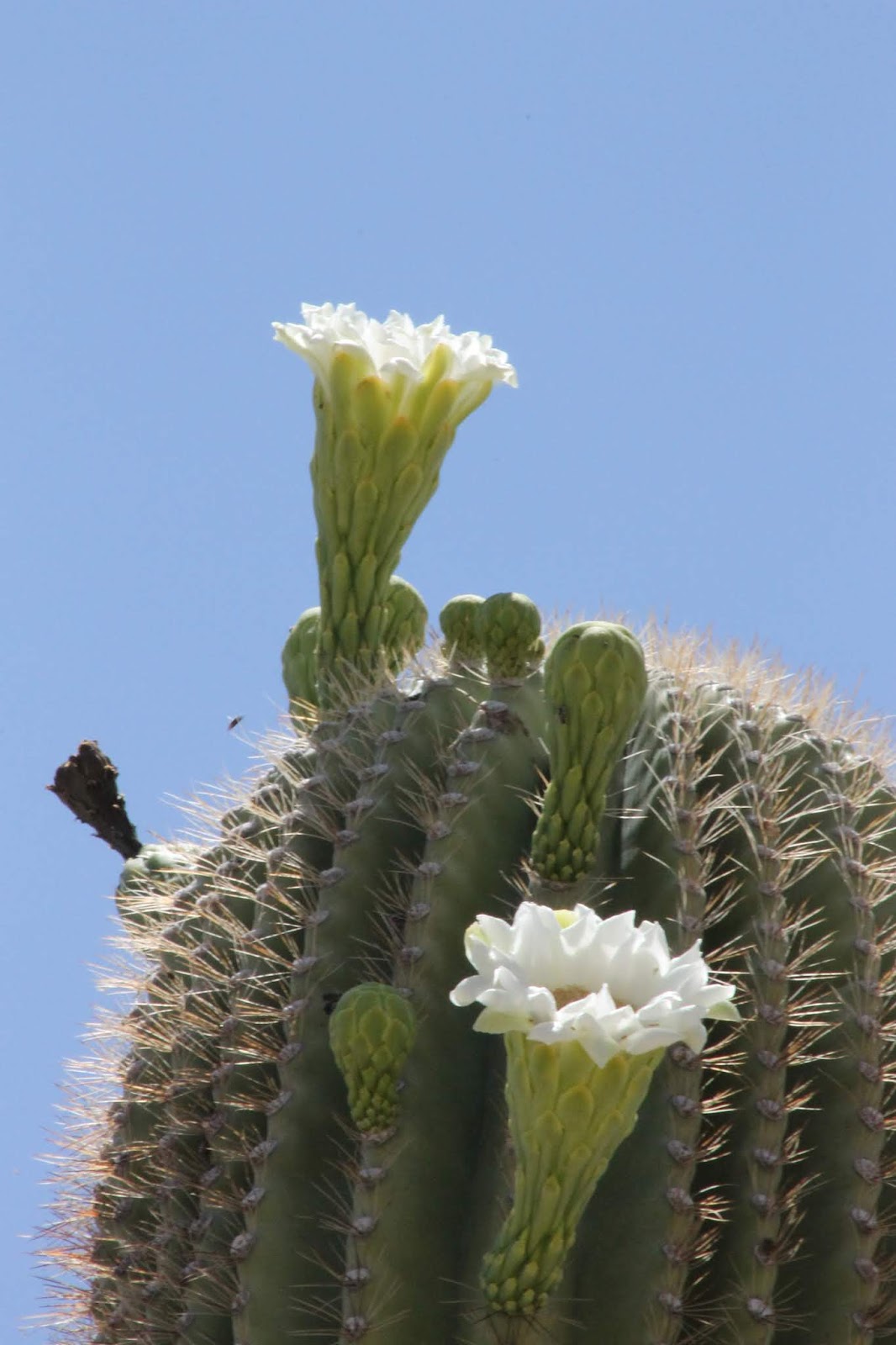
Above: Chihuahuan desert in Big Bend National Park; below, saguaro flowers in the Sonoran desert near Tucson.
But even
within one of these subtypes of desert has a lot of habitat diversity. The
Chihuahuan Desert grow on the tops of hills as well as on the slopes and
lowlands. At the tops of some of these mountains in southern California,
Arizona, New Mexico, and Texas, and in northern Mexico, there are some small
oak forests. These forests are the remnants of oak lands that used to be
widespread in the countryside back when the climate was wetter. As the climate
became drier, the forests survived only as little patches on somewhat cooler
and wetter hilltops. Most of these oak species are found nowhere else in the
world; some of them live only in one forest. If you scan your eyes over the
entire Chihuahuan Desert, you might not even notice these forests. Of course,
the oak-patch animals are a lot different than those of surrounding desert
land. See here for a link to a 2013 blog entry.

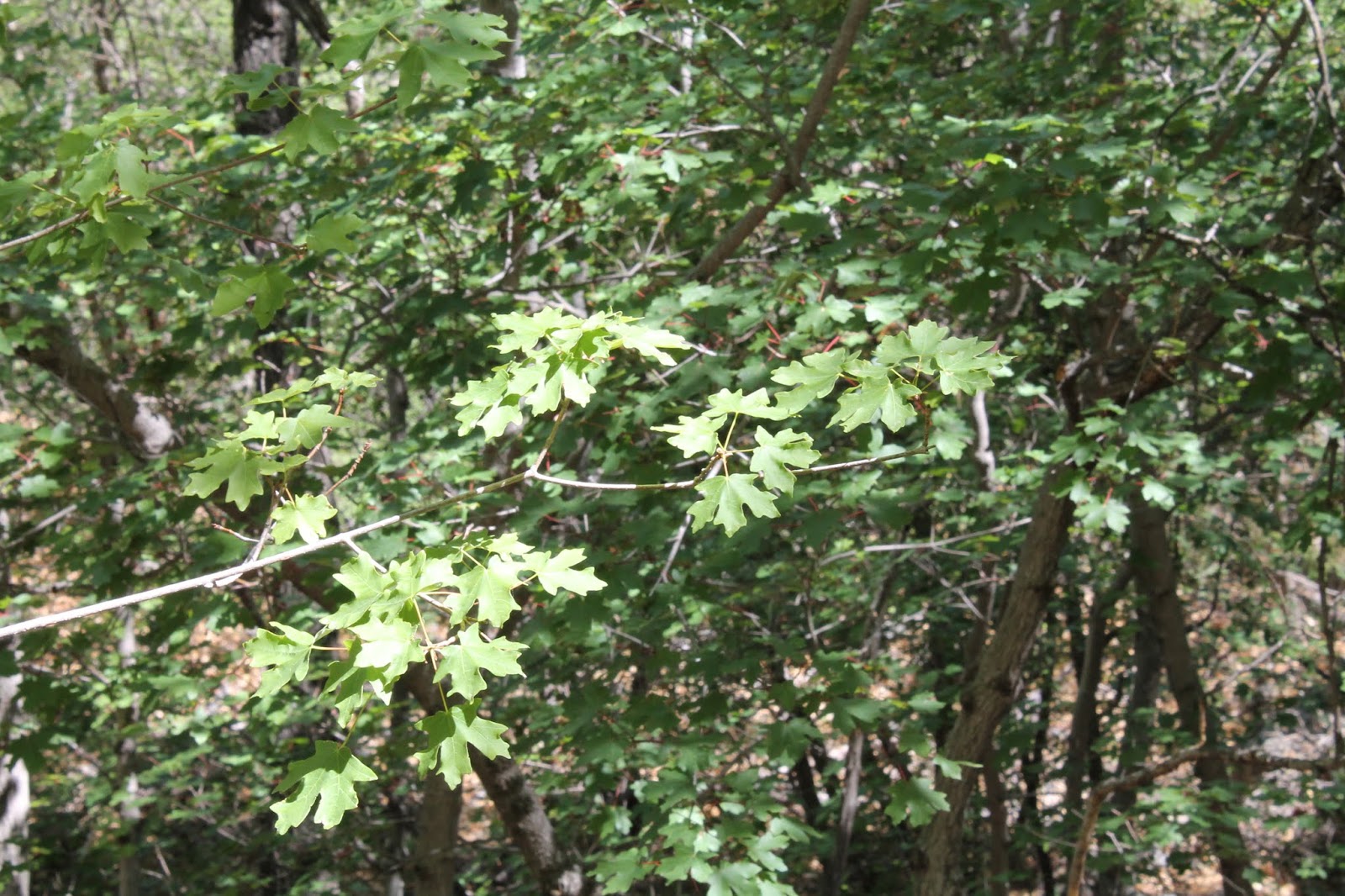
Maple trees in a desert? In Big Bend National Park, maple trees grow in an isolated moist spot near the base of the pinnacles.
Another
example is desert arroyos. Arroyos
are stream beds that are dry most of the time but which can be filled by flood
waters during heavy rain. The soil under the arroyos is usually wetter than in
the surrounding desert. Not surprisingly, the species of plants that live there
are almost entirely different than those of the surrounding landscape. In
southwestern North America, one of the shrubs that grows in arroyos, but not
away from them, is the desert willow Chilopsis
linearis, which is not really a willow.
An
arroyo is the same as the middle eastern wadi,
although the species found in wadis are almost completely different from those
in arroyos.
All this
does not include what scientists sometimes call “polar deserts” in which there
is too little snowfall to allow soils to support plant life even during the
brief summers.
I find
the word “desert” to be a useful category. It is one of the entries in my
Encyclopedia of Biodiversity. It refers to a place with too little water
to support a thick growth of plants. But I recognize that “desert” is an
artificial category that exists only as a way of us making sense of the world.
As I explain in my soon-to-be-published ScientificallyThinking, humans tend to lump things into categories, which is find
unless we then homogenize everything within the categories.
The
human tendency to lump things into categories may seem harmless enough when we
lump different habitats into the category “desert.” This makes us overlook much
beautiful diversity. But when we start lumping people into racial categories,
we start assuming they are all alike, characterized usually by the worst people
in each race.