Showing posts with label crinoids. Show all posts

Saturday, December 19, 2015

Another trove of fossils in Oklahoma

Creationists have to close their eyes very, very tightly and keep saying “Na na na I can’t hear you” when they encounter evidence, which surrounds them, of evolution. One of the places of which this is most true is Oklahoma. Oklahoma has lots of fossils that demonstrate the old age of the Earth, and is also one of the hotbeds of creationism. Oklahoma creationists are, therefore, some of the people who are most skillful at selectively ignoring whatever they do not want to see.

Yesterday I took a hike with Nature Conservancy members at Nickel Preserve, near Tahlequah, Oklahoma. If you do not know about this wonderful organization, please follow the link provided. We climbed a very steep slope with loose soil to some limestone bluffs, from which we could look out over the bottomland flats and the forested hills. I felt like one of my Cherokee ancestors (Tahlequah has been the capital of the Cherokee Nation of Oklahoma since 1839) who thought nothing of running up and down hills in search of game. Near the bluffs, but not elsewhere in the forest, there were lots of sugar maples, which are abundant in the eastern deciduous forests but in Oklahoma are mainly found near cliffs.


Certain layers of the limestone had crinoid fossils. Crinoids are echinoderms (related to starfish) that like inside of limestone stalks that they create. The stalks look superficially like a stack of coins.


Some of the limestone layers were crammed with the fossils.


But other layers were not. In this photo, you can see that the crinoid fossils are restricted to one narrow layer.


There were just a few lampshell fossils:


The reason that some layers had lots of fossils and others did not was probably that the fossiliferous layers are remnants of shallow water environments, while the other layers are remnants of sediments deposited farther from shore. Shallow water, permeated by sunlight, often has more and larger sessile organisms, because there is more food at the base of the food chain, than in deeper, darker waters. These limestone layers are a record of changes in sea level over the course of many thousands of years. The reason that the fossil deposits are almost entirely crinoids in this location, and almost entirely mollusks in other locations, in Oklahoma, may be due to the advantage of numbers. Once crinoids are abundant, their massive reproduction keeps mollusks from literally being able to gain a foothold; and vice versa. This is one reason why crinoids and nearly every other kind of sessile invertebrate are rare today in mussel beds.

The point is that these fossils could not possibly represent the random sloshings of Noachian flood waters. If all of these layers were deposited during a single Flood of Noah, why do some layers have fossils and others do not, and why are the fossils not a random selection of animals that lived on the Earth the day that Noah went into the Ark and closed the door? Creationists have no explanation whatsoever for why the Flood waters would have sorted out fossils into an evolutionary order.

A cache is where you hide a lot of things (from French cacher, to hide); a trove is where you find a lot of things (from French trouver, to find). The crinoid cliffs northeast of Tahlequah, Oklahoma is definitely a trove of evidence, one which tells us about the past history of the Earth.


Monday, April 13, 2015

Spring in Oklahoma: Scientists Go Outside

The Oklahoma Academy of Science had its spring field meeting this past weekend at Sequoyah State Park near Muskogee. Fortunately we missed the torrential rains that started falling today. It was gently cool, and softly overcast—which made the green of the new leaves very intense. On Saturday morning and afternoon we had field trips.We saw beautiful and interesting plants. Examples include the mayapple (Podophyllum peltatum in the Berberidaceae):


And spiderwort (Tradescantia ernestiana in the Commelinaceae):


We also saw the mycotrophic orchid Corallorhiza wisteriana. It does not have chlorophyll. It gets its nutrition from decaying wood. But not directly. It is mycotrophic rather than saprophytic because mutualistic fungi absorb the nutrients from rotting wood and provide them to the orchid.


On one of our hikes we visited a nearby Boy Scout camp owned and operated by the family of Andrea Blair, a graduate student at Oklahoma State University Tulsa campus.

We saw a magnificently blooming buckeye (Aesculus glabra in the Hippocastanaceae). But it was on the other side of the creek so I had to wade across to get photos of it. This would have been a simple matter except that the rocks were just the right size to hurt my tender old feet.


Especially in the afternoon, the field trips combined forces to gain a multi-disciplinary view of nature. Liz Bergey of OU found a slime mold. And we all wished for a competent paleontologist when we found abundant fossils near the lake shore. In this photo, you can see many crinoids (a kind of echinoderm, with stalks that look like stacks of coins), corals, and bryozoans (now known as ecoprocts). The bryozoans were of the genus Archimedes and looked more like a fish backbone. That’s what I thought they were at first, but I never saw any “fish ribs” with the “backbones,” which meant I had to be wrong.


On Friday and Saturday evenings, guest speakers provided fascinating presentations. On Friday, Charles Brown of University of Tulsa told us about his over three decades of research into the costs, benefits, and evolution of colony behavior in cliff swallows. You think you’ve had bedbugs? But a single little swallow nest can have hundreds of them. On Saturday, Ron Bonett of University of Tulsa told us about salamanders in Oklahoma, and about the repeated evolution of species in which juveniles become sexually reproductive. In the photo, field meeting organizer Connie Murray (of Tulsa Community College Metro campus) talks with Charles Brown.


Every spring and fall, OAS has wonderful field meetings. There are always lots of interesting things to see, and wonderful people to explore with. My thanks to everyone who made the meeting a success, including our Executive Director David Bass who had to make sure everything happened.

Thursday, March 26, 2015

Second Oklahoma Evolution Road Trip, part two

On the Tuesday of the second Oklahoma Evolution Road Trip (see previous entry), the students and instructors drove around south central Oklahoma to look at some amazing geological and fossil features. Most of the places were the same ones the participants saw on the first Oklahoma Evolution Road Trip (see links in previous entry). The students were excited to find so many different kinds of shallow marine fossils. We saw ammonoids, some of them quite large, and huge numbers of oyster shells of the species Texigryphaea navia. Some of them had eroded out of the powdery limestone matrix and were just lying around. First photo: notice the ammonoid fossil. Second photo: Dianne  finds the impression of a large mollusk.


At a roadcut that exposed Ordovician deposits, students found crinoids and lots of coral fossils. The corals formed branches, and in many cases the little pits in which the coral animals live were visible. The first photo shows Victoria looking for fossils, and the second photo shows imbedded fossils of coral and crinoids.


We visited the museum at Goddard Youth Camp, where Clayton Edgar showed us a cast of the most complete skeleton of Acrocanthosaurus atokensis (similar to T. rex), whose footprints we later saw down in Texas. You can learn a lot about a dinosaur from its skeleton, especially from the wounds that healed, and the ones that did not.


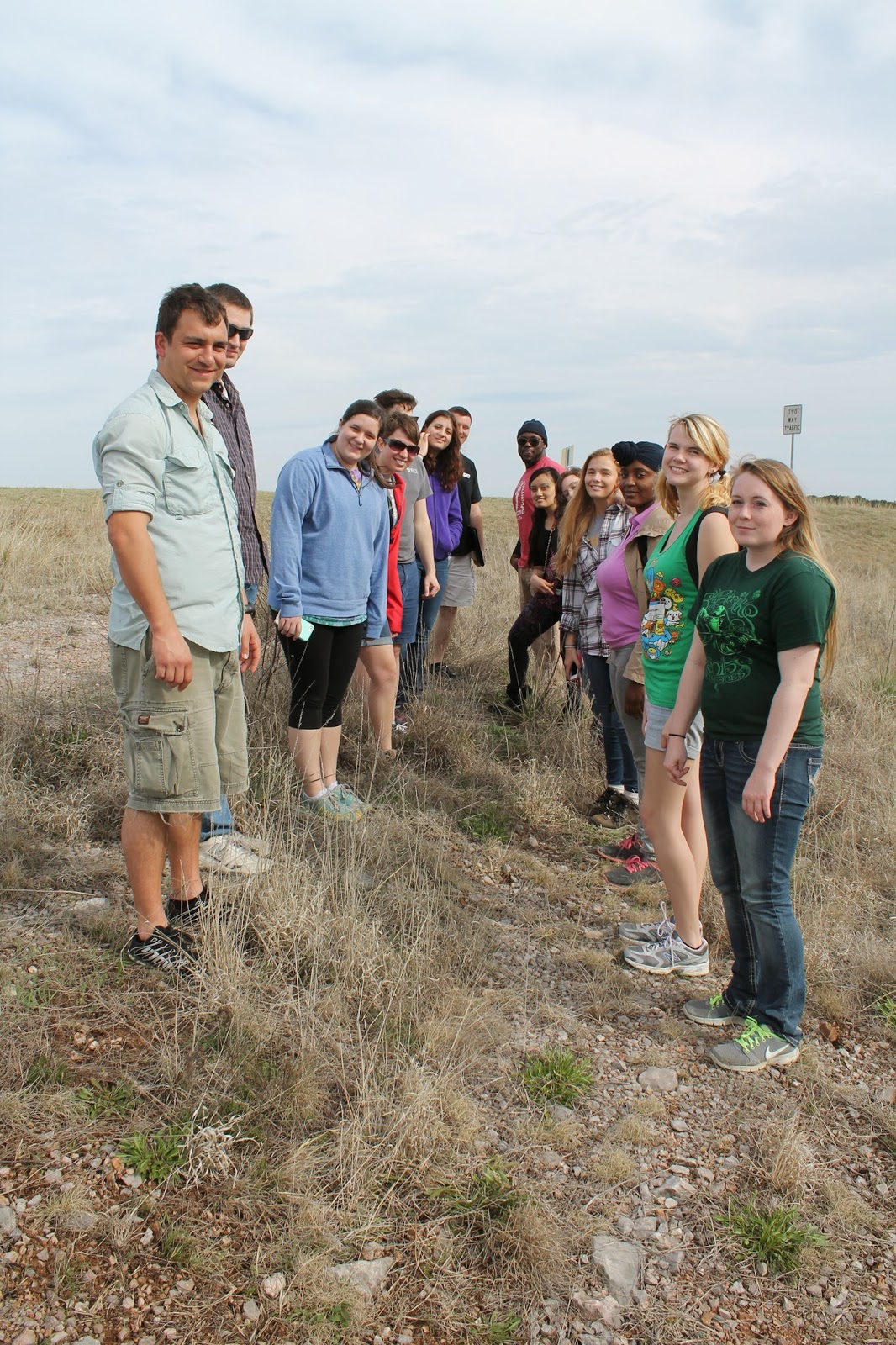
We went to the top of the Arbuckle Mountains and looked down on Turner Falls, a widely popular recreation destination. But that’s not all we saw. We saw fossils of stromatolites also, images of which I have posted previously. Out of privacy concerns I will indicate only the first names of the students. Left to right, front row: Camille, Dr. Stan Rice, Cadence, Brian, Kelvin, Sujana, Dianne; second row: Molly, Hannah, Kandra, Dr. Gordon Eggleton, Bruce, Turner, David, Kelly, Victoria, Jessica.


The Arbuckle Mountains are an anticline, in which the oldest deposits are on top. How did that happen? Geologic forces pushed up the mountains. Subsequent erosion washed some of them away. The oldest layers, on top of today’s mountains, used to have all the other layers above them. Ah, but if we claim that this is how the oldest layers ended up on top, then there should be some evidence, shouldn’t there? And we saw it. We stopped to see Ordovician limestone layers that had not only been pushed over on their sides but had been warped and distorted by the immense pressure. We also saw conglomerate rock that had filled in a valley during the Pennsylvanian period. Large limestone boulders had washed violently down from the mountains that were still huge at that time. Carbonate leached from these boulders had cemented them together into conglomerate, which is a natural analog of concrete. In the photo, you can see the students standing on either side of what had been, about 270 million years ago, a steep cliff.


The most unexpected part was when most of the students, and myself, had to wait about 45 minutes at a famous fried pie restaurant while one of the vans made an emergency side trip. Fried pies are nice, but you can’t talk about fried pies for 45 minutes. So we decided to play a game. I don’t remember whose idea it was, but we ended up guessing each other’s spirit animals. One of the students really liked dogs, so I got the students to figure out how dogs were domesticated from wolves. And then I joked about my spirit animal. Who am I? I have not had sex for thirty million years, which means my parasites should have evolved to drive me to extinction, but they haven’t, because I can dry up and blow away like dust in the wind and leave my fungal parasites behind [link to article]. I am a rotifer. I could never have guessed when we left that morning that I would be in a restaurant telling students about rotifers. We also talked about marsupials. In the photo, the students are watching a video of a joey (baby kangaroo) being born.


Our first field trip day was even better than we could have planned.

Friday, July 5, 2013

Seeing Fossils


My wife and I spent part of July 4 the way Thomas Jefferson and Benjamin Franklin would have approved of: we went looking for fossils. We walked on the Quaternary alluvial bed of the Arkansas River in Tulsa. We have been there many times, but all we saw, or thought we saw, was sand, smooth stones, broken glass (some of it smoothed by abrasion), ultraviolet-bleached plastic, shopping carts, and miscellaneous embarrassing items. But this time we looked for, and therefore saw, things we had previously overlooked.

One thing we found was coal. Just a few fragments of it. We do not know if it washed down from coal deposits no longer being mined, or from piles of coal. That’s the think about alluvial deposits, especially for a major river: you know almost nothing about where they came from. And we saw a few fossils, such as this one of crinoids.


But another experience we had was the opposite of seeing what we had previously overlooked. We saw some rocks that we might have imagined to have fossils in them. Just the day before, I had examined fossil deposits along Lake Oologah north of Claremore, Oklahoma, and I saw what I thought was a fossilized stem. It was a different color from the surrounding matrix and had parallel ridges that looked like wood grain. Then I noticed that the ridges extended past the differently-colored region. I also found what looked like a weird animal fossil. What a strange shape! I’m not going to tell you what it looked like, but it was something that it most definitely could not have been. What we saw among the rocks in the riverbed were structures that we imagined might be fossils. One of them looked like stromatolite layers, with just the right waviness that could not be explained as ripple marks. Were we just imagining this to be a piece of stromatolite? And the thing that looked like a fragment of fish backbone and ribs. Well, isn’t that what we expected to find?

This brings up, again, the important point that the human mind sees what it expects to see, whether (in this case) the absence of fossils or their abundance. Once we started looking for fossils, I wanted to find at least one every ten minutes or so, in order to feel that I was having a good time. Fossils have always been a good medium for observer bias. Today we laugh at medieval people who thought that cephalopod shell fossils were actually thunderbolts turned into stone. But we are no different from those people in seeing what we expect to see. It is sort of like e e cummings who said, so whatever we lose like a you or a me it’s always ourselves we find in the sea, or in this case, the sand of a river bottom.