Showing posts with label fossils. Show all posts

Friday, July 6, 2018

A Beautiful Scientific Mind: Charles Darwin and His Fossils

I recently skimmed through Adrian Lister’s book Darwin’s Fossils: The Collection that Shaped the Theory of Evolution (Smithsonian Books, 2018). I am not aware that any previous book has gone through all of the specimens that Darwin collected while traveling around the world on H.M.S. Beagle in 1832-1835. Nearly every science-literate person has heard about the finches Darwin saw on the Galápagos Islands, and how these observations eventually led him to think of natural selection. But what about the fossils that he collected and sent back to England?

Previous authors such as Niles Eldredge have noted that Darwin’s fossils included the bones of numerous large extinct mammals from South America, and that it was from this that Darwin concluded what could be called the succession of forms. That is, in the past, the kinds of fossilized mammals lived in the same locations that they are currently found. Glyptodonts (giant armadillos) lived in South America; armadillos lived there today. Giant llamas lived there in the past; llamas live there today. Giant sloths lived there in the past; sloths live there today. Darwin concluded, and scientists widely agreed, that when species become extinct, they are succeeded by similar species in the same location. Today, we can hardly force ourselves to avoid saying that modern species live in the same places that their ancestors lived. But “ancestors” means “evolutionary ancestors” and this is the very thing that Darwin eventually concluded from his observations. But he had to gather the evidence first.

Darwin collected a lot of other fossils as well. He collected petrified wood. He found a petrified forest in Patagonia. He noted that the bases of the trunks were inclined away from the Andes, and so were the sedimentary layers in the rocks, which implied that the Andes had been pushed up out of the Earth since those sedimentary layers had been formed. He also found a few carbonized leaves such as those that can today be found near Clarkia, Idaho, about which I wrote in 2014.

Darwin also found fossilized seashells far above the high tide line, some of them even high in the Andes. The conclusion that was obvious to him, as to us, is that land that was once below the sea has risen. But Darwin was not satisfied with drawing the obvious conclusion. He wanted to eliminate other possible explanations, and to do so before his critics might attempt it in print. Suppose, for example, that the fossilized seashells above high tide were not actually fossils, but were modern middens? That is, what if fishermen hauled seashells up onto land (which they did in fact do) and that what Darwin was seeing was just a pile of leftover shells? Darwin observed midden heaps that were produced by fishermen, and found that the shells were in piles, while the putative fossil shells were individually spaced out, not in piles. In fact, when Darwin asked local fishermen if the putative fossils could have put the shells there, they laughed at the idea.

Darwin suspected that the fossil seashells far above high tide were not deposited in the places where they had lived but had been dead at the time the waves deposited them on an ancient beach. He needed evidence for this. He saw that some of the shells had dead barnacles on the inner surface, which means the shells had been dead for a while before being buried in sediments. If Darwin had not looked for this evidence, he might not later have been able to distinguish fossil shells from an ancient seashore vs. fossil shells from an ancient shell bed.

Darwin also thought that earthquakes caused the successive stepwise uplift of land in South America. But he wanted evidence for this. He got it. In 1835, he witnessed a severe earthquake in Concepción on the Pacific coast of Chile. This one earthquake lifted the land surface at least eight feet. Such earthquakes happen about every century; these earthquakes could easily have produced the Andes. If Darwin had not seen one of these earthquakes for himself, he would have had to depend on second-hand accounts. In fact, an earthquake at least as strong as the 1835 quake, in almost exactly the same place, occurred in 2010.

My point is that while he was on his voyage, Darwin was not just collecting fossils but testing scientific hypotheses about them while he was there rather than wishing he had done so when he got back home. Until I looked through Lister’s book, I had not known this.

Lister’s book also told the story of Darwin’s discovery that coral atolls formed as volcanoes subsided in the ocean floor. This would explain not only their roughly circular shape but also why the atolls were not perfectly circular, like volcanoes, and why they were much larger than volcanoes. The new corals built their reefs on top of old reefs, each new reef being in a slightly different location from the old reef. (A delightful story: When prominent geologist Charles Lyell read Darwin’s theory of coral reefs, he danced around with wild contortions. I’d always thought Lyell was kind of a stick-in-the-mud but I was wrong.) Darwin could not actually prove that there were volcanoes at the bases of coral atolls, however. This was first done in 1952 when geologists drilled a hole down into a coral reef, piercing through thousands of feet of coral limestone, until they hit volcanic rock.

I would not recommend buying this book, unless you are a paleontologist, because it is heavy reading for the rest of us. But it is well illustrated and taught me some new things that, even though I have read dozens of books about Darwin, I’d never known. Get it from your library.

Darwin had a beautiful mind. He was always questioning everything, including his own assumptions. This made him a happy man, because he noticed so many beautiful details of the natural world that he might otherwise have overlooked. The natural world is full of surprises, but only to the person who looks closely and thinks carefully.

Sunday, February 7, 2016

New video!

See the video in which Darwin visits Ashfall Beds State Park in Nebraska, a huge pile of mammal skeletons--all the bones still in place--from 12 million years ago!

Thursday, March 26, 2015

Second Oklahoma Evolution Road Trip, part two

On the Tuesday of the second Oklahoma Evolution Road Trip (see previous entry), the students and instructors drove around south central Oklahoma to look at some amazing geological and fossil features. Most of the places were the same ones the participants saw on the first Oklahoma Evolution Road Trip (see links in previous entry). The students were excited to find so many different kinds of shallow marine fossils. We saw ammonoids, some of them quite large, and huge numbers of oyster shells of the species Texigryphaea navia. Some of them had eroded out of the powdery limestone matrix and were just lying around. First photo: notice the ammonoid fossil. Second photo: Dianne  finds the impression of a large mollusk.


At a roadcut that exposed Ordovician deposits, students found crinoids and lots of coral fossils. The corals formed branches, and in many cases the little pits in which the coral animals live were visible. The first photo shows Victoria looking for fossils, and the second photo shows imbedded fossils of coral and crinoids.


We visited the museum at Goddard Youth Camp, where Clayton Edgar showed us a cast of the most complete skeleton of Acrocanthosaurus atokensis (similar to T. rex), whose footprints we later saw down in Texas. You can learn a lot about a dinosaur from its skeleton, especially from the wounds that healed, and the ones that did not.


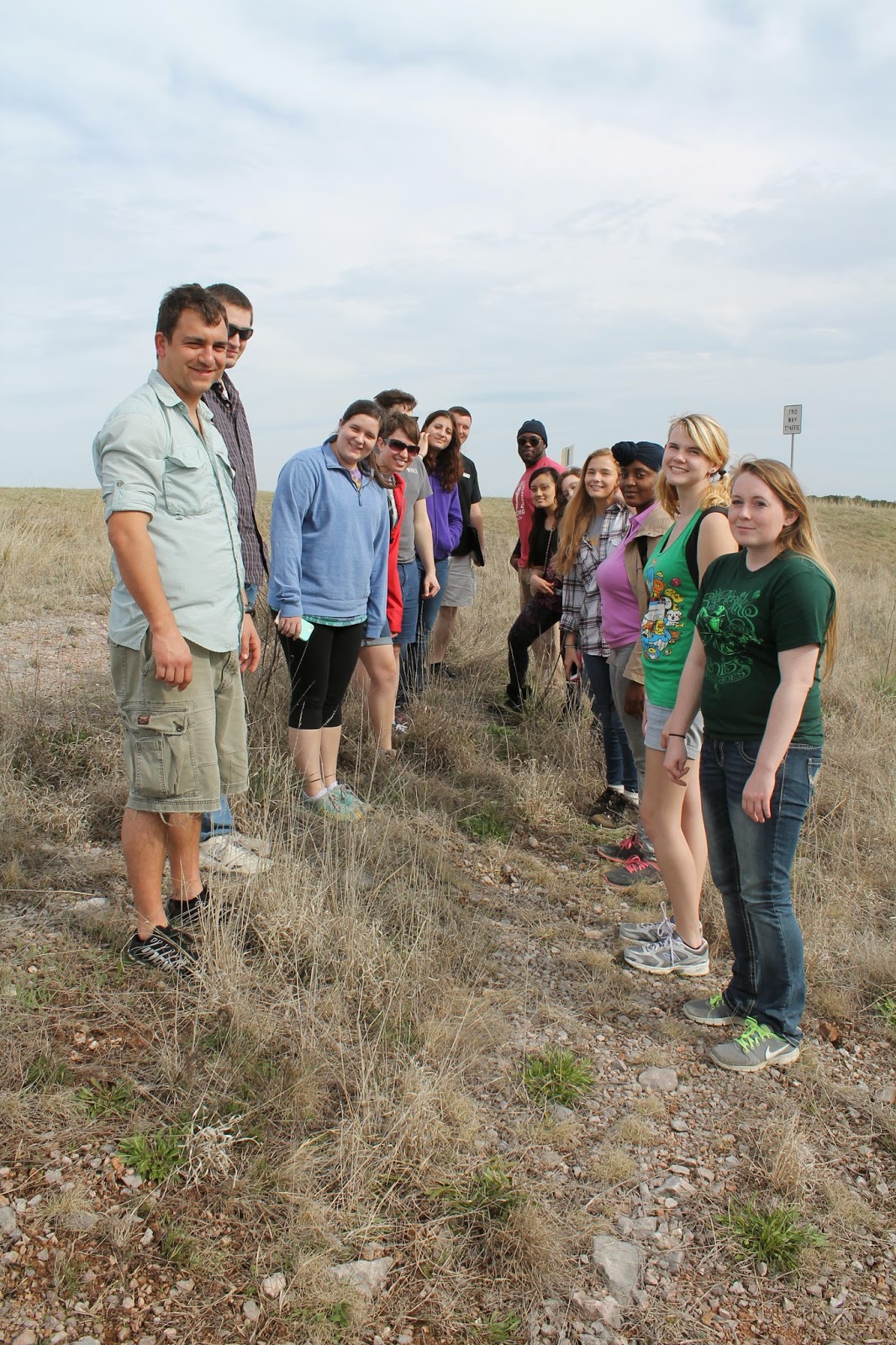
We went to the top of the Arbuckle Mountains and looked down on Turner Falls, a widely popular recreation destination. But that’s not all we saw. We saw fossils of stromatolites also, images of which I have posted previously. Out of privacy concerns I will indicate only the first names of the students. Left to right, front row: Camille, Dr. Stan Rice, Cadence, Brian, Kelvin, Sujana, Dianne; second row: Molly, Hannah, Kandra, Dr. Gordon Eggleton, Bruce, Turner, David, Kelly, Victoria, Jessica.


The Arbuckle Mountains are an anticline, in which the oldest deposits are on top. How did that happen? Geologic forces pushed up the mountains. Subsequent erosion washed some of them away. The oldest layers, on top of today’s mountains, used to have all the other layers above them. Ah, but if we claim that this is how the oldest layers ended up on top, then there should be some evidence, shouldn’t there? And we saw it. We stopped to see Ordovician limestone layers that had not only been pushed over on their sides but had been warped and distorted by the immense pressure. We also saw conglomerate rock that had filled in a valley during the Pennsylvanian period. Large limestone boulders had washed violently down from the mountains that were still huge at that time. Carbonate leached from these boulders had cemented them together into conglomerate, which is a natural analog of concrete. In the photo, you can see the students standing on either side of what had been, about 270 million years ago, a steep cliff.


The most unexpected part was when most of the students, and myself, had to wait about 45 minutes at a famous fried pie restaurant while one of the vans made an emergency side trip. Fried pies are nice, but you can’t talk about fried pies for 45 minutes. So we decided to play a game. I don’t remember whose idea it was, but we ended up guessing each other’s spirit animals. One of the students really liked dogs, so I got the students to figure out how dogs were domesticated from wolves. And then I joked about my spirit animal. Who am I? I have not had sex for thirty million years, which means my parasites should have evolved to drive me to extinction, but they haven’t, because I can dry up and blow away like dust in the wind and leave my fungal parasites behind [link to article]. I am a rotifer. I could never have guessed when we left that morning that I would be in a restaurant telling students about rotifers. We also talked about marsupials. In the photo, the students are watching a video of a joey (baby kangaroo) being born.


Our first field trip day was even better than we could have planned.

Friday, October 17, 2014

Another World at Black Mesa: Oklahoma Academy of Science field meeting, part one.

Recent announcement: I have uploaded a video about The Great Unconformity in the Black Hills, one of the best geological evidences of an old earth in North America.

Here is the first of three entries I wrote for the blog of the Oklahoma Academy of Sciences.

On September 19, 2014, hundreds of people hit the road and headed out through the Panhandle of Oklahoma as if being shot through the barrel of a rifle. We came to rest right at the very tip, at Black Mesa State Park. Black Mesa is like a different world, more closely resembling New Mexico than any part of Oklahoma with which most of us are familiar. As we left most of the trees, and even many of the shrubs, behind, we knew that we were also leaving behind comfort and safety. We were exposing ourselves not only to stormy weather (which, despite predictions, did not materialize) and almost desert-like conditions, but also to biological dangers, everything from rattlesnakes to hantavirus. Hantavirus has already claimed lives in the Panhandle. Notice that “Hantavirus” is spray-painted on the board of this house.


What surprised me most about this meeting is that there were over a hundred undergraduate students. As president, I had begun to worry that perhaps OAS was becoming a coterie of old people. But the average age of the people at this meeting must have been about twenty, despite the considerable statistical leverage provided by seasoned individuals such as Craig Clifford, David Bass, and myself. I can only hope this means that science is alive and well in the next generation of Oklahomans. Of course, they will probably all find jobs in other states where the pay is better.

Once we all got settled down in our bunkhouses and tents, we had dinner provided by a caterer who was actually willing to drive all the way out to Black Mesa. I am still amazed that any caterer would be willing to do this.

Our evening program was a presentation by Dr. Anne Weil of OSU.


She teaches anatomy in medical school during the academic year, and does vertebrate paleontology research in summer. She studies dinosaurs and ancient mammals. The land that is now Oklahoma had some truly amazing dinosaurs. She handed around what appeared to be pieces of rock. But they were fossilized dinosaur bone fragments. Even after being told what they were, I could not tell that they were anything other than rocks, except for one, which clearly had fossilized bone tissue in it. She conveyed to us some of the excitement of scientific research, often punctuated with “Yay!” and “Woo!” By using microscopes and isotopes, Anne said, we can ask and answer questions that Cuvier could not even imagine.


In the next entry, I will write about a couple of the field trips in the vicinity of, and up to the top of, Black Mesa, on Saturday, September 20.

Friday, October 10, 2014

Videos about plant fossils

I just posted three videos about Fossil Bowl, the most amazing plant fossil site in the world, in Idaho.


Also, an update for the entry about Oklahoma earthquakes: This morning there was a 4.3 earthquake near Cushing, Oklahoma, where I was born.

Thursday, September 18, 2014

My Fun Evolution Trip Part Ten: The Most Amazing Plant Fossils in the World, part two.

The leaf fossils that I saw at Fossil Bowl (see previous essay) came from a 15-year-old Miocene forest that dominated what is now northern Idaho. These forests closely resembled the rich forests of deciduous and evergreen trees that now characterize parts of China and, to a lesser extent, the eastern US. They were almost totally unlike the modern forests of northern Idaho, which are dominated by conifers such as Douglas fir.

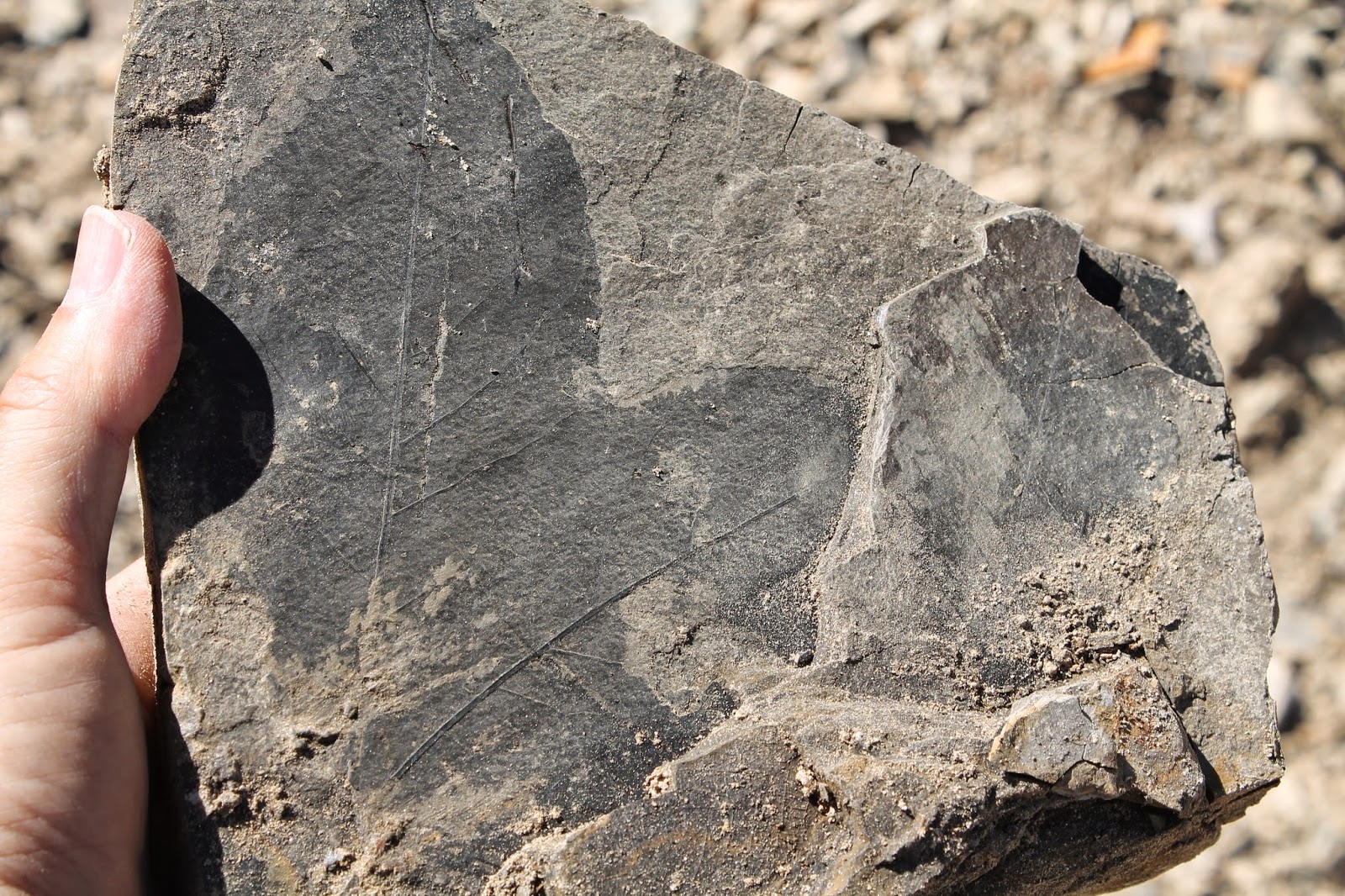
Here are just a few of the fossil leaves that I found. I have used William Rember’s online gallery for identification. My identifications are tentative for several reasons. One is that I might have found some leaves previously undiscovered in this location. Another is that some crucial diagnostic features, such as leaf bases and margins and overall shapes, might be missing. I offer these images for others to help identify.

Bald cypress: Today, Taxodium is found only in swampy areas of North America and Mexico.


Greenbriar: today Smilax is common in much of eastern North America and in Asia.


Beech: This leaf appears to be a false beech Pseudofagus idahoensis; a small poplar leaf (Populus) is in the upper left.


Sycamore: This fossil appears to be Platanus dissecta.


This specimen looks like a red oak (Quercus), perhaps Q. payettensis.


In this image, I believe I recognize a birch (Betula vera) in the lower right, though birch leaves have smaller teeth.


This image reminds me of a mulberry (Morus), which has not been reported from these deposits. Its lobes but not its margins resemble sycamore. The closest match I can find in reported records is a sweetgum, Liquidambar pachyphyllum. In the layer immediately underneath it is a Pseudofagus leaf.


Anyone have a guess about these?


These fossils also tell us an ecological story. First, this was a very diverse forest, with many tree species, resembling forests found today in China and in the southeastern United States. Second, we can say it was predominantly a beech forest, because Pseudofagus was the most common leaf fossil.

And there are some evolutionary themes we can learn from these fossils. First, these leaves fell (over the course of many years, producing many layers) in a forest very different from anything known in the Pacific Northwest today. The climate 15 million years ago was warmer and wetter, which allowed trees to grow that today survive only much further south in Asia and North America where there is more rainfall. The principal reason for this is that, 15 million years ago, the Cascades had not yet formed a rain shadow. The “temperate rainforests” of the Pacific slope more closely resemble the Miocene forests than do the forests of Idaho today. However, even the rich, moist Pacific slope forests of today there are few broadleaf trees, mostly bigleaf maple and tanbark oak. Fossil Bowl preserves a lost forest.

Creationists have an impossible time explaining how a Flood could have collected just these kinds of leaves—bald cypress, sycamore, alder, avocado, elm, etc.—and no others. But some creationists doubtless claim that this is a post-Flood deposit which formed just in the last 4000 years since Noah stepped out of the Ark. But this explanation is no better. Somehow floating rafts of vegetation had to bring just these kinds of plants to what is now Idaho, where they grew into a forest, and then—after the Flood—volcanoes arose and created the rain shadow that now exists. All this in 4000 years. The volcanoes would have to rise pretty fast, faster than they are now. Maybe God speeded things like this up after the Flood. But the Bible does not say this; creationists would have to just make it up.


The thing that is perhaps most interesting to us, and difficult for creationists to explain, is how such a forest is just a little different from those found in southeastern North America and in Asia today. The modern forests have the same genera but not the same species. Even the studies of DNA from chloroplasts of the preserved leaves show that there has been just a little bit of genetic change over the last 15 million years. Modern species of sycamores, for example, do not have leaves like the one in the photo above; modern sycamore species would have evolved just in the last 4000 years at a pace far more rapid than any evolutionary scientist would accept.

Monday, September 15, 2014

My Fun Evolution Trip Part Nine: The Most Amazing Plant Fossils in the World, part one.

Ever since I read about the Idaho Miocene fossil beds, at a place called Fossil Bowl, decades ago in an essay by Stephen Jay Gould, I have wanted to visit them. This past summer I finally had the chance. I drove south of Coeur d’Alene in State Highway 3 for about fifty miles and drove through the little town of Clarkia, which has no services and which you could almost drive past without noticing. On the right (west) side of the road was a big open area that had been converted into a motocross track. Unless you have specific directions or just happen to see the hand-painted plywood sign set far back from the road, you will never recognize this as being a famous fossil deposit.

I drove in and looked for a sign telling me where to go. Because I had called the Kienbaum family (the owners) before coming, I knew to look for a house on the hill. So I started driving up what I thought was the driveway and found myself on the motocross track. I didn’t see it coming. Suddenly I was going up a steep slope and then my car (a little Scion) launched off into invisible space and came thumping down on the track. It didn’t make it up the next incline. Fortunately I found a way to exit the track. I found a van of young adult bikers who were taking an air conditioning break, and who had been immensely entertained by the sight of a little car on a motocross track, and they told me how to find the driveway. I had to knock on every door of the house with unfinished siding before Mrs. Kienbaum could tell me to look for her husband and sons in one of the many workshop buildings downhill. The younger son found me and led me through a crowded storehouse full of wooden furniture that Mr. Kenneth Kienbaum had made. I paid ten dollars for the privilege of digging fossils and taking them with me, perhaps the best ten dollars I ever spent. Kenneth told me of the interest that even major media such as PBS were showing in this site. I will be posting some YouTube videos [my channel] of my visit and will announce when I do. I make videos with no budget. If you want to see a video about Fossil Bowl that was actually produced with a budget, using support from Bucknell University, the University of Idaho, and the Botanical Society of America, see Plants Are Cool Too! Episode 2 produced by the very creative Dr. Chris Martine.

The younger Kienbaum son led me to a place I could park right beside the fossil deposit. You would never guess what it was. The outcrop is about the size of a three-car garage.


I set to work digging and photographing fossil leaves. (Others have found fossil fishes, but I did not. Leaves are always more abundant than fishes.) I found many good specimens that had already been excavated and were just lying around on the ground. One of my best specimens was one I found by stepping on it. I will provide some details and photos of these specimens in the next essay.

How did these fossils form? Fifteen million years ago, during the Miocene epoch, leaves of a lush forest fell into a lake and were preserved in sediments. Oxygen destroys organic matter, but the water and sediments kept these leaves away from oxygen. In fact, some of the leaves are not leaf fossils, but are actually still leaves, complete with tissue and DNA. I believe that these leaves have provided the oldest DNA specimens ever found, far older than the 30,000-year-old Neanderthal DNA in Europe. The organic molecules from the 70-million-year-old T. rex fossils were collagen, the protein that makes up cartilage, not DNA.

Once exposed to oxygen, these leaves quickly turn black. They are still beautiful fossils, but the organic matter is reduced to a residue. So to find “fresh” leaves, you have to split intact rocks open, which the older son, Riley Kienbaum, showed me how to do.


The leaves, mostly autumn deciduous leaves, are separated by layers of sediments. The leaves form a slightly weaker layer in the rock, so that you can carefully split open the rock and expose the leaves. Riley did this for me and I saw some leaves that still had the same red autumn colors that they had 15 million years ago!


I brought back some slabs of rock, which I kept moist, and which I split open in my laboratory and showed to my students. Unfortunately, in my specimens, the rocks layers crumbled and I was unable to recover any fresh-looking leaves.

How do we know the ages of these leaves? Radiometric dating provides the answer. Radiometric dating can be performed only on volcanic material. But 15 million years ago the Cascades were just rising up as a series of volcanoes, many of which remain active today. The volcanic dust layers interspersed with the leaves and sediments can be dated.

Meanwhile, motorcyclists did some amazing maneuvers just a few feet away from where I was digging. Some of them came over to see what I had found. They were genuinely interested in the fossils and were some of the nicest people I have met

Before planning your trip, it is good to contact the owners and make sure access is open when you plan to visit. They are really very nice people.


In the next essay, I will tell you about the fossils I found.

Friday, August 8, 2014

My Fun Evolution Trip Part 1: Ashfall Beds, Nebraska


Today I begin a series of essays about a long trip I recently completed, which took me from Oklahoma to Idaho and back, stopping at lots of places of ecological and evolutionary interest. The second day of the trip, July 20, I visited Ashfall Beds in Nebraska, which is one of the most amazing fossil deposits in the world.

Ashfall Beds State Park is in rural Nebraska. It is not on the way to anything, but it was my principal reason for going to Nebraska. But it is well worth a trip to Nebraska even if for no other reason.

About twelve million years ago, life was abundant in the savannas of what is now Nebraska. There was certainly an abundance of animal life. Reptiles included the giant Hesperotestudo tortoise, now extinct. Among the now extinct mammals were horned rodents of the family Mylagauidae, the “raccoon dog” Cynarctus, saber-toothed deer (I am not making this up), and three-horned deer. There was a kind of dog that specialized on eating fruit. There were three kinds of small camels. The most abundant mammal in this fossil deposit was the now extinct rhinoceros Teleoceras.

 
The nearest relatives of some of these mammals live today in Eurasia and South America. Mammals such as these and many others were thriving in North America until about twelve thousand years ago (not twelve million), when they died in the Pleistocene Extinction. This extinction event probably resulted from the interaction of climate change and overhunting by newly-arrived humans, neither one of which by itself would have been sufficient. It was an interaction, with the effects of climate change amplifying the effects of overhunting, and not a simple additive effect.

What was perhaps most interesting about these mammals is that they represented earlier stages of evolution. The best example is probably the horses. Some of them, such as Protohippus and Hypohippus, had three toes, while others, like Pliohippus and Hipparion, had a hoof and two small stubby toes. Some horses grazed (ate grass), while others browsed (ate broad leaves). The specimen numbered "2" is one of the horses.


What happened? One day a volcano over the Yellowstone Hot Spot erupted and sent ash into the air. The finest ash traveled to what is now Nebraska, where it covered the leaves and grass. The mammals breathed and ate the ash. Tubercles on their bones showed that they survived for weeks (but not years) after eating the ash. One of the symptoms was that they got very thirsty and converged on a water hole. But drinking water did not save them, and they died, piled up on top of one another at the water hole. That’s where we find the mass of bones today, entombed in volcanic ash. It was not like one day in Pompeii; it took a few weeks, but with the same effect.

Creationists have a nearly impossible time explaining such a fossil deposit. They make no attempt at all to explain how Noah’s Flood could have produced this deposit. Instead, they claim that this deposit was formed after the flood in pretty much the way scientists have discovered. They just claim that it all happened in the last four thousand years rather than the twelve million years indicated by radiometric dating of the ash. Processes such as the formation of the sedimentary cap over the volcanic ash occur slowly today, but the creationists simply invoke a more rapid pace, perhaps of miraculous origin. The Bible indicates no such miracles, but creationists love to just make up miracles whenever they want to. In one creationist article about Ashfall beds, the authors do not address why the mammals are similar to but not the same as modern mammals—for example, the three-toed horses. There were no modern horses of the genus Equus. And no modern camels (even the South American ones) or dogs or cats or… Are we to suppose that God scooched the primitive-looking mammals over to North America, and kept the modern ones out, just to trick us into accepting evolutionary science?

Ashfall Beds is an amazing place to see fossils which fit in perfectly with evolutionary processes and the evolutionary timeline.

Friday, July 5, 2013

Seeing Fossils


My wife and I spent part of July 4 the way Thomas Jefferson and Benjamin Franklin would have approved of: we went looking for fossils. We walked on the Quaternary alluvial bed of the Arkansas River in Tulsa. We have been there many times, but all we saw, or thought we saw, was sand, smooth stones, broken glass (some of it smoothed by abrasion), ultraviolet-bleached plastic, shopping carts, and miscellaneous embarrassing items. But this time we looked for, and therefore saw, things we had previously overlooked.

One thing we found was coal. Just a few fragments of it. We do not know if it washed down from coal deposits no longer being mined, or from piles of coal. That’s the think about alluvial deposits, especially for a major river: you know almost nothing about where they came from. And we saw a few fossils, such as this one of crinoids.


But another experience we had was the opposite of seeing what we had previously overlooked. We saw some rocks that we might have imagined to have fossils in them. Just the day before, I had examined fossil deposits along Lake Oologah north of Claremore, Oklahoma, and I saw what I thought was a fossilized stem. It was a different color from the surrounding matrix and had parallel ridges that looked like wood grain. Then I noticed that the ridges extended past the differently-colored region. I also found what looked like a weird animal fossil. What a strange shape! I’m not going to tell you what it looked like, but it was something that it most definitely could not have been. What we saw among the rocks in the riverbed were structures that we imagined might be fossils. One of them looked like stromatolite layers, with just the right waviness that could not be explained as ripple marks. Were we just imagining this to be a piece of stromatolite? And the thing that looked like a fragment of fish backbone and ribs. Well, isn’t that what we expected to find?

This brings up, again, the important point that the human mind sees what it expects to see, whether (in this case) the absence of fossils or their abundance. Once we started looking for fossils, I wanted to find at least one every ten minutes or so, in order to feel that I was having a good time. Fossils have always been a good medium for observer bias. Today we laugh at medieval people who thought that cephalopod shell fossils were actually thunderbolts turned into stone. But we are no different from those people in seeing what we expect to see. It is sort of like e e cummings who said, so whatever we lose like a you or a me it’s always ourselves we find in the sea, or in this case, the sand of a river bottom.

Monday, April 29, 2013

Evolution in Oklahoma, a Road Trip: Piles and Piles of Fossils


Don’t forget the Oklahoma Evolution Road Trip, May 30-June 2. We have enough registrants that the trip is unlikely to be canceled, but there is still room! Tentative deadline is May 3, but we can accept a few more applications after that date. We just need to plan ahead about how many rooms and vehicles, and how much food, to provide. Read more about it here as well as in blog entries posted earlier (below).

One of the places we will be visiting, in our search for fossils, is Fort Washita, near Durant, Oklahoma. It is a site of great historical interest. It was built by the U.S. Army to defend the Chickasaw tribe against western tribes, whose land had been taken in order to resettle the Chickasaws from their ancestral homeland that the U.S. had confiscated. Then, in the Civil War, Ft. Washita became a Confederate fort. History and politics back then was a big mess, just as it is today, only there was a war going on right here on our American soil.

Ft. Washita was located on a hill because it allowed visibility across the prairie in order to observe the approach of understandably hostile tribes, or (later) Union soldiers. Today, most of the surrounding landscape is forested, but when the fort was built it was mostly prairie, with some scattered post oaks and bois-d’arcs. It is possible that some of the very large post oaks and bois-d’arcs that are today on fort property were alive when the fort was active. Each bois-d’arc tree appears to be several trees that have grown together. This probably occurred because the animals that originally dispersed the large fruits (e.g. mammoths and gomphotheres) have been extinct for thousands of years. The mammoths would have spread the seeds out in their dung, but since the mammoths were extinct the fruits simply landed on the ground and all the seeds began to grow in a clump.


But the main topic of interest is something that very few visitors notice when they come to the fort. I am embarrassed to admit that I did not take notice of it until recently. Most of the original buildings are made from rocks quarried from an extremely fossiliferous layer. Some of the stones appear to consist almost entirely of mollusk fossils. We’ve all seen fossils, but perhaps nothing quite like this.


So join us for the Road Trip if you can!

Wednesday, April 10, 2013

Evolution in Oklahoma, a Road Trip: A Dramatic Geological Past, part one.

Breaking news: European Space Agency scientists just announced that the universe is older than previously thought: it is 6,001 years old, not 6,000. (Actually the official estimate was raised from 13.7 billion to 13.8 billion years.)

In a previous entry, I announced an Evolution Road Trip for May 30 to June 2, 2013. See here for more information. I will now tell you some reasons why I am excited about this trip. First, the geological evidence of the evolutionary past.

In the Arbuckle mountains of central Oklahoma, the sedimentary layers have been lifted up and eroded, with the result that the oldest deposits are highest in the mountains. Creationists love to point out this reverse order as evidence against evolution. But you can actually see the angles by which the layers have been uplifted.

Another thing you can see in the deposits is the difference between near-shore and deep-water (near the edge of the continental shelf) deposits. In shallow water, there is plenty of sunlight, a strong food chain, and lots of fossils; in deep water, there are fewer fossils. In addition, coarser sediments accumulate in shallow water, while finer sediments disperse into deeper water. No Flood of Noah could explain why most of the fossils are found in coarser sediments. There is a roadcut that we will visit on this trip that displays this evidence very nicely. See the photo for the Ordovician fossils found at that site. Look closely and you can see disarticulated crinoid segments, branches of bryozoans, mollusks, and even pieces of sand dollars.


At the top of the Arbuckles, you can see stromatolites. They look like lumpy rocks. But if you look closely at the photos you can see some of the splotches that used to be cyanobacterial mats; and you can see the layers inside the lumps that resemble those found in modern stromatolites.


Why are stromatolites exciting? Because a billion years ago, stromatolites were just about the highest form of life.

In the next entry, I will tell some more exciting geological stories about Oklahoma.

Note: There was an ecotour in Big Bend in March that cost $2885 for five days not counting travel, plus $450 for single accommodations. Considering this, the Oklahoma Evolution Road Trip is quite a bargain. We have a tentative registration deadline of May 3.