Showing posts with label OSLEP. Show all posts

Sunday, March 29, 2015

Second Oklahoma Evolution Road Trip, part three

On the Thursday of the Second Oklahoma Evolution Road Trip (see previous entries), we went down into the mystical, mythical, misty land of Texas, through fog that shrouded the Red River. We kept driving down to Dinosaur Valley State Park. After a picnic lunch, we looked for dinosaur footprints. This location is described more fully in earlier blog entries (here, and follow the links). We could only see a couple of prints, because the river was up, filling the footprints with sand and gravel. We did find one—one of the best—that was above water level and with which the students had their photos taken.


I did not need to tell the students very much; this brilliant group pretty much figured out all the things you could learn about dinosaurs by studying not just their footprints but their trackways. We wished that we could have been there when the water was low and Glen Kuban was with us. As a consolation prize, the next day I showed them some videos from my YouTube channel in which Glen explains the trackways (for example here and here).

Technical note: since the earlier entries, the Paluxysaurus dinosaur has been assigned to the genus Sauroposeidon.

I also told the students about the “man-track” controversy, in which a relatively small number of creationists claim that there are human footprints alongside and even overlapping the dinosaur footprints. This would show that humans and dinosaurs lived at the same time and that, ergo, all of evolutionary science was wrong. Of course, the creationists cannot explain how, in the middle of Noah’s Flood, dinosaurs came out of their hidey holes and left footprints in sediments that had just been deposited by that flood. But we will let that pass. If, in fact, there are verifiable human prints overlapping with dinosaur prints, then evolution has a problem.

So we all went (and paid our admission fees) to Carl Baugh’s Creation Evidences Museum, which I have described in earlier blog entries (for example here). The first thing that I noticed was that the displays (with fake slave shackles) that claimed that evolution led to slavery had been removed. But several of the students went straight to the display that claimed to show a human footprint overlapping an Acrocanthosaurus print. They all noticed that the so-called “man-print” looked fake. All the toes were perfect, and there did not appear to be an arch. One particularly observant student pointed out to me that the silica grains inside the man-print reflected light, while the silica grains outside the print did not, which is exactly what you would expect if the print was carved into the rock. Gotcha! Another alleged man-print did not appear to have any relief, but looked like a layer of paint. Finally, one of the students noticed that the alleged man-print and the (undoubtedly real) dinosaur print had the same amount of relief. But this should not have been possible; the dinosaur would have compressed the mud, and the human footprint on top of it would have been shallower. I’m not absolutely sure about this, but it does look a little suspicious, doesn’t it?

Some of the alleged man-prints were very large and supposedly produced by giants (Homo bauanthropus, which Baugh named after himself). The students also saw the hammer supposedly deposited in Cretaceous limestone. (It might have slipped in a limestone crack maybe a few decades ago and was then cemented by dissolved calcite.) Some of the students were quite skeptical that giants would use such a small hammer. Maybe it was for dental work, one of them said. These students noticed things that, in my previous visits, I had not. I remain grateful for their insights.

We watched (some of us more, some less) a video of Carl Baugh explaining the history of the planet to us. It is an astonishingly different version than what scientists accept, and even most creationists. He explained the red shift of the galaxies, which makes some of them appear to be 13 billion light years away, by saying that God stretched out the heavens really really really fast on one of the days of Creation. Consider that 13 times 365 is 4,745. God would have stretched out the heavens at 4.7 trillion times the speed of light to do this. He would have had to suspend the physical laws of the whole universe to do this, except on Earth, which was unruffled by all this cosmic excitement. A miracle? I suppose the creationists can make up as many miracles as they like. He said the vapor canopy created a pink light. He also said, I think, that ultraviolet light, cycling through the vapor canopy, created the magnetic field. He also said that God increased the diameter of the Earth after the Flood. He also said that Psalm 18 describes a great noise that shot out into the heavens, “which we assume was microwaves.” A biblical literalist claiming that noise is microwaves? Our heads were spinning with the things Baugh just made up. Perhaps the most amazing was his claim that everything in the fossil record is larger than their modern (post-Flood) counterparts. There are numerous counter-examples (one thinks of horses, for example), but, I suppose, Baugh could explain these away by saying that the organisms that are larger today are not, in fact, counterparts of the smaller organisms in the fossil record.

Outside the museum there is what looks like a petrified log, but one which petrified quickly in a mineral hot spring.


The very existence of petrified wood seems to indicate an old Earth; but can petrified wood actually be young? Look at the photo and you will see that it is mineralized, not petrified; the wood is still there, forming easily visible fibers. Real petrified wood (such as this piece from outside of the Goddard Youth Camp museum) is not like this.


The hyperbaric chamber, which I saw on earlier visits, and which looks like a TV set submarine, is still sitting idle. I asked about this. The receptionist said that all they needed was $250,000 more dollars and they could get it up and running. To prove what? They want to prove that the high air pressure that a vapor canopy would have caused makes organisms grow bigger and healthier. They cannot get permission to experiment on humans or animals, so they presumably still plan (as I was told in 2013) to use plants. But couldn’t they build a smaller chamber for plants, one that would not require so much money? The same observant student who had noticed the silica grains also saw what looked like a small pressure chamber back in a corner. One of the members of our group speculated that the hyperbaric chamber was just a ploy to keep raising money.

Afterward, we went back to the picnic area to discuss what we had seen. We tried to figure out the genetics of Noah and his family. How could five people (Noah, Mrs. Noah, and the wives of the three sons; the sons would have had only the alleles from their parents) have contained all of human genetic diversity? Well, maybe they could have, if they were black. Studies consistently show that almost all human genetic diversity is contained within Africa, with other races having subsets of that diversity. One problem is that, if all humans are descended from Noah’s family, shouldn’t human DNA show a distribution pattern centered around Mt. Ararat, which is in modern Turkey, where the Ark supposedly landed? That is, instead of an afrocentric distribution, shouldn’t there be (I am the first person to use these terms, and I claim priority) an araratocentric or turkocentric distribution of human genetic diversity? The Adam and Eve in the Baugh museum mural were pure white. We also discussed whether the Flood water would have been fresh or salt water or maybe brackish. Whatever the case may be, many species of fishes would not have survived, and the Bible makes no mention of fishes aboard the Ark. Finally, the students noted that it was strange that footprints of a race of giants would be found in Baugh’s museum, but no other evidence for these giants is found anywhere else in the world: in particular, no giant human bones.


However interesting dinosaurs are, humans with their ability to invent stories are much more interesting. Having reached this conclusion, we relocated to a famous barbecue restaurant in Glen Rose.

Thursday, March 26, 2015

Second Oklahoma Evolution Road Trip, part two

On the Tuesday of the second Oklahoma Evolution Road Trip (see previous entry), the students and instructors drove around south central Oklahoma to look at some amazing geological and fossil features. Most of the places were the same ones the participants saw on the first Oklahoma Evolution Road Trip (see links in previous entry). The students were excited to find so many different kinds of shallow marine fossils. We saw ammonoids, some of them quite large, and huge numbers of oyster shells of the species Texigryphaea navia. Some of them had eroded out of the powdery limestone matrix and were just lying around. First photo: notice the ammonoid fossil. Second photo: Dianne  finds the impression of a large mollusk.


At a roadcut that exposed Ordovician deposits, students found crinoids and lots of coral fossils. The corals formed branches, and in many cases the little pits in which the coral animals live were visible. The first photo shows Victoria looking for fossils, and the second photo shows imbedded fossils of coral and crinoids.


We visited the museum at Goddard Youth Camp, where Clayton Edgar showed us a cast of the most complete skeleton of Acrocanthosaurus atokensis (similar to T. rex), whose footprints we later saw down in Texas. You can learn a lot about a dinosaur from its skeleton, especially from the wounds that healed, and the ones that did not.


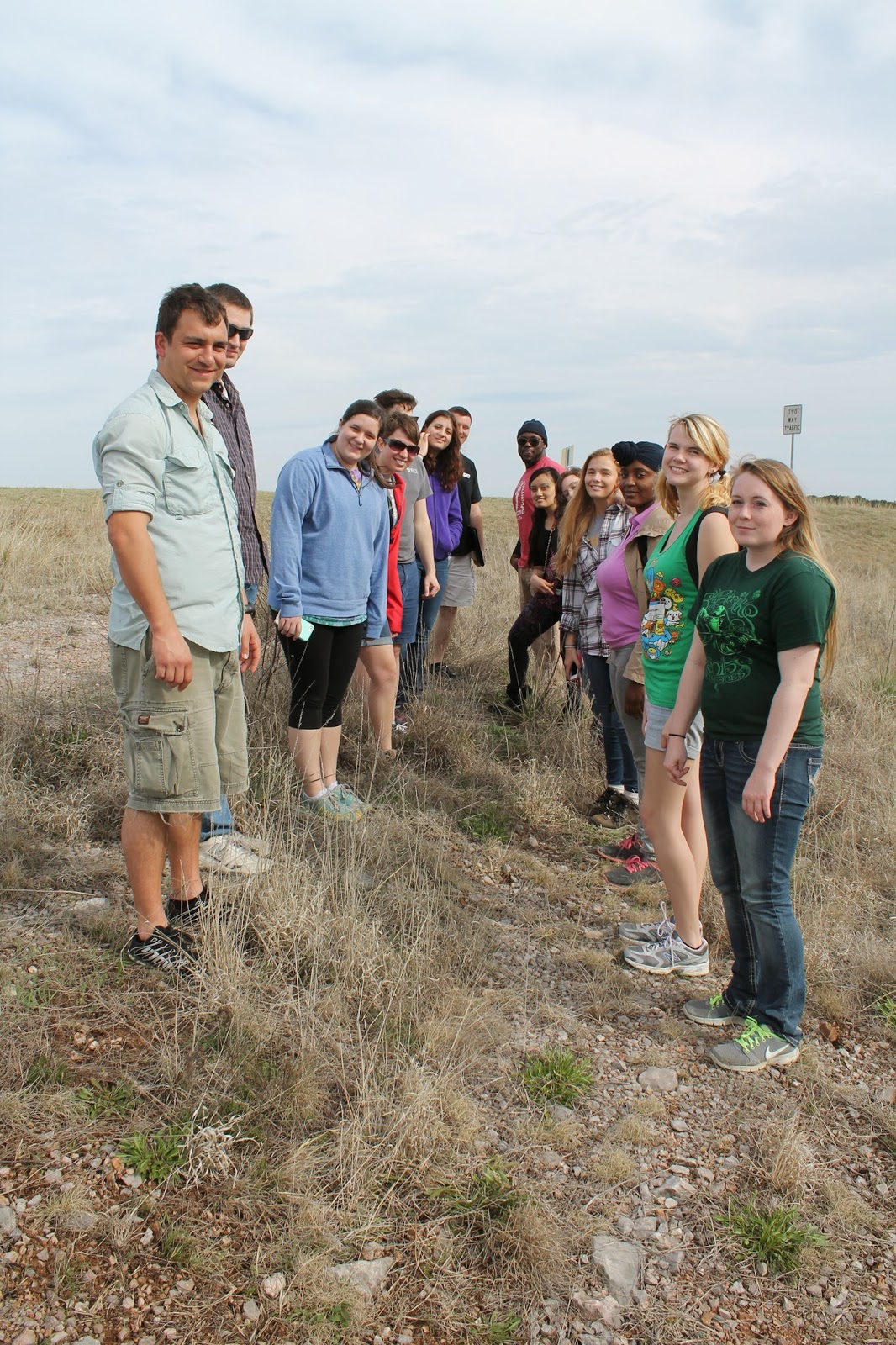
We went to the top of the Arbuckle Mountains and looked down on Turner Falls, a widely popular recreation destination. But that’s not all we saw. We saw fossils of stromatolites also, images of which I have posted previously. Out of privacy concerns I will indicate only the first names of the students. Left to right, front row: Camille, Dr. Stan Rice, Cadence, Brian, Kelvin, Sujana, Dianne; second row: Molly, Hannah, Kandra, Dr. Gordon Eggleton, Bruce, Turner, David, Kelly, Victoria, Jessica.


The Arbuckle Mountains are an anticline, in which the oldest deposits are on top. How did that happen? Geologic forces pushed up the mountains. Subsequent erosion washed some of them away. The oldest layers, on top of today’s mountains, used to have all the other layers above them. Ah, but if we claim that this is how the oldest layers ended up on top, then there should be some evidence, shouldn’t there? And we saw it. We stopped to see Ordovician limestone layers that had not only been pushed over on their sides but had been warped and distorted by the immense pressure. We also saw conglomerate rock that had filled in a valley during the Pennsylvanian period. Large limestone boulders had washed violently down from the mountains that were still huge at that time. Carbonate leached from these boulders had cemented them together into conglomerate, which is a natural analog of concrete. In the photo, you can see the students standing on either side of what had been, about 270 million years ago, a steep cliff.


The most unexpected part was when most of the students, and myself, had to wait about 45 minutes at a famous fried pie restaurant while one of the vans made an emergency side trip. Fried pies are nice, but you can’t talk about fried pies for 45 minutes. So we decided to play a game. I don’t remember whose idea it was, but we ended up guessing each other’s spirit animals. One of the students really liked dogs, so I got the students to figure out how dogs were domesticated from wolves. And then I joked about my spirit animal. Who am I? I have not had sex for thirty million years, which means my parasites should have evolved to drive me to extinction, but they haven’t, because I can dry up and blow away like dust in the wind and leave my fungal parasites behind [link to article]. I am a rotifer. I could never have guessed when we left that morning that I would be in a restaurant telling students about rotifers. We also talked about marsupials. In the photo, the students are watching a video of a joey (baby kangaroo) being born.


Our first field trip day was even better than we could have planned.

Sunday, March 22, 2015

Second Oklahoma Evolution Road Trip, part one

The first Oklahoma Evolution Road Trip, May-June 2013, was so successful that Gordon Eggleton and I tried it again. This time, we were fortunate enough to have the generous financial and administrative support of the Oklahoma Scholar Leadership Enrichment Program (OSLEP), which means that Gordon and I did not have to publicize the trip and that we got paid a lot more this time than the first time. In 2013, Gordon and I had to do everything: make all the arrangements for food and accommodations, and drive the vans, as well as delivering the content itself. This time, the Director (Karl Rambo) and the Administrative Assistant (Jeri Smalley) took care of all of that, including driving the vans. To me and Gordon this felt like a luxury. Last but not least, the 2013 trip was right during the worst tornado in recent Oklahoma history. This time, we just got a little bit of rain. You can read about the 2013 trip in these entries: 1, 2, 3, 4, and 5.

The OSLEP program started about forty years ago. It is a higher education program that is independent of all the colleges and universities in Oklahoma, though it is housed at OU. It has an entirely separate budget line. Its purpose is to encourage top college students in Oklahoma to take elective classes outside of their majors, classes that will challenge them to think and be creative and to deal with important subjects from a multidisciplinary perspective. Therefore, students from any major can take any course. Students from all over Oklahoma participate; in my class, students came from seven different universities in Oklahoma, including one student from my own campus but whom I had never met. While most of the students were from the sciences (biology and anthropology), I had students from business, computer science, creative writing, and even an aspiring professional trombone player. The students receive three upper-division credits from OSLEP courses. The program brings in notable scholars from all over the country as instructors. For example, May Berenbaum, perhaps the top entomologist in America, taught one of the courses. OSLEP has its choice of top instructors, and are not limited to Oklahoma; Gordon and I were therefore honored to have been chosen to lead an OSLEP course. OSLEP is a high quality program, and if anyone outside of Oklahoma doubts the quality of our education, they need only to learn about it (see here).

Students in these courses do creative work rather than take tests. In the Oklahoma Evolution Road Trip course, students did the following projects:

  • Pre-class assignment questions, based on a textbook (actually, on a PDF of my revised Encyclopedia of Evolution)
  • Group projects in biogeography
  • Short reports about endogenous viruses and pseudogenes
  • Individual presentations about a geological period
  • A course journal with notes and photos from field trips


The course lasted about four days (Monday late morning to Friday noon), two of which days were field trips. I will tell about the field trips in upcoming entries. The class was at the University of Oklahoma Biological Station on the north shore of beautiful Lake Texoma. Because most of the students did not have their own transportation, and because there is almost no “entertainment” anywhere close to the station, our experience was exactly like being on a retreat. All leaders and students were friendly, positive (as well as brilliant) people.

As pretty much everyone now expects, I began the course Monday morning by showing up as Charles Darwin and saying “May you look this good when you are 206 years old,” then telling them how fortunate they were to have so much more evidence that supports evolutionary science than Darwin did when he was alive. Monday afternoon was pretty much the entire lecture part of the course. I went over their pre-class study questions. Since they had written answers already, my overview was brief and consisted mostly of photographs for us to discuss. Gordon went over some basics of the geological features that they would see, especially what an anticline is.

At the last minute, I realized that the students needed something more than class, so I jumped up and went outside to find a nice sidewalk. I found one, right next to the classroom, that was exactly 50 of my little paces long. I paced it off as a timeline of Earth history, then brought the students out to walk it. The first few paces were the Earth cooling down and the oceans forming. Then, after life began, I took them on the next 32 paces when the highest life forms were bacteria. (“Bacteria!” we kept saying as we walked along.) Then, about 16 paces before the end, we discussed the endosymbiotic origin of eukaryotes. They were nearly at the end of the sidewalk—only eight more paces to go—before the Cambrian Explosion, and there was barely room for me to stand on the part of the sidewalk that represented the time after the extinction of the dinosaurs. There was a crack in the sidewalk in which a coat of paint would represent all of civilization, and in which their lives would be a microscopic layer of molecules.

The evenings, and Wednesday late afternoon, were available for the students to prepare their powerpoint presentations. The basis on which the quality of the work was to be judged was how informative and interesting it was to the rest of the class. That is, how well they taught each other.

The students decided to be creative. After all, it was Spring Break! Even getting three credits is not worth having a dull Spring Break. Their final presentation PowerPoints included some creative ones. One student created a pantheon out of the major animal and plant species, and another explained the Triassic (when the Earth was recovering from The Permian extinction) from the viewpoint of a “lonely Coelophysis.” (“All of my friends are dead…well, 95 percent of them…”) One of the students said she might do some kind of interpretive dance in her presentation, but in the end it was just a PowerPoint.

Impromptu discussions could and did come up. For example, when we discussed a certain endogenous retrovirus that sometimes got activated during cancer, we wondered whether this retrovirus might be a contributing factor to the cancer. The students quickly spotted the conflation of correlation with causation. I mentioned Kenneth Boulding’s Utterly Dismal Theorem as an example of misattributing causation. The director, Karl Rambo, a cultural anthropologist, was able to help us understand this better.

Finally, one rewarding part of the course for me was the chance to meet with colleagues. I was glad to talk to Karl about creative ways of getting faculty to exchange ideas with one another. This is something that does not happen much because faculty people are too busy to do this anymore. I was glad to talk with Gordon also, whom I seldom see except when we are working on this road trip together. Finally, Ken Hobson from OU was spending some time at the station, and it is always fun to chat with Ken.


I hope that the Oklahoma Evolution Road Trip becomes a recurring course in the OSLEP program. With fifteen students, we had just the right number for good class dynamics and to almost exactly fill two vans. We all agreed that it was one of the best Spring Breaks we ever had.