Showing posts with label Cretaceous. Show all posts

Friday, November 13, 2026

Gaia Save Us! Not So Fast, part three. The Great Extinctions

 This is the third in a series of essays.

 One of the great insights of modern science has been that the ecosystem of the Earth as a whole might be self-regulating, that is, it regulates its systems (temperature, geology, atmospheric chemistry, biology) the way a body regulates itself. It adds a new dimension to the meaning of Mother Earth. This is an insight usually attributed to James Lovelock, who called the Earth Gaia, and extended by the late, great biologist Lynn Margulis. Neither one of them intended to imply that the Earth was a goddess; Lynn Margulis particularly told me so. Gaia is a self-regulating systems, not a goddess.

In this series of essays, I wish to explain that Earth has a regulatory system, which you can call Gaia if you like. But this system is very unresponsive except on the largest scales of time and space. Don’t trust Gaia to solve any of our current ecological problems.

This third essay is about how Gaia did not save us from mass extinctions. The previous essay was November 8.

You have heard about the event (the Terminal Cretaceous Event) that caused the dinosaurs (except birds, which are dinosaurs) to become extinct. Dinosaurs have caught everyone’s imagination, and even more dramatic is the fact that it was almost certainly a giant asteroid slamming into the Earth that caused the dinosaurs to die. Dinosaurs and an asteroid—it doesn’t get much more dramatic than that. Of course, the asteroid did not have to hit all the dinosaurs. It caused a massive firestorm that baked many of them, and thick smoke that brought years of darkness, freezing the survivors. Surely Gaia could not prevent asteroids from hitting the planet and cannot be faulted for the Cretaceous extinction.

But there was an earlier, much larger, extinction event, at the end of the Permian Period, about 250 million years ago. Although it did not involve an asteroid, it did involve one of the largest volcanic eruptions in Earth history, which poured lava over much of Siberia. It was a long, slow eruption. If you lived away from the eruption site, you might not have noticed anything on a day to day basis. But it did put a lot of sulfur dioxide into the upper atmosphere, which not only cooled the Earth but also poisoned the oceans, gradually.

The end of the Permian was also when all the continents crashed together to form the supercontinent Pangaea, which means the “whole earth.” This, in itself, would have made a major contribution to extinction, since many species live in shallow waters around the continents. One big continent has less shallow water around it than numerous, smaller continents. Also, to the extent that the climate was hospitable at the start of the Permian, it probably was not at the end. The middle of this giant continent of Pangaea, far from the coastal rains, would have been dry, much like the Gobi Desert today. Gaia has no control over continental movements, no more than over volcanic eruptions, which are both aspects of plate tectonics, and thus cannot be faulted for the Permian extinction.

A Gaia that cannot protect us from mass extinctions is of little help to the Earth. Gaia has no mind and is slow. It may have saved Earth from becoming an ice planet or a hellish one. But on a day to day, or million year to million year, basis, it is of little help to the planet.

Thursday, March 26, 2015

Second Oklahoma Evolution Road Trip, part two

On the Tuesday of the second Oklahoma Evolution Road Trip (see previous entry), the students and instructors drove around south central Oklahoma to look at some amazing geological and fossil features. Most of the places were the same ones the participants saw on the first Oklahoma Evolution Road Trip (see links in previous entry). The students were excited to find so many different kinds of shallow marine fossils. We saw ammonoids, some of them quite large, and huge numbers of oyster shells of the species Texigryphaea navia. Some of them had eroded out of the powdery limestone matrix and were just lying around. First photo: notice the ammonoid fossil. Second photo: Dianne  finds the impression of a large mollusk.


At a roadcut that exposed Ordovician deposits, students found crinoids and lots of coral fossils. The corals formed branches, and in many cases the little pits in which the coral animals live were visible. The first photo shows Victoria looking for fossils, and the second photo shows imbedded fossils of coral and crinoids.


We visited the museum at Goddard Youth Camp, where Clayton Edgar showed us a cast of the most complete skeleton of Acrocanthosaurus atokensis (similar to T. rex), whose footprints we later saw down in Texas. You can learn a lot about a dinosaur from its skeleton, especially from the wounds that healed, and the ones that did not.


We went to the top of the Arbuckle Mountains and looked down on Turner Falls, a widely popular recreation destination. But that’s not all we saw. We saw fossils of stromatolites also, images of which I have posted previously. Out of privacy concerns I will indicate only the first names of the students. Left to right, front row: Camille, Dr. Stan Rice, Cadence, Brian, Kelvin, Sujana, Dianne; second row: Molly, Hannah, Kandra, Dr. Gordon Eggleton, Bruce, Turner, David, Kelly, Victoria, Jessica.


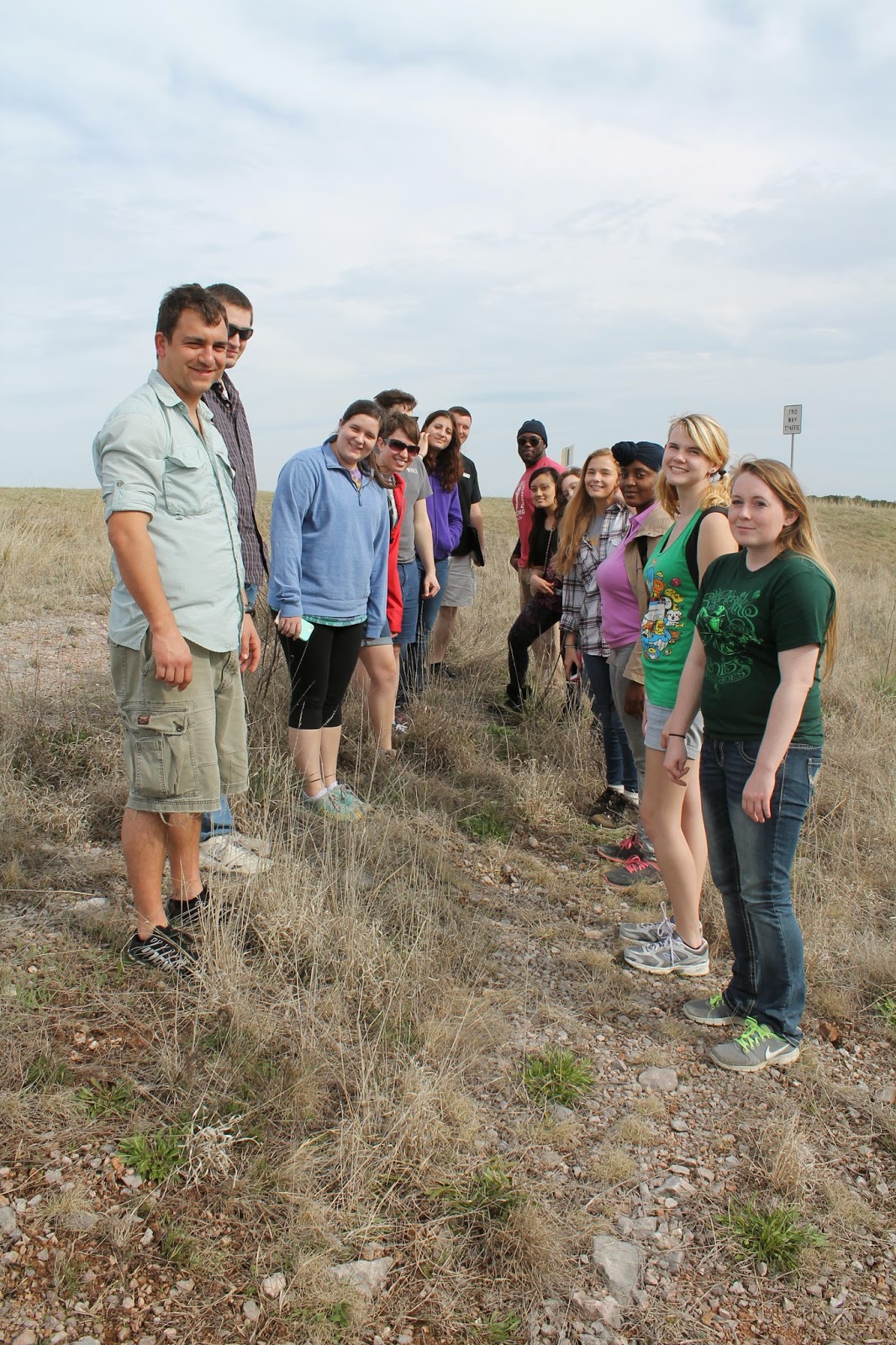
The Arbuckle Mountains are an anticline, in which the oldest deposits are on top. How did that happen? Geologic forces pushed up the mountains. Subsequent erosion washed some of them away. The oldest layers, on top of today’s mountains, used to have all the other layers above them. Ah, but if we claim that this is how the oldest layers ended up on top, then there should be some evidence, shouldn’t there? And we saw it. We stopped to see Ordovician limestone layers that had not only been pushed over on their sides but had been warped and distorted by the immense pressure. We also saw conglomerate rock that had filled in a valley during the Pennsylvanian period. Large limestone boulders had washed violently down from the mountains that were still huge at that time. Carbonate leached from these boulders had cemented them together into conglomerate, which is a natural analog of concrete. In the photo, you can see the students standing on either side of what had been, about 270 million years ago, a steep cliff.


The most unexpected part was when most of the students, and myself, had to wait about 45 minutes at a famous fried pie restaurant while one of the vans made an emergency side trip. Fried pies are nice, but you can’t talk about fried pies for 45 minutes. So we decided to play a game. I don’t remember whose idea it was, but we ended up guessing each other’s spirit animals. One of the students really liked dogs, so I got the students to figure out how dogs were domesticated from wolves. And then I joked about my spirit animal. Who am I? I have not had sex for thirty million years, which means my parasites should have evolved to drive me to extinction, but they haven’t, because I can dry up and blow away like dust in the wind and leave my fungal parasites behind [link to article]. I am a rotifer. I could never have guessed when we left that morning that I would be in a restaurant telling students about rotifers. We also talked about marsupials. In the photo, the students are watching a video of a joey (baby kangaroo) being born.


Our first field trip day was even better than we could have planned.