Showing posts with label Acrocanthosaurus. Show all posts

Friday, July 28, 2017

Dinosaur Trackways on the Blank Slate of the Mind

The last couple of days, I have had the privilege of working, again, with Glen Kuban down in the bed of the Paluxy River near Glen Rose, Texas (Dinosaur Valley State Park). Usually we work alone, or with a couple of other people, but this time there was a little crowd. A BBC film crew brought their cameras and even a photographic drone to get video footage of the dinosaur trackways, which I have written about numerous times previously in this blog, for example here). They also came to interview Glen, who has worked on these tracks (and knows each footprint by name) for 37 years, and he will not get some worldwide recognition for the work he has done. Congratulations, Glen! You deserve it.

Watch for the BBC video when it comes out. It will be called Rediscovering T Rex. The trackways in the park are not T. rex, but there are very few verified footprints of T. rex. But in the Paluxy river bed you can see long trackways of Acrocanthosaurus, which was similar to T. rex in many ways. The BBC does not yet have an American distributor for this video, so far only Canada and France, but I’ll bet that within a year or so you can find the video on Amazon or your local library.


I have posted a YouTube video of Glen and the film crew, if you want to experience what it was like to be there.

We were at the trackway site that was made infamous in the 1970s-era creationist movie Footprints in Stone, where creationists claimed that human footprints overlapped dinosaur footprints, thus proving, they claimed, that the entire evolutionary timetable of Earth history was wrong. The evidence of human footprints in 110-million-year-old mud (now limestone) was skimpy and some of it faked. Most creationists, even those who have not publicly disavowed the “manprints of the Paluxy,” pretty much ignore them. The son of the producer of the creationist movie, when he discovered that his father had misled his viewers about these footprints, destroyed all remaining copies of the movie. There was no discussion of this uniquely American controversy with the BBC crew, even though they knew about it, because it is such a dead issue even among creationists; certainly European viewers would wonder why anyone took so much as two breaths to talk about the supposed man-prints.

But there are still passionate creationists, mostly in the Glen Rose vicinity, who believe that the supposed man-tracks are real and that they prove that not only are all evolutionary scientists wrong, but even most creationists. They are a crazy little cult. They still have a museum right near the state park, although it appears to be on the skids and is now only open two days a week. I have posted essays in this blog about the Mantrack cult in the past (for example here). The state park personnel who were with Glen, me, and the BBC crew told me that this little cult has so effectively spread the hoax that lots of visitors still ask them how to find the man-tracks. It gets pretty intense sometimes, and rather than to create a confrontation, the park personnel sometimes have to simply walk away or busy themselves with some other park visitor.

We sort of expected that some members of this cult would come and try to disrupt the BBC filming. This did not happen, however, perhaps because there were a half dozen park employees on the scene. This track site is hard to find but the cult members, some of whom own adjacent land, can get there. They act as if they also own the river bed, and have in the past tried to keep Glen from studying the tracks. Actually, the river bed belongs to the state of Texas.

But one of the cult members came by, claiming that he was taking photographs for the City of Glen Rose. I very much doubt that the city government actually sent him, however. They might have posted some of his photos in the past, but he was acting in no official capacity. Of course, this man, whose name I forgot, and just as well, started going through his little speech about how belief in the man-tracks took less faith than belief in what he called “strict evolution.” Glen had told me beforehand almost verbatim what this little speech would be. It is as if the cult members are programmed to give their little speeches, and they will not respond to anything you say. They act as if they are brainwashed.

But that was not actually the precipitating event. The man started by saying that a cold front was coming through this weekend, and that it would only be about 92 degrees instead of the normal 97 degrees. This, he claimed, disproved the entire science of global warming. As I am one of the climate scientists that Donald Trump hates and Emmanuel Macron loves, I had to point out that this was an invalid conclusion. Global warming does not mean that temperatures never decrease; it means that they increase more, and more often, than they decrease. Well, this was all the cue he needed to self-identify as a right-wing extremist (or words to that effect; I did not yet so label him) and launch into his speech.

This man went on to comment on the fact that paleontologists have stopped using the genus name Paluxysaurus and started using Sauroposeidon instead. This shows, said the man, that scientists are wrong about this and, why not, everything else also. But changing names of organisms reflects the ongoing process of coming to better understand the evolutionary history of the organisms. And, of course, science advances because scientists make mistakes and then learn from them, something that religious cults almost by definition cannot do. Cults believe themselves to be directly inspired by God, and to admit one mistake totally undermines their reason for being.

I wish to make two points from this. First, the religious fundamentalists are now attacking all of science and education on two fronts. Formerly, they focused all their attention on evolution. Now, they also consider climate scientists to be servants of Satan. This is why scientific and educational organizations, all the way from national and international organizations such as the AAAS and NCSE to local ones such as the Oklahoma Academy ofScience and Oklahomans for Excellencein Science Education, of both of which organizations I am a past president, disseminate as much information about climate science as about evolutionary science.

The second point explains the title of this essay. The lumpy limestone of Dinosaur Valley State Park has proven to be one of the most creative blank slates upon which a religious cult can write its own version of the history of the universe. The dinosaur footprints are real enough. The supposed man-tracks are incomplete dinosaur footprints. On some of these prints, the dinosaur toes have eroded away. On others, the creationists have deliberately ignored the dinosaur toe prints. Early creationists film footage and notes show clearly that they knew the dinosaur toe marks were present. In a few infamous instances, creationists have even carved human toes on the dinosaur prints, or carved entire fake human footprints in the limestone. Rather than getting insights from the evidence in the limestone, they have used the limestone as a blank notebook on which to write their own version of reality, a version not even shared by most creationists.


It is unclear whether these cult members are dangerous. Of the hundreds of videos I have posted on my Darwin Youtube channel, the only ones on which rabidly angry comments have been posted were those in which I showed Glen Kuban at work in the Paluxy riverbed. A couple of times I have wondered whether to report these creationists to the FBI, but their comments were just short of personal threat. Of course, there were atheist comments also, which insulted the creationists. The creationist comments did not threaten the atheist commentators, Glen, or myself with any violence; they merely hoped that God would rain down fire and brimstone from the sky to destroy us and our children, that’s all. The blank pages of limestone on which this cult writes its version of reality includes at least the hope that everyone who disagrees with them will be destroyed.

Sunday, March 29, 2015

Second Oklahoma Evolution Road Trip, part three

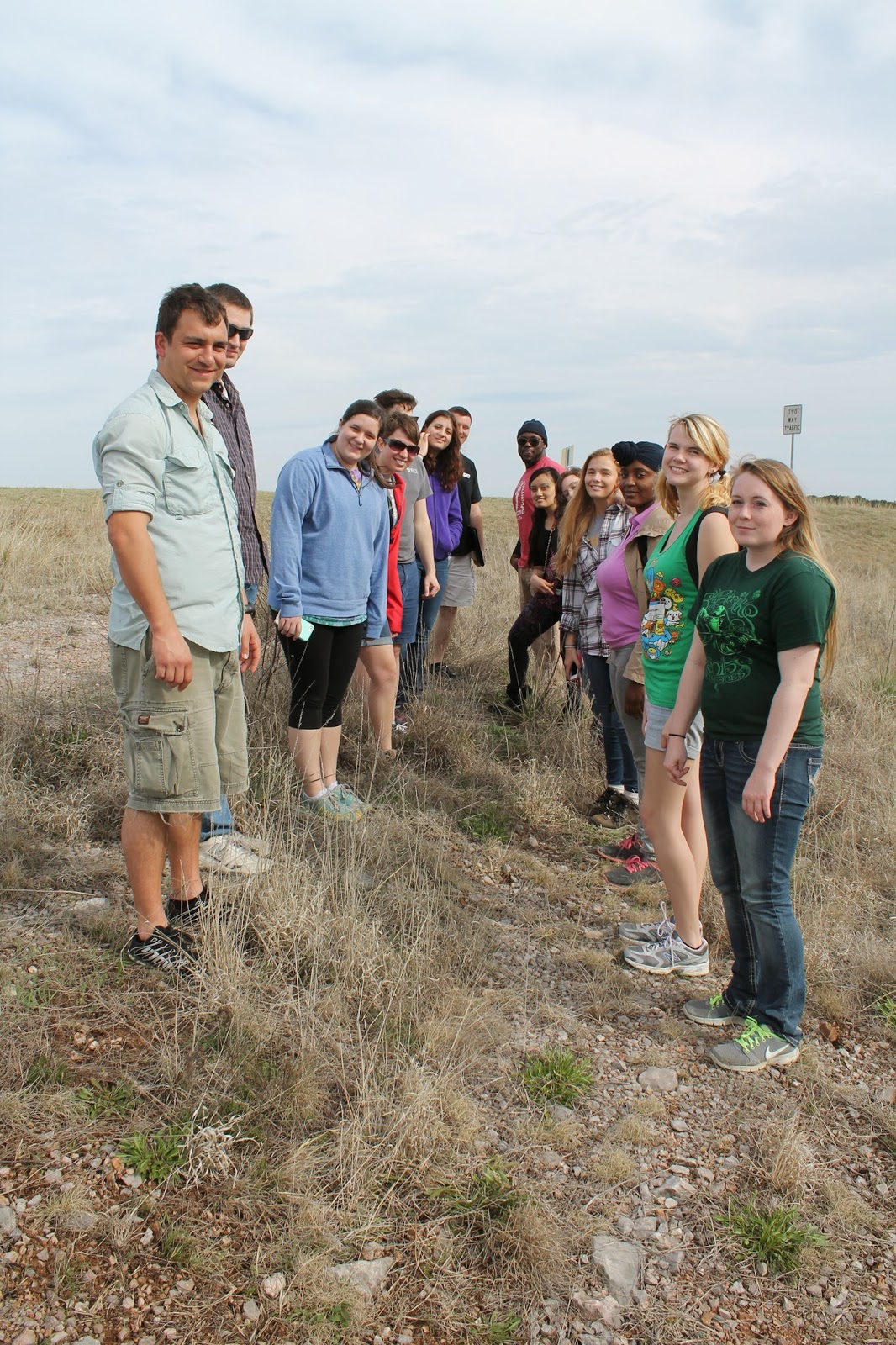
On the Thursday of the Second Oklahoma Evolution Road Trip (see previous entries), we went down into the mystical, mythical, misty land of Texas, through fog that shrouded the Red River. We kept driving down to Dinosaur Valley State Park. After a picnic lunch, we looked for dinosaur footprints. This location is described more fully in earlier blog entries (here, and follow the links). We could only see a couple of prints, because the river was up, filling the footprints with sand and gravel. We did find one—one of the best—that was above water level and with which the students had their photos taken.


I did not need to tell the students very much; this brilliant group pretty much figured out all the things you could learn about dinosaurs by studying not just their footprints but their trackways. We wished that we could have been there when the water was low and Glen Kuban was with us. As a consolation prize, the next day I showed them some videos from my YouTube channel in which Glen explains the trackways (for example here and here).

Technical note: since the earlier entries, the Paluxysaurus dinosaur has been assigned to the genus Sauroposeidon.

I also told the students about the “man-track” controversy, in which a relatively small number of creationists claim that there are human footprints alongside and even overlapping the dinosaur footprints. This would show that humans and dinosaurs lived at the same time and that, ergo, all of evolutionary science was wrong. Of course, the creationists cannot explain how, in the middle of Noah’s Flood, dinosaurs came out of their hidey holes and left footprints in sediments that had just been deposited by that flood. But we will let that pass. If, in fact, there are verifiable human prints overlapping with dinosaur prints, then evolution has a problem.

So we all went (and paid our admission fees) to Carl Baugh’s Creation Evidences Museum, which I have described in earlier blog entries (for example here). The first thing that I noticed was that the displays (with fake slave shackles) that claimed that evolution led to slavery had been removed. But several of the students went straight to the display that claimed to show a human footprint overlapping an Acrocanthosaurus print. They all noticed that the so-called “man-print” looked fake. All the toes were perfect, and there did not appear to be an arch. One particularly observant student pointed out to me that the silica grains inside the man-print reflected light, while the silica grains outside the print did not, which is exactly what you would expect if the print was carved into the rock. Gotcha! Another alleged man-print did not appear to have any relief, but looked like a layer of paint. Finally, one of the students noticed that the alleged man-print and the (undoubtedly real) dinosaur print had the same amount of relief. But this should not have been possible; the dinosaur would have compressed the mud, and the human footprint on top of it would have been shallower. I’m not absolutely sure about this, but it does look a little suspicious, doesn’t it?

Some of the alleged man-prints were very large and supposedly produced by giants (Homo bauanthropus, which Baugh named after himself). The students also saw the hammer supposedly deposited in Cretaceous limestone. (It might have slipped in a limestone crack maybe a few decades ago and was then cemented by dissolved calcite.) Some of the students were quite skeptical that giants would use such a small hammer. Maybe it was for dental work, one of them said. These students noticed things that, in my previous visits, I had not. I remain grateful for their insights.

We watched (some of us more, some less) a video of Carl Baugh explaining the history of the planet to us. It is an astonishingly different version than what scientists accept, and even most creationists. He explained the red shift of the galaxies, which makes some of them appear to be 13 billion light years away, by saying that God stretched out the heavens really really really fast on one of the days of Creation. Consider that 13 times 365 is 4,745. God would have stretched out the heavens at 4.7 trillion times the speed of light to do this. He would have had to suspend the physical laws of the whole universe to do this, except on Earth, which was unruffled by all this cosmic excitement. A miracle? I suppose the creationists can make up as many miracles as they like. He said the vapor canopy created a pink light. He also said, I think, that ultraviolet light, cycling through the vapor canopy, created the magnetic field. He also said that God increased the diameter of the Earth after the Flood. He also said that Psalm 18 describes a great noise that shot out into the heavens, “which we assume was microwaves.” A biblical literalist claiming that noise is microwaves? Our heads were spinning with the things Baugh just made up. Perhaps the most amazing was his claim that everything in the fossil record is larger than their modern (post-Flood) counterparts. There are numerous counter-examples (one thinks of horses, for example), but, I suppose, Baugh could explain these away by saying that the organisms that are larger today are not, in fact, counterparts of the smaller organisms in the fossil record.

Outside the museum there is what looks like a petrified log, but one which petrified quickly in a mineral hot spring.


The very existence of petrified wood seems to indicate an old Earth; but can petrified wood actually be young? Look at the photo and you will see that it is mineralized, not petrified; the wood is still there, forming easily visible fibers. Real petrified wood (such as this piece from outside of the Goddard Youth Camp museum) is not like this.


The hyperbaric chamber, which I saw on earlier visits, and which looks like a TV set submarine, is still sitting idle. I asked about this. The receptionist said that all they needed was $250,000 more dollars and they could get it up and running. To prove what? They want to prove that the high air pressure that a vapor canopy would have caused makes organisms grow bigger and healthier. They cannot get permission to experiment on humans or animals, so they presumably still plan (as I was told in 2013) to use plants. But couldn’t they build a smaller chamber for plants, one that would not require so much money? The same observant student who had noticed the silica grains also saw what looked like a small pressure chamber back in a corner. One of the members of our group speculated that the hyperbaric chamber was just a ploy to keep raising money.

Afterward, we went back to the picnic area to discuss what we had seen. We tried to figure out the genetics of Noah and his family. How could five people (Noah, Mrs. Noah, and the wives of the three sons; the sons would have had only the alleles from their parents) have contained all of human genetic diversity? Well, maybe they could have, if they were black. Studies consistently show that almost all human genetic diversity is contained within Africa, with other races having subsets of that diversity. One problem is that, if all humans are descended from Noah’s family, shouldn’t human DNA show a distribution pattern centered around Mt. Ararat, which is in modern Turkey, where the Ark supposedly landed? That is, instead of an afrocentric distribution, shouldn’t there be (I am the first person to use these terms, and I claim priority) an araratocentric or turkocentric distribution of human genetic diversity? The Adam and Eve in the Baugh museum mural were pure white. We also discussed whether the Flood water would have been fresh or salt water or maybe brackish. Whatever the case may be, many species of fishes would not have survived, and the Bible makes no mention of fishes aboard the Ark. Finally, the students noted that it was strange that footprints of a race of giants would be found in Baugh’s museum, but no other evidence for these giants is found anywhere else in the world: in particular, no giant human bones.


However interesting dinosaurs are, humans with their ability to invent stories are much more interesting. Having reached this conclusion, we relocated to a famous barbecue restaurant in Glen Rose.

Thursday, March 26, 2015

Second Oklahoma Evolution Road Trip, part two

On the Tuesday of the second Oklahoma Evolution Road Trip (see previous entry), the students and instructors drove around south central Oklahoma to look at some amazing geological and fossil features. Most of the places were the same ones the participants saw on the first Oklahoma Evolution Road Trip (see links in previous entry). The students were excited to find so many different kinds of shallow marine fossils. We saw ammonoids, some of them quite large, and huge numbers of oyster shells of the species Texigryphaea navia. Some of them had eroded out of the powdery limestone matrix and were just lying around. First photo: notice the ammonoid fossil. Second photo: Dianne  finds the impression of a large mollusk.


At a roadcut that exposed Ordovician deposits, students found crinoids and lots of coral fossils. The corals formed branches, and in many cases the little pits in which the coral animals live were visible. The first photo shows Victoria looking for fossils, and the second photo shows imbedded fossils of coral and crinoids.


We visited the museum at Goddard Youth Camp, where Clayton Edgar showed us a cast of the most complete skeleton of Acrocanthosaurus atokensis (similar to T. rex), whose footprints we later saw down in Texas. You can learn a lot about a dinosaur from its skeleton, especially from the wounds that healed, and the ones that did not.


We went to the top of the Arbuckle Mountains and looked down on Turner Falls, a widely popular recreation destination. But that’s not all we saw. We saw fossils of stromatolites also, images of which I have posted previously. Out of privacy concerns I will indicate only the first names of the students. Left to right, front row: Camille, Dr. Stan Rice, Cadence, Brian, Kelvin, Sujana, Dianne; second row: Molly, Hannah, Kandra, Dr. Gordon Eggleton, Bruce, Turner, David, Kelly, Victoria, Jessica.


The Arbuckle Mountains are an anticline, in which the oldest deposits are on top. How did that happen? Geologic forces pushed up the mountains. Subsequent erosion washed some of them away. The oldest layers, on top of today’s mountains, used to have all the other layers above them. Ah, but if we claim that this is how the oldest layers ended up on top, then there should be some evidence, shouldn’t there? And we saw it. We stopped to see Ordovician limestone layers that had not only been pushed over on their sides but had been warped and distorted by the immense pressure. We also saw conglomerate rock that had filled in a valley during the Pennsylvanian period. Large limestone boulders had washed violently down from the mountains that were still huge at that time. Carbonate leached from these boulders had cemented them together into conglomerate, which is a natural analog of concrete. In the photo, you can see the students standing on either side of what had been, about 270 million years ago, a steep cliff.


The most unexpected part was when most of the students, and myself, had to wait about 45 minutes at a famous fried pie restaurant while one of the vans made an emergency side trip. Fried pies are nice, but you can’t talk about fried pies for 45 minutes. So we decided to play a game. I don’t remember whose idea it was, but we ended up guessing each other’s spirit animals. One of the students really liked dogs, so I got the students to figure out how dogs were domesticated from wolves. And then I joked about my spirit animal. Who am I? I have not had sex for thirty million years, which means my parasites should have evolved to drive me to extinction, but they haven’t, because I can dry up and blow away like dust in the wind and leave my fungal parasites behind [link to article]. I am a rotifer. I could never have guessed when we left that morning that I would be in a restaurant telling students about rotifers. We also talked about marsupials. In the photo, the students are watching a video of a joey (baby kangaroo) being born.


Our first field trip day was even better than we could have planned.

Saturday, June 8, 2013

Oklahoma-Texas Evolution Road Trip, Part Four. Dinosaur Tracks


Dinosaur Valley State Park appears to be mainly a place for kids to go swimming in safe shallow water. There are no longer any dinosaurs there, I think even Carl Baugh would admit. The water was at a normal level, not flood stage, but we could find only a few Acrocanthosaurus prints. They were, however, quite striking.


When I visited this riverbed in September 2011 with Glen Kuban (see entries on this blog for October 7, 14, 21, and 29 of 2011), there was hardly any water in the river. God had not yet answered Governor Perry’s call to prayer for rain. At that time, we could see entire trackways of dinosaur prints.

The Road Trip participants met outside the gift shop, by the dinosaur statues (apparently left over from a movie set). I found that everyone had a pretty good idea what you could tell from dinosaur trackways as opposed to individual footprints. That is, what does an ichnologist study? If you know the size and stride, you can calculate how fast the creature was running. Some trackways were made by dinosaurs running about 30 miles per hour. But it took awhile for the participants to figure out what was most glaringly wrong about the statues. It was this: both the big herbivorous dinosaur and the smaller carnivore were dragging their tails. In the trackways of the riverbed, there are extremely few tail traces. A Paluxysaurus tail could weigh a ton, but the animal held it up above the ground, perhaps for balance, or perhaps to whip it around to knock the living daylights out of one of those humans who was chasing it, in the middle of The Flood no less, with a hammer, which the human dropped into the mud and it eventually ended up in Carl Baugh’s museum. (BTW, how did fresh and salt water stay separate during The Flood? For answers, see my 1988 and 1989 articles in Creation/Evolution, published at the time by the National Center for Science Education. These articles appear to not be on the NCSE website anymore.)

We enjoyed some Texas barbecue in Glen Rose. Someone on NPR said that you can throw a rock anywhere in Texas and hit a barbecue place that is better than anyplace else in the world. That is only a slight exaggeration. But were we just having fun? No. Even this was class time. I told people about Harvard professor Wranglin’ Rich Wrangham’s barbecue theory of human evolution. The ability to cook food, whether of plant or animal origin, allowed humans to ingest more calories; this was essential for brain enlargement.

We drove safely back to the OU Biological Station, arriving after sunset and quickly retiring to our rooms.

Thursday, June 6, 2013

Oklahoma-Texas Evolution Road Trip, Part Two. The World of the Past, continued.


Note: I corrected the spelling of Texigryphaea in the previous entry.

On May 31, the participants in the Oklahoma Evolution Road Trip rode in the van up US 177 north of Dickson. Just south of Lake of the Arbuckles is the road that leads to Goddard Youth Camp, about which more later. Right at that intersection is a large new roadcut right through Ordovician marine deposits. You can find this on the geological map of the Arbuckles. You will probably want to enlarge the PDF to 100% and navigate around. The deposit is labeled in salmon as Osv (Ordovician Sylvan Viola Group) at about 34 degrees 23’ latitude and 96 degrees 58’ longitude. We probably also wandered into the OSDh (labeled in purple) which is the Hunton group, of Ordovician-Silurian-Devonian age. Despite the treacherous footing on loose stones, the participants scoured all over the place for fossils, finding mollusks, rings from crinoid stalks (a kind of echinoderm), and brachiopods, which resemble sideways mollusks. Back when these deposits formed, brachiopods were as abundant as mollusks. But brachiopods were either inferior or unlucky during the Permian extinction 250 million years ago, and since that time they have been rare. I found something that might be a fossil or might be a crystal. Interpreting what you see in a fossil deposit is not always as easy as it looks in the books and documentaries. The photos show Mary Kay Johnston and Gordon Stallings, and a brachiopod fossil found by Sharon Young.


Lots of pickup trucks and rigs drove rapidly and loudly up and down the highway. Were there really a dozen red pickups, or was it the same one a dozen times? About the time we heard but did not see a major automobile collision, we decided it was time to go.

We ate lunch at the museum at Goddard Youth Camp, where Clayton Edgar, son of the camp founder, met us. Many school, scout, and church groups stay at this camp. I asked Clayton whether the church groups expect him to tell them about creationism. He said he would if they insisted on it, but their mission was to teach about the deciduous forest, the prairie, and dinosaurs.

Clayton introduced us to Fran the Acrocanthosaur, or at least a cast of her bones. Cephas Hall found the 90 percent complete skeleton near Hochatown in eastern Oklahoma in terrestrial Cretaceous deposits. The story of this skeleton, which was stolen and reclaimed, is told in this book. Clayton showed us where Fran’s major injuries had healed.


This was not to be the last time that Mary Kay was to have an encounter with an acrocanthosaur.

When we got to the top of the Arbuckle Mountains, we could see the Cambrian period Colbert rhyolite (Cc in red, at about 34 degrees 30’ latitude and 97 degrees 15’ longitude on the geological map; note that “Cambrian” is a C with a line through it). The Cambrian period began about 540 million years ago. We stopped at the overlook to see Turner’s Falls, perhaps the most beautiful view in Oklahoma, and Collings Castle, built by a retired OU Professor in the mid twentieth century. (All of us professors are rich enough to build castles.)


Thousands of people stop there, and very few know that the rocks along the little path are actually Cambrian stromatolites of the Cool Creek Formation (Ccm in tan). Stromatolites are formed by single-celled algae and layers of minerals. They are very rare in the fossil record after the Cambrian period, because animals with jaws (which evolved at that time) could easily graze on them. The reappearance of stromatolites after the Permian extinction was part of the evidence that animal food chains had been disrupted worldwide. Stromatolites are found today only in shallow seas that are too salty for animals to live. They look like brains on the heads of the Star Trek Talosians. Gordon Eggleton and I had previously scouted some out, but it was Gordon Stallings who tracked down some much better specimens.


I can't resist telling you that the living plant beside the stromatolite fossil is Cissus incisa in the grape family Vitaceae.

Also, nearby, we saw the Silurian age Sylvan shale. Shale forms from mud, and is usually a rock, but this shale erodes back into mud very easily.

Next we stopped at a scenic overlook where, about 280 million years ago, a very dramatic thing happened. Today Oklahoma is in the middle of the North American Plate, but during the Pennsylvanian period three plates were moving violently in this area. This movement eventually produced warped wrinkles of anticlines and synclines. This is called the Southern Oklahoma Aulacogen. An aulacogen is an arm of a three-way junction in which a continental plate is breaking up in three directions. During the Pennsylvanian period, forces beneath the plate pushed up the Arbuckle Mountains, raising up the Cambrian and Ordovician layers that had already hardened into rock. Aulacogens can cause whole mountains to collapse to form valleys known as grabens, which subsequently filled in. This was one such place: 280 million years ago cliffs of Ordovician rock (Owk, Ordovician West Spring/Kindblade, cream colored on the map) towered over a deep valley. Violent erosion washed large chunks of rock into the valley, and minerals glued them together into some of the most amazing conglomerate rock (IPcr, Pennsylvanian Collings Ranch conglomerate in blue on the map). Look on the map at about 34 degrees 25’ latitude and 97 degrees 11’ longitude, follow the faint line that indicates Interstate 35. These violent crustal movements also broke up the Ordovician limestone into big chunks.


We then drove east into land in which pre-Cambrian granite had been pushed to the top. It is the pCgg, Precambrian granitic gneiss at about 34 degrees 22’ latitude and 96 degrees 37’ longitude, which is light orange with red x’s on the map. Granite, an igneous rock, has no fossils, and erodes more slowly than limestone. The Blue River flows through this granite, which is perhaps why the water is clearer than that of the Washita which drains primarily limestone.

It was finally time for us to see something alive, not dead. I introduced the group to one of the rarest trees in the world, the seaside alder, Alnus maritima.


The Oklahoma seaside alder is (along with the Georgia and Delmarva seaside alders) one of three remnant populations of a species that had once been widespread. Alder seeds germinate in sunny, wet gravel, of which there was a lot at the end of the last ice age but which is rare today. Today, if the ground is wet it is shady. My research has shown that the alders produce thousands of healthy seeds but no seedlings survive past their first year. You can download a PDF of the article here.

We also compared three different evolutionary adaptations to two different kinds of habitats. Oak trees grow slowly and produce strong wood in stable forests, where they can “expect” to live for centuries. But alders and cottonwoods live in unstable riparian habitats, where floods frequently wash the trunks away. Cottonwoods grow quickly and produce cheap wood, since they can “expect” to live only about a century; a large flood kills them. Alders produce numerous weak trunks, which get killed every few years by floods (or, in this case, a large fire that burned the forest in 2011). The underground clump, however, can survive for perhaps centuries. They start growing back immediately after fires and floods.

Evolution has, therefore, produced a great variety of adaptations. No single adaptation is “the best.” Oaks, cottonwoods, and alders all prosper in different ways. Stromatolite algae, acrocanthosaurs, echinoderms, mollusks, and brachiopods all prospered (and some continue to prosper or at least, like brachiopods, cling to survival) in different ways.

Friday, October 14, 2011

Dinosaur Adventure part 2


As described in the previous blog entry, I went to Dinosaur Valley State Park in Texas, where I met with Glen Kuban, who showed me hundreds of dinosaur footprints in the bed of the Paluxy River. During the ongoing drought, the riverbed was exposed, and with it footprints left by dinosaurs 100 million years ago, when the ground on which we stood had been part of the Gulf of Mexico. In the globally warmed Cretaceous world, sea levels were higher, and reached up into what is now north Texas; also, North America was not quite in the same place that it is now.

Glen helped me make a few video clips, which I am posting, about one a week, on YouTube. In two of them, Glen shows the viewers the dinosaur footprints and explains what you can learn from them. Last week I posted a Darwin video clip; this week, an interview with Glen.

The most interesting revelations about dinosaur life come from not the individual footprints but the trackways of prints. The trackways were left by at least two species of dinosaurs. One was the large, long-necked, herbivorous dinosaur species in the genus Paluxysaurus, which was a sauropod similar to the brontosaurus. What can we learn about these dinosaurs from their trackways? First, Glen pointed out, a group of them was walking in the same direction. They apparently lived in herds rather than as loners. Second, the trackways were close together, indicating that the sauropods walked with their legs underneath them, like birds, rather than out to the side, like lizards. Third, these dinosaurs, though their tails may have weighed a ton, did not drag their tails. This sounds to me like the sauropods had a pretty healthy metabolism and lots of muscle. If they had dragged their tails, they would have left grooves in the mud. See one of the above photos of sauropod trackways. These are the same trackways that I photographed back in March, when they were underwater and visible as green smudges in the photos that I took at that time.

The other species of dinosaur whose prints are common in the Paluxy River bed was a theropod in the genus Acrocanthosaurus; it was sort of a medium-sized T. rex. These dinosaurs left three-toed footprints. The above photos include some adult footprints and a baby footprint (with my foot for scale). The theropods were walking in lots of different directions, and were probably foraging. While it is possible that they were tracking the sauropods to attack and eat them, it is also possible that they were searching for shellfish to eat in the tidal flats. By knowing the size of the dinosaur and the distance between the footprints, it is possible to calculate the speed at which they were walking. Most of them were ambling along, as you might expect if they were looking for seafood left by the receding tide, but in another location the prints were far enough apart that they must have been running at almost 30 miles per hour, which is a very rapid speed for such a large animal—and this was in mud! Imagine how they could have run on solid ground!

The footprints were made 110 million years ago, and subsequently hardened into stone, along with the sediments that had covered them. There may be hundreds of thousands of dinosaur footprints in this layer of rock in northern Texas, but almost all of it is covered with hills. Only in a few places, such as the Paluxy River bed, has this rock layer been exposed by recent erosion. You can’t even find them in the nearby Brazos River, which has apparently eroded through them. Since nobody is going to spend millions of dollars to bulldoze away the hills to expose new footprints, the Paluxy prints represent a rare trove of dinosaur footprints.

And they do not last very long once they are exposed. Large areas of the Paluxy River bed, which used to have dinosaur footprints (even as recently as the 1980s, when Glen began his work), have broken up due to erosion caused by the river. It doesn’t take very long. The river undermines the trackway layer, and then the layer (of soft limestone) cracks and crumbles. Glen and I stood on an approximately 100 square meter slab of limestone with tracks in it, while right beside it was a larger area of riverbed with broken stones which had formerly had dinosaur footprints.

So if you want to see the Paluxy footprints, you’d better go now, while the drought is going on (before God heeds the entreaties of Governor Perry) and before the footprints erode away. To be continued.


Don't forget my website and, if you are interested, my religion blog.


Don't forget my website and religion blog (if you are interested).

Saturday, April 16, 2011

My Fun Creationist Weekend, Part Eight (final installment)


On the weekend of March 5, I visited two creationist museums (see previous seven entries). One was the museum in which Carl Baugh had displays which, he claimed, proved that humans and dinosaurs left footprints in the same layers of mud.

Before I went home, ending my fun creationist weekend, I visited Dinosaur Valley State Park to see some real dinosaur footprints, still in the river bed (see bottom photo). The water is high in spring, and only a few prints were visible: round holes that are the footprints of large herbivorous Paluxysaurus dinosaurs, and three-toed footprints of small carnivorous Acrocanthosaurus dinosaurs. Some of the prints are visible under water, especially when green algae grow inside of them (see top photo). This was the part of my Texas trip that was refreshing and realistic, and I recommend a visit to this park if you are in the area.

Before I left Glen Rose, I did one more thing that altered my mind. I stopped at a barbecue place. It is well known that you can throw a rock anywhere in Texas and it will hit a barbecue place better than almost any other in the world. I had the brisket. The waitress brought me a pile of meat. It was pretty good, but it usually takes me a week to eat this much meat. I quite literally left Glen Rose feeling like what I thought a Neanderthal would have felt like. Neanderthals, you may know, ate mostly meat, according to scientists who have studied their coprolites. But recently a scientist studied Neanderthal tooth deposits and found that they also ate grains. Well, I suppose they must have had a piece of Texas toast with their barbecue.

Don’t miss my new book, Life of Earth: Portrait of a Beautiful, Middle-Aged, Stressed-Out World, just published by Prometheus Books.