Showing posts with label University of Oklahoma Biological Station. Show all posts

Sunday, March 22, 2015

Second Oklahoma Evolution Road Trip, part one

The first Oklahoma Evolution Road Trip, May-June 2013, was so successful that Gordon Eggleton and I tried it again. This time, we were fortunate enough to have the generous financial and administrative support of the Oklahoma Scholar Leadership Enrichment Program (OSLEP), which means that Gordon and I did not have to publicize the trip and that we got paid a lot more this time than the first time. In 2013, Gordon and I had to do everything: make all the arrangements for food and accommodations, and drive the vans, as well as delivering the content itself. This time, the Director (Karl Rambo) and the Administrative Assistant (Jeri Smalley) took care of all of that, including driving the vans. To me and Gordon this felt like a luxury. Last but not least, the 2013 trip was right during the worst tornado in recent Oklahoma history. This time, we just got a little bit of rain. You can read about the 2013 trip in these entries: 1, 2, 3, 4, and 5.

The OSLEP program started about forty years ago. It is a higher education program that is independent of all the colleges and universities in Oklahoma, though it is housed at OU. It has an entirely separate budget line. Its purpose is to encourage top college students in Oklahoma to take elective classes outside of their majors, classes that will challenge them to think and be creative and to deal with important subjects from a multidisciplinary perspective. Therefore, students from any major can take any course. Students from all over Oklahoma participate; in my class, students came from seven different universities in Oklahoma, including one student from my own campus but whom I had never met. While most of the students were from the sciences (biology and anthropology), I had students from business, computer science, creative writing, and even an aspiring professional trombone player. The students receive three upper-division credits from OSLEP courses. The program brings in notable scholars from all over the country as instructors. For example, May Berenbaum, perhaps the top entomologist in America, taught one of the courses. OSLEP has its choice of top instructors, and are not limited to Oklahoma; Gordon and I were therefore honored to have been chosen to lead an OSLEP course. OSLEP is a high quality program, and if anyone outside of Oklahoma doubts the quality of our education, they need only to learn about it (see here).

Students in these courses do creative work rather than take tests. In the Oklahoma Evolution Road Trip course, students did the following projects:

  • Pre-class assignment questions, based on a textbook (actually, on a PDF of my revised Encyclopedia of Evolution)
  • Group projects in biogeography
  • Short reports about endogenous viruses and pseudogenes
  • Individual presentations about a geological period
  • A course journal with notes and photos from field trips


The course lasted about four days (Monday late morning to Friday noon), two of which days were field trips. I will tell about the field trips in upcoming entries. The class was at the University of Oklahoma Biological Station on the north shore of beautiful Lake Texoma. Because most of the students did not have their own transportation, and because there is almost no “entertainment” anywhere close to the station, our experience was exactly like being on a retreat. All leaders and students were friendly, positive (as well as brilliant) people.

As pretty much everyone now expects, I began the course Monday morning by showing up as Charles Darwin and saying “May you look this good when you are 206 years old,” then telling them how fortunate they were to have so much more evidence that supports evolutionary science than Darwin did when he was alive. Monday afternoon was pretty much the entire lecture part of the course. I went over their pre-class study questions. Since they had written answers already, my overview was brief and consisted mostly of photographs for us to discuss. Gordon went over some basics of the geological features that they would see, especially what an anticline is.

At the last minute, I realized that the students needed something more than class, so I jumped up and went outside to find a nice sidewalk. I found one, right next to the classroom, that was exactly 50 of my little paces long. I paced it off as a timeline of Earth history, then brought the students out to walk it. The first few paces were the Earth cooling down and the oceans forming. Then, after life began, I took them on the next 32 paces when the highest life forms were bacteria. (“Bacteria!” we kept saying as we walked along.) Then, about 16 paces before the end, we discussed the endosymbiotic origin of eukaryotes. They were nearly at the end of the sidewalk—only eight more paces to go—before the Cambrian Explosion, and there was barely room for me to stand on the part of the sidewalk that represented the time after the extinction of the dinosaurs. There was a crack in the sidewalk in which a coat of paint would represent all of civilization, and in which their lives would be a microscopic layer of molecules.

The evenings, and Wednesday late afternoon, were available for the students to prepare their powerpoint presentations. The basis on which the quality of the work was to be judged was how informative and interesting it was to the rest of the class. That is, how well they taught each other.

The students decided to be creative. After all, it was Spring Break! Even getting three credits is not worth having a dull Spring Break. Their final presentation PowerPoints included some creative ones. One student created a pantheon out of the major animal and plant species, and another explained the Triassic (when the Earth was recovering from The Permian extinction) from the viewpoint of a “lonely Coelophysis.” (“All of my friends are dead…well, 95 percent of them…”) One of the students said she might do some kind of interpretive dance in her presentation, but in the end it was just a PowerPoint.

Impromptu discussions could and did come up. For example, when we discussed a certain endogenous retrovirus that sometimes got activated during cancer, we wondered whether this retrovirus might be a contributing factor to the cancer. The students quickly spotted the conflation of correlation with causation. I mentioned Kenneth Boulding’s Utterly Dismal Theorem as an example of misattributing causation. The director, Karl Rambo, a cultural anthropologist, was able to help us understand this better.

Finally, one rewarding part of the course for me was the chance to meet with colleagues. I was glad to talk to Karl about creative ways of getting faculty to exchange ideas with one another. This is something that does not happen much because faculty people are too busy to do this anymore. I was glad to talk with Gordon also, whom I seldom see except when we are working on this road trip together. Finally, Ken Hobson from OU was spending some time at the station, and it is always fun to chat with Ken.


I hope that the Oklahoma Evolution Road Trip becomes a recurring course in the OSLEP program. With fifteen students, we had just the right number for good class dynamics and to almost exactly fill two vans. We all agreed that it was one of the best Spring Breaks we ever had.

Wednesday, June 5, 2013

Oklahoma-Texas Evolution Road Trip, Part One. The World of the Past


Ten participants and two instructors met for what might be the First Annual Oklahoma Evolution Road Trip at the University of Oklahoma Biological Station on the shores of beautiful Lake Texoma May 30-June 2, 2013.

As in almost all scientific meetings, the best part of the Oklahoma Evolution Road Trip 2013 was the participants getting to know one another and exchange ideas. I will write more about this later, but I wanted to begin with it. What a fine group of people, each with different insights to contribute! Get a group of people like this together, and good things are bound to happen! I hope I speak for everyone when I say that interacting with the participants was the most memorable thing about this trip. I want to thank all of the participants, who made every moment of work I put into planning and execution of this trip very, very worthwhile. Although I have led many long field trips (as an adjunct faculty member at the Wheaton College Science Station in the Black Hills during summers from 1993 to 2005), this was the first trip in which I had to organize everything. I believe I thought of and prepared for everything, but had I not, the strong network of camaraderie in the group would have made up for it. The meeting of minds in this trip is every professor’s, every teacher’s, and every trip leader’s dream. And, starting with this entry, it will be clear to every reader how important a part Dr. Gordon Eggleton, retired professor from my home institution (Southeastern Oklahoma State University), played in opening our eyes to the world of the past.

After we all met for the first of many good meals at noon on May 30, we had a brief introduction to geology, including how we know the age of the Earth and of fossil deposits. Gordon Eggleton showed us how layers of rock can be deformed into arch-shaped anticlines in which, when they are eroded, the oldest layers can end up at the top of a mountain and younger ones at the bottom. (Older layers above younger layers is one of the creationist arguments against an old Earth.) And this is exactly what happened in the Arbuckle Mountains, with Cambrian period rhyolite (the Colbert formation) at the very top, with Cretaceous period layers at the bottom. The Cambrian period began about 540 million years ago, long before the Cretaceous, which began about 120 million years ago.

We saw three Cretaceous layers of limestone in southern Oklahoma on Thursday May 30. The real bonanza was the Kiamichi limestone, which is full of fossils. It is between the younger Caddo limestone and the older Goodland limestone. We visited Ft. Washita, which was built in the early nineteenth century. The slabs from which Ft. Washita was built came from Kiamichi limestone, and there appeared to be more mollusk shells than matrix in them. It is possible that the Kiamichi limestone formed in shallow seas in which a vibrant food base of microscopic algae supported abundant mollusk populations. And almost all the mollusks were probably the same species, Texigryphaea navia. This book about the geology of Bryan County (named after William Jennings Bryan) (see Figure 10 on page 16) shows the layers of Bryan County rocks, with our three layers of limestone near the bottom of the series. The geological description of the Kiamichi limestone indicates that Texigryphaea is a major component of the rock itself. In the second photo, Carl Rutledge takes a close look at the fossil-crammed slabs.


Geological deposits are not jumbled as one might expect from a gigantic flood of Noah. Each contains only fossil species characteristic of the geological period, and even then not all of them. Terrestrial Cretaceous deposits, such as those in eastern Oklahoma, often contain dinosaur bones, but in south central Oklahoma the Cretaceous deposits are all from shallow seas.

Ft. Washita is also interesting for historical reasons. The fort was built in the nineteenth century to defend the Chickasaws and Choctaws, whom the U.S. government had forced from their ancestral homelands in the Southeast, into eastern Oklahoma, then called Indian Territory. The Chickasaws and Choctaws did not want to leave their homeland, which is why this forced migration is called the “Trail of Tears.” Nor did the Caddos and Comanches, who were already in Indian Territory, like the forced influx of other tribes. Another “Trail of Tears” was the forced migration of Cherokees to northeastern Indian Territory, a journey that my great-great-grandfather made. Ft. Gibson was built to protect the Cherokees. The Cherokee tribe sued the United States government for the right to remain in their homeland. The case went to the Supreme Court, under Chief Justice John Marshall, and the Cherokees won! But President Andrew Jackson said, “Let John Marshall enforce it.” Jackson defied the Supreme Court. Ft. Washita also served as a staging area for the Mexican-American War and the Gold Rush. The Union abandoned it to the Confederates before the Civil War. Many Confederate soldiers in Indian Territory were Native Americans. The last Confederate general to surrender was Stand Watie, a Cherokee, who held out as long as he could near Ft. Towson in far southeastern Oklahoma.

During the nineteenth century, the Ft. Washita region was mostly prairie, with scattered bois-d’arc (Maclura pomifera) and post oak (Quercus stellata) trees. We saw some gnarled old bois-d’arc trees that, for aught we knew to the contrary, dated back to those times. Twentieth century fire suppression has allowed trees such as elms that had previously been confined to river bottoms to spread over the hillsides. Many of the bois-d’arcs appeared to be several trees growing together. The bois-d’arc fruit has many seeds, and several trees could grow from a fruit lying on the ground. Back before the extinction of the large herbivorous mammals at the end of the most recent Ice Age, the seeds could be dispersed and scattered about from the intestines of the mammals. This is an excellent example of a “ghost of evolution,” in which an adaptation (in this case, bois-d’arc fruits) makes no sense because the co-evolutionary partner (the large mammal) is now extinct. You can read more in the book by Connie Barlow. Teachers may find Connie Barlow’s YouTube vid about the ghosts of evolution very thought-provoking and useful for students.

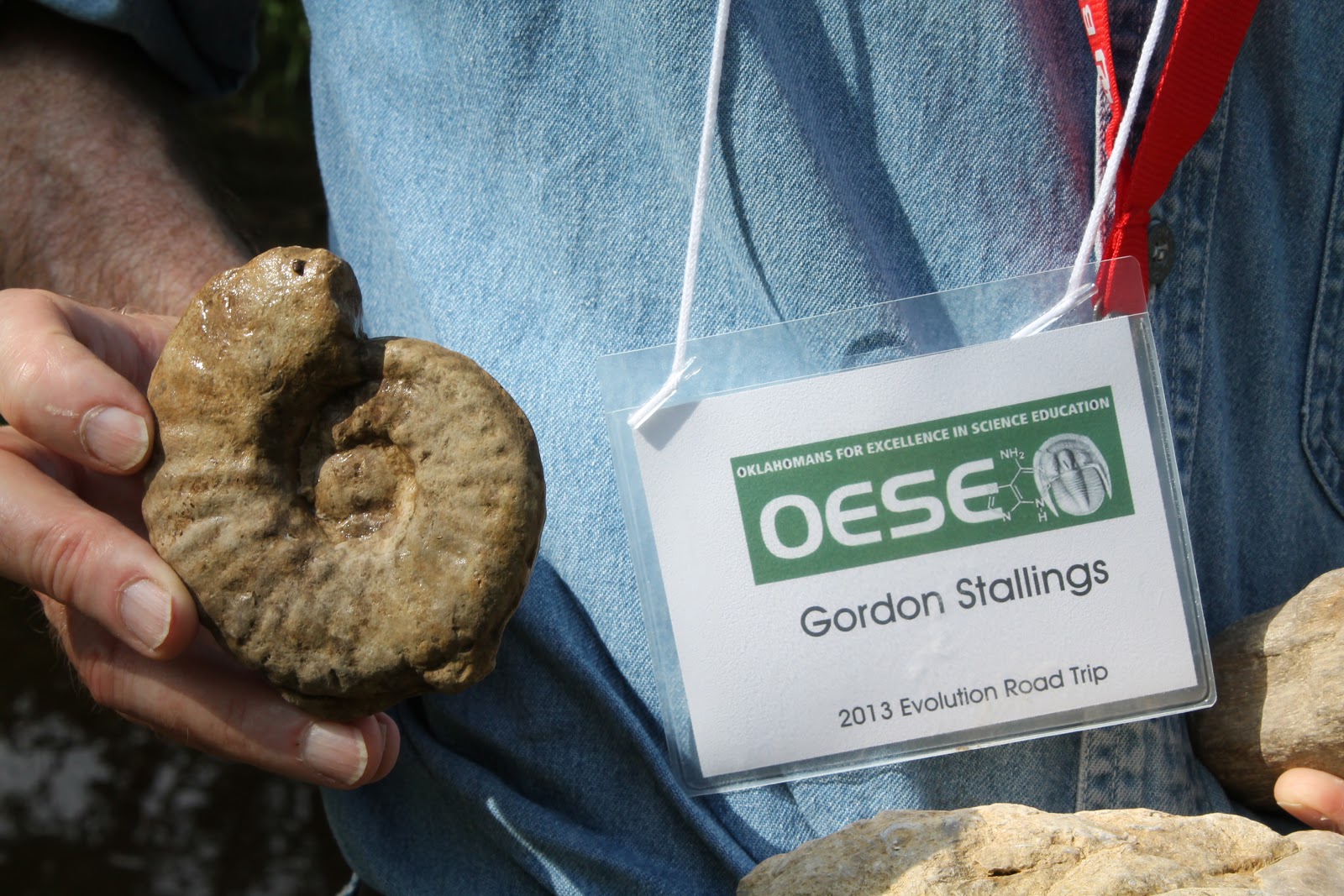
The Caddo limestone also contains fossils. Many fossils have eroded from this layer into a little stream that we visited on a slick muddy back road (Watkins Road south of State Route 199, which connects with Kinlock Road). Members of the Road Trip group scoured the stream bed and found dozens of interesting fossils, including mollusks and echinoderms. The mollusks included bivalves and casts of ammonites. The people in the photo are Sharon Young, Fran Stallings, Jim Huff, and Gordon Eggleton.


We also stopped at a paved low-water crossing that had been built over a natural low-water crossing formed from hard, fossiliferous Kiamichi limestone.

After supper back at the Station, we met to review the history of the Earth. Rather than to go over it here, I will direct your attention to the University of California Museum of Paleontology website, which summarizes what happened on Earth during each geological period. I would also refer you to my revised Encyclopedia of Evolution, but it is available only by subscription from Infobase Publishing, or will be someday maybe when they get around to it. My original encyclopedia is out of print, but you can probably find used copies. We also discussed how to teach this information to students so that they can appreciate it. The way not to do it is to give a lecture, the way I did. Instead, we can get the students to encounter Deep Time by having them walk along a sidewalk that represents the history of the Earth, in which multicellular life emerges only in the last few meters and in which a human life is as thin as a coat of paint. A useful link for teachers is here. We can also get students to think about the different lines of evidence that led to the conclusion that a giant asteroid hit the Earth 65 million years ago, causing the Cretaceous extinction. A good resource for this is the video The Day the Mesozoic Died by Sean Carroll, produced by Howard Hughes Medical Institute. The Permian extinction had an even greater impact on the Earth, even though it was probably caused by volcanoes rather than an asteroid. Less is known about it because it occurred 250 million years ago. A very readable account of the Permian extinction is the book by Michael Benton. An appreciation of Deep Time and the use of scientific thinking to figure out what happened in the past—there are endless possibilities here for teachers!

We listened to NOAA warnings about storms passing all around us, but by nightfall the storms had mostly calmed down. The next day we visited more fascinating geological sites, as described in the next blog entry.

Saturday, March 16, 2013

Evolution in Oklahoma, a Road Trip: First Announcement


I am pleased to announce that Oklahomans for Excellence in Science Education and the Oklahoma Academy of Sciences are sponsoring an evolution road trip in southern Oklahoma and northern Texas this summer. That is, so long as we get at least nine registrants. The dates are Thursday May 30 (my 56th birthday) to Sunday June 2. Our home base is the University of Oklahoma Biological Station on the shores of beautiful Lake Texoma. The cost will be $350 per person; for participants who want a single room, the cost is $400. You can’t beat that for a four-day weekend of outdoor science! The trip is open to anyone interested in science, regardless of background, but we particularly want to draw local pre-college science educators. If you are a schoolteacher and want to go on this trip, you can get professional development credit and (if we get enough participants or donations) a partial refund of the costs. Furthermore, if we have enough participants, we may be able to give partial refunds to everyone.

For reasons that I will explain in upcoming entries, I am pretty excited about this trip. I realize that many of my readers live far away from Oklahoma. But if you’ve never been here, you might be surprised. No, it doesn’t look like the flat dry set of a Rodgers and Hammerstein musical. It is a fascinating concatenation of ecology and geology (which is part of the reason that there is so much oil and gas here). Y’all come, y’hear?

The trip is designed especially for pre-college science instructors, although anyone with an interest in science is invited to participate. We expect to get together a group of people who will enjoy talking with one another and investigating some perhaps little-known highlights of southern Oklahoma and northern Texas—perhaps little-known even to people who live around here. I admit that, until Dr. Gordon Eggleton showed me around, I had no idea how many exciting bits of geological evidence there are in southern Oklahoma. There is a dramatic and hidden history underneath the Oklahoma dirt. Today, Oklahoma sits quietly in the middle of the North American plate. But a hundred million years ago, it was a pretty exciting place.

You can read all about it at the University of Oklahoma Biological Station website (http://www.ou.edu/uobs/evolution.html). The full brochure, with photos, is there, along with a registration form and instructions.

In upcoming blog entries, I will write about some of the things we will see on this trip. If you want to read about it how, visit the website above. If you cannot come but would like to make a donation to help defray the cost for participating schoolteachers, you can make a donation to the University of Oklahoma Foundation. Contact me at srice@se.edu if you are interested. You will be provided with a letter to acknowledge the tax-exempt status of your donation.