Showing posts with label Fort Washita. Show all posts

Saturday, May 30, 2015

Thirst for Conquest

May 28, 2015, was the 175th anniversary of the Indian Removal Act. On that day in 1830, President Andrew Jackson signed the bill that required the U. S. Army to evict southeastern Native tribes, including my Cherokee tribe, from their native lands and send them to Oklahoma. Many people think of this as a land grab; that is, the federal government wanted Native land and whatever resources (such as the Dahlonega gold mines) it might possess. That is, the motivation was primarily economic. However, as I will explain, this does not seem to be the case. I believe that the primary, if unrecognized, motivation was the thirst for conquest.

My first piece of evidence for this comes from the Indian Removal of the 1830s. The federal government had to spend a lot more money to send the Cherokees and other tribes on forced marches than they could possibly have recovered, especially since most of the land and its wealth went to the states, such as Georgia, rather than into federal coffers. The federal government had to expend army resources to drive the tribes westward, and had to provide Natives with food and shelter (both barely adequate, but still costly on the whole) during the journey. Then, when the Native tribes got to Indian Territory, the government had to maintain forts to protect the Cherokees and other relocated tribes from attacks by the tribes who originally lived in the region. Ft.Gibson, in northeastern Oklahoma, was built in 1824 but primarily served to protect the Cherokees after the Trail of Tears after 1839. Ft. Washita, Oklahoma, was built in 1842 for the express purpose of protecting Chickasaws and Choctaws from the indigenous tribes in southern Oklahoma.


So the federal government spent a lot of resources to move and then protect the southeastern tribes. It seems unlikely that the federal government came out economically ahead by this. Therefore the Indian Removal was not merely, to use a term from Steve Inskeep’snew book, a land grab.

My second piece of evidence to demonstrate that the federal government wanted to conquer Native tribes rather than to just get their land comes from the story of Chief Joseph of the Nez Perce tribe. The army had already taken his tribe’s land, and he and the remnant of his tribe was fleeing to Canada. When they were only forty miles from Canada, the federal army caught them in 1877 and sent them as prisoners to various reservation localities. If the only motive was to get their land, then the federal government would have let them flee U.S. territory. All the rest was unnecessary expense intended only to crush the Nez Perce.

In prehistoric times, the thirst for conquest may have been a profitable adaptation. When one tribe fought another, they did not merely desire the other tribe’s land or resources, but experienced a bloodlust, fully experiencing the other tribe as evil, feeling a desire to make the other tribe suffer before being slaughtered. That is, natural selection may have favored both the behaviors and the feelings of conquest and annihilation. The white American government did not just want Native American land, but wanted to drive Native Americans to extinction or at least to put them somewhere where they could be forgotten.

Another set of behaviors and feelings that may have been profitable to prehistoric humans is to depict the enemy tribe as not merely evil but powerfully evil—that is, to believe and feel that the enemy has supernatural force. A tribe that believes its enemies to be supernaturally evil will fight harder than a tribe that considers its enemies to be merely humans worthy of annihilation. Unfortunately, while the thirst for enemy annihilation is pretty much a thing of the past in America, the belief that one’s enemies are supernaturally powerful is not.

There are two recent examples of this.

  • In 2012, according to the Houston Chronicle, Lubbock County (Texas) judge Tom Head said regarding President Barack Obama, “He’s going to try to hand over the sovereignty of the United States to the (United Nations), and what is going to happen when that happens? I’m thinking the worst. Civil unrest, civil disobedience, civil war maybe. And we’re not just talking a few riots here and demonstrations, we’re talking Lexington, Concord, take up arms and get rid of the guy…Now what’s going to happen if we do that, if the public decides to do that? He’s going to send in U.N. troops. I don’t want ‘em in Lubbock County. OK. So I’m going to stand in front of their armored personnel carrier and say ‘you’re not coming in here’.”
  • In 2015, Texas governor Greg Abbott feared that President Obama was planning a military takeover of Texas. Not satisfied with words, Abbott ordered the Texas State Guard to monitor a U.S. Navy Seal training operation.


In both of these instances, the Texas officials accused President Obama of planning to do things that are very nearly physically impossible. By what possible set of causal factors could President Obama order United Nations troops into Texas? By what possible set of causal factors could President Obama bring about a military takeover of Texas? In both cases, the Texas officials seemed to be giving Obama a kind of infernal, supernatural power. To them, he is not merely a political opponent but the manifestation of spiritual evil. (Strangely enough, a little over a week later, Governor Abbott begged this same President Obama for federal assistance to recover from Texas flash floods.)


The tribes who had a desire to annihilate enemy tribes, and the desire to depict one’s enemies as supernaturally evil, prevailed in the prehistoric struggle for existence. We are their descendants. And their behaviors and feelings live on in us, as manifested in recent history and in current events.

Wednesday, June 5, 2013

Oklahoma-Texas Evolution Road Trip, Part One. The World of the Past


Ten participants and two instructors met for what might be the First Annual Oklahoma Evolution Road Trip at the University of Oklahoma Biological Station on the shores of beautiful Lake Texoma May 30-June 2, 2013.

As in almost all scientific meetings, the best part of the Oklahoma Evolution Road Trip 2013 was the participants getting to know one another and exchange ideas. I will write more about this later, but I wanted to begin with it. What a fine group of people, each with different insights to contribute! Get a group of people like this together, and good things are bound to happen! I hope I speak for everyone when I say that interacting with the participants was the most memorable thing about this trip. I want to thank all of the participants, who made every moment of work I put into planning and execution of this trip very, very worthwhile. Although I have led many long field trips (as an adjunct faculty member at the Wheaton College Science Station in the Black Hills during summers from 1993 to 2005), this was the first trip in which I had to organize everything. I believe I thought of and prepared for everything, but had I not, the strong network of camaraderie in the group would have made up for it. The meeting of minds in this trip is every professor’s, every teacher’s, and every trip leader’s dream. And, starting with this entry, it will be clear to every reader how important a part Dr. Gordon Eggleton, retired professor from my home institution (Southeastern Oklahoma State University), played in opening our eyes to the world of the past.

After we all met for the first of many good meals at noon on May 30, we had a brief introduction to geology, including how we know the age of the Earth and of fossil deposits. Gordon Eggleton showed us how layers of rock can be deformed into arch-shaped anticlines in which, when they are eroded, the oldest layers can end up at the top of a mountain and younger ones at the bottom. (Older layers above younger layers is one of the creationist arguments against an old Earth.) And this is exactly what happened in the Arbuckle Mountains, with Cambrian period rhyolite (the Colbert formation) at the very top, with Cretaceous period layers at the bottom. The Cambrian period began about 540 million years ago, long before the Cretaceous, which began about 120 million years ago.

We saw three Cretaceous layers of limestone in southern Oklahoma on Thursday May 30. The real bonanza was the Kiamichi limestone, which is full of fossils. It is between the younger Caddo limestone and the older Goodland limestone. We visited Ft. Washita, which was built in the early nineteenth century. The slabs from which Ft. Washita was built came from Kiamichi limestone, and there appeared to be more mollusk shells than matrix in them. It is possible that the Kiamichi limestone formed in shallow seas in which a vibrant food base of microscopic algae supported abundant mollusk populations. And almost all the mollusks were probably the same species, Texigryphaea navia. This book about the geology of Bryan County (named after William Jennings Bryan) (see Figure 10 on page 16) shows the layers of Bryan County rocks, with our three layers of limestone near the bottom of the series. The geological description of the Kiamichi limestone indicates that Texigryphaea is a major component of the rock itself. In the second photo, Carl Rutledge takes a close look at the fossil-crammed slabs.


Geological deposits are not jumbled as one might expect from a gigantic flood of Noah. Each contains only fossil species characteristic of the geological period, and even then not all of them. Terrestrial Cretaceous deposits, such as those in eastern Oklahoma, often contain dinosaur bones, but in south central Oklahoma the Cretaceous deposits are all from shallow seas.

Ft. Washita is also interesting for historical reasons. The fort was built in the nineteenth century to defend the Chickasaws and Choctaws, whom the U.S. government had forced from their ancestral homelands in the Southeast, into eastern Oklahoma, then called Indian Territory. The Chickasaws and Choctaws did not want to leave their homeland, which is why this forced migration is called the “Trail of Tears.” Nor did the Caddos and Comanches, who were already in Indian Territory, like the forced influx of other tribes. Another “Trail of Tears” was the forced migration of Cherokees to northeastern Indian Territory, a journey that my great-great-grandfather made. Ft. Gibson was built to protect the Cherokees. The Cherokee tribe sued the United States government for the right to remain in their homeland. The case went to the Supreme Court, under Chief Justice John Marshall, and the Cherokees won! But President Andrew Jackson said, “Let John Marshall enforce it.” Jackson defied the Supreme Court. Ft. Washita also served as a staging area for the Mexican-American War and the Gold Rush. The Union abandoned it to the Confederates before the Civil War. Many Confederate soldiers in Indian Territory were Native Americans. The last Confederate general to surrender was Stand Watie, a Cherokee, who held out as long as he could near Ft. Towson in far southeastern Oklahoma.

During the nineteenth century, the Ft. Washita region was mostly prairie, with scattered bois-d’arc (Maclura pomifera) and post oak (Quercus stellata) trees. We saw some gnarled old bois-d’arc trees that, for aught we knew to the contrary, dated back to those times. Twentieth century fire suppression has allowed trees such as elms that had previously been confined to river bottoms to spread over the hillsides. Many of the bois-d’arcs appeared to be several trees growing together. The bois-d’arc fruit has many seeds, and several trees could grow from a fruit lying on the ground. Back before the extinction of the large herbivorous mammals at the end of the most recent Ice Age, the seeds could be dispersed and scattered about from the intestines of the mammals. This is an excellent example of a “ghost of evolution,” in which an adaptation (in this case, bois-d’arc fruits) makes no sense because the co-evolutionary partner (the large mammal) is now extinct. You can read more in the book by Connie Barlow. Teachers may find Connie Barlow’s YouTube vid about the ghosts of evolution very thought-provoking and useful for students.

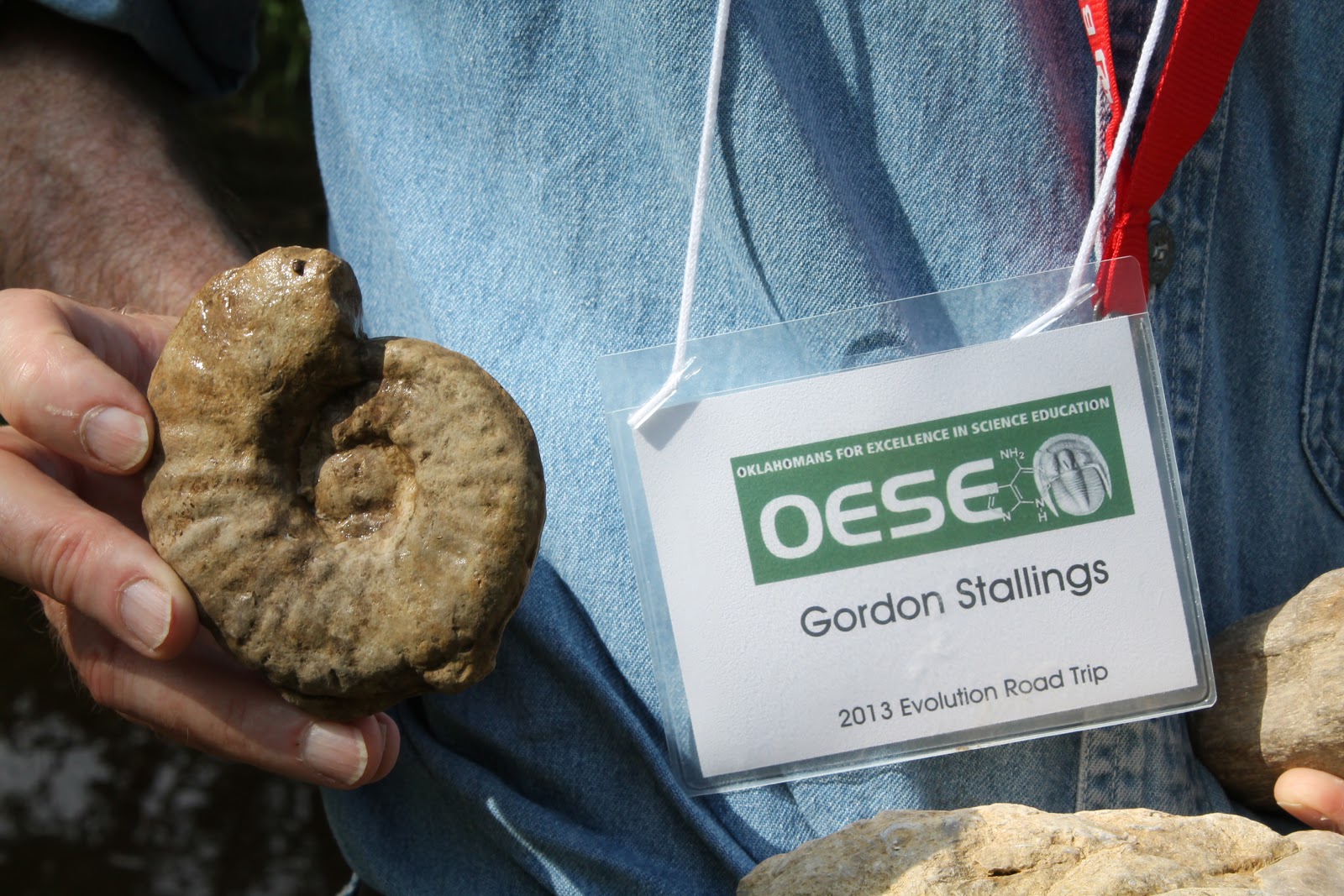
The Caddo limestone also contains fossils. Many fossils have eroded from this layer into a little stream that we visited on a slick muddy back road (Watkins Road south of State Route 199, which connects with Kinlock Road). Members of the Road Trip group scoured the stream bed and found dozens of interesting fossils, including mollusks and echinoderms. The mollusks included bivalves and casts of ammonites. The people in the photo are Sharon Young, Fran Stallings, Jim Huff, and Gordon Eggleton.


We also stopped at a paved low-water crossing that had been built over a natural low-water crossing formed from hard, fossiliferous Kiamichi limestone.

After supper back at the Station, we met to review the history of the Earth. Rather than to go over it here, I will direct your attention to the University of California Museum of Paleontology website, which summarizes what happened on Earth during each geological period. I would also refer you to my revised Encyclopedia of Evolution, but it is available only by subscription from Infobase Publishing, or will be someday maybe when they get around to it. My original encyclopedia is out of print, but you can probably find used copies. We also discussed how to teach this information to students so that they can appreciate it. The way not to do it is to give a lecture, the way I did. Instead, we can get the students to encounter Deep Time by having them walk along a sidewalk that represents the history of the Earth, in which multicellular life emerges only in the last few meters and in which a human life is as thin as a coat of paint. A useful link for teachers is here. We can also get students to think about the different lines of evidence that led to the conclusion that a giant asteroid hit the Earth 65 million years ago, causing the Cretaceous extinction. A good resource for this is the video The Day the Mesozoic Died by Sean Carroll, produced by Howard Hughes Medical Institute. The Permian extinction had an even greater impact on the Earth, even though it was probably caused by volcanoes rather than an asteroid. Less is known about it because it occurred 250 million years ago. A very readable account of the Permian extinction is the book by Michael Benton. An appreciation of Deep Time and the use of scientific thinking to figure out what happened in the past—there are endless possibilities here for teachers!

We listened to NOAA warnings about storms passing all around us, but by nightfall the storms had mostly calmed down. The next day we visited more fascinating geological sites, as described in the next blog entry.

Monday, April 29, 2013

Evolution in Oklahoma, a Road Trip: Piles and Piles of Fossils


Don’t forget the Oklahoma Evolution Road Trip, May 30-June 2. We have enough registrants that the trip is unlikely to be canceled, but there is still room! Tentative deadline is May 3, but we can accept a few more applications after that date. We just need to plan ahead about how many rooms and vehicles, and how much food, to provide. Read more about it here as well as in blog entries posted earlier (below).

One of the places we will be visiting, in our search for fossils, is Fort Washita, near Durant, Oklahoma. It is a site of great historical interest. It was built by the U.S. Army to defend the Chickasaw tribe against western tribes, whose land had been taken in order to resettle the Chickasaws from their ancestral homeland that the U.S. had confiscated. Then, in the Civil War, Ft. Washita became a Confederate fort. History and politics back then was a big mess, just as it is today, only there was a war going on right here on our American soil.

Ft. Washita was located on a hill because it allowed visibility across the prairie in order to observe the approach of understandably hostile tribes, or (later) Union soldiers. Today, most of the surrounding landscape is forested, but when the fort was built it was mostly prairie, with some scattered post oaks and bois-d’arcs. It is possible that some of the very large post oaks and bois-d’arcs that are today on fort property were alive when the fort was active. Each bois-d’arc tree appears to be several trees that have grown together. This probably occurred because the animals that originally dispersed the large fruits (e.g. mammoths and gomphotheres) have been extinct for thousands of years. The mammoths would have spread the seeds out in their dung, but since the mammoths were extinct the fruits simply landed on the ground and all the seeds began to grow in a clump.


But the main topic of interest is something that very few visitors notice when they come to the fort. I am embarrassed to admit that I did not take notice of it until recently. Most of the original buildings are made from rocks quarried from an extremely fossiliferous layer. Some of the stones appear to consist almost entirely of mollusk fossils. We’ve all seen fossils, but perhaps nothing quite like this.


So join us for the Road Trip if you can!