Showing posts with label oak. Show all posts

Thursday, September 18, 2014

My Fun Evolution Trip Part Ten: The Most Amazing Plant Fossils in the World, part two.

The leaf fossils that I saw at Fossil Bowl (see previous essay) came from a 15-year-old Miocene forest that dominated what is now northern Idaho. These forests closely resembled the rich forests of deciduous and evergreen trees that now characterize parts of China and, to a lesser extent, the eastern US. They were almost totally unlike the modern forests of northern Idaho, which are dominated by conifers such as Douglas fir.

Here are just a few of the fossil leaves that I found. I have used William Rember’s online gallery for identification. My identifications are tentative for several reasons. One is that I might have found some leaves previously undiscovered in this location. Another is that some crucial diagnostic features, such as leaf bases and margins and overall shapes, might be missing. I offer these images for others to help identify.

Bald cypress: Today, Taxodium is found only in swampy areas of North America and Mexico.


Greenbriar: today Smilax is common in much of eastern North America and in Asia.


Beech: This leaf appears to be a false beech Pseudofagus idahoensis; a small poplar leaf (Populus) is in the upper left.


Sycamore: This fossil appears to be Platanus dissecta.
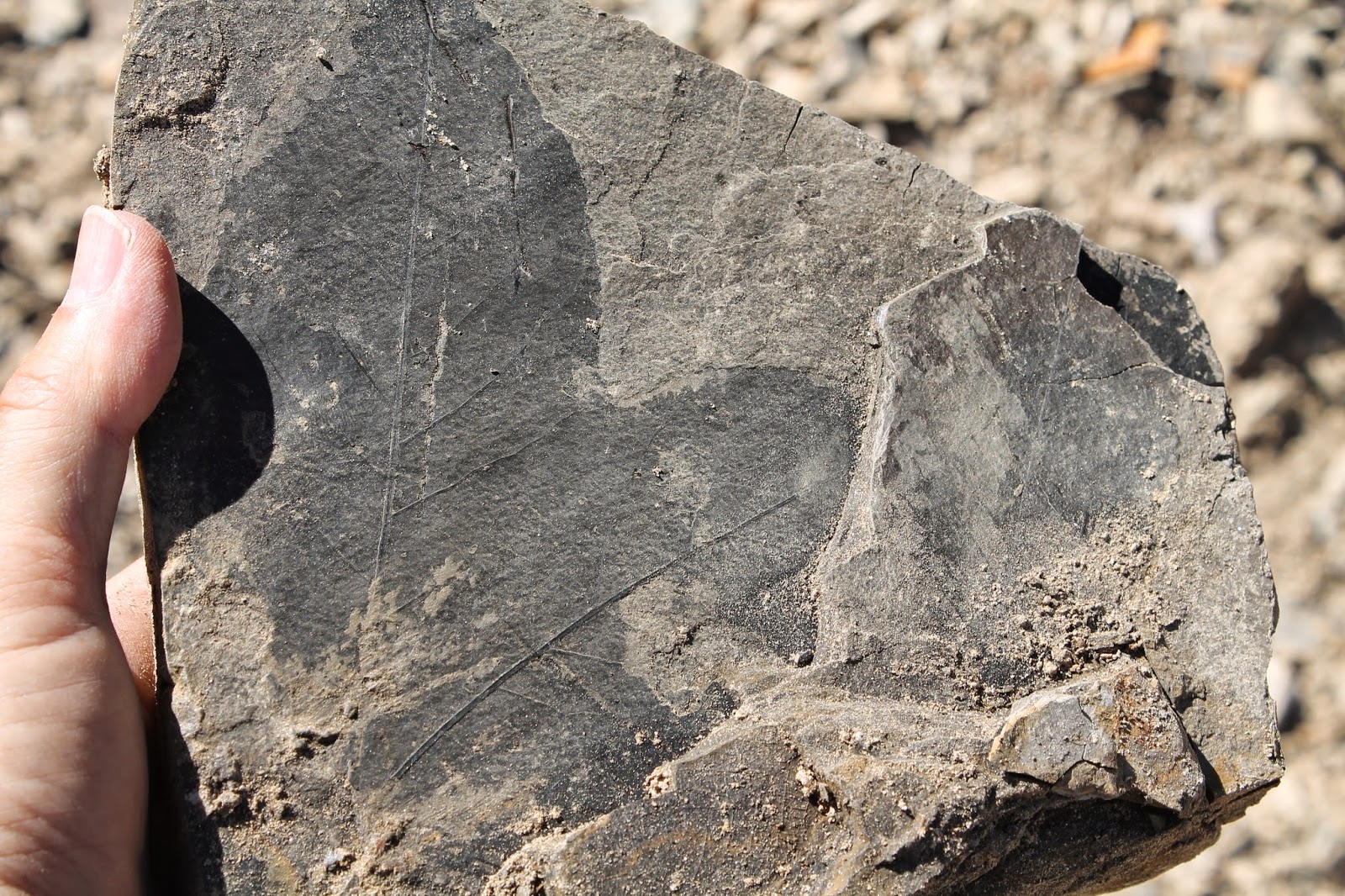


This specimen looks like a red oak (Quercus), perhaps Q. payettensis.


In this image, I believe I recognize a birch (Betula vera) in the lower right, though birch leaves have smaller teeth.


This image reminds me of a mulberry (Morus), which has not been reported from these deposits. Its lobes but not its margins resemble sycamore. The closest match I can find in reported records is a sweetgum, Liquidambar pachyphyllum. In the layer immediately underneath it is a Pseudofagus leaf.


Anyone have a guess about these?


These fossils also tell us an ecological story. First, this was a very diverse forest, with many tree species, resembling forests found today in China and in the southeastern United States. Second, we can say it was predominantly a beech forest, because Pseudofagus was the most common leaf fossil.

And there are some evolutionary themes we can learn from these fossils. First, these leaves fell (over the course of many years, producing many layers) in a forest very different from anything known in the Pacific Northwest today. The climate 15 million years ago was warmer and wetter, which allowed trees to grow that today survive only much further south in Asia and North America where there is more rainfall. The principal reason for this is that, 15 million years ago, the Cascades had not yet formed a rain shadow. The “temperate rainforests” of the Pacific slope more closely resemble the Miocene forests than do the forests of Idaho today. However, even the rich, moist Pacific slope forests of today there are few broadleaf trees, mostly bigleaf maple and tanbark oak. Fossil Bowl preserves a lost forest.

Creationists have an impossible time explaining how a Flood could have collected just these kinds of leaves—bald cypress, sycamore, alder, avocado, elm, etc.—and no others. But some creationists doubtless claim that this is a post-Flood deposit which formed just in the last 4000 years since Noah stepped out of the Ark. But this explanation is no better. Somehow floating rafts of vegetation had to bring just these kinds of plants to what is now Idaho, where they grew into a forest, and then—after the Flood—volcanoes arose and created the rain shadow that now exists. All this in 4000 years. The volcanoes would have to rise pretty fast, faster than they are now. Maybe God speeded things like this up after the Flood. But the Bible does not say this; creationists would have to just make it up.


The thing that is perhaps most interesting to us, and difficult for creationists to explain, is how such a forest is just a little different from those found in southeastern North America and in Asia today. The modern forests have the same genera but not the same species. Even the studies of DNA from chloroplasts of the preserved leaves show that there has been just a little bit of genetic change over the last 15 million years. Modern species of sycamores, for example, do not have leaves like the one in the photo above; modern sycamore species would have evolved just in the last 4000 years at a pace far more rapid than any evolutionary scientist would accept.

Wednesday, March 20, 2013

We All Love Stories, Even about Oaks


If you came to this blog seeking more information about the summer evolution road trip, it can be found in the previous entry, and more information will be available in upcoming days.

You could almost define Homo sapiens as the species that loves stories. We evolved that ability around African stone age campfires, where the ability to tell and to understand stories conferred social advantages. We interpret our lives as stories; we could not imagine ourselves as eternal beings. And in science, we love stories also. Stories about how the digestive system works. (The epitome of this approach was the book, published about eighty years ago, entitled Through the Alimentary Canal with Gun and Camera. And apparently Mary Roach, author of Bonk and Stiff, is coming out with a new contribution to the literature of alimentary expeditioning, Gulp.) Stories about how ecosystems work. And stories about evolution. We are (well, most of us) much more interested in the stories of evolution than in the theory. We have to be careful to not read too much into the stories. It is all too easy to think of Tiktaalik crawling out of the water toward life on land, as if he were Odysseus trying to get home to Ithaca after the Trojan War. At least, we have to be careful to keep that kind of thinking out of our science; but it remains part of our folklore.

I sometimes like to imagine the saga of the oaks. Somewhere in Eurasia, maybe 80 million years ago, there was a population of trees that produced acorns: the first population of oaks (genus Quercus). What was the secret of their success? Was it the acorns, or was it something else? These early oaks may have resembled the white oaks (section Quercus), which have spineless leaves and acorns that mature the same year that they are produced, for these oaks are found throughout the Northern Hemisphere.

Then geological and climatic changes occurred throughout the Northern Hemisphere. The Atlantic Ocean formed, and the Rocky Mountains arose, and the arctic climate got colder. This separated the oaks of Europe, Asia, California, and eastern North America from one another. Unique oak species evolved in each of these locations and in others. In some cases, this produced new species of white oaks, such as Q. aliena in eastern Asia; Q. robur in Europe; Q. macrocarpa (the bur oak) in eastern North America; and Q. douglasii in California. In other cases, isolation resulted in whole new sections of the genus. For example, the black and red oaks (section Lobatae) have spines on their leaves and their acorns mature the year after they are produced. They apparently evolved in North America, but then diverged into different species such as Q. rubra (red oak) in eastern North America and Q. kelloggii in California. The ring-cupped oaks (section Cyclobalanopsis) evolved and diversified in Asia. Sections Mesobalanus and Cerris evolved and diversified in Asia and Europe, and section Protobalanus in western North America. What was the story here? Did the divergence between white and black oaks have anything to do with the spines or lack of spines on their leaves? Or with how long it took their acorns to mature? We might never know. In some cases, oak species ended up isolated in unusual places, such as Q. copeyensis in Panama.

Climate changes were also important. The Sierra Nevada and the Rocky Mountains not only separated eastern and western oak populations in North America, but also created rain shadows; the resulting deserts further isolated the oak species. In dry regions (of which there were almost none until about 30 million years ago), many oaks evolved into evergreens, keeping their leaves over the winter. In many places, some of the oaks are evergreen and some are deciduous. All the oaks in eastern North America are deciduous except Q. virginiana (the live oak), and in California they are all evergreen except Q. kelloggii.

The oaks represent just one of many thousands of evolutionary stories: of genealogy, of migration, of response to adversity (such as changing climates). Just as Samuel Butler wrote The Way of All Flesh in the nineteenth century about five generations of the Pontifex family, an oak expert could write The Way of All Leaf.

Pick any group of trees, whether walnuts or sycamores; or any group of wildflowers, such as the phlox; or any group of animals; or any other group of organisms. Each has an evolutionary story, indeed an evolutionary saga.
