Showing posts with label Fossil Bowl. Show all posts
Showing posts with label Fossil Bowl. Show all posts
Friday, October 10, 2014
Videos about plant fossils
I just posted three videos about Fossil Bowl, the most amazing plant fossil site in the world, in Idaho.
Also, an update for the entry about Oklahoma earthquakes: This morning there was a 4.3 earthquake near Cushing, Oklahoma, where I was born.


Thursday, September 18, 2014
My Fun Evolution Trip Part Ten: The Most Amazing Plant Fossils in the World, part two.
The
leaf fossils that I saw at Fossil Bowl (see previous essay) came from a
15-year-old Miocene forest that dominated what is now northern Idaho. These
forests closely resembled the rich forests of deciduous and evergreen trees
that now characterize parts of China and, to a lesser extent, the eastern US.
They were almost totally unlike the modern forests of northern Idaho, which are
dominated by conifers such as Douglas fir.
Here
are just a few of the fossil leaves that I found. I have used William Rember’s
online gallery for identification.
My identifications are tentative for several reasons. One is that I might have
found some leaves previously undiscovered in this location. Another is that
some crucial diagnostic features, such as leaf bases and margins and overall
shapes, might be missing. I offer these images for others to help identify.
Bald
cypress: Today, Taxodium is found
only in swampy areas of North America and Mexico.

Greenbriar:
today Smilax is common in much of
eastern North America and in Asia.

Beech:
This leaf appears to be a false beech Pseudofagus
idahoensis; a small poplar leaf (Populus)
is in the upper left.

Sycamore:
This fossil appears to be Platanus dissecta.
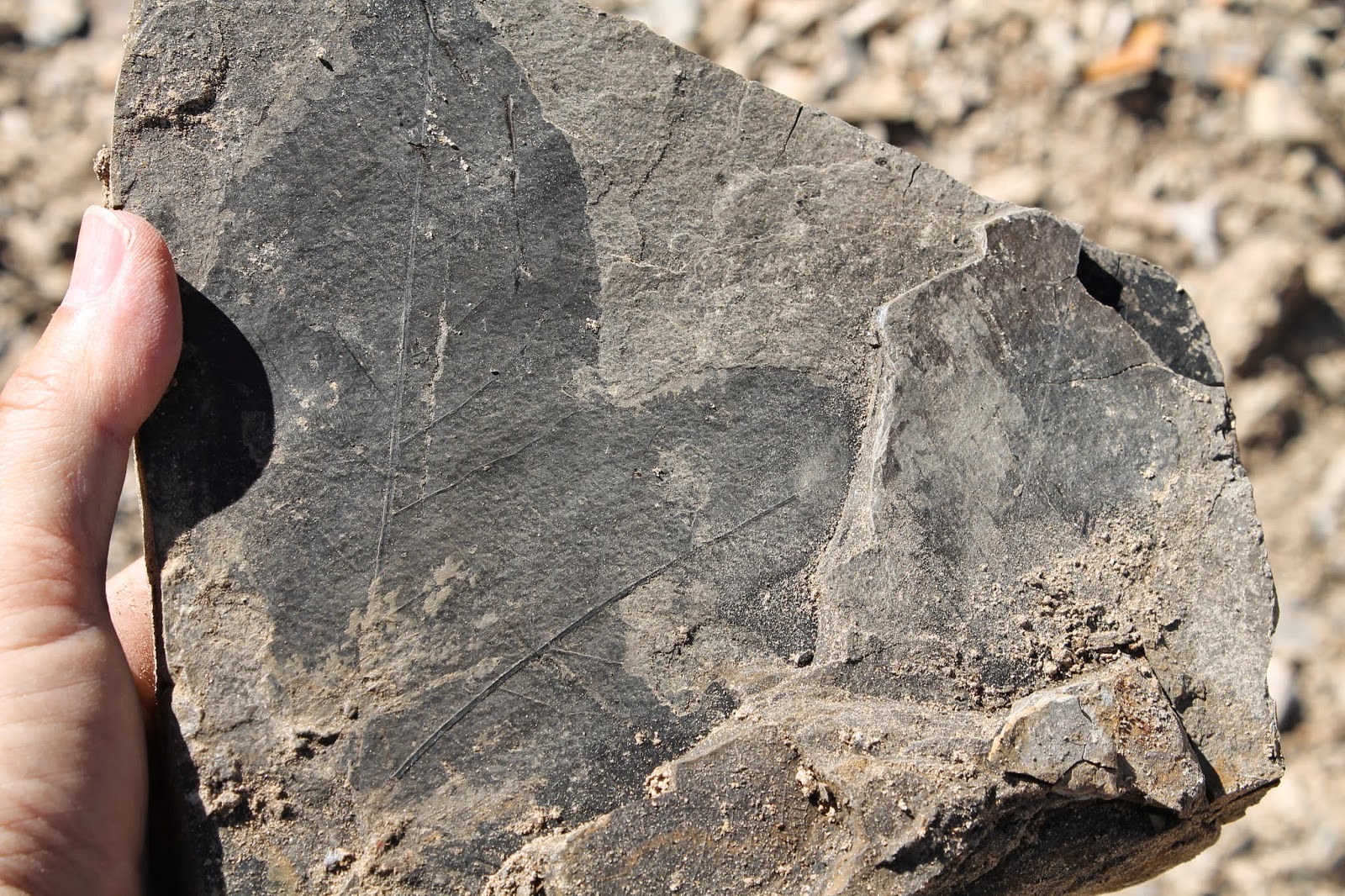
This
specimen looks like a red oak (Quercus),
perhaps Q. payettensis.

In
this image, I believe I recognize a birch (Betula
vera) in the lower right, though birch leaves have smaller teeth.

This
image reminds me of a mulberry (Morus),
which has not been reported from these deposits. Its lobes but not its margins
resemble sycamore. The closest match I can find in reported records is a
sweetgum, Liquidambar pachyphyllum.
In the layer immediately underneath it is a Pseudofagus
leaf.

Anyone
have a guess about these?


These
fossils also tell us an ecological story. First, this was a very diverse
forest, with many tree species, resembling forests found today in China and in
the southeastern United States. Second, we can say it was predominantly a beech
forest, because Pseudofagus was the
most common leaf fossil.
And
there are some evolutionary themes we can learn from these fossils. First,
these leaves fell (over the course of many years, producing many layers) in a
forest very different from anything known in the Pacific Northwest today. The
climate 15 million years ago was warmer and wetter, which allowed trees to grow
that today survive only much further south in Asia and North America where
there is more rainfall. The principal reason for this is that, 15 million years
ago, the Cascades had not yet formed a rain shadow. The “temperate rainforests”
of the Pacific slope more closely resemble the Miocene forests than do the
forests of Idaho today. However, even the rich, moist Pacific slope forests of today
there are few broadleaf trees, mostly bigleaf maple and tanbark oak. Fossil
Bowl preserves a lost forest.
Creationists
have an impossible time explaining how a Flood could have collected just these
kinds of leaves—bald cypress, sycamore, alder, avocado, elm, etc.—and no
others. But some creationists doubtless claim that this is a post-Flood deposit
which formed just in the last 4000 years since Noah stepped out of the Ark. But
this explanation is no better. Somehow floating rafts of vegetation had to
bring just these kinds of plants to what is now Idaho, where they grew into a
forest, and then—after the Flood—volcanoes arose and created the rain shadow
that now exists. All this in 4000 years. The volcanoes would have to rise
pretty fast, faster than they are now. Maybe God speeded things like this up
after the Flood. But the Bible does not say this; creationists would have to
just make it up.
The
thing that is perhaps most interesting to us, and difficult for creationists to
explain, is how such a forest is just a
little different from those found in southeastern North America and in Asia
today. The modern forests have the same
genera but not the same species. Even the studies of DNA from chloroplasts
of the preserved leaves show that
there has been just a little bit of genetic change over the last 15 million
years. Modern species of sycamores, for example, do not have leaves like the
one in the photo above; modern sycamore species would have evolved just in the
last 4000 years at a pace far more rapid than any evolutionary scientist would
accept.
Monday, September 15, 2014
My Fun Evolution Trip Part Nine: The Most Amazing Plant Fossils in the World, part one.
Ever
since I read about the Idaho Miocene fossil beds, at a place called Fossil
Bowl, decades ago in an essay by Stephen Jay Gould, I have wanted to visit
them. This past summer I finally had the chance. I drove south of Coeur d’Alene
in State Highway 3 for about fifty miles and drove through the little town of
Clarkia, which has no services and which you could almost drive past without
noticing. On the right (west) side of the road was a big open area that had
been converted into a motocross track. Unless you have specific directions or
just happen to see the hand-painted plywood sign set far back from the road,
you will never recognize this as being a famous fossil deposit.
I
drove in and looked for a sign telling me where to go. Because I had called the
Kienbaum family (the owners) before coming, I knew to look for a house on the
hill. So I started driving up what I thought was the driveway and found myself
on the motocross track. I didn’t see it coming. Suddenly I was going up a steep
slope and then my car (a little Scion) launched off into invisible space and
came thumping down on the track. It didn’t make it up the next incline.
Fortunately I found a way to exit the track. I found a van of young adult
bikers who were taking an air conditioning break, and who had been immensely
entertained by the sight of a little car on a motocross track, and they told me
how to find the driveway. I had to knock on every door of the house with
unfinished siding before Mrs. Kienbaum could tell me to look for her husband
and sons in one of the many workshop buildings downhill. The younger son found
me and led me through a crowded storehouse full of wooden furniture that Mr. Kenneth
Kienbaum had made. I paid ten dollars for the privilege of digging fossils and
taking them with me, perhaps the best ten dollars I ever spent. Kenneth told me
of the interest that even major media such as PBS were showing in this site. I
will be posting some YouTube videos [my channel] of my visit and will announce
when I do. I make videos with no budget. If you want to see a video about
Fossil Bowl that was actually produced with a budget, using support from
Bucknell University, the University of Idaho, and the Botanical Society of
America, see Plants Are Cool Too! Episode 2 produced by the very creative Dr. Chris Martine.
The
younger Kienbaum son led me to a place I could park right beside the fossil
deposit. You would never guess what it was. The outcrop is about the size of a
three-car garage.

I
set to work digging and photographing fossil leaves. (Others have found fossil
fishes, but I did not. Leaves are always more abundant than fishes.) I found
many good specimens that had already been excavated and were just lying around
on the ground. One of my best specimens was one I found by stepping on it. I
will provide some details and photos of these specimens in the next essay.
How
did these fossils form? Fifteen million years ago, during the Miocene epoch,
leaves of a lush forest fell into a lake and were preserved in sediments.
Oxygen destroys organic matter, but the water and sediments kept these leaves
away from oxygen. In fact, some of the leaves are not leaf fossils, but are
actually still leaves, complete with tissue and DNA. I believe that these
leaves have provided the oldest DNA specimens ever found, far older than the
30,000-year-old Neanderthal DNA in Europe. The organic molecules from the
70-million-year-old T. rex fossils were collagen, the protein that makes up
cartilage, not DNA.
Once
exposed to oxygen, these leaves quickly turn black. They are still beautiful
fossils, but the organic matter is reduced to a residue. So to find “fresh”
leaves, you have to split intact rocks open, which the older son, Riley
Kienbaum, showed me how to do.

The
leaves, mostly autumn deciduous leaves, are separated by layers of sediments.
The leaves form a slightly weaker layer in the rock, so that you can carefully
split open the rock and expose the leaves. Riley did this for me and I saw some
leaves that still had the same red autumn colors that they had 15 million years
ago!

I
brought back some slabs of rock, which I kept moist, and which I split open in
my laboratory and showed to my students. Unfortunately, in my specimens, the
rocks layers crumbled and I was unable to recover any fresh-looking leaves.
How
do we know the ages of these leaves? Radiometric dating provides the answer.
Radiometric dating can be performed only on volcanic material. But 15 million
years ago the Cascades were just rising up as a series of volcanoes, many of
which remain active today. The volcanic dust layers interspersed with the
leaves and sediments can be dated.
Meanwhile,
motorcyclists did some amazing maneuvers just a few feet away from where I was
digging. Some of them came over to see what I had found. They were genuinely
interested in the fossils and were some of the nicest people I have met
Before
planning your trip, it is good to contact the owners and make sure access is
open when you plan to visit. They are really very
nice people.
In
the next essay, I will tell you about the fossils I found.
Subscribe to:
Posts (Atom)