Showing posts with label herbivore. Show all posts

Friday, June 2, 2023

Evolutionary Mysteries 2: Why Some Young Leaves Are Red

This week’s evolution video is about why some young leaves are red. You may have noticed that the unfolding leaves on plants as diverse as redbuds and blackjack oaks are reddish—in some cases, as with the blackjack, a brilliant scarlet. This is not true of all plants, but true of enough of them to invite an evolutionary answer.

The leading contender for an explanation is that young leaves are pretending to be dead. A young leaf has its whole life before it. Its entire contribution to the growth of the plant can be threatened by a herbivore eating it. When a herbivore eats an older leaf, however, the plant has less to lose in terms of future growth. The reddish color of a young leaf is a camouflage that makes a healthy young leaf look dead, thus diverting herbivores to the older leaves. This becomes more believable when you consider that many insects would not distinguish between red and brown, the color of plant death. The red color is caused by anthocyanins. They will reduce the amount of sunlight that gets to the chloroplasts, but by the time the leaf is fully grown and ready to produce food, the anthocyanins fade.

While this explanation is the most likely, it is not the only possibility. It could be that the young leaf is vulnerable to harmful ultraviolet radiation, which can cause damage but is outside the range of photosynthetically useful light. The red color, therefore, might be protection from ultraviolet damage.

And there is no reason why both answers could not be true at the same time.

To prove which of these explanations, or any other, might be true would be difficult. It might require breeding plants that produce more or less anthocyanin: young leaves without it, older leaves with it. Actually, some horticultural variants (such as red-leaved redbud trees) have adult leaves that are red (and green at the same time, resulting in a purplish color). Do these reddish adult leaves have less herbivore damage than green leaves? I do not know, but it is possible. Another way would be to compare herbivore damage in red vs. green patches on the same leaf; one study demonstrated that herbivores avoided the red areas ofvariegated leaves.

Keep your eyes open and there are mysteries of nature all around you that cry out for an evolutionary explanation.

Saturday, October 29, 2022

I Thought I Knew Everything about Abutilon

I thought I knew everything about the velvetleaf plant, Abutilon theophrasti. I even wrote part of my doctoral thesis about it. But I was wrong. During the 42 years since I began working on this species, I knew no more about it than a farmer knows about corn.

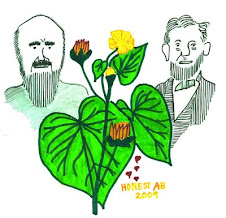
Oh, I knew the basic things. Abutilon is perhaps the most abundant weed in the soybean fields of the American Midwest. It raises its large, heart-shaped leaves bravely above the soybean canopy. As a member of the plant family Malvaceae, its flowers have many stamens united into a phalanx by their filaments. Unlike the better-known hibiscus, okra, and cotton, the velvetleaf flowers have small yellow petals. It produces button-shaped fruits, which are round clusters of multi-seeded capsules that look like a giant asterisk. The green fruits turn grayish when mature. The heart-shaped seeds drop out into the soil, where they may remain dormant but alive for many decades. Like most weeds, they grow in places where the soil has been disturbed, such as a current or recently abandoned farm field. It is the emblem I used for this blog.

I also knew enough about it to admire its grim efficiency. The stems and leaves are covered with soft hairs—hence the names velvetleaf, velvet plant, and velvetweed—but these hairs are sticky and, to many of us, irritating. This is probably one reason why it is the rare herbivore that eats its leaves.

Of greatest interest to me was its tremendous photosynthetic capability and its flexibility. Its large leaves absorbed carbon dioxide (which I measured) and made sugar at a rapid rate, translocating it to all parts of the plant. The feeling I still carry for this plant is that it was pumped full of water, pushing out new stems, leaves, and roots, and full of food to nourish them. Down in the shade, it would lose less water into the air, so it grew fewer roots. With less light down in the shade, velvetleaf plants produce thinner leaves, but provides just as much chlorophyll, with the result that the leaves look the same from the outside but have twice as much chlorophyll per unit weight as do leaves that grow in the sun. In the sun, the plant grows short, thick stems; in the shade, it grows long skinny stems that are more likely to thrust the leaves above any surrounding plants. You can read all about its photosynthetic and phenotypic flexibility in the first two chapters of the plain-English version of my thesis.

Abutilon is also one of the most important weeds to evolve herbicide resistance. Due to the enhanced production of a protective enzyme, some mutant plants will not die even when you spray them. There is a cost to this resistance. The mutant plants produce six times as much of the protective enzyme, a cost that they would not bear if herbicides were not used. But since farmers collectively spend billions of dollars to spray for velvetleaf, this cost is an investment that pays off spectacularly, especially in fields of herbicide-resistant genetically engineered soybeans. The mutant weeds grow more slowly than the normal weeds, but they are the ones that survive.

I even knew a little bit about its human history. I knew it had more common names than practically any other plant. Besides velvetleaf, it is also known as buttonweed and crown weed because of its asterisk-like fruits. It is also called stampweed, butterprint, and pie-marker because settlers used the immature green fruits to stamp decorations into piecrusts or pads of butter for commercial sale. It is called Indian mallow because, although it originated in China, somebody thought it came from India.

It is also called pigpenweed because it is the only major Midwestern weed that pigs will not eat. I confirmed this experimentally, though not with adequate replication. Our friend Joe lived on a farm that had a pigpen. The earth was beaten down and no plants remained in their fragrant space. When I threw in a little bit of lamb’s-quarters (Chenopodium album), a weed related to spinach, the pigs would scramble to eat it. The same with pigweed (Amaranthus retroflexus) and smartweed (Polygonum pensylvanicum, now Persicaria pensylvanica). As a control, I threw some Abutilon into the pigpen. The pigs did not approach it.

Velvetleaf cannot grow in the hot, dry summers of Oklahoma. But I have found it in Oklahoma, growing in soil along the margins of drainage creeks connected to the Arkansas River. Apparently, the seeds, floating in the water of major rivers, drift up into the creeks when the water rises. In Tulsa, they have formed a medium-sized, viable reproductive population.

But it turns out there were a lot of things I did not know until just recently. One of its common names (Chinese jute) should have given it away. (That makes eleven common English names for the same plant.) Until the twentieth century, it was raised both in Asia and in the American Midwest as a row crop for its fibers. During that time, so many seeds fell into the soil that the farmland, now used for soybeans, was infested with the weeds. I had assumed that the invasion of Abutilon into the Midwest came from plants that escaped from gardens of cottage butter-makers. That would not, of course, explain its incredible abundance, especially since the seeds do not travel very far from one place to another unless carried in soil or turf.

Most amazing of all, Abutilon is edible. “The leaves are edible stir-fried or in an omelet,” says Wikipedia and several websites that have copied it. Since its hairs are irritating, its leaves must be cooked, but the leaves are particularly popular in the cuisine of the Maldives islands, mixed with fish and coconut. The seeds are eaten in Kashmir and China, including as a component of bread. I tried to convince my wife, who makes wonderful and creative types of bread, to try it, but she was not interested.

All a farmer knows about corn is that if you plant it at the right time and the right distance apart from other corn seedlings, it will grow very large and produce big ears with lots of seeds. All I knew about velvetleaf was its tremendous growth rate and flexibility. I cannot estimate how many velvetleaf plants I killed, cutting and putting the fine roots, taproots, stems, and leaf blades into separate little paper sacks, to dry and weigh them. Velvetleaf was more like a photosynthetic machine to me than a real, living organism. Only much later have I stepped away to admire it for its amazing characteristics.

Friday, October 22, 2021

The Deadly Tomato


As I walked through the weeds between the early-successional trees in the field about which I earlier wrote, I noticed a Solanum dimidiatum weed (horsenettle). It was in the same genus as the potato, a close relative of the tomato. And it had what looked like little green tomatoes on it. This is the time of year when tomatoes are really good. But if you think these tomatoes might be delicious, think again. The entire plant is filled with toxins that are dangerous, even deadly, to most animals.


[Photo from Carolina Biological Supply Company] 

The horsenettle plant expends a lot of its energy creating these toxic compounds [what are they]. Expensive they may be, but they protect the plant from having its leaves eaten by most animals. But there is at least one group of animals that can eat the leaves as if they are not toxic at all. The sphinx moth (Sphingidae) caterpillars (hornworms) of the genus Manduca can eat them with little effect on their growth. I know this because I have measured the growth of hornworms when they ate ground-up horsenettle leaves and when they did not; their growth was the same. The toxins do not protect the horsenettles from hornworms, but in many cases, there are no hornworms about. The plant is taking a chance. It invests in imperfect, but usually good, protection.

You may wonder how to compare hornworms that eat horsenettle tissue and those that do not. To what do you compare the ones that do? This is an interesting story. You can purchase little hornworms, special vials to grow them in, and hornworm chow. They do not naturally eat this chow, but if you start them on it when very young, they will eat it and grow grossly big. It is sort of hornworm junk food. The control worms are the ones that eat only the chow; the experimental worms have horsenettle tissue mixed in with the chow.

Herbivores, and the defenses of plants against them, are a constantly moving evolutionary target. They hardly ever get it right, but they come close enough that there are lots of plants, and lots of herbivores, in the world. Any plant that invested too much in defense would grow slowly and die; but if it invested too little, it would disappear down the gullets of extinction. There is a balance of nature, but it is imperfect and shifting.

Saturday, April 17, 2021

New Video: Darwin Eats Tree Leaves

In this video, Darwin jumps around in springtime exuberance and eats leaves of a water oak (Quercus nigra). He was inspired to do this by seeing a French video in which a naturalist ran around in the French woodlands and ate young leaves. He smiled really big and talked about how good they were, including oaks, willows, poplars, beeches, etc.

But the French videographer warned his viewers that they should do this only with very young leaves. Older leaves in European forests are full of toxic compounds which, although they will not kill you, at least taste bad. The leaves manufacture these compounds (for example tannins) to discourage animals, especially caterpillars, from eating them.

But it can be expensive for a leaf to defend itself. Every molecule of defensive chemical that the leaf makes has a construction cost in energy and raw materials. These costs could be used to make more leaf area, which is an investment in photosynthesis that will bring in more energy and raw materials. The ideal amount of defense spending for a leaf (or a nation) is zero, but this is not possible in a dangerous world. Therefore, leaves, like nations, economize their defense spending. Leaves make defensive chemicals only when they are needed.

Ever since the work of Paul Feeney fifty years ago, scientists have understood that, in European forests, many herbivorous insects die during the cold winters. Their populations build back up during the warm, wet summers. The forest trees, such as the oaks studied by Feeney, economize their defense spending by producing very few defensive compounds in the spring, then more and more as the summer goes on. In the early spring, therefore, the forest is almost like a big salad bowl, especially for the Frenchman I mentioned earlier. In the video, Darwin decides to eat a young water oak leaf in Oklahoma.

Darwin got a surprise. The leaf was bitter. Then he understood why. In Oklahoma, the winters are not very cold (February 2021 being a significant exception) and many insects can find little crevices to hide in. In Oklahoma in the spring, unlike in Europe, the insects can come out in full force. The young leaves are ready for them, having defended themselves with chemicals. Many of the insects die during the long, hot, dry summers in Oklahoma; that is, their populations die back in the summer, not so much in the winter.

This raises the possibility that tannin concentrations in Oklahoma oaks are high in the spring and lower in the summer. Of course, once the leaf produces tannins, why not just keep them all summer? But it is possible that the tannins can be degraded and the molecules used for something else. I tried to measure this in post oaks (Q. stellata), only to discover that I am not a very good chemist and failed to measure the tannin levels correctly.

I did try a different, creative approach to determining whether the early season oak leaves were more toxic than the late season leaves. I ground up leaves in liquid nitrogen and mixed them up into hornworm chow. You read that correctly. Hornworm chow. It turns out you can buy hornworm eggsand caterpillars, and even chow and growth vials, from Carolina Biological Supply. Wild hornworms usually eat tomato leaves, but these caterpillars eat chow, and, apparently, almost anything you mix into it, like leaf powder. The hornworms grew best on the chow. But they grew bigger and faster when they ate late-season oak leaf powder than early-season powder.

So my advice to Darwin is, if you want to eat tree leaves in the spring, go to Europe.

Thursday, April 1, 2021

Tentworms in the Forest

Today, I took a walk in a forest near Tulsa. Spring came late this year for most of the United States. The buds of most of the woody plants have begun to open, but very few leaves have expanded. One kind of tree, the black cherry (Prunus serotina), has opened its leaves. And as soon as the leaves opened, they were eaten by tentworm caterpillars (Malacosoma americanum).

Mindlessly and cruelly efficient, that’s what it was. Dozens of hungry tentworm caterpillars hid inside of silk tents that they wove where branches diverged in wild cherry trees. While it looked soft, the silk was actually very tough. Though a bird would easily see the caterpillars through the translucent fabric, it would take a lot of messy work for the bird to tear through the fabric and eat them. At night, when the birds cannot see them, they slip out of their tents and eat the young leaves. It seemed like a perfect arrangement for the benefit of the caterpillars. Tents festooned cherry trees throughout the forest.


This was not merely an interesting observation. It was observations like this that spawned a whole branch of ecological research. Why is the world green? Given the astonishing ability of insects to multiply their numbers, why have they not eaten every leaf and sprig of grass on the planet? Outbreaks such as locust plagues prove that they could do so, given the opportunity. What stops them? The answer is, lots of things. The interaction between plants and the animals that eat them (collectively called herbivores) is dynamic and constantly shifting.

Despite what seemed like an easy feast, there were lots of chances for things that could go wrong for the caterpillars. Like most plants, the cherry tree produces toxins in its leaves that inhibit the growth of herbivores. The cherry leaves, like the leaves of all the other plants in the deciduous forest, are not a big salad bowl. Toxin production, however, is metabolically expensive. To make the toxins, the leaves must use energy and molecules that they would otherwise use for growth and food production. That is, if the leaves defend themselves more, they grow less.

Young leaves are often tender and have relatively few toxins. This appears to be the case with wild black cherry. If the tentworms are going to eat them, it is best to do so early in the spring. If the eggs hatch too late in the spring, the leaves may be tougher and more toxic. That is, the caterpillars must get their timing right. I looked around me and saw that the leaves of most of the trees were just emerging. Black cherry was one of the earliest trees to open its leaves.

But, aside from encountering leaves that may be harder to eat, what problems might the caterpillars encounter if they emerge too late? Black cherry trees produce nectar in their flowers (which open later in the spring), but also from “extrafloral nectaries,” structures on their reddish bark that produce nectar. Nectar inside a flower attracts pollinators, but what benefit might the cherry tree get from producing nectar on its bark? In numerous other species, extrafloral nectaries attract and feed ants. When the ants visit the cherry tree, they do not just eat nectar. If they encounter big packages of protein, such as tentworms, they will swarm over them and eat them. As the spring progresses, ants become more common and they search a larger and larger area. Late tentworms might find themselves under attack. They need to hide and pupate soon if they are to have a chance.

But the caterpillars must also not hatch too early. In a previous year in this same forest, I found dozens of tents filled with caterpillars, and no leaves for them to eat. The particular pattern of weather conditions that year had tricked the caterpillars into hatching too early. That year, many or most of the caterpillars probably starved. This event interrupted what might otherwise have been a year-by-year population explosion of tentworms.

Herbivores often specialize on certain species of plants whose toxins they have evolved to tolerate. Some herbivores, such as gypsy moths, seem able to eat almost any kind of tree leaf. But even they have their limits. They do not eat grasses, for example. These tentworms, however, seemed to eat only black cherry leaves. Perhaps this was because they were the leaves that were available at the right time. I decided to look more closely to decide if this might be the case.

The black cherry trees were almost, but not the only, early leaves. The invasive Bradford pear (Pyrus calleryana) is the tree that wakes up earliest in the springtime. Before the buds of any other woody plant open, the Bradford pear is in full white bloom. By the time the tent caterpillars swarmed over the wild cherry trees, the Bradford pear leaves were already out. Why were there no caterpillars eating their leaves? Perhaps the pear leaves had toxins that the tent caterpillars could not tolerate. This seemed unlikely, because the pears and the cherries are closely related species in the rose family. The same is true of the serviceberry leaves (Amelanchier canadensis). But I had nothing to go on. All I knew was that the wild cherries had caterpillars and the serviceberries and the invasive pears did not.

Or did they? One of the habits of a successful scientist, whether professional or amateur, is to keep looking closely, to not be satisfied with a quick glance. After seeing dozens of caterpillar tents on black cherry trees, I finally found one on a Bradford pear. The tent was small, and the caterpillars were short and skinny compared to those on the cherry trees. They had not eaten very much, and this meager diet would almost certainly cause them to starve before reaching adequate size for pupation. I also found one tent, similarly small and with scrawny caterpillars, on a red oak tree (Quercus rubra).

Tent caterpillars have been widely reported to prefer cherry trees, and this is certainly what I see every spring in this particular forest. But they have also been found on other kinds of trees; my observation of tentworms on a red oak was therefore unusual but not something to write home about. It is difficult, without extensive research, to know why the tentworms prefer cherry trees. Perhaps it is because the caterpillars often eat cherry leaves, and when the adults emerge to mate, they look for cherry trees as places to lay their eggs. This cycle of preference from one generation to another might maintain the association between tentworms and cherries. This, however, is not a very convincing explanation. As I saw on just a single day of exploration, the tentworms occasionally hatch on and try to eat other kinds of trees. It would not take long for the tentworms to spread to other tree species, if the leaves were just as suitable a food for them as are cherry leaves.

Still, if the tentworms begin their feast on the right kind of tree, not too early, and not too late, they would seem to have it pretty good. But the natural world is full of perils. Dozens of species of other insects attack or parasitize the eggs, caterpillars, or pupae. Though I cannot find a published confirmation of this, I suspect that some of the parasites may affect the nervous system of the caterpillars in such a way as to alter their behavior. There are parasitic worms that cause strange behavior in, for example, snails. In particular, the worm makes the snail climb out on a twig tip where a bird can eat it. I have seen a few tentworms, in the daytime, on the outside of their tents, where birds could easily find and eat them. Was it because parasitic worms influenced their behavior? Perhaps so. The caterpillars would occasionally twitch!

Finally, the effects of the tentworms on the cherry trees may not be as great as it would at first appear. I have seen hundreds of cherry trees infested and completely denuded by these caterpillars, but I have not seen any of them die. Since I did not mark the trees, I cannot be certain; but there are certainly not very many tentworm victims. Since the tentworms must finish their work as quickly as possible, well before the end of springtime, the cherry trees simply grow a new set of leaves once the caterpillars have pupated.

No matter what the cherry tree does, there is a cost. It could produce costly toxins early in the spring, thus defending itself from tentworms; or it could allow the leaves to be eaten, and grow them back. For reasons that at least I do not know, evolution has selected the latter option for the black cherry.

All this, from just looking closely at and thinking about something I saw while walking through the forest.

Wednesday, June 26, 2019

Poison Ivy Isn't Poison


Yes, you heard that right. Poison ivy is not poison. I recently posted a YouTubevideo in which I cuddle up next to a poison ivy plant (they are ubiquitous in Oklahoma) to address this topic.

Plants—all plants, all the time—are engaged in a silent struggle for existence. You cannot see it, especially in a peaceful forest, but you can imagine it. Leaves contain thousands of different chemicals that are mildly or very toxic to herbivores. This makes perfect sense, because any plant that did not defend its leaves against herbivores—any leaf that said, “Come and eat me!”—would quickly disappear down the gullets of extinction. Each kind of plant has its own cocktail of poisons.


But when a plant defends its leaves, it is an investment decision. Plants that produce too much defensive chemical, and thus waste their precious resources, risk extinction just as surely as a plant that produces too little. A leaf has to pay for itself by photosynthesis, but also by not having excessive maintenance costs, including defense.

None of this, however, explains poison ivy. In poison ivy and related species within the genus Toxicodendron, a set of chemicals collectively called urushiol harm humans, but not most other mammals. According to this scholarly article (which can be downloaded here), “Deer, goats, mice, and other mammals readily eat poison ivy foliage without apparent discomfort.” I have seen squirrels eating the berries. Clearly, urushol is not a metabolic poison.

The human immune system reacts to urushiol as if it is a pathogen. That is, urushiol is an allergen, not a poison. Poison ivy itch is a massive allergy. Some people are more allergic to urushiol than others, just as is the case with other allergens such as pollen (hay fever), gluten, etc. But why does poison ivy affect only humans? It seems incredible to me that humans might have exerted an evolutionary pressure on poison ivy sufficient to select for the urushiol response.

As far as I can tell, no one has explained why poison ivy plants produce urushiol. It must have some function unrelated to defense. There will always be mysteries and unanswered questions in science!

I am working on a book, tentatively entitled Silent Struggle: The Hidden World of Plants. Watch for it!