Showing posts with label agriculture. Show all posts

Monday, July 20, 2026

Stars in the Daytime: Stories of Disruption, by Stan Rice, story 3. Bleeding Earth

Author Stan Rice has just published another collection of short stories: Stars in the Daytime: Stories of Disruption. Stan Rice is better known as a science writer, and scientific content and themes show up in most of his stories, including those in this collection.

Here is the author’s summary from Amazon: “You cannot see stars in the daytime, but they, like hidden reality, are always there. In these nine stories, Stan Rice asks, what if God appeared in the sky, with a message for Muslims? Can a theme park haunted castle help a young woman escape from genocide? What if an old greenhouse is the site of shifting timelines? What if a hotel burglar is actually a kindly man? What if a man discovers his girlfriend thinks of him as a teddy bear, then needs him? What happens if a demon from hell changes places with a human being on Earth? In one of the stories, Ruth meets Carmen.”

The stories in this collection are: When Pigs Fly; The Haunted Castle (both reviewed earlier); Bleeding Earth (reviewed here); The Book of Ruth; The Old Burrill House; The Lord Will Provide: Two Stories of Faith; The Gentleman; Ursa Minor; and You Little Demon (reviewed in later essays).

Robb is an environmentalist who works at the Natural Resources Conservation Service (NRCS), a federal agency which is friendly to farmers, not to the environment. Robb meets DoAnna, who owns a large farm and does everything environmentally wrong. But she knows it and asks Robb for advice. He gives her more advice (such as “Get rid of your cows”) than she wants. But he nearly convinces her to be an eco-farmer until she catches him trespassing on her land to get runoff water samples to identify her farm as a major source of pollution. They had just started to be friends…

Robb loses his job even before DoAnna files a complaint about his trespassing. Depressed and sleepy, he parks his car at a rest stop and falls asleep. He awakens during a severe dust storm and finds DoAnna has prepared him a picnic lunch. She is now convinced he is right—our farms are blowing away in the wind—and she hires him as a full-time advisor on how to make her farm into an eco-farm. They soon become lovers.

Running an eco-farm turns out to be nightmarishly difficult, especially the way Robb and DoAnna do it. The project (raising hemp) fails. They have to start over—but how? They blame each other for what has happened. A summer storm brings on a mud-fight, which leaves them laughing and loving once again.

This story is of particular interest to readers interested in science who may not realize how difficult it is to turn a conventional, pesticide-and-herbicide farm into a “green” farm. It also shows the NRCS is caught in a delicate spot: they have to enforce environmental laws without alienating farms whose cooperation with conservation programs is, after all, voluntary. If being “eco-friendly” were easy, all farmers would have done it already. Rice, far from being a raging environmentalist, seems to understand this.

Friday, January 30, 2026

Comrade Corn Cob


Until his death in 1952, Joseph Stalin was practically God in the Soviet Union. Everything that was believed and everything that was done had to conform to his wishes, even, as I described in another essay, music.

Stalin considered himself the ultimate authority in science, as well. He even had his own theory of genetics that was strikingly different from genetics as understood in the western world, and everywhere (even Russia) today. He copied his theory (Lysenkoism) from Comrade Trofim Lysenko. In this theory, things that happen to a plant or an animal during its life get passed on to the offspring. This would include the ability of crops, such as wheat, to endure cold temperatures if the seeds were frozen in cold temperatures. That is, you can create cold-hardy wheat by freezing the seeds. Millions of Russians and Ukrainians died in famines because of this stupid theory: when they planted frozen wheat seeds, the wheat simply died over the winter. (Wheat is often planted in the fall, then it produces seeds in the late spring.)

Lysenko was a fake scientist if there ever was one anywhere.

undefined

Another Soviet scientist, Nikolai Vavilov, was a real scientist. He studied genetics extensively and traveled the world to find seeds that carried the genetic basis of adaptation. He knew you had to breed cold-hardy wheat, not just freeze the seeds. Vavilov was a geneticist in the modern sense. In return for his scientific beliefs, he was imprisoned, where he died.

Photo noir et blanc, en légère contre-plongée, d’un homme moustachu en costume élégant.

As soon as Stalin died, the Communists felt free, at last, to admit that they had created a “cult of personality” around Stalin, a cult that nearly destroyed the Soviet Union. The new leader, Nikita Kruschchev, was an enthusiastic promoter of agricultural research, after the pattern of Vavilov, not Lysenko. His enthusiasm was so great that he was called “Corn Cob.” When he visited America about 1968, one of his main interests was how Americans grew corn.

Once freed from the Stalin personality cult, conditions in the Soviet Union began to improve a lot, but not enough. The Soviet Union collapsed, and Russia began to enter the modern world of prosperity.

That is, until it entered another period of personality cult, this time centered on Vladimir Putin. Russia’s war of aggression against Ukraine is, as nearly as most of us can tell, just a personal whim of Putin. Maybe in the future Russia will see Putin as an evil dictator, and as destructive to Russia as was Stalin. A lot of pain and suffering remains ahead before that can happen.


Friday, January 23, 2026

Champs d'Avenir: Fields of the Future

This is a little essay I wrote to share with my French class about “fields of the future.”  It was based on an article in Strasbourg Magazine, Oct.-Nov. 2025. I quoted a few lines from the article, but I wrote most of it and cannot guarantee the accuracy of the translation. This article shows that what is considered rare and progressive in America is ordinary and mainstream in France.

First, the English translation:

In America and France, most food production is in big fields which contain only one type of crop. In Alsace, one sees big fields of corn, sunflower, beets, and wheat. The big fields need lots of pesticides and fertilizers. Big machines consume a lot of fuel. In the future, we need organic food (“bio” in French). People want organic food. This is an excellent business opportunity for farmers in Strasbourg and for consumers, especially for school cafeterias.

Ms. Anaïs Meyer planted thousands of crocus bulbs in the soil on the roof of a parking garage near Deux Rives. Crocus flowers are the source of saffron. “I do everything with my own hands; there is no need for watering or pesticide,” she explains. The article does not say, but saffron is a high-value product (very expensive at the store).

Urban agricultural projects at Neuhof, the Cité d’Ill, and at Elsau. Nicolas Burgmann, a gardener, cultivates tomatoes, squashes, carrots, leeks, and beets in Neuhof.

The farmers welcome groups from pre-schools, schools, and retirement homes.

It is the agriculture of the future! According to the mayor of Strasbourg, “The agriculture of tomorrow is growing in Strasbourg.”

In French:

En Amérique et en France, la plupart de la production alimentaire est en grandes champs qui contiennent qu’une type de plante. En Alsace, on voit des grandes champs de maïs, tournesol, betterave, et blé. Les grandes champs ont besoin de beaucoup de pesticides et de l’engrais. Les grosses machines consomment beaucoup de carburant. À l‘avenir, on a besoin de nourriture biologique (bio). Les gens veulent des aliments bio. C’est une excellente opportunité commerciale pour les agriculteurs à Strasbourg et pour les consommateurs, spécialement pour les cantines scolaires.

·         Mme. Anaïs Meyer a planté des milliers bulbes de crocus dans le sol du toit du parking près de Deux Rives. Les fleurs de crocus sont la source de safran. « Je fais tout de mes mains, il n’y a ni arrosage, ni pesticide, » elle explique. L’article ne le dit pas, mais le safran est un produit de grande valeur (c’est très cher dans la supermarché).

·         Projets d’agriculture urbaine au Neuhof, à la Cité d’Ill, et à l’Elsau. Le maraîchère Nicolas Burgmann cultive des tomates, courges, courgettes, carottes, poireaux, et les betteraves en Neuhof.

·         Les fermiers bio accueillent des groups venant de crèches, d’écoles, et d’Ehpad.

C’est l’agriculture de l’avenir ! Selon le maire de Strasbourg, « L’agriculture de demain se cultive à Strasbourg. »

Friday, August 29, 2025

What We Can Learn from Native American History

I have just published my sixth book, Forgotten Landscapes: How Native Americans Created Pre-Columbian North America and What We Can Learn from It. I am starting a series of essays and videos to promote portions of this book.

I have posted a video about how pre-contact Native American cities had many practices from which we, in industrial society, can and must learn today, which corresponds to the last chapter of my book.

There are many things we can learn from Native American history, but in the video and book I focused on three things.

First, we could learn to live more sustainably. They had satisfactory and comfortable lives without making a big impact upon the Earth, over the long term. They practiced agriculture that we today call agroforestry, which requires less input of energy, chemicals, and labor than the “modern” agriculture we practice today. They did not do this because they were ecologically advanced but just because it was easier for them to leave the trees standing than to cut them down. The result was less soil erosion and fewer pests. They also lived sustainably because they allowed trees to keep their villages cool rather than, as we do today, cranking up air conditioning (which of course they did not have).

Second, they celebrated cultural diversity. They had to. There were five hundred different tribes, most of them with mutually unintelligible languages. No tribe was big enough to ignore all the others, with whom they had extensive trade networks. No wonder they were so good at sign language. They could live alongside other tribes who were different from them, which we seem unable to do today. They had wars, but not as many as Europe did at the time.

Third, they had a love of discovery. Modern politicians, and most other people, are boastfully ignorant of the natural laws of how the world works and our ecological impact on the planet. Modern people don’t know or care how to live on Earth. But if Natives had that attitude, there is no way they would have spread from Siberia to the tip of South America in about a thousand years, all the while figuring out how to survive in habitats totally unlike any they had ever encountered.

You can probably think of a lot more ways. I hope you read my book and think about this.

Friday, July 4, 2025

Darwin Eats an American Dinner

I have just published my sixth book, Forgotten Landscapes: How NativeAmericans Created Pre-Columbian North America and What We Can Learn from It. I am starting a series of essays and videos to promote portions of this book.

I have just posted a video on this topic.

As I explain in chapter 4 of the book, Native Americans depended largely on agriculture. Native Americans (mainly in Mexico) domesticated many important crop plants, such as maize (what we usually call corn), some kinds of beans, squashes, tomatoes, peppers, and chocolate. The impact on world agriculture has been significant: today, maize is grown not just in the Americas but Europe, Africa, and Asia as well.

In chapter 2 I explain that pre-Columbian Native Americans and their villages and cities were healthy. Largely this was because of a healthy diet. The meat was largely venison, turkey, and squab (from passenger pigeons). But also their diet, based on corn and beans, was healthy because of protein complementarity. Corn has protein, but you cannot live on corn protein, because an essential amino acid (lysine) is largely absent. Beans have protein, but you cannot live on bean protein, because an essential amino acid (methionine) is largely absent. But mix the two together, and you have a complete source of protein.

This is called protein complementarity and is found all over the world: corn and beans in America, lentils and wheat in the Middle East, and rice and soybeans in Asia. All of these traditional diets were healthy.

In addition, Native American diet had plenty of Vitamin C—as did the traditional diets of people on other continents, if the poor had access to fresh fruits and vegetables.

But in one important aspect, European peasants had an unhealthy diet and Native Americans did not. Many European peasants had to live off of rye bread. The ergot fungus (Claviceps purpurea) lives in rye plants, and when the rye grain is produced it is mixed with ergot spores. These spores have a toxin, lysergic acid diethylamide, that partially destroys blood circulation and results in fingers and toes being stubby and falling off, and in a generally crummy state of health. No such fungus or toxin grows in maize, the basis of Native American food.

Lysergic acid diethylamide is better known as LSD, and at larger doses can produce hallucinations.

Once in a while, outbreaks of ergotism occurred in European rye fields, especially after cold winters and wet springs. At these times, the peasants got a big dose of LSD and had hallucinations—acid trips, which they could not explain. This was the cause of witch hunts and werewolf crazes in the middle ages. Once again, this is something that never happened among Native Americans.

Native Americans, before Columbus, were healthy, and one reason was that they ate healthy food which, unlike European peasant food, never contained LSD.

Have a nice July 4 meal of corn, beans, squash, tomatoes, peppers, and of course chocolate! 

Saturday, October 29, 2022

I Thought I Knew Everything about Abutilon

I thought I knew everything about the velvetleaf plant, Abutilon theophrasti. I even wrote part of my doctoral thesis about it. But I was wrong. During the 42 years since I began working on this species, I knew no more about it than a farmer knows about corn.

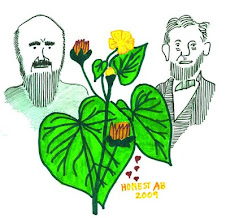
Oh, I knew the basic things. Abutilon is perhaps the most abundant weed in the soybean fields of the American Midwest. It raises its large, heart-shaped leaves bravely above the soybean canopy. As a member of the plant family Malvaceae, its flowers have many stamens united into a phalanx by their filaments. Unlike the better-known hibiscus, okra, and cotton, the velvetleaf flowers have small yellow petals. It produces button-shaped fruits, which are round clusters of multi-seeded capsules that look like a giant asterisk. The green fruits turn grayish when mature. The heart-shaped seeds drop out into the soil, where they may remain dormant but alive for many decades. Like most weeds, they grow in places where the soil has been disturbed, such as a current or recently abandoned farm field. It is the emblem I used for this blog.

I also knew enough about it to admire its grim efficiency. The stems and leaves are covered with soft hairs—hence the names velvetleaf, velvet plant, and velvetweed—but these hairs are sticky and, to many of us, irritating. This is probably one reason why it is the rare herbivore that eats its leaves.

Of greatest interest to me was its tremendous photosynthetic capability and its flexibility. Its large leaves absorbed carbon dioxide (which I measured) and made sugar at a rapid rate, translocating it to all parts of the plant. The feeling I still carry for this plant is that it was pumped full of water, pushing out new stems, leaves, and roots, and full of food to nourish them. Down in the shade, it would lose less water into the air, so it grew fewer roots. With less light down in the shade, velvetleaf plants produce thinner leaves, but provides just as much chlorophyll, with the result that the leaves look the same from the outside but have twice as much chlorophyll per unit weight as do leaves that grow in the sun. In the sun, the plant grows short, thick stems; in the shade, it grows long skinny stems that are more likely to thrust the leaves above any surrounding plants. You can read all about its photosynthetic and phenotypic flexibility in the first two chapters of the plain-English version of my thesis.

Abutilon is also one of the most important weeds to evolve herbicide resistance. Due to the enhanced production of a protective enzyme, some mutant plants will not die even when you spray them. There is a cost to this resistance. The mutant plants produce six times as much of the protective enzyme, a cost that they would not bear if herbicides were not used. But since farmers collectively spend billions of dollars to spray for velvetleaf, this cost is an investment that pays off spectacularly, especially in fields of herbicide-resistant genetically engineered soybeans. The mutant weeds grow more slowly than the normal weeds, but they are the ones that survive.

I even knew a little bit about its human history. I knew it had more common names than practically any other plant. Besides velvetleaf, it is also known as buttonweed and crown weed because of its asterisk-like fruits. It is also called stampweed, butterprint, and pie-marker because settlers used the immature green fruits to stamp decorations into piecrusts or pads of butter for commercial sale. It is called Indian mallow because, although it originated in China, somebody thought it came from India.

It is also called pigpenweed because it is the only major Midwestern weed that pigs will not eat. I confirmed this experimentally, though not with adequate replication. Our friend Joe lived on a farm that had a pigpen. The earth was beaten down and no plants remained in their fragrant space. When I threw in a little bit of lamb’s-quarters (Chenopodium album), a weed related to spinach, the pigs would scramble to eat it. The same with pigweed (Amaranthus retroflexus) and smartweed (Polygonum pensylvanicum, now Persicaria pensylvanica). As a control, I threw some Abutilon into the pigpen. The pigs did not approach it.

Velvetleaf cannot grow in the hot, dry summers of Oklahoma. But I have found it in Oklahoma, growing in soil along the margins of drainage creeks connected to the Arkansas River. Apparently, the seeds, floating in the water of major rivers, drift up into the creeks when the water rises. In Tulsa, they have formed a medium-sized, viable reproductive population.

But it turns out there were a lot of things I did not know until just recently. One of its common names (Chinese jute) should have given it away. (That makes eleven common English names for the same plant.) Until the twentieth century, it was raised both in Asia and in the American Midwest as a row crop for its fibers. During that time, so many seeds fell into the soil that the farmland, now used for soybeans, was infested with the weeds. I had assumed that the invasion of Abutilon into the Midwest came from plants that escaped from gardens of cottage butter-makers. That would not, of course, explain its incredible abundance, especially since the seeds do not travel very far from one place to another unless carried in soil or turf.

Most amazing of all, Abutilon is edible. “The leaves are edible stir-fried or in an omelet,” says Wikipedia and several websites that have copied it. Since its hairs are irritating, its leaves must be cooked, but the leaves are particularly popular in the cuisine of the Maldives islands, mixed with fish and coconut. The seeds are eaten in Kashmir and China, including as a component of bread. I tried to convince my wife, who makes wonderful and creative types of bread, to try it, but she was not interested.

All a farmer knows about corn is that if you plant it at the right time and the right distance apart from other corn seedlings, it will grow very large and produce big ears with lots of seeds. All I knew about velvetleaf was its tremendous growth rate and flexibility. I cannot estimate how many velvetleaf plants I killed, cutting and putting the fine roots, taproots, stems, and leaf blades into separate little paper sacks, to dry and weigh them. Velvetleaf was more like a photosynthetic machine to me than a real, living organism. Only much later have I stepped away to admire it for its amazing characteristics.