Showing posts with label Abutilon. Show all posts

Friday, May 26, 2023

Evolutionary Mysteries: The Sensitive Plant


One of the common weeds in open areas of Oklahoma is the sensitive plant, genus Mimosa. Its leaves are divided into leaflets, and each leaflet into pinnules. It is called a sensitive plant because the leaves, when touched, will close up. The most famous sensitive plant (available from retailers) is Mimosa pudica, a now-widespread weed of tropical and other warm areas, although the Oklahoma plants are probably M. quadrivalvis. I have just posted a Darwin video about this plant if you would like to see it at work.

The reason I call it an evolutionary mystery is that nobody is quite sure why the leaves close up in response to touch. The leading explanation, which I dutifully included in my botany classes, is that it is a defense against herbivorous insects. An insect such as a grasshopper might land on what looks like a big juicy leaf, only to see it disappear, becoming what looks to an insect like an inedible stem.

This leaf response is a response to touch, not necessarily to an insect’s touch. The leaves also close up in response to raindrops. This opens the possibility that the leaves close up not so much to escape the attention of a herbivore but to keep from being weighed down my raindrops.

A related genus within the subfamily Mimosoideae, the genus Albizzia, is the famous mimosa tree. Its leaves do not close in response to touch. Instead, they close up each night and open each morning. The leading explanation for this, one first proposed by Charles Darwin and his son Francis (widely considered the founder of modern plant physiology), is that by closing up the leaf avoids frost damage caused by the clear night sky.

Of course, more than one explanation can be correct at the same time. The mimosa tree, by closing its leaves at night, might avoid frost damage and at the same time damage from raindrops. I have frequently seen mimosa trees which, on rainy mornings, have delayed re-opening their leaves.

The biggest problem with all evolutionary stories, this one and others to follow, is that they leave unanswered the question of my other plants do not have this adaptation. All leaves would benefit from closing up in response to an insect, but almost none of them do, except those of sensitive plants.

In this case, the herbivore and raindrop explanations may be valid within this evolutionary lineage. For whatever reason, the genus Mimosa evolved bags of pressurized water known as pulvini that quickly push the leaves closed in response to touch. Other leaves, without pulvini, cannot close up. The leaves benefit from closing up if they happen to have, for this or for some other reason, pulvini. Other plants, such as the velvetleaf Abutilon theophrasti, lower their leaves each night and raise them each morning, just like Mimosa. Abutilon has pulvini. I do not know why pulvini are not more widespread in the plant kingdom. Abutilon is in the Malvaceae family. Pulvini are also found in the Marantaceae and Oxalidaceae. Most plants do not have them. It is not that the other plant families would receive no benefit from having their leaves open and close, or raise and lower; they, perhaps by chance, do not have pulvini.

The ”adaptive stories” of evolution, such as touch-sensitive leaves, are usually very good at explaining the benefit that an organism may get from having the adaptation, but are usually not very good at explaining why other organisms do not have the adaptation.

Saturday, October 29, 2022

I Thought I Knew Everything about Abutilon

I thought I knew everything about the velvetleaf plant, Abutilon theophrasti. I even wrote part of my doctoral thesis about it. But I was wrong. During the 42 years since I began working on this species, I knew no more about it than a farmer knows about corn.

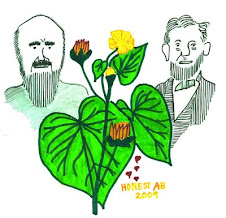
Oh, I knew the basic things. Abutilon is perhaps the most abundant weed in the soybean fields of the American Midwest. It raises its large, heart-shaped leaves bravely above the soybean canopy. As a member of the plant family Malvaceae, its flowers have many stamens united into a phalanx by their filaments. Unlike the better-known hibiscus, okra, and cotton, the velvetleaf flowers have small yellow petals. It produces button-shaped fruits, which are round clusters of multi-seeded capsules that look like a giant asterisk. The green fruits turn grayish when mature. The heart-shaped seeds drop out into the soil, where they may remain dormant but alive for many decades. Like most weeds, they grow in places where the soil has been disturbed, such as a current or recently abandoned farm field. It is the emblem I used for this blog.

I also knew enough about it to admire its grim efficiency. The stems and leaves are covered with soft hairs—hence the names velvetleaf, velvet plant, and velvetweed—but these hairs are sticky and, to many of us, irritating. This is probably one reason why it is the rare herbivore that eats its leaves.

Of greatest interest to me was its tremendous photosynthetic capability and its flexibility. Its large leaves absorbed carbon dioxide (which I measured) and made sugar at a rapid rate, translocating it to all parts of the plant. The feeling I still carry for this plant is that it was pumped full of water, pushing out new stems, leaves, and roots, and full of food to nourish them. Down in the shade, it would lose less water into the air, so it grew fewer roots. With less light down in the shade, velvetleaf plants produce thinner leaves, but provides just as much chlorophyll, with the result that the leaves look the same from the outside but have twice as much chlorophyll per unit weight as do leaves that grow in the sun. In the sun, the plant grows short, thick stems; in the shade, it grows long skinny stems that are more likely to thrust the leaves above any surrounding plants. You can read all about its photosynthetic and phenotypic flexibility in the first two chapters of the plain-English version of my thesis.

Abutilon is also one of the most important weeds to evolve herbicide resistance. Due to the enhanced production of a protective enzyme, some mutant plants will not die even when you spray them. There is a cost to this resistance. The mutant plants produce six times as much of the protective enzyme, a cost that they would not bear if herbicides were not used. But since farmers collectively spend billions of dollars to spray for velvetleaf, this cost is an investment that pays off spectacularly, especially in fields of herbicide-resistant genetically engineered soybeans. The mutant weeds grow more slowly than the normal weeds, but they are the ones that survive.

I even knew a little bit about its human history. I knew it had more common names than practically any other plant. Besides velvetleaf, it is also known as buttonweed and crown weed because of its asterisk-like fruits. It is also called stampweed, butterprint, and pie-marker because settlers used the immature green fruits to stamp decorations into piecrusts or pads of butter for commercial sale. It is called Indian mallow because, although it originated in China, somebody thought it came from India.

It is also called pigpenweed because it is the only major Midwestern weed that pigs will not eat. I confirmed this experimentally, though not with adequate replication. Our friend Joe lived on a farm that had a pigpen. The earth was beaten down and no plants remained in their fragrant space. When I threw in a little bit of lamb’s-quarters (Chenopodium album), a weed related to spinach, the pigs would scramble to eat it. The same with pigweed (Amaranthus retroflexus) and smartweed (Polygonum pensylvanicum, now Persicaria pensylvanica). As a control, I threw some Abutilon into the pigpen. The pigs did not approach it.

Velvetleaf cannot grow in the hot, dry summers of Oklahoma. But I have found it in Oklahoma, growing in soil along the margins of drainage creeks connected to the Arkansas River. Apparently, the seeds, floating in the water of major rivers, drift up into the creeks when the water rises. In Tulsa, they have formed a medium-sized, viable reproductive population.

But it turns out there were a lot of things I did not know until just recently. One of its common names (Chinese jute) should have given it away. (That makes eleven common English names for the same plant.) Until the twentieth century, it was raised both in Asia and in the American Midwest as a row crop for its fibers. During that time, so many seeds fell into the soil that the farmland, now used for soybeans, was infested with the weeds. I had assumed that the invasion of Abutilon into the Midwest came from plants that escaped from gardens of cottage butter-makers. That would not, of course, explain its incredible abundance, especially since the seeds do not travel very far from one place to another unless carried in soil or turf.

Most amazing of all, Abutilon is edible. “The leaves are edible stir-fried or in an omelet,” says Wikipedia and several websites that have copied it. Since its hairs are irritating, its leaves must be cooked, but the leaves are particularly popular in the cuisine of the Maldives islands, mixed with fish and coconut. The seeds are eaten in Kashmir and China, including as a component of bread. I tried to convince my wife, who makes wonderful and creative types of bread, to try it, but she was not interested.

All a farmer knows about corn is that if you plant it at the right time and the right distance apart from other corn seedlings, it will grow very large and produce big ears with lots of seeds. All I knew about velvetleaf was its tremendous growth rate and flexibility. I cannot estimate how many velvetleaf plants I killed, cutting and putting the fine roots, taproots, stems, and leaf blades into separate little paper sacks, to dry and weigh them. Velvetleaf was more like a photosynthetic machine to me than a real, living organism. Only much later have I stepped away to admire it for its amazing characteristics.