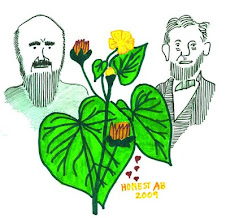
Darwin says no to the idea of Survival of the fittest.
Another bad evolutionary myth is “Survival of the fittest,” in the sense that the animals that fight the most are the winners of the battle—the “law of the jungle.” You can find examples of this—ask any subordinate male gorilla—but at least as often, perhaps more often, animal evolution produces altruism. Altruism is where animals obtain direct benefits from being nice to each other. Individual animals can enhance their fitness by being nice to their genetic relatives (kin selection), by being nice to other animals who may later be nice in return (direct reciprocity), or by gaining social status by being conspicuously generous (indirect reciprocity). Even the jungle does not follow “the law of the jungle.” There’s lots of altruism within species of jungle animals, as well as mutualism between species.
Altruism has been perhaps the most important aspect of human evolution. Tribes that had the most altruism prevailed in the evolutionary landscape, because the fitness of each individual in the tribe was enhanced by cooperation. Ninety-five percent of our evolutionary history took place in hunter-gatherer tribes, which were largely socialistic or communistic. Modern governments, which have power concentrated at the top and oppress the masses of poor, are a dysfunctional modern development that disregards our strong altruistic adaptations.
Altruism is a natural part of our psychology and has to be carefully brainwashed out of humans. As the lyrics go in Rogers and Hammerstein’s South Pacific, “You have to be carefully taught to hate, before you are six or seven or eight…” I heard an interview of the New York Times reporter who had been kidnapped by terrorists. He told how the young terrorists had to watch videos over and over about killing people and blowing things up. The culminating video was of the decapitation of a Polish victim. These young men had to be deliberately, repeatedly desensitized to altruism in order to be effective terrorists. By the way, religion is the best method of desensitization that humans have ever invented. Sometimes it sensitizes people too.
It is the myth of Survival of the Fittest that creationists often attack, pretending that in doing so they are attacking evolutionary science. It is strange, is it not, that religious conservatives who attack evolution also champion capitalism, which is one of the most anti-altruistic systems ever devised.
Showing posts with label Evolutionary mythology. Show all posts
Showing posts with label Evolutionary mythology. Show all posts
Monday, January 25, 2010


Wednesday, January 20, 2010
Darwin says No to the idea of inevitable progress

One of the biggest evolutionary myths is that evolution is a march of advancement from “lower” forms up to humans, the highest animal. This idea misses the whole point of evolution. Insects are less intelligent than we are, but they are really good at things we cannot do such as laying millions of eggs, hiding in little holes, etc. Intelligence is our human adaptation, and we do it pretty well; but other species are just as “advanced” as we are, with different adaptations. (The original paperback cover of my Encyclopedia of Evolution had a staircase with monkeys at the bottom and humans at the top. The publisher respected my rejection of this image. To read more about my encyclopedia, see my website.)
As shown in the picture, the early amphibian Tiktaalik roseae, discovered a couple of years ago by Neil Shubin (author of Your Inner Fish), was not trying to evolve into something loftier. It was just getting away from predators by living in shallow water and, later, on land. Natural selection favored those Tiktaalik individuals who were adapted to shallow water conditions. While the water was full of dangerous predators, the land had nothing more dangerous than large insects.
Incidentally, the cartoonists have “had a field day” with Tiktaalik. In one cartoon, the male amphibian said to his wife, who was still in the water, “Come on, Arlene, be reasonable. I’m not trying to change your religious convictions. All I said was, can we take a little walk?” One scientist (Robert A. Martin) has suggested that legs evolved to help males clasp onto females while mating. Cartoonists have also latched upon sex as a factor in the evolution of Tiktaalik. In one cartoon, a young male amphibian crawls out of the water and thinks to himself, “I am so going to get laid now.” In another cartoon, the male amphibian crawls out, while his mate stays in the water and says, “It may be evolution to you, but I call it ‘avoidance of intimacy issues.’” (I keep up with the cartoons by subscribing to my favorite scientific journal, Funny Times.
The need to crawl out of the water, towards glorious humanity, is a strong evolutionary myth, but is completely wrong.
Sunday, January 10, 2010
Darwin says no!

Religion is not the only place where you find mythology. Most people use the word “mythology” to refer to false stories, to lies; and since they deal with large subjects such as where the world came from and the meaning of life, myths are (to most people) really really big lies. But mythology consists of stories that provide a framework of meaning to our lives; their technical accuracy is wholly irrelevant. The Judeo-Christian myth of the Exodus provides a framework for liberation. Patriotism has a lot of myths, turning dead politicians into heroic statesmen. Even the patriotic stories we know to be wrong—like George Washington and the cherry tree—help make us more patriotic. There is also some really good evolutionary mythology. All species share a common ancestry, so all life on the planet is really our extended family: this is one really good evolutionary myth.
But some mythology is bad. This happens when the overarching idea is wrong. We all know examples of this, such as versions of religion that teach that God is going to burn the world up really soon and therefore we can go ahead and pollute and destroy the planet right now. This myth is not just technically inaccurate, as are all myths, but will lead us to destroy our planet and feel righteous while doing it.
In future entries, I will give what I consider to be some examples of bad evolutionary myths. (You can see
Bad evolutionary myths not only mislead people into misunderstanding evolution, but also provide whipping boys for creationists to use.
Subscribe to:
Posts (Atom)