Saturday, March 7, 2020

In Praise of Bitterness


In the general biology labs that I teach, the students map out which portions of their tongues can taste sweet, sour, salty, and bitter chemicals. Of course, they hate the bitter quinine.

The ability to taste bitter compounds, and to dislike them, is of immense importance to our survival today as it has been throughout animal evolution. Most bitter compounds are potentially toxic, and if we taste something bitter, we may need to stop eating it so quickly that disgust, rather than rational decision, is necessary.

One student, however, was unable to taste the quinine. I never found out if he could taste any other bitter compounds. This is not a good thing for him. He has to be extremely careful about what he consumes.

According to a genetics website at the University of Utah, “Humans have about 30 genes that code for bitter taste receptors. Each receptor can interact with several compounds, allowing people to taste a wide variety of bitter substances.” This is because a wide variety of different molecules can be toxic. Many medicines are toxic in large quantities, and taste bitter even in small quantities; and these medicines are not chemically similar to one another. The ability of the human tongue to detect “bitter” is actually thirty different abilities. In this way the human brain has a single response—“This is bitter, don’t eat it”—to a great variety of potential threats.

Next time you taste something bitter, think about this and feel a little gratitude to your nervous system for protecting you.

Wednesday, March 4, 2020

The Scientific Method and Reincarnation: The Bridey Murphy Story


I ran across a book that my late mother-in-law had: The Search for Bridey Murphy, by Morey Bernstein, published in 1956.

Bernstein was a businessman who became interested in hypnosis and all of the many medical benefits it could potentially confer. But his interests went beyond this. He was interested in age regression, in which the person who is hypnotized not only remembers early childhood, but relives it. The memories of early childhood, even infancy, are stored away in the brain, some hypnotists claim, and can be unleashed.

If a subject is hypnotically regressed to infancy, he or she may be able to describe sensations and memories from infancy, in words, even though they could not talk during infancy. This brings up an interesting question. How could one determine whether the subject is actually re-living infancy? Bernstein said that, when a subject is regressed back into infancy, their reflexes actually change. Infants and young children have the Babinski reflex, but older children and adults do not.  During age regression, the hypnotist can get the subject to actually change from the adult reflex to the infant reflex. This would be strong evidence of the effectiveness of age regression. I do not know how good the evidence is, having read about it only in this book.

But Bernstein wanted to take age regression back further—not just back to infancy, but back before birth. Just keep going...back into a previous lifetime. If hypnotized subjects had true memories of past lifetimes, this would prove reincarnation. But how can the hypnotist know whether the memories are true, and are of past lifetimes? This brings us to some interesting points about the scientific method.

It is not enough just to dismiss spiritualist assertions on the grounds of inherent absurdity. The most famous agnostic, the inventor of the word agnostic, Thomas Henry Huxley, made this point. What Huxley did was to give spiritualism a chance, after which he (along with E. Ray Lankester) showed that at least the spiritualist seances that he attended were, in fact, hoaxes. He concluded this, rather than assuming it. And he knew this did not prove all spiritualist experiences were hoaxes.

First, consider bias. Bernstein tried very hard to prove that he was not biased. He openly admits that he started off completely agnostic about religious concepts. That is, he claims that his discoveries convinced him despite, not because of, his initial bias. Further, he was rich enough from his business, he did not need to pull a hoax to get rich. These two preconditions are helpful, but do not eliminate the possibility of bias. Some evangelical Christian apologists (most famously Josh McDowell, author of Evidence that Demands a Verdict in which he claims to prove Christian doctrine) say that they started off as atheists and were converted by the evidence that they found. However, despite his lack of initial bias, McDowell definitely developed a bias later. And even though Bernstein was rich enough to not need a hoax, there are plenty of rich people who cannot keep themselves from trying to get richer by unethical means. But at least Bernstein made an effort to begin in an unbiased fashion.

One thing that greatly reduced the chance of bias is that there were independent fact-checkers. This did not completely eliminate the chance of error, however; journalists are looking for an exciting story (even back then, if it bleeds, it leads) and would prefer the reincarnation conclusion over fraud or delusion.

Second, consider how one can evaluate the quality of the evidence of a past life obtained from a hypnotized person. Perhaps the strongest evidence would be if the person provided details that the person could not possibly know. (This is a condition that is nearly impossible to satisfy today. Everyone has a world of information at their fingertips. Give me a little time, and access to the internet, and I could make up a convincing fake story that I am a reincarnated Viking. But in the pre-internet days, this evidence was much harder to get and thus more meaningful.)

Bernstein hypnotized a woman he called Ruth Simmons (she was actually Virginia Tighe), who was born in Iowa in the twentieth century. When he regressed her back before her birth, she revealed that she had been an Irish woman Bridey (Bridget) Murphy who was born in 1798 and died in 1864. She did, indeed, reveal a lot of details that seemed convincing. She even started talking with an Irish brogue during the hypnotic sessions, something she could not do normally. Are you convinced yet? She said that she could dance the “Morning Jig” when she was alive in Ireland. Bernstein gave her a post-hypnotic suggestion: that, upon awakening, she should dance the jig for the observers. And she did. Are you convinced yet? The woman also gave geographical details that a twentieth-century American would almost certainly not know about Ireland (actually, Northern Ireland), including the conflicts between Protestants and Catholics in the nineteenth century. Are you convinced yet?

The Bridey Murphy story became a sensation after it was published in a newspaper in 1954 and as a book in 1956. It seemed like everyone was talking about it. People with a spiritual (but not fundamentalist Christian) inclination were swept up into believing it. Materialistic people subjected it to ridicule. Even Donald Duck’s uncle McScrooge made fun of it. In her copy, my mother-in-law wrote down the address of the Bridey Murphy Discussion Group of Peoria, which met in Marquette Heights in nearby Pekin, Illinois.


[This is a photo from a movie adaptation.]

The book was rushed into print with too little fact-checking to even satisfy the author. But there was plenty of fact-checking afterward. And here is where the scientific method gets interesting. During the intense discussion, there were two competing hypotheses: that Ruth Simmons was making it all up, either as fraud or delusion, vs. Ruth Simmons really was remembering her past life as Bridey Murphy. (And she even had a vague memory, it seems, of dying as a baby in New Amsterdam, which is today New York, over a century earlier than Bridey Murphy.)

The people who wanted to prove Simmons was making it all up pointed to supposed errors in the facts she recited. But her defenders showed, in every case it seems, that the story was credible. The places she mentioned, and the terms she used, the customs to which she referred, were not inaccurate for the time and place, even when they could not be verified. In a few instances, Bridey seemed to be exaggerating in order to make her husband seem more prominent than he was. She claimed he was a barrister (the highest grade of lawyer), but that he managed accounts for stores, something that only the lowest grade of accountants did. But this may have enhanced the credibility of her account: she was telling—and exaggerating—her life experience, not a mere story.

Besides, someone pointed out, the Bridey Murphy story is, by itself, too boring to be a fabrication. After all, everyone wants to be a reincarnated king, not a serf or something. But Bridey was just a woman who got married, never had kids, and died at age 66 after falling down the stairs. The only interesting thing in her story was that she was in a mixed marriage (she was Protestant, her husband Catholic).

Bernstein provided long transcripts of the tape-recorded hypnosis sessions in the book. In session after session, he asked the same questions, such as what her husband’s name was. One’s eyes start to glaze over. But this repetition was actually quite valuable. They proved that the woman was not just making it up as she went along. The information was deep inside her brain, and came out the same way every time. Even a good liar would have a hard time keeping a consistent story for six sessions of hypnotism. Also, for this reason, it was clearly not a delusion.

In the competition between the fraud/delusion hypothesis and the reincarnation hypothesis, the latter easily won.

This is where it really gets interesting. New evidence emerged. (Don’t you just hate it when that happens? New facts can destroy a nice story.) When Ruth Simmons was growing up in Chicago, an old Irish woman lived across the street. Her name was Bridey Murphy Corkell. The hypothesis that turned out to be true was a third hypothesis not previously considered: that Ruth had learned the story very well from this woman, even learned her accent, and even learned the jig, and then forgot where or even that she had heard it. This is a now-well-established phenomenon known as cryptomnesia, or hidden memory.

There have been other famous cases of possible cryptomnesia from the world of creative arts. The difference between cryptomnesia and plagiarism is whether the person knows that they are recycling the work of another artist. George Harrison of Beatles fame may have plagiarized My Sweet Lord from another musical group (this was the interpretation of the court in the ensuing lawsuit), or he may genuinely have mistaken his memory of the melody for his own creation. This apparently also happened to Umberto Eco, author of Name of the Rose.

In a way, every creative person has a gnawing fear that he or she will unwittingly steal ideas from someone else. I write books; how can I possibly know if I stole an idea from a book that I read maybe forty years ago? I would need a list of every book I have read since I graduated from high school. What kind of nerd would keep a list like that? Me, that’s who. My complete list now contains 1,411 titles, the last of which is The Search for Bridey Murphy. I can always scan the list before sending a final fiction manuscript to a publisher. This does not guarantee that I did not steal a plot from a forgotten movie or an episode of Perry Mason. (In the latter case, I have also kept a list of the Perry Mason episodes I have watched. I used one for an endnote in my most recent book. God, I am such a nerd.) I steal plots from the Bible all the time, but I am aware of what I am doing.

It gets even more complicated. Someone may absorb an idea from the surrounding culture and mistakenly think it is his or her own. This is called a Zeitgeist (a German word for “time ghost”). Science writer Loren Eiseley (Darwin’s Century) famously said that Charles Darwin got the idea for natural selection from Edward Blyth, without realizing it, because it was an idea already floating around in scholarly culture. Probably nobody believes this anymore, since all of Darwin’s contemporaries seemed genuinely surprised at Darwin’s creative hypothesis. Darwin thought of natural selection a long time before Alfred Russel Wallace, but he worried himself sick that it would look to the world as if he had stolen Wallace’s idea. Fortunately, Wallace happily acknowledged Darwin’s priority.

None of this proves that reincarnation does not exist. It just means that evidence, like that of Bridey Murphy, is not good enough.

The scientific way of thinking can help us understand almost anything better than other ways of thinking. This even includes reincarnation.

Friday, February 14, 2020

Language and Teaching Science: A Story


In other essays, I have discussed the biological adaptation known as language, and how the communication of ideas is only one of the many functions of language. It is also a medium of social bonding among people who speak the same language. An important part of this bonding is that the people share idioms, that is, phrases that they understand but which makes no sense to outsiders. One example of an English idiom is, “Let’s have a pea-pickin’ time.” My students inform me that this is no longer a common phrase in English. I’m surprised that it ever was; picking peas is not my idea of a good time. A few decades ago, however, this idiom was in common circulation.

About 1972, I was a young high school student in an agricultural part of California. Many Hispanic migrant families moved from one fruit-picking job to another. One day, a girl from one of these families showed up at our high school, unable to speak any English. How was she supposed to take classes, such as biology? Our Spanish teacher, Mr. Jesse Guerrero, had the answer. He knew that I was pretty good at Spanish (for a second language), and at science. He and other teachers agreed that I should translate the English biology book into Spanish. I agreed and set to work immediately.

The title of chapter 1 was “Let’s Have a Pea-Pickin’ Time.” It was about genetics, which is based on the nineteenth-century research of Gregor Mendel, who studied genetic inheritance patterns in peas.  This chapter was about him.

If I translated the title directly, it would be “Tengamous tiempo de recoger guisantes.” This makes even less sense in Spanish than it does in English (“Let us have the time to pick peas”). I brought this problem to Mr. Guerrero, who said a better translation would be “Divertámanos,” or “Let’s have fun.” But then there is no connection to the subject matter of the chapter (Mendel and his peas).

What was the solution to the problem? The girl dropped out. That took care of the problem, for us anyway.

This was when I first realized that different languages, in all their diverse beauty, exist only in part for the purpose of communicating information.

Wednesday, February 12, 2020

We All Love Our Hypotheses: A Story of Charles Darwin


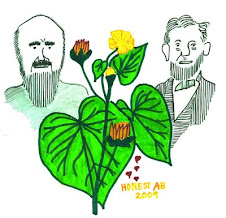
On this day in 1809, both Abraham Lincoln and Charles Darwin were born. Here’s to the next 211 years of freedom and science!


And here is a little story about Charles Darwin.

All of us, especially scientists, love our hypotheses. But what scientists try to do, and often succeed at doing, is to test the hypotheses and then let go of those that do not pass the test. This is why we consider ourselves “objective” (rather than subjective), and this is one of the major ways in which scientific thinking differs from non-scientific thinking.

But, as individuals, scientists often find it difficult to let go of cherished ideas. This is why science is a community; one scientist might cling to a useless hypothesis, but the other scientists can challenge him or her.

One good example of a scientist clinging to a cherished hypothesis was Charles Darwin. I do not refer to evolution; he was right about that. But at the time Darwin wrote the Origin of Species, and for the rest of his life, Darwin did not know how traits could be passed on from one generation to another. That is, neither he nor anybody else understood heredity. Well, one man did: Gregor Mendel. But Mendel did not know that he knew. He died, not knowing that every biology student in the world would learn his name.

Here is why this was such a problem for Darwin. A scholar named Fleeming Jenkin wrote a criticism of natural selection. Jenkin invited us to imagine a situation where a new, superior, but rare hereditary variation was introduced into a population. No matter how good it was, it would get swamped out by the rest of the population before natural selection could save it. Jenkin used a violently racist example which was, we now regret, common in his day.

If heredity acts like a paint pot, then Jenkin’s argument cannot be answered. A drop of white paint will disappear in red paint and is lost forever. But Mendel discovered, and Darwin believed, that traits were not like paint. They were more like (to use my analogy) marbles. White marbles can mix in with red marbles, but retain their individuality, and can someday show up again. Rare traits retain their individuality and can become common. But how?

Darwin, in the course of writing a big book Variation in Domesticated Plants and Animals, came up with an explanation. He believed that all parts of the body produced what he called gemmules, and these gemmules found their way, presumably through the blood, to the reproductive organs, where they were passed on to the offspring. The circumstances of life can cause organs to change the kinds of gemmules they release. This is how acquired traits can be inherited, in Darwin’s theory of pangenesis.

Darwin was not the only person who was excited about pangenesis. So was his younger cousin Francis Galton, often called the childless father of eugenics. Galton knew more about heredity than Darwin; in fact, Galton gathered lots of inheritance data for his book Hereditary Genius. He also contributed to the early development of statistics. He invented the correlation coefficient in statistical regression. And he was ready to subject pangenesis to an experimental test, which he was sure would confirm the theory.

Galton used different breeds of rabbits, with recognizably different coat colors. He took blood from one kind of rabbit and injected it into the bloodstream of a different kind. He was careful to not harm the rabbits, even though he transfused up to one-third of their blood volume. Galton expected that this blood, full of gemmules, would cause the rabbits to have offspring with the characteristics not of their parents but of their blood donors, at least sometimes.

All of the rabbit-blood experiments failed. Galton was not sure what to do next. Darwin was, however, sure. Darwin simply made a post-hoc rationalization. Triumphantly, Darwin said that the gemmules must find their way to the generative organs through some medium other than blood. This assertion led to no further experiments. Pangenesis theory declined into oblivion, and today we all learn about Mendelian genetics.

Darwin was more objective than almost every other scientist of or since his day. But, like any human, he was imperfect. Objectivity failed him in the matter of his beloved pangenesis theory.

Wednesday, January 29, 2020

Do Non-Human Animals Have Music? A Meditation on Shostakovich


This essay is a personal reflection on my encounter with a specific piece of music, not a general overview of the subject of animals and music, to which other scientists, not I, have devoted their careers. It is clear that many animals (including fruit flies) use sound for communication, especially for territories and mating. The sounds have patterns that scientists cannot resist calling musical. But maybe we are imputing our experiences onto the animal kingdom. We already do this when we call a beehive’s captive egg-laying machine a “queen.”

To me, the defining characteristic of music, rather than just pretty sounds, is the internal, mental effect that it has. In this, the musical experience is closely allied to the religious experience. And this is why the musical experience can be so powerful and so individual.

My first exposure to the Fifth Symphony of Soviet composer Dmitri Shostakovich was when the symphonic band I was in, early in graduate school, played a transcription of the finale. Shortly thereafter, in 1982, I bought the record of the Bernstein performance, and listened to it a lot. That was the same year that I read The Lord of the Rings trilogy. For me, and perhaps nobody else, the music and the novels were closely associated. Especially in the first movement of the symphony, I could hear The Lord of the Rings: the quiet dance of Luthien Tinuviel, in elfin mists and waterfalls, during a quiet throbbing of the strings; I also heard marching armies, attacking orcs, and prancing horses.

It was also at that time that I was experiencing, as young people often do, wrenching emotions, the kind that make no sense in retrospect but which are all-consuming when they occur. It was at this time that, to me, the slow climax of the strings in the middle of the finale (manuscript numbers 113-114) encapsulated my life. I felt this so strongly that I copied out the melody and taped it to my door. Certainly, for me, this symphony was a way of giving substance to my own personal and very intense emotions.


Recently I heard a performance of this symphony by the Tulsa Signature Symphony, led by Andrés Franco. It was certainly an intense performance; the maestro was practically dancing on the podium. The entire concert was, first, Franco’s explanation of how the symphony was written and its musical meaning; and, second, the symphony itself. I was surprised how many people besides myself enjoyed the lecture so much. It was from this lecture that I learned that the Shostakovich Fifth Symphony had intense emotional meaning to the Russians under Stalin’s Soviet dictatorship—almost a whole nation experiencing the kind of intensity in 1937 that I felt in 1982. During the first performance in the Soviet Union, many in the audience wept.

I had never thought about this until Maestro Franco explained it. The entire Soviet Union was under the most brutal form of dictatorship—the psychological form. Nobody could trust anyone else, even among friends and family. Any other person might tattle on you to the Soviet authorities, whereupon you would be arrested, imprisoned, and either killed or allowed to die. Millions died during Stalin’s purges and the famine that he directly caused by imposing the totally bogus genetic theories of pseudo-scientist Trofim Lysenko (see my earlier essay). Under such conditions, not only was it impossible to, without risking your life, to complain about Stalin, but it was impossible to even weep for the agony that he caused. Everyone was supposed to pretend to be happy little Communists. The performance of Shostakovich’s symphony was the only place in the USSR where you could cry in public and get away with it.

Dmitri Shostakovich stayed in the Soviet Union until his death in 1975, writing music that was as daring as he could get away with. After his death, his son Maxim and grandson Dmitri the younger defected to the United States.

The performance of this symphony was, for me, though perhaps less so than for the millions of people suffering under Stalin, a ravishing experience. A couple of parts in Franco’s performance were not what I expected. I have listened to the Leonard Bernstein recording for almost 40 years. The end of the finale, as performed by Bernstein, was like the bird of the spirit of the Russian people flying away into the sky. As Maestro Franco performed it, it sounded like this bird never quite got off the ground, dragged down because a gigantic soviet medallion draped around its neck, and it could barely rise any higher than the missile silos. But the tempo is the conductor’s prerogative.

This is what makes music what it is, as Maestro Franco explained. It unites us, despite the many other things that divide us. “Songs” do not unite birds; it is the means of their competition with one another for territory and for mates. At this time in American history (the performance was right in the middle of Trump’s impeachment trial, though nobody could have predicted this would happen), America needs something to bring us together. It is divided as it has perhaps never been since the Civil War. About half of Americans are perfectly satisfied with Trump declaring himself to be free of any constitutional constraints; to be, as the congressional prosecutors literally said the very day of the concert, a tyrant, a king, a dictator. We desperately need something to unite us. Politics certainly cannot. Even science (which the conservatives openly reject) cannot. Can music unite us? Perhaps it is music that will keep our very souls alive in coming years. It appears that music, especially that of Dmitri Shostakovich, was what kept the Russian soul alive during the dark Stalinist decades.

Sunday, January 26, 2020

The Decline and Fall of Garrett Hardin


Back in the 1970s and 1980s, Garrett Hardin was a big name in popular science. His fame began with the publication of “The Tragedy of the Commons” in Science in 1968, in which he explained how human society, like any animal society, will evolve towards the over-exploitation of any resources that are not privately held. This article was and remains a direct attack on the role of altruism (about which I have often written in this blog). With altruism, members of a population agree with one another to, among other things, share common resources fairly for the benefit of everyone. It is an unstable condition, but has such great benefits that, in numerous human societies, it has worked, even if imperfectly. But to read what Hardin wrote, you would get the impression that it can never work at all.


Today, few scientists agree with Hardin’s approach. Many ecologists and environmental scientists use his Science article for discussion. Chances are that you already know that much of Hardin’s work is now ignored. In what follows, I just want to give you an example of why his views have fallen into disrepute.

In his book Nature and Man’s Fate, Hardin stated his beliefs very clearly. He said that, since mankind is part of nature, then the only way we can hope to solve any of the world’s problems is to let natural selection take care of it. For example, what do we do about diseases? In particular reference to genetic diseases, Hardin explained why eugenics could not work. The reason is that nobody is smart enough to choose which people are superior and should be chosen to breed (positive eugenics) or which people are inferior and should be prevented from breeding (negative eugenics). Today, most people (including most scientists) believe eugenics is an unethical idea; but to Hardin, it was merely impractical.

Even though no human is smart enough to guide the process of eugenics, Hardin said, nature is smart enough. Look at all the amazing adaptations natural selection has produced! Surely the problems of the human species, at least the genetic ones, can be solved by natural selection. But to do so, Hardin said, we have to let natural selection have its way with our species. He praised competition, over and over, and said that natural selection would weed out inferior people.

Let nature take its course: this was Hardin’s fundamental belief. He had no tolerance for the tender hearts of liberals who wanted to interfere with natural selection’s work of clearing away inferior people.

Nearly every scientist rejects this view today. We spend a lot of money trying to save the lives of people with genetic abnormalities whom Hardin apparently believed should die. Indeed, natural selection would solve our problems, but only after the deaths of millions of people and the passage of hundreds of years.

Or not. During the hundreds of thousands of years before modern medicine, natural selection was all we had to solve our genetic problems. And it didn’t. If natural selection is going to save us, when the hell is it going to start doing so?

Hardin went further. He said that we should not interfere with any society that might start performing deeds that we consider morally dangerous. He said that, due to genetic diversity, there are many, many possible “constellations of moral principles” that could assemble themselves in human societies. Some of them we would call good, and some of them we would call evil. But there are far more evil and partly-evil constellations than there are good ones. And we should let the evil ones have their way, do whatever the hell they want to do, and let natural selection choose the winner.

He added one provision: no society should be allowed to threaten the existence of any other society.

One example of what he meant is that if a country has too high of a birth rate, then other countries should just let it starve to death.

Though Hardin did not use this example, his view requires that Nazi Germany needed to be stopped, but only because it started taking over other countries. If the Nazis had just stayed home and killed their own Jews and Gypsies and Slavs and gays, then that would have been, according to Hardin, just fine.

Have I misinterpreted him? Read it for yourself, from page 278 of the Mentor paperback reprint of his book: “The good constellations…are only a tiny fraction of all that are possible, but this fraction is surely a large number. It may be hard to resist trying to punish a society whose moral practices are repugnant to us, but only a policy of live-and-let-live will permit the development of the variety of communities that is needed to insure man’s continued existence…Put bluntly, every community must be free to go to hell in its own way, so long as its action does not endanger the continued existence of other communities. A community must, for instance, enjoy the freedom to breed itself into a state of starvation, if it so wishes, without a finger being lifted elsewhere to interfere with its stupidity. To interfere, to save it from the consequences of its own immorality is but to postpone and aggravate the problem, and to spread the moral infection.”

With regard to what was at the time the book was written called “the population explosion,” Hardin has been proved wrong over and over and over. Developed countries did NOT leave the less developed countries alone to die in their own misery of starvation and disease. Developed countries sent food, medicine, and education to those countries, the very things that Hardin considered to be wrong. By Hardin’s hypothesis, the fertility rates of these miserable countries should have skyrocketed, or at least not declined. But what actually happened was that in nearly every country, nearly every decade, especially the “poor” countries, fertility rates have declined precipitously. About 1953, Guatemala had a fertility rate of 7.0 (that is, the typical family had 7 kids); today the rate is 2.7. In Bangladesh, fertility went down from 6.7 to 2.1; the exact same figures for Mexico. In South Africa, it declined from 6.5 to 2.4. This occurred in hundreds of countries over many decades. This represents a couple of thousand tests of the Hardin hypothesis, and in nearly all cases, the hypothesis failed. By the time of his death by suicide in 2003, he must have already realized this, for the decline in fertility rates had been ongoing for decades by that time.

One problem with letting “a society” choose its own fate is that societies do not choose their fates; individuals do. Natural selection, which Hardin claimed to have known everything about, works on individuals, not societies. Notice the quote above. “A community must…enjoy the freedom to breed itself into a state of starvation, if it so wishes.” Communities do not breed; people do. And as soon as individual people in “poor” countries got the opportunity to be healthy and well fed, they chose to have fewer kids. Hardin not only chose a brutal application of natural selection, but an incorrect one.

Hardly anyone today says, “Let those poor dark countries breed themselves to hell.” We now all know Hardin was wrong. But it is now high time for us to relegate Garrett Hardin’s views to the dustbin of cruel and failed biological theories, alongside the Trofim Lysenko he so vigorously (and correctly) criticized. Good riddance!

In passing, Hardin added something that we all know is usually wrong: that people who have inherited wealth “almost universally” feel an obligation to do good. Let people who have inherited their wealth keep all of it, because they will use it to help society. What a crock. Many do—a perfect example of the indirect reciprocity form of altruism about which Hardin knew nothing—but there are just as many counter-examples. For every Rockefeller there is a Trump.

When I was in graduate school, a fellow student expressed amazement that I had not taken Hardin’s human ecology class when I was a student at the University of California at Santa Barbara. But today, as I look back on it, I am glad I did not.

Hardin tried to steal some glamor from Darwin to polish his views. I have italicized the passages in which Hardin compared his cruel and incorrect view of the world to Darwin’s correct view of how non-human species evolve. This is how he ended his book (page 297 of the paperback): “Out of luxuriant waste, winnowed by selection, come designs more beautiful and in greater variety than ever man could plan. This is the lesson of Nature that Darwin has spelled out for us. Man, now that he makes himself, cannot do better than to emulate Nature’s example in allowing for waste and encouraging novelty. There is grandeur in this view of life as a complex of cybernetic systems that produce adaptedness without foresight, design without planning, and progress without dictation. From the simplest means, man, now master of his own fate, may evolve societies of a variety and novelty—yes, and even of a beauty—that no man living can now foresee.”

Saturday, January 18, 2020

The Evolutionary Functions of Religion


Something as pervasive as religion, which is found in every human cultural group, must have an evolutionary explanation. I assert this without proof, but I trust that most scientists agree with me. Even though religion must have served a useful function to enhance fitness in the past, today it might serve no useful function.

Or does it?

I will present three functions of religion.

First, it facilitates altruism. This is a good thing. Altruism is an instinct in animals, especially in humans. But how can you be altruistic? Religious groups provide ways of doing so. Give them your time and money, and they can direct it toward people who need help. It certainly beats walking the street and looking for people who need help. One example is that poor rural villages in Africa need clean drinking water even more than they need advanced medicines. Civil engineers can join a religious organization that sponsors them to install wells in rural villages. (You can’t just dig a hole in the ground. Surface water would contaminate it. Rural villages need civil engineers from advanced countries to help them have healthier lives.) As far as I can see, this is pure altruism. Thank God for this kind of religion.

Second, it impedes the discovery of truth. Throughout history, religions have suppressed truth. So far, it has always been temporary. The Catholic Church persecuted Galileo, but they now celebrate him. By 1843, the cathedral at Strasbourg had an astronomical clock (Horlogue Astronomique) that celebrated the Copernican system it had condemned three centuries earlier.


Religions eventually embrace truth but only after sometimes centuries of resistance. I used to be a member of the American Scientific Affiliation, a group of Christians in the sciences who meet together to confront scientific and social issues from a Christian perspective. After immense angst, they usually end up embracing concepts that other scientists had long before accepted. Never has the ASA presented any new perspective on science. I finally left because I got tired of the endless angst that these fine people put themselves through (usually internal, rather than external, conflict) for reasons that were ultimately unimportant. Thus, I conclude, even good religion impedes the discovery of truth. 

Third, it makes money for religious leaders. This cannot explain the origin of religion, for it only works when altruistic and other instincts are already in place. Charismatic leaders who use religious devices can brainwash people into following them, giving them lots of money, and ignoring the times when they are discovered to have moral failings that they condemn in others. Examples have filled books. This continues because people still have an instinct for credulity, to believe religious leaders, even after repeated proof that many of them are frauds, and there is so much money to be made that there is a big intake of new fraudulent leaders. I used to be in one such cult, and know what it feels like to slowly and painfully extract myself from it.

Religion is part of our nature and will not go away. We need to be aware of it and allow only its good functions to operate.