Friday, August 26, 2022

The Cost of Peace

I think that peace is always better than war in every possible way, including economic benefits. But peace comes with lots of costs, and we should not let them take us by surprise. Here is an example.

Ethiopia has, it seems, always been embroiled in civil war. The Tigray War continues, though it is in the news less than at the beginning of the year. It would seem that everyone would want Ethiopian civil wars to end.

Ethiopia has 1.8 million hectares of irrigable farmland, very little of it being currently used. If civil war ended, they could irrigate most of this land. Right now, nobody would invest in Ethiopian infrastructure that might be destroyed by conflict at any moment. Peace would encourage international investment.

But international investment would not be absolutely necessary. The people could build low earth dams (called micro-dams) that would trap a lot of water in small irrigation ponds. If the only war problems were international, these micro-dams would not constitute a military target—too many of them.

Ethiopia is the source of 86 percent of the water that flows through the Nile. Right now, most of that water is claimed and used by Egypt and the Sudans. But if Ethiopians built all the possible micro-dams, they could use 7.2 billion cubic meters of water per year and could store 50. This would vastly reduce the water flow in the Nile. Egypt’s plans to irrigate large new areas would be jeopardized. The Aswan High Dam is a very visible military target, although Ethiopia could probably not endanger it. War, however, might be unavoidable.

This is an example of how peace can cause more war. If you add on top of this the inevitable droughts, which make people and nations feel desperate, you have an ugly situation. And that is in a part of the world we pretty much ignore.

Peace is worth almost any cost, but these costs must not take us by surprise.

Thursday, August 18, 2022

How We Know Stuff

Now here is a topic about which I could write without end. But I am going to use just one small example, about which I am nearly certain you have not heard.

A few decades ago, I bought an old, torn-up book from a cheap bookstore in Champaign, Illinois called Acres of Books. It (not to be confused with the California store by the same name) seems to have gone out of business. I bought it for five cents. It was Parley’s Universal History, published in 1886 as a children’s summary of world history from the viewpoint of triumphant white American males. It was meant as a catechism for students to recite the facts of history. It started with Adam and Eve being driven out of the Garden and ended with Abraham Lincoln and the glorious triumph of the Grand Army of the Republic over the Confederacy which, to the author, was the climax of human history.


Supposedly today we value critical thinking over rote memorization, although in conservative religious schools the latter may still predominate. Here in Oklahoma, teachers are afraid to question creationism, global warming denialists, anti-vaxxers, and those who deny that the Tulsa Race Massacre happened. It makes me wonder if we have made much progress since 1886. Remember, this was almost thirty years after the Origin of Species.

But the most interesting thing about this shabby book is that one of the students, almost certainly an adolescent boy, filled the book with hundreds of pencil sketches, mostly of a woman who must have been his teacher. This was back in the days of long skirts, bustles, frilly blouses, and fancy hair. These doodles showed a fixation upon and exaggeration of the woman’s considerable bust. None of the drawings showed any bare skin except the face, and the face was often unclear. A hormonal adolescent can fixate upon anything even remotely sexual.


My point is that the boy was not thinking critically or carefully about what he was being taught in the book. He just soaked it up. His mind was on other things.

And this is how we come to believe many things. We soak them up uncritically while our minds are wandering over other things.

Wednesday, August 10, 2022

Was Clements Right for the Wrong Reasons?

Frederic Clements was an important plant ecologist of the early twentieth century. His influence virtually dominated the development of plant ecology. He understood plant communities (such as a deciduous forest, or a desert) as being analogous to organisms, and the process of ecological succession (recovery of a plant community from disruption) as being analogous to a body healing itself. Succession reached a “climax” at a single vegetation type that was best suited to the local environment.

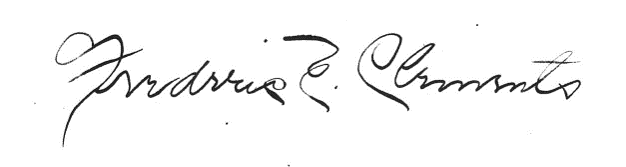
Clements could command assent to his views by means of his strong character. You can see that character even in his signature, which I scanned from an actual letter that I have since sent to the Ecological Society archives.

Starting with scientists such as Henry Gleason, many plant ecologists criticized the Clements view of ecological climax. Gleason said that there were no discrete plant communities. Each species of plant had its own distribution. What we call a forest was where many forest species of plants happened to have overlapping individual distributions.

The plant ecology laboratory of Fakhri Bazzaz, where I got my Ph.D. in 1987, was so strongly influenced by Gleason’s viewpoint that he called it The Gleason Laboratory. We thought it was kind of funny that Clementsian ecologists would refer to an oak forest as a Quercetum (as if, like a species, it should have a Latin name), a pine forest a Pinetum, etc.

But maybe Clements was on to something, though he could not have understood why. Recent research by ecologists such as Suzanne Simard has shown that an entire forest—even the different species—can be interconnected by means of mycorrhizae, the fungi that often live in roots. Hormone messages, minerals, even water and calories, can pass through these connections. In this way, a forest can really be an interconnected whole, in which some of the plants take partial care of other plants the way some organs of your body take care of others. She focused on coniferous forests with birches and alders. While I remain unsure about, say, a cross-timbers oak forest being an interconnected net of mycorrhizae, I can think of several ways in which an alder thicket, such as those on the Blue River that I have studied, form an integrated unit. They live in a habitat where floods frequently wash away the soil, and where underground connections between the plants might be particularly valuable.

Being trained in a lab that saw a forest as individual trees, I resisted Simard’s viewpoint a little at first, and then when I became convinced of it, it was a new revelation to me. Although Clements did study fungi (and wrote a book about them), I have found no evidence that he understood mycorrhizae as a method of making an oak forest into a Quercetum. But if he were alive today (he died in 1945) and read Simard’s book, he might have said, “Told you so.”

Among the letters now at the Ecological Society archives, I ran across copies of correspondence between University of Illinois ecologist Arthur Vestal and other prominent figures in the history of ecology, not only Clements but also Henry Cowles, Cornelius Muller (whom I met), and Liberty Hyde Bailey, who (as author of The Holy Earth) was a big thinker to rival Clements. These were interesting though not significant documents. They show the humorous and human side of these prominent scientists. In the letter from Clements to Vestal, which contained the signature above, Clements was urging Vestal to get a portable typewriter to take with him into the field. It was much better for taking field notes than paper, which can get damp. You can carry a portable typewriter right out to the places you are studying. In another letter, Vestal wrote to Charles Shull that “You will think me a reprehensible discombobulator for not sending you the seeds…” In another letter, Vestal lamented that, with the beginning of the Fall 1926 semester, he was in a disagreeable mood because, instead of having time for his beloved research, he had to teach 200 freshmen. (I enjoyed teaching before my retirement, but many scientists do not.)

These great minds, fumbling through issues that we today take for granted, are now lost to the general awareness even of other scientists, although a few science historians will run across their archives. But these old scientists helped form the ground upon which we now build our work. It’s just that, sometimes, we might have to do a little deconstruction (for example of the idea that each tree is a separate individual struggling for its own existence) before we can continue our construction.

Monday, August 1, 2022

Climate Crisis: Where Should I Live?

Despite the recent passage of a Senate bill, the U.S. is still making almost no response to the challenge posed by global climate change.

Separate from this, I plan to move to northeastern France for family reasons. This by itself is a decisive reason for me to move there.

These situations have allowed me to think about where I would rather live—northeastern France vs. Oklahoma—during the upcoming inevitable worldwide climate crisis, and where I would prefer that my grandchildren grow up. These are personal reasons, but some of them may be useful to the rest of you. (I never post essays on this blog that are only of personal interest to me.)


(Photo from The Guardian)

A. Direct responses to climate change

1.     I want to live somewhere away from the coast, where sea level rise is already causing problems. Oklahoma and northeastern France are both equal in being far from the nearest coastlines. Conclusion: America is about the same as France in this regard.

2.     I want to live someplace that is not prone to floods or droughts. Again, Oklahoma and eastern France are equivalent in this regard. Both have occasional severe floods in recent years, as well as droughts and wildfires. In France, the wildfires are in the south. Conclusion: America is a little less safe than France in this regard.

3.     I want to live someplace where heat waves are currently brief. Here, northeastern France has the advantage that their canicules and vagues de chaud are shorter than in the U.S. Conclusion: America is a little less safe than France in this regard.

4.     I want to live someplace that is not utterly dependent on fossil fuels. Though Europe still largely depends on fossil fuels, such as gas from Russia, there are more alternative sources of energy there than in America, on a per-capita basis. This includes nuclear energy, which is common in France. The stresses of international energy politics will have less effect on France than on America in upcoming decades. Conclusion: America is a little less safe than France in this regard.

5.     I want to live someplace with robust agriculture, since droughts and storms will inevitably reduce agricultural production and national food security. American agriculture is famous for its agricultural output, but it is almost entirely dependent on fossil fuel inputs for energy and fertilizer, and to pump groundwater. An interruption of transportation would hobble American agriculture. France has a large agricultural output (it seemed to me that Lorraine was almost one big wheat field, and maize is common in Alsace). A major contributor to stability of food production is farmers’ markets, which are much more common in France than in America. However, agricultural production in France, even the wet part, has been hit strongly by recent droughts. Conclusion: America is a little less safe than France in this regard.

B. Indirect effects of climate change. As detailed in Christian Parenti’s book Tropic of Chaos, the world already has many threats to peace and security, and many of these are related to environmental disasters such as drought. Climate change will exacerbate these problems that already exist. For example, there will be even more climate refugees crossing national borders than at present.

1.     I want to live in a society in which people are willing to give up a little personal comfort for the common good. America is not such a place. Almost a third of Americans have refused to do anything, anything at all, to reduce the spread of covid. Fortunately, the public spirit of the remaining two-thirds (vaccines, masking, social distancing) has brought about the evolution of milder viruses.

a.      Would Americans be willing to use less air conditioning, less heating, or less water in order to prevent a society-wide shortage? I do not think so. Europe is already much more frugal in their use of resources than America, and, to compensate for the reduction in Russian gas supplies, has indicated a willingness to use  a further 15 percent less. In both places, whenever you flip a switch or turn on a faucet, it is called “demand,” as if you insist to the death on your right to use as much as you want, regardless of your neighbors. But in America it really is a demand. Conclusion: America is much less safe than France in this regard.

b.     In America, we insist on the right to create as much public nuisance as possible, especially noise and litter. My house in Oklahoma is right under a flight path for vintage airplanes, which fly low overhead all day every day and sometimes half the night. In Oklahoma, we have (by my repeated count) a hundred pieces of garbage for each mile of highway. France also has bruit and déchets sauvages, but not nearly as much. At least in northeastern France, people are quiet and polite, except in Paris. Conclusion: America is worse than France in this regard.

2.     I want to live someplace with lower crime. This is because, as economic stress spreads worldwide, crime will increase everywhere, and I want to start from a lower threshold. Clearly, France is safer in this respect. I want to live someplace with fewer guns. The French have few; but in Oklahoma, gun ownership is epidemic. It is illegal for a judge to order a mentally unstable person to be denied gun ownership. Recent Congressional legislation has helped a little. Conclusion: America is much less safe than France in this regard.

3.     I want to live in a society without underlying racism. Although northeastern France has Nazi sympathizers who occasionally spray-paint swastikas in public places, the U.S. also has this problem, in addition to frequent police shootings of blacks, and mass shootings that are absent from most other parts of the world. In France, Arabs are a minority with whom the dominant culture has friction. But in America, the friction between whites and blacks, and whites and Hispanics, is greater. France has no equivalent of the utter suppression of Native Americans. Racism, all over the world, will get worse. Conclusion: America is much worse than France in this regard.

4.     I want to live someplace with good public infrastructure. I look forward to not having to own a car or drive. In America, you pretty much need a car unless you live in a rest home. This will become more important as gas becomes more expensive. American infrastructure repair is more expensive than in France because France simply does not have as many big pickup trucks (I don’t remember seeing any), although they do have commercial trucks (les camions). Conclusion: America is worse than France in this regard.

5.     I want to live someplace that has no possibility of rulership by religious fundamentalists. So-called Christian Fundamentalists get their way on almost every issue in America, especially in Oklahoma, where a single fundamentalist teacher can get a whole school system downgraded. France has Fundamentalist Muslims, but they have no chance of controlling national politics. Conclusion: America is much less safe than France in this regard.

6.     I want to live in a country that is at peace with its neighbors. Europe is famous for its seamless union of nations. France’s problem with illegal immigration from the south, across the Mediterranean, is less than America’s problem with illegal immigration not only from Mexico but all of Central and South America, without a sea to slow it down. Illegal immigration will get worse with global warming, more so in America than in France. Conclusion: America is much less safe than France in this regard.

7.     I want to live in a country that is not threatened by Russia, led by the obviously insane Vladimir Putin. All of Europe is in danger from him, while America is protected by an ocean. However, Europe is less likely to be a Russian nuclear target. One of the top targets is right here in Oklahoma. Conclusion: America is about the same as France in this regard.

8.     I want to live in a country that is not totally dominated by major corporations. In France, corporations have more influence than individual citizens, but the problem is worse in America, where at least one corporation has stated (according to This Changes Everything by Naomi Klein) that global warming and its resulting threat of international conflict would be a great opportunity to sell weapons. Conclusion: America is much less safe than France in this regard.

One of the things I will miss about America is the number of spectacular places to travel, especially the diversity of natural areas. America has everything from deserts to forests to alpine tundra. But, fortunately, I did a lot of traveling before retirement age. I been everywhere, man. Now, though I am not elderly, I am old enough to find travel stressful. France has forests in the north and dry scrublands in the south, a much diminished range of landscapes than in America. Relative to area, both countries have about the same amount of beautiful coastline. In France, I can get to lots of nice places without a car. I would be really bummed out if I knew that, in moving to France, I’d never get to see the giant sequoias of California, of which France has no equivalent. Fortunately, I have walked among them about a dozen times. I’ll have to be content with the memories.

I would be moving to northeastern France with my family anyway. But, in a traumatic future of global climate change, I have found twelve ways in which France is at least a little better than America and two ways in which the two countries are equivalent. I found no examples in which France was worse.

There are numerous things about France that many Americans would not like, but which do not bother me. I can summarize these ways: “In France, taxes are high and life is good.”

Moving to a new country, with a new language, is difficult, and it is not a reasonable solution for most of you. But think about it.

Tuesday, July 26, 2022

Religion Allows No Gray Areas of Uncertainty (as in Abortion)

Nearly everything on Earth (and probably every place else in the universe) has areas of uncertainty between opposites. For example, there are plants, and there are animals, but there are some protists that could be considered neither one nor the other.

But religion is in the business of creating absolute distinctions. You are either going to Heaven, or to Hell; something is either sinful, or it is not; there are the sheep, and the goats.

One recent example of the difference between science and fundamentalist religion involves abortion. I have written very little about abortion, since I know little about it, and my opinions have little validity. I will let other people get angry on one side or the other. I am more interested in the light band of grayness between the two sides. Here are two relevant stories.

A Texas couple looked forward to having a child and were overjoyed with preparation for its arrival. Then, mid-pregnancy, an unthinkable tragedy occurred. The woman’s water broke, and all the amniotic fluid was lost. The fetus was thus doomed to death. But Texas has a heartbeat law. Abortion is murder if a heartbeat is detectable. In this case, the fetus still has a heartbeat, and under Texas law a doctor cannot abort the fetus. The woman has to carry the fetus, which has no hope of survival (unless God performs a miracle), perhaps risking her own health, until the heartbeat stops, something that could take a long time. What kind of law would insist that a woman carry a fetus until it inevitably dies? Only a law that attempts an absolute definition of pregnancy and allows of no exceptions, that’s what.

In Ohio, a nine-year-old girl was raped, and became pregnant. But Ohio law forbids abortions once a fetal heartbeat can be detected. She had an abortion in Indiana. What kind of law would force a now ten-year-old girl to carry through a pregnancy from a rape? This assumes that her body would even be capable of handling this. Only a law that attempts an absolute definition of pregnancy and allows of no exceptions, that’s what.

I am not saying whether or not a state should or should not have an anti-abortion law. But it is clear to me that individual exceptions must be allowed. But individual exceptions are something that fundamentalist religions will not allow.

The only thing I am absolutely sure about is that we can trust the women. A mother’s love is a force of nature. Mothers are not looking for a chance to kill their fetuses unless an old white man points a gun and tells them not to. Abortion is an act of desperation, as the above examples and thousands of other news items illustrate.

Among other things, life is about gray areas of uncertainty. An absolute light/dark distinction is a characteristic of death. Science fiction writer Clive Staples (C.S.) Lewis made this distinction in his Perelandra novels. In these novels, the forces of evil wanted to make everything black and white, as on the Moon; but on Earth, there is a lot of penumbra. Many religious fundamentalists today would side with Lewis’s forces of evil. But Lewis was a Christian and used to be, at least when I was younger, a very popular Christian writer. Times, apparently, have changed, or at least Christianity has.

Friday, July 8, 2022

Are Scientists Saving the World, Or Just Making Work for Themselves?

Ecologists have a lot to do. We are busy studying a rapidly-vanishing natural world and trying to figure out how to save it. But I am increasingly frustrated because a lot of “ecological research” is just a repackaging of what we already know, and which can have no easily-imaginable impact on saving the natural world.

What we need more of is research such as what I am now finishing—a study that demonstrates that temperate trees are opening their buds sooner in the springtime due to global warming and doing so at an amazing rate. My data set has 6,068 observations, all of which I made individually. They show that Oklahoma deciduous trees (in this case, of 22 different species) are opening their buds on the average one day earlier each year. This makes them more vulnerable to the occasional late-spring frosts such as the deep freeze that descended upon Oklahoma and Texas in February 2021. Back when buds opened in March, such a freeze might have had little effect, but buds are now opening in February, and the effect of the freeze on them was profound. I know many other scientists, such as Carol Augspurger, recently retired from the University of Illinois, who are also conducting important research.

I very much doubt that my findings, or Carol’s, would make any difference to politicians, who pay attention only to the contributions made to them by oil corporations who want us to burn baby burn as much carbon as possible, regardless of what the effects might be at some future time—or, as we now know, what the effects might be right now. Oil executives are rich and do not live where wildfires or hurricanes can harm them.

But I ran across a scientific paper—alas, there are many papers like this—in which 12 authors wrote about a phenomenon that they think they discovered called nonstationarity. [https://esajournals.onlinelibrary.wiley.com/doi/pdf/10.1002/fee.2298] What, you may ask, is nonstationarity? It is the confounding of changing properties that govern ecological phenomena. Ecological systems, they claim, are under constant change and exhibit spatially and temporally varying trends. Do you follow me? They claim that ecological research needs to accommodate spatial and temporal variability in ecological patterns and processes.

All of which we already knew. The authors just developed some new software to study it differently. No new data, no new discoveries, just a new kind of analysis that tells us the same things that we already knew. They had no new data about real trees, or real birds, or real lakes, or real oceans.

What is an example of temporal nonstationarity? The fact that tree rings are sometimes thicker and sometimes thinner. They even have a photograph of some tree rings to prove their point. We have known this for almost a hundred years. It is very interesting, but not new. They claim that their work is “key to…translating findings to local policies and practices.”

Politicians, interested only in money, would not be interested in the results of my analysis of 6,068 budbursts and their climatic correlates. But they would be utterly hostile toward the idea of professional ecologists and academics using taxpayer money to repack old news into new conglomerates. The authors list six National Science Foundation grants that went into their paper. The authors came from numerous academic institutions and even from a taxpayer-funded National Laboratory. I suspect that the main effect of this paper is to advance the academic careers of the authors. The paper was prominently published by the Ecological Society of America, the major scientific society of ecologists, which should have a better idea of what ecologists should spend our time doing.

Friday, July 1, 2022

New Video: When is a Leaf a Leaf?

In a new video, Darwin looks at leaves—and leaflets and pinnae. He finds an evolutionary puzzle here.

We all think we know what leaves are. They are the (usually) thin green structures on plants that allow rapid photosynthesis. I, like many other botanists, have studied the plasticity of leaf thickness and size in response to sun and shade. Leaves on individual plants grown in the shade are thinner than those grown in the sun; that is, they have fewer layers of photosynthetic cells. Each cell, however, has more chlorophyll. Therefore, even though a sun leaf and a shade leaf may have nearly equal amounts of chlorophyll per square centimeter, and appear equally green to you, the shade leaves have much more chlorophyll per gram than the sun leaves. Shade leaves tend to be bigger, also. Plant species that grow down in the shade tend to have bigger leaves than plant species that usually grow out in the sun. I studied this pattern in the velvetleaf plant Abutilon theophrasti (Rice, S. A. and F. A. Bazzaz 1989. Plasticity to light conditions in Abutilon theophrasti: comparing phenotypes at a common weight. Oecologia 78: 502-507).

But this argument applies equally well to other photosynthetic surfaces. In many plants, each leaf consists of three or more leaflets. In the video, Darwin explores the leaflets of nandina, a common garden shrub. Its leaflets are divided into even smaller surfaces, known as pinnae.  Leaflets can be larger or smaller, thicker or thinner, depending on their growth environment.

Natural selection favors a flexibility of photosynthetic surfaces. But, it seems, it does not matter whether these surfaces are leaves, leaflets, or pinnae. Natural selection works on whatever variation happens to be available. Oaks do not have compound leaves; natural selection favors flexibility of leaf area in oaks. Plants in the legume family frequently have leaves that consist of leaflets or leaflets that consist of pinnae. In this case, natural selection favors flexibility of leaflet or pinnae area. This is an example of what has been called the phylogenetic effect: natural selection works within the limits of the variation that is available to it, which might be limited by the evolutionary ancestors of the population.

Why do oaks have leaves but nandinas have pinnae? Maybe it is just because of who their ancestors were.