Friday, September 30, 2022

Beware of Generalizations: A Leaf Story

Here is another generalization that botanists often make. It is the subject of a Darwin video that I just posted. As in the previous example, this generalization is based on patterns and facts of nature.

The leaves of plants (whether individuals or species) that live down in the shade of the deciduous forest tend to have thin leaves. There is a perfectly good reason for this. If a plant produced thick leaves down in the shade, it would be a wasted investment, since the light is not strong enough to penetrate entirely through a thick leaf. Thus, the chlorophyll in the cells near the bottom of the leaf would not be able to make very much food through photosynthesis. Also, thick leaves tend to have thick layers of wax on its surfaces, which is a protection against drying out. But leaves down in the shade seldom experience very dry conditions. It follows, then, that plants with thick, waxy leaves are adapted to living in open, sunny conditions. Ninety-nine times out of a hundred, this generalization holds true.


But there are exceptions. One of them is the American holly, Ilex opaca. It has thick, waxy leaves, but this species is found mostly in the shade of American deciduous forests. Its leaves are, on an area basis, much heavier than other forest floor plants; most of the plants have leaves that weigh about 2 milligrams per square centimeter, while holly leaves are about 5 milligrams per square centimeter.

It turns out there is a perfectly good reason. This species of holly is evergreen. It keeps its leaves even when the deciduous trees overhead have dropped theirs. Its leaves, therefore, get bombarded not with spring or summer sunlight but with winter sunlight. In warm forests such as those in Oklahoma, where I live, a winter day might be warm enough that the holly could benefit from making food through photosynthesis in the bright winter sun. In colder areas, the thick wax might save the leaf from excessive water loss, especially if the underground water is frozen and unavailable to the leaf.

The leaves of most forest understory plants are adapted to the shade of spring and summer, but some are adapted to the full sunlight of winter.

This leads naturally to a consideration of evolutionary constraints. On the forest floor, deciduous plants are adapted to spring and summer, while evergreens are adapted to winter. A plant cannot adapted to both summer and winter, at least not very well. There is little doubt that holly leaves are not very efficient at making food in the seasons when the trees overhead shade them. But when the leaves drop, holly’s evergreen leaves can make food when the other plants cannot, in late fall, winter, and early spring. This is the evolutionary constraint: the plants with the greatest evolutionary fitness are those that adapt to one, or the other; they cannot do both. In some cases, such as the little herb Geum canadense, the plants produce relatively thick, evergreen leaves near the ground, which persist for over a year, but each year the stem grows into the air with thin leaves. The whole stalk then dies in the fall.

“Thin leaves in the shade” is one of the most widespread generalizations in nature; but the exceptions tell us a lot about ecology and evolution.

Tuesday, September 27, 2022

Beware of Generalizations: A Pollination Story

Botanists teach that wind-pollinated plants produce lots of pollen and do not bother with nectar or pretty petals. Nectar and pretty petals attract bees, which carry pollen efficiently between one flower and another. Wind-pollinated flowers, however, produce lots of pollen and let the wind carry it. That’s the story. That’s what everybody teaches (I did) you will find in every book (including mine). And, in general, it is true.

But keep your eyes open for exceptions to the rule. I was out for a hike, not expecting to see anything out of the ordinary. But I kept my eyes open. This is what I saw:

This ragweed (Ambrosia trifida) produces lots of pollen, but no nectar or colorful petals. Bees are not as stupid as we sometimes think. This honeybee found the pollen, without needing to be attracted to the flowers. She started stuffing as much pollen as possible in her pollen buckets. She probably went back to the nest to deposit bee bread, but no nectar.

I assumed that I could tell what pollinates a flower by just looking at it. If animals such as bees pollinate it, it should have colorful petals. Consider willows. Even though the male flowers have very inconspicuous petals, they have big anthers full of pollen. The female flowers also have very inconspicuous petals. I assumed willows were wind pollinated. But it turns out that the flowers have nectar, and bees can smell it. It is bees that pollinate willows.

Close and repeated observations reveal the truths of nature. Quick glances and generalizations do not.

In the next essay, I will tell a story about another generalization, involving leaves and photosynthesis, which turns out to have exceptions.


Saturday, September 17, 2022

War Against Farmers and the Land

Vandana Shiva, a prominent author in India, titled her essay “Globalization and the War against Farmers and the Land,” in The Essential Agrarian Reader edited by Norman Wirzba (2003).

At first this title seemed to be hyperbole. But she was serious that international agribusiness corporations were actually at war against farmers (that is, poor farmers) and the land. And the more I read, I became convinced that she was right. The corporations, of course, do not see themselves in this way. The essay is outdated only in the numbers that it cites; the basic situation is little changed since 2003.

The kind of agriculture that is promoted by big agribusiness around the world is the kind that requires farmers to buy patented seeds and to use expensive inputs, such as irrigation water, pesticides, and fertilizers. The fields are monocultures, which consist of only one type of crop (the cash crop). There are many poor farmers (especially in India, about which Shiva knows a lot) who cannot afford these purchases or, if they do, they go into debt; and each round of harvest makes them fall deeper and deeper in debt. (I cannot help but think of Sixteen Tons, the song about American coal miners who worked hard only to find themselves deeper in debt every year.) As a direct result of being overwhelmed with debt, Shiva indicates, many farmers in India have committed suicide, often by drinking pesticides. Farmers who are not quite so desperate just sell their kidneys. Agribusiness may provide cheap food for you, American consumer, but brings unspeakable misery to poor farmers who raise it. The situation is little different in Mexico, according to Angus Wright’s book The Death of Ramón González, where farm workers endure (or don’t live to endure) pesticide poisoning so that Americans can have cheap fresh vegetables in winter.

Of course, agribusiness corporations will not say “We make huge profits off of human suffering.” Instead, they have to come up with a justification, and to do so they use creative numbers. Here are some examples.

First, the corporations need to convince people that monocultures (one type of crop) have superior yields to polycultures (different crops mixed together). According to their published figures, monocultures always outproduce polycultures. But the way they calculate these yields is on an area basis: tonnes of yield per hectare. They are hoping that we will not notice their mathematical sleight-of-hand. Of course a hectare of just wheat will have higher wheat yields than a hectare of wheat mixed with beans. All other things being equal, a hectare of monoculture wheat will yield exactly twice as much wheat as a hectare that is only half wheat. That is like saying that nobody lives in your house because, at this moment, your bedroom has no one in it. But if you calculate crop yields over the whole countryside of wheat and beans, polycultures almost always outproduce monocultures. This, according to Shiva, is the correct way to calculate the yields. She calls this the land equivalent ratio (LER). In India, the overall LER is 1.62. That is, polycultures yield 62 percent more than monocultures. Or, if you calculate a polyculture’s yield just on the basis of the actual area used by a particular crop, the yield is 62 percent higher. A cassava/maize/groundnut polyculture outproduces monocultures of these three crops by a factor of 2.51.

Sometimes, polycultures (that is, traditional native gardens) can outproduce monocultures by an even greater factor. Shiva gives an example of terraced fields in the Himalayas, which produce jhangora, marsha, tur, urad, gahat, soybean, bhat, rayans, swanta, and kodo. (You’ve probably never heard of any of these, except soybean, but the people eat them.) Shiva notes that the polycultures produce six times more yield than monoculture rice even during dry years. I would have said, especially during dry years, because different crops have different water requirements, and a drought is unlikely to kill all the different kinds of crops, thus leaving some food—and income—for the poor farmers.

The biodiversity in traditional polycultures can be breathtaking. Shiva notes that in sub-Saharan Africa, farmers (mostly women) cultivate 120 different kinds of food plants in the spaces alongside the cash crops. Of course, this reduces the yield of the cash crops a little, but not as much as you might expect, since the food crops compete only partially for light and moisture with the cash crops.

To top it all off, the monocultures are for cash crops intended for other people, not the farmers, to eat. Would a monoculture of kodo out-yield the kodo grown in polycultures? Nobody knows, since the agribusiness corporations do not sell kodo seeds, and nobody knows whether or how much kodo yield would increase with fertilizer and pesticides.

Clearly, agribusiness monoculture would not survive long if its success depended on feeding local people. Then why does it persist? One reason is that agribusiness has convinced international lending agencies that the only profitable kind of agriculture is based on irrigation, fertilizer, and pesticide. The loans, therefore, are for groundwater pumps and chemicals. If you just want to raise food for your village, it is hard to get a loan, and even harder to pay it back. Recently, mostly since Shiva wrote this piece, microcredit has become available to many small farmers, craftspeople, etc. These are very small loans that can be paid back when a farmer, using whatever methods she prefers, earns profits from extra crops or from crafts. The developers of the idea of microcredit (Muhammad Yunus and the leaders of the Grameen Bank in Bangladesh) won the Nobel Prize for it in 2006. Despite the success of microcredit, there is still a long way to go.

Polyculture on small farms is more profitable, though not to the agribusiness corporations that sell the inputs. In India, according to Shiva, farms up to five acres earned 735 rupees per acre, while farms 35 acres and over earned 346 rupees per acre. These numbers are different now, but the difference is probably even greater today.

Polycultures feed local people, but the very purpose of monocultures is to export food from countries that have a lot of poor people to industrialized countries such as the United States. China is now appropriating land in poor countries to get food and raw materials from them.

Shiva also considers agribusiness to be at war with the land because high-input monocultures often require irrigation, which contributes to salt buildup; pesticides and fertilizers poison the runoff water.

One possible problem is that, as fewer people each year want to farm, the remaining farmers must cultivate more acres. In doing so, they may need more inputs and will be unable to give as much attention to each acre.

Agribusiness says, we are just trying to feed the world. Defenders of small farms say, we are just trying to feed the world, and we can do it better than agribusiness.

Friday, September 2, 2022

Oklahoma, Land of Boastful Ignorance

Are you planning a move, or is your company planning a relocation? Companies like to relocate their employees to states that have a good quality of life. For employees who have kids, this means a good educational system.

But don’t come to Oklahoma.


According to a recent report, Oklahoma ranks 40th for overall child well-being. I think you or your company’s employees would not want to raise your kids here, unless you can afford a private school.

Oklahoma ranks 45th in childhood education. The major reason for this is (according to the Democratic candidate, and one of two Republican candidates, for state superintendent) a teacher shortage. It is difficult to recruit new teachers or to keep old ones. Why?

One reason is that teachers are not paid very well, in comparison to other jobs or states. But many or most teachers enjoy teaching and would not quit just because of low salaries. The Oklahoma teachers’ strike in 2018 was primarily over school funding, not salaries, although the state did increase their salaries that year.

One thing that discourages teachers in Oklahoma is that they are in the crossfire of conservative anger. If parents do not want their children to have to wear masks during a pandemic, it is the teachers to whom the parents complain, sometimes abusively. If teachers dare to mention that people of color (especially Native Americans in Oklahoma, which used to be Indian Territory) have experienced oppression, parents can complain that those teachers have violated an actual state law (HB1775) that prohibits the teaching of historical oppression of people of color. Ostensibly, the law is just against “critical race theory,” but teachers often avoid all mention of racially charged historical events like the Tulsa Race Massacre of 1921 in order to stay out of trouble. If teachers even mention LGBTQ, they might find themselves in trespass of SB615. And if a science teacher mentions evolution…well, they just don’t.

Teachers are tired of having ignorant politicians dictate what they should teach and are tired of being the brunt of conservative hatred. There are other jobs at which they can use their talents, that pay more, and at which their opinions can remain private.

The solution, so far, has been to hire teachers on “emergency certification.” This means that the teacher needs no qualifications other than, I assume, to not be a criminal. If they have a college degree in a subject, but no education courses, they can get “alternative certification.” But for emergency certification, you don’t need the subject matter courses either. From what I could tell from state websites, the emergency teacher has to submit a portfolio of experience. But approval is up to local school boards.

So if a qualified teacher leaves, an emergency teacher can replace her or him. This person could then teach creationism, global warming denialism, and hatred (or at least mild disgust) towards LGBTQ people. While they cannot (I think) teach racism, they can teach that there are no problems with racism that require any change in societal thinking.

And more change is likely to come. One of the Republican candidates for state superintendent openly proclaimed that teachers should be required to teach that America is the best country that has ever existed in the history of the world.

Already, 3,600 out of 45,000 teachers in Oklahoma have emergency certification. This downward slide can only favor the indoctrination of children with extreme conservative views. This is already a major problem for recruiting new employees into the Oklahoma work force. For every new company moving to Oklahoma, another leaves.

Where there is the worst, there is also the best. Many high school biology teachers are members of NABT, the National Association of Biology Teachers. They have a new president each year. Three of the presidents in recent decades have been from Oklahoma. All three were high school teachers, though they are now on college faculties or in administrative positions. Three! This shows that, in Oklahoma, to be a good science teacher, you have to be motivated almost as much as a missionary.

I have little personal interest in this, as I have retired and plan to leave Oklahoma. I was just hoping that I could feel good about not only having been born in Oklahoma, having spent most of my career in Oklahoma, and about my Oklahoma family roots that go back six generations. But instead I will have to be at least a little bit ashamed.

Friday, August 26, 2022

The Cost of Peace

I think that peace is always better than war in every possible way, including economic benefits. But peace comes with lots of costs, and we should not let them take us by surprise. Here is an example.

Ethiopia has, it seems, always been embroiled in civil war. The Tigray War continues, though it is in the news less than at the beginning of the year. It would seem that everyone would want Ethiopian civil wars to end.

Ethiopia has 1.8 million hectares of irrigable farmland, very little of it being currently used. If civil war ended, they could irrigate most of this land. Right now, nobody would invest in Ethiopian infrastructure that might be destroyed by conflict at any moment. Peace would encourage international investment.

But international investment would not be absolutely necessary. The people could build low earth dams (called micro-dams) that would trap a lot of water in small irrigation ponds. If the only war problems were international, these micro-dams would not constitute a military target—too many of them.

Ethiopia is the source of 86 percent of the water that flows through the Nile. Right now, most of that water is claimed and used by Egypt and the Sudans. But if Ethiopians built all the possible micro-dams, they could use 7.2 billion cubic meters of water per year and could store 50. This would vastly reduce the water flow in the Nile. Egypt’s plans to irrigate large new areas would be jeopardized. The Aswan High Dam is a very visible military target, although Ethiopia could probably not endanger it. War, however, might be unavoidable.

This is an example of how peace can cause more war. If you add on top of this the inevitable droughts, which make people and nations feel desperate, you have an ugly situation. And that is in a part of the world we pretty much ignore.

Peace is worth almost any cost, but these costs must not take us by surprise.

Thursday, August 18, 2022

How We Know Stuff

Now here is a topic about which I could write without end. But I am going to use just one small example, about which I am nearly certain you have not heard.

A few decades ago, I bought an old, torn-up book from a cheap bookstore in Champaign, Illinois called Acres of Books. It (not to be confused with the California store by the same name) seems to have gone out of business. I bought it for five cents. It was Parley’s Universal History, published in 1886 as a children’s summary of world history from the viewpoint of triumphant white American males. It was meant as a catechism for students to recite the facts of history. It started with Adam and Eve being driven out of the Garden and ended with Abraham Lincoln and the glorious triumph of the Grand Army of the Republic over the Confederacy which, to the author, was the climax of human history.


Supposedly today we value critical thinking over rote memorization, although in conservative religious schools the latter may still predominate. Here in Oklahoma, teachers are afraid to question creationism, global warming denialists, anti-vaxxers, and those who deny that the Tulsa Race Massacre happened. It makes me wonder if we have made much progress since 1886. Remember, this was almost thirty years after the Origin of Species.

But the most interesting thing about this shabby book is that one of the students, almost certainly an adolescent boy, filled the book with hundreds of pencil sketches, mostly of a woman who must have been his teacher. This was back in the days of long skirts, bustles, frilly blouses, and fancy hair. These doodles showed a fixation upon and exaggeration of the woman’s considerable bust. None of the drawings showed any bare skin except the face, and the face was often unclear. A hormonal adolescent can fixate upon anything even remotely sexual.


My point is that the boy was not thinking critically or carefully about what he was being taught in the book. He just soaked it up. His mind was on other things.

And this is how we come to believe many things. We soak them up uncritically while our minds are wandering over other things.

Wednesday, August 10, 2022

Was Clements Right for the Wrong Reasons?

Frederic Clements was an important plant ecologist of the early twentieth century. His influence virtually dominated the development of plant ecology. He understood plant communities (such as a deciduous forest, or a desert) as being analogous to organisms, and the process of ecological succession (recovery of a plant community from disruption) as being analogous to a body healing itself. Succession reached a “climax” at a single vegetation type that was best suited to the local environment.

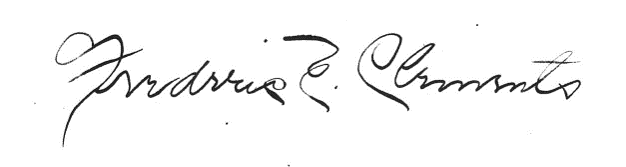
Clements could command assent to his views by means of his strong character. You can see that character even in his signature, which I scanned from an actual letter that I have since sent to the Ecological Society archives.

Starting with scientists such as Henry Gleason, many plant ecologists criticized the Clements view of ecological climax. Gleason said that there were no discrete plant communities. Each species of plant had its own distribution. What we call a forest was where many forest species of plants happened to have overlapping individual distributions.

The plant ecology laboratory of Fakhri Bazzaz, where I got my Ph.D. in 1987, was so strongly influenced by Gleason’s viewpoint that he called it The Gleason Laboratory. We thought it was kind of funny that Clementsian ecologists would refer to an oak forest as a Quercetum (as if, like a species, it should have a Latin name), a pine forest a Pinetum, etc.

But maybe Clements was on to something, though he could not have understood why. Recent research by ecologists such as Suzanne Simard has shown that an entire forest—even the different species—can be interconnected by means of mycorrhizae, the fungi that often live in roots. Hormone messages, minerals, even water and calories, can pass through these connections. In this way, a forest can really be an interconnected whole, in which some of the plants take partial care of other plants the way some organs of your body take care of others. She focused on coniferous forests with birches and alders. While I remain unsure about, say, a cross-timbers oak forest being an interconnected net of mycorrhizae, I can think of several ways in which an alder thicket, such as those on the Blue River that I have studied, form an integrated unit. They live in a habitat where floods frequently wash away the soil, and where underground connections between the plants might be particularly valuable.

Being trained in a lab that saw a forest as individual trees, I resisted Simard’s viewpoint a little at first, and then when I became convinced of it, it was a new revelation to me. Although Clements did study fungi (and wrote a book about them), I have found no evidence that he understood mycorrhizae as a method of making an oak forest into a Quercetum. But if he were alive today (he died in 1945) and read Simard’s book, he might have said, “Told you so.”

Among the letters now at the Ecological Society archives, I ran across copies of correspondence between University of Illinois ecologist Arthur Vestal and other prominent figures in the history of ecology, not only Clements but also Henry Cowles, Cornelius Muller (whom I met), and Liberty Hyde Bailey, who (as author of The Holy Earth) was a big thinker to rival Clements. These were interesting though not significant documents. They show the humorous and human side of these prominent scientists. In the letter from Clements to Vestal, which contained the signature above, Clements was urging Vestal to get a portable typewriter to take with him into the field. It was much better for taking field notes than paper, which can get damp. You can carry a portable typewriter right out to the places you are studying. In another letter, Vestal wrote to Charles Shull that “You will think me a reprehensible discombobulator for not sending you the seeds…” In another letter, Vestal lamented that, with the beginning of the Fall 1926 semester, he was in a disagreeable mood because, instead of having time for his beloved research, he had to teach 200 freshmen. (I enjoyed teaching before my retirement, but many scientists do not.)

These great minds, fumbling through issues that we today take for granted, are now lost to the general awareness even of other scientists, although a few science historians will run across their archives. But these old scientists helped form the ground upon which we now build our work. It’s just that, sometimes, we might have to do a little deconstruction (for example of the idea that each tree is a separate individual struggling for its own existence) before we can continue our construction.