Showing posts with label bacteria. Show all posts

Friday, June 20, 2025

The Real Me and the Real You

My main purpose in my social media is to help you make better sense of the world and your life in it. I do this primarily by sharing my scientific understanding and my personal experiences. My social media (just two blogs, here and here, and video channel) have now had over 900,000 visits. The main traffic is from search engines. This means that most of my readers are not followers but are finding my work because they are searching for insights not about me but about the topics I write about. And that is just the way I like it.

Perhaps the most fundamental question we have about ourselves and the world is, who am I? This question is of interest not just to me, but to whoever might read this essay.

What, exactly, is the real me? There is no easy answer to this question. Each of us consists of at least two general things: the self that we want to be, and the self that we are subconsciously.

Over the first of these we have a measure of control. We can control what we think, the decisions we make, the kinds of interactions we have with people, the things we say. This is generally the self that we present to the world. Some people think this is a false face, merely an image of what we want people to think about us. But we all know it is much more than this. It is the self that we want to be, not just how we want to appear.

Over the second of these we have less control. We can generally control what we say, but sometimes we blurt things out before we have a chance to think about them. Curses, for example, come from a different part of the brain than regular speech. Most of us cannot control our dreams, either. When we experience things that make us angry or lusty, our heartbeats and breathing become more rapid, and there are other physiological responses that I do not need to tell you about, even if we try to calm ourselves down. These things make up the self that we do not want to be, not merely the things we wish to keep hidden.

Over some things, we have an intermediate level of control. For example, my blood sugar is high, enough for me to require medication but not drastic intervention. I cannot completely control it. It is my cell membranes that do not absorb enough of it from my blood. The main thing I can do is to eat less sugar. Medication and eating less sugar has reduced my blood sugar down from the crisis level it used to be. Blood sugar level is the result both of things I can control and things I cannot.

I suggest that the real me, and the real you, are the first of the two. They are the most highly developed systems in our evolutionary history. The second “self” has an ancient origin that goes back at least to the origin of the vertebrates. At least, I think so. Do fishes get angry?

Another way of dividing ourselves up into the selves we want and the selves we hide is to consider the things over which our DNA has direct control. Our DNA does not control everything about our bodies. It controls the structure of our brains, nerves, muscles, bones, and systems such as the digestive system. It controls, basically, everything that is within our epidermis and mucous membranes. But it does not control what is outside of our bodies, which includes the things that are in our digestive system.

The contents of our intestines includes not just the partially-digested things that we have decided to eat (which is under our conscious control) but also trillions of bacteria and other microbes. We cannot control what those microbes do. They metabolize, to get energy and nutrients for themselves, and eject their wastes into our intestines. These wastes include carbon dioxide (odorless), methane (odorless), and hydrogen sulfide (the smell of farts). Though we can to a certain extent influence their timing, neither we nor our DNA can control our farts. The cosmos inside our intestines is a wild world over which we have no control other than diet (yogurt helps) and medicine.

And our digestive system responds not so much to us—our nervous system, or even our DNA—as to the wild world in our intestines. When the bacteria in the food produce a lot of gas, they expand the intestine. Local nerve networks take care of what happens next. Intestinal nerves detect the expansion, then cause the smooth muscles around the intestine to start contracting, which will push the food and the farts along further down the line. One result is that when a fart is on the way, you can’t stop it. Another result is that when you gotta go, you gotta go. Your brain can control the muscles at the end of the line, the sphincter muscles, to try to hold it in, but success is not guaranteed.

So another view of yourself is that the real you is what the DNA controls, and the secret you is what your bacteria do.

So when an honest biographer says, regarding the subject, which might be you or me, “he or she tells the true story, warts and all” (maybe farts and all), this is not really being honest. Warts are caused by viruses, and farts by bacteria. Your honest biography would be what your DNA does, and what you decide to do, rather than by the random, uncontrollable activities of your bacteria or your subconscious mind.

The bacteria and subconscious mind are not always bad. Having written what I just wrote, and living a more relaxed life, both the products of the real me, have an effect on what my subconscious mind and even my bacteria do.

I hope this helps. And tell your bacteria that I said hi.


Tuesday, October 11, 2022

Scientific Fads

Science is a relentless pursuit of truth via evidence, right? Well, more so than most other ways of thinking, but scientists are still human. As explained in my book Scientifically Thinking: How to Liberate Your Mind, Solve the World’s Problems, and Embrace the Beauty of Science (what a pompous title), scientific research is specifically designed to keep human scientists from falling into the common frailties of human thought (I have a chapter about each of them).

One example is that scientists are attracted to fads just like anyone else. Here are some examples:

Before Darwin, evolutionary theories were pretty speculative and justly earned the dislike of scientists. Darwin presented not just evidence for evolution but a mechanism for how it could work. All at once, evolution became a scientific theory. (Some problems, such as the objection raised by Fleeming Jenkin, come out of the woodwork with sometimes wild speculations. Herbert Spencer’s version of evolution was quite different from Darwin’s, and has essentially no supporters today, but it was Darwin who made Spencerism briefly viable. Darwinism also opened the door for the application of evolutionary ideas in the interpretation of human history and the evolution of languages (for example, by John Fiske in his 1883 Excursions of an Evolutionist), and theological applications such as those by Henry Ward Beecher.

Once Koch and Pasteur had proven that the diseases that they studied were caused by microbes, then most medical research (about 1880-1910) focused on microbes. This was before the modern understanding of genetics. At least the focus on microbes was a welcome relief from the older concepts of demons, humours, and vapours. And we continue to be surprised by microbial influences on what we thought were simply metabolic diseases. Some researchers think that plaque buildup in arteries, leading to heart disease, may be a response to bacterial infection, and that antibiotics might be used to treat some cases of heart disease.

For a while, it was a fad for scientists to find microbial causes of every disease. The truth, it turns out, is more complicated.

Another example. When the Alvarezes and colleagues proposed that an asteroid caused the Cretaceous Extinction, the proposal was met with skepticism or worse. But as evidence accumulated, a consilience of independent lines of evidence, everyone was convinced that they were right. It wasn’t long before scientists proposed asteroid causes of other Earth events. Colleagues of Luann Becker proposed that the Permian Extinction was also caused by the asteroid that formed the Bedout Crater. The Alvarez group was able to find the Chicxulub Crater in Yucatan, from 65 million years ago; finding the Bedout Crater from 250 million years ago was not as easy, and this might be the reason the Bedout hypothesis is so weak. 

But then other scientists proposed an asteroid cause of the mass extinction of North American mammals at the onset of the Younger Dryas cooling period. Although not all of the evidence presented by Firestone and colleagues has been discounted, it has not proven convincing enough to change most scientists’ minds, especially since this asteroid would have hit less than 13,000 years ago. Scientists (that is, not including me; I am no expert in this field) still prefer to say that the Pleistocene Extinction was caused by an interaction of global warming after the most recent ice age and overhunting—though neither of these factors could alone explain the extinction. Asteroids were a fad.

As with science, so also with technology. Most agricultural researchers, working in labs well-funded by the government and private industry, have jumped on the bandwagon of GM and claim that world hunger can be solved by genetic modification of crops. There are even more scientists, and they are more certain, since the development of CRISPR enzymes. I am not one of the GM technophobes (though I respect those such as Gary Paul Nabhan who do fear it), but our world food problem is way too complex for genetic modification to solve it and, by concentrating the power of agribusiness, will probably make the problem worse, as I explained in previous essays. Genetic modification, and its detractors, are both fads.

I can only hope that the scientific method will help scientists to avoid the pitfalls of human thinking right when everyone else needs our guidance.

Wednesday, January 5, 2022

A Future Full of Plagues


Happy New Year, y’all.

The late nineteenth and the twentieth century was an amazing time of medical progress. Nearly every disease at least began to submit to scientific eradication. Not just infectious diseases, but cancer and nutritional diseases also. It seemed as if nothing could stop the progress of medicine.

But, it was apparent by the late twentieth century, one thing could stop the progress of medicine against bacterial diseases: the evolution of antibiotic resistance. Many bacteria that cause disease (which most do not) evolved resistance against many antibiotics, rendering them obsolete. This actually occurred by the process of natural selection: resistance evolved. By the end of the twentieth century, two things became apparent. The first is that we needed to keep developing new antibiotics. The second is that we had to decrease our reliance on antibiotics.

With regard to the first, we have done an inadequate job. Private pharmaceutical companies have not been developing new antibiotics as rapidly as the old ones become obsolete. This is because new antibiotics are not profitable. When a corporation develops a new antibiotic, it has a limited time span of use. First, each patient takes the antibiotic for a limited time, usually ten to fifteen days. Second, after a few years, the bacteria evolve resistance. It is much more profitable for pharmaceutical corporations to develop and market new drugs against diseases that cannot evolve resistance, and for which the patient must take the drug every day for the rest of his or her life. An example would be depression. The result is that our “armamentarium” (medical historians like military metaphors) of antibiotics is growing smaller each year.

With regard to the second, there are clearly things that we can do. Doctors used to prescribe antibiotics with little regard as to whether they were necessary. Since antibiotics do not work against viruses, doctors began to prescribe antibiotics only after they knew the infection was bacterial, not viral, in origin. This was and continues to be a good thing. But another thing we can all do to reduce the use of antibiotics is to prevent the spread of diseases.

There are many ways to reduce the spread of disease, and everyone knows what they are. As the covid pandemic broke out, and before vaccinations were available, we were told to practice social distancing and to wear masks. These practices were very effective, so that covid incidence began to decline even before vaccinations were widely available. It is now very clear that we can reduce our dependence on antibiotics by using vaccination, masking, and social distancing to control the spread of bacterial diseases. If we do these things, the old antibiotics will become obsolete more slowly, or, if we are lucky, not at all. Penicillin almost became obsolete, but it remains effective for some uses even after almost eighty years of use.

But there are no antibiotics against viruses. For viral diseases such as the various kinds of coronavirus, we have only vaccination, masking, and social distancing. That’s it. (Well, there is one alternative: massive dieoff, in which natural selection produces a resistant population of humans. I have actually had people tell me that this is an acceptable solution to the problem.)

Political conservatives in many countries, however, have shown hostility against all three of these ways of preventing the spread of disease. The Islamic fundamentalists have been rejecting vaccination for decades, with the result that many diseases that could have been eradicated are still in the world. And now Christian fundamentalists, and fierce conservatives (often the same people) reject masking, social distancing, and vaccination with unbridled fervor. They would, literally die—and have you die, too—than to participate in any of these.

New infectious diseases will come along. They always do. And when the next one comes, millions of fierce conservatives will make sure that the disease gets a free ride to spread through the world as much as possible. It is almost as if death from covid (even their own deaths) are a badge of honor to them. If the disease is bacterial, these conservatives who would rather die than to wear a mask will get the germs to spread faster than antibiotics can be used to control them.

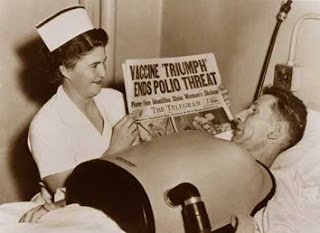
The nurse in this photo is showing a headline to a man who is confined to a ventilator because the polio virus destroyed the nerves that allowed him to breathe. The news came too late for him, but the nurse intended it as good news that, at least, the next generation of people would not have to suffer from polio. Neither of them would have guessed that millions of people would consider the polio vaccine to be evil. When Edward Jenner developed the smallpox vaccine; when Louis Pasteur developed the rabies vaccine; when Jonas Salk developed one of the polio vaccines—they could not have imagined that people would consider them evil and actively work against them.

We are, it appears, entering a new dark age of plagues. We have political conservatives to thank for it.

Wednesday, April 10, 2019

Thinking Back on René Dubos: Ecological and Evolutionary Medicine


For many years, I have been teaching a subject in general biology classes that I call the Ecology and Evolution of Disease. It includes the subject that is now called Evolutionary Medicine (it now even has its own journal). I continue to be amazed that no general biology textbooks seem to mention it.

I grew up thinking what most people still think about health and contagious disease. As Ogden Nash wrote, “A mighty creature is the germ, though smaller than the pachyderm...” It was all very simple. Germs caused contagious diseases. The solution was to kill the germs. Problem solved.

But it is not so simple, and the book that opened my eyes to the real complexity of health and disease was Man Adapting, a 1965 book by René Dubos. It was an old book when I first read it in the late 1980s. It was ahead of its time, and maybe still is.


Dubos’s main point was that health is a creative response. It is delimited by biology and evolution but it is highly personal. That is, a disease can take a different course in different individuals. Dubos said that, when we ask what man is, we should not be satisfied with the answer that he was an ape. Instead, we should think of ourselves as ecosystems in which health is the result of the proper balance of all of our physiological processes, as well as all the microbial species that call our bodies home.

Dubos wrote about how the human body is an integrated whole, and conditions of the body can alter the course of disease. For example, stress can affect the immune system, with the result that bacteria that are already present but unnoticed can flare up into disease. This is now well known. The stress of viral disease can make a person susceptible to bacterial infections such as sinusitis and pneumonia, caused by “germs” that were already present. The stress of allergies caused me recently to have severe sinusitis. We have all seen examples of people who, from stress and its related habits such as smoking, seem to always be sick. Also, Dubos may have been one of the first scientists to write extensively about how an upset to biological rhythms can result in disease, including infections.

And the effects of stress can pass on from one generation to another. A mother animal who experiences stress can have behaviorally abnormal offspring, and it might result in part from the effects of stress on the prenatal environment of the fetus.

Dubos also included a lot of information about how Old World diseases killed up to 90 percent of many Native American and Polynesian populations, because they had never evolved resistance to these germs. Why didn’t the Europeans die of New World diseases? Because there weren’t very many. America was populated by immigrants from Siberia, and Polynesia by people sailing long distances in boats. Only healthy people could have made those journeys. This opened my eyes to a whole new understanding of some parts of human history. After Dubos, many historians have written about this.

An important, and still often ignored, aspect of our body ecosystem is its microbial inhabitants. Gnotobiotic animals (born, raised, and maintained in totally sterile conditions) are abnormal. Their organs develop abnormally, and so do their immune systems. They heal more slowly from injuries.

Many parts of our bodies, especially the skin and digestive tract, harbor trillions of bacteria, most of which are harmless, and some of which are beneficial. Some of the beneficial ones produce molecules which, to them, are wastes, but to us are vitamins, especially B vitamins. In our intestines, the lactobacilli and bacteroides are beneficial, while bacteria such as the famous E. coli are usually harmless. E. coli just seem to be along for the ride. In rodent colonies with normal intestinal bacteria, kept in total isolation from the outside environment and other rodents, the E. coli gradually disappear, leaving the lactobacilli and bacteroides to dominate. But even the merely non-harmful bacteria can do us some favors by crowding out the pathogenic bacteria.

This is the ecology of disease within a human body. (There is also the ecology whereby bacteria spread from one host to another.) But evolution also plays a role. This was the book where I first read about how many disease organisms have evolved to become less virulent. For example, many diseases, such as smallpox, leprosy, and (a disease Dubos and his wife studied) tuberculosis became less and less deadly over the course of many decades even before the introduction of antibiotics and antiviral therapy. Some infectious diseases have pretty much evolved themselves out of existence. One example is the English sweating sickness, which was a severe plague from 1485 to 1551. Its main symptom was profuse sweating. Then it vanished. Perhaps, Dubos speculated, it evolved into such a mild form that nobody noticed it after 1551.

I knew he was right as soon as I read his book, because I could think of my own stories. I had read many gruesome stories about smallpox. But my own grandmother had smallpox. For her, it was a severe but not deadly disease, and did not leave pock marks when she recovered. She had become infected with a relatively mild strain of smallpox. Before the WHO began its campaign of worldwide vaccination to eradicate it, smallpox was already on its way out. I also knew this from direct experience. I grew up in Tulare County, California, after which the disease tularemia is named. It is endemic to the area, and probably everyone who lived there had gotten it. Only, for us in the twentieth century, it was a mild disease that we mistook for the flu. I did not know I had had it until I tested positive for tularemia antibodies when I was a teenager.

How can a disease evolve to become milder? The simplest explanation is that a horrible germ that quickly kills its host cannot easily spread to a new host after it kills the first host. The first host is too sick to get up and spread germs around, and everybody stays away from him if he tries. Also, some people are naturally immune to the disease, and they are the ones who survive the most often. But the main reason is that the mild germs are the ones that are successful at spreading to new hosts.

This is the evolutionary process of balanced pathogenicity. It was scientifically demonstrated by a study on a rabbit virus, myxomatosis, in Australia in the 1960s. The rabbit populations evolved resistance to the virus, and the virus populations evolved into a milder form.

I got the impression from reading Man Adapting that balanced pathogenicity was true of all infectious diseases. Of course, it is not. Cholera has not evolved into milder form, because you get it from drinking contaminated water—water that has been contaminated by very sick, or by mildly sick, people. You cannot avoid the bad germs of the very sick people, mixed in as they are with the mild germs of the mildly sick people. Also, malaria may evolve to become worse, because mosquitoes like to bite sick people who cannot shoo them away, rather than alert people who are busy. (However, Dubos pointed out, a person who is very sick from malaria will die sooner, such that the mosquitoes might bite the mildly sick people more often simply because there are more of them.)

It was this book, Man Adapting, that changed many of my views of science, making them less linear and more holistic.