One
of the things that makes humans different from other animals is that we have a
uniquely well developed sense of creating and appreciating art. I myself am
mediocre at musical composition and art, but I consider myself a good writer.
Writing, especially fiction, is an art.
But
in some cases art, including fiction, seems like a waste of time that could be
more profitably spent in some other way. But art makes us more humane; that is,
it increases our capacity for empathy and altruism, both of them extremely
important products of evolution and both of them dangerously low in the world. Almost
anything we can do to increase our sense of empathy is worth the cost. If my
writing helps to increase the sense of empathy in my readers, it was worth
doing. Below is an example.
I
have been reading recently about how white Americans have slaughtered Natives
in gruesome ways, hundreds or thousands of times. This is our white national
guilt. We need to face up to this part of our history, even if it makes white
people uncomfortable. Here in Oklahoma, it is illegal to teach anything (such
as but not limited to history) in such a way as to make anybody (that is,
anybody white) feel guilty.
One
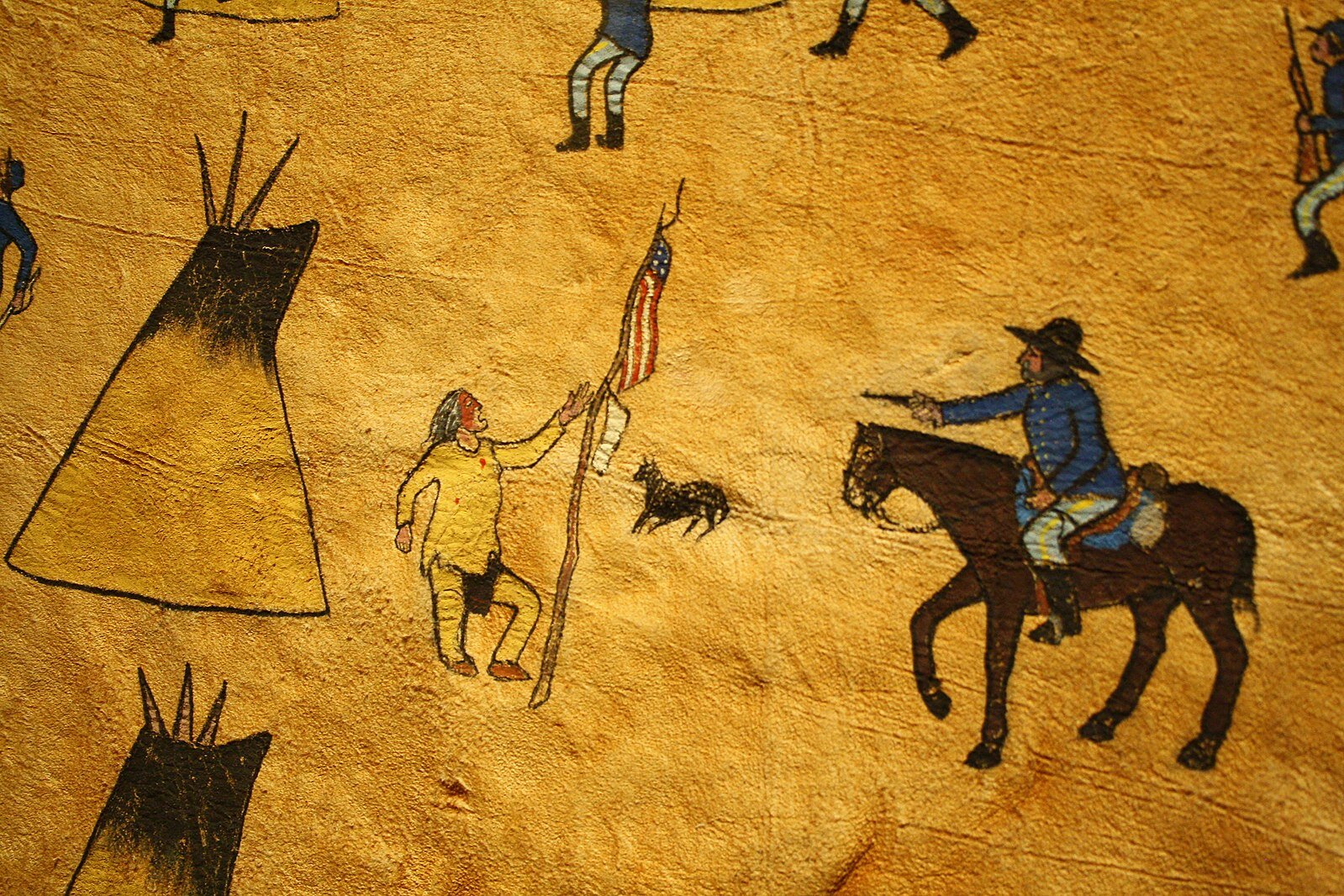
famous example of a white massacre of Natives is the Sand Creek Massacre in southeastern Colorado. Colonel John Chivington attacked a peaceful party of
Cheyenne Natives. A former minister, Chivington justified his massacre by
saying “Nits make lice.” He hunted down women and children who fled the camp
and mutilated them. His soldiers sliced open a pregnant woman. One soldier
sliced the pubic hair from a Cheyenne woman, and it was on display in Denver.
The next decade, in the Black Hills, whites bought Sioux scalps for up to $300
apiece. (It was as common for whites to scalp Natives as the other way around.)
I will not go into more details, partly because they sicken me. You can read
about it in Edward Lazarus’ monumental 1991 book, Black Hills White Justice.
This
is what happens when powerful men are free to do whatever they please to poor
and helpless people. There is no sentiment that can stop them.
At
the same time, writers of stories and novels depicted Native Americans as being
brave, honorable, noble, and respectful at least to people who were not killing
them. An example that comes to mind, of which everyone has heard, is Last of
the Mohicans. Painters such as George Catlin lived among them and painted
them as real people, with real lives and relationships. While the
nineteenth-century fiction about Native Americans seems racist to us today, at
the time it stood out as practically the only defense of the humanity of
Natives. At the time of the slaughters of Cheyenne and Sioux, “East-river”
humanitarians (east of the Missouri River in Dakota Territory) called for peace
with, rather than slaughter of, Natives.
Whenever
the Natives struck back against the Army that gleefully massacred them, the
newspapers (writing what they considered non-fiction) would loudly proclaim the
Natives to be savages that deserved extermination. In particular, one editorial
proposed a Final Solution for the Natives. He wrote, “It’s high time the sickly
sentimentalism about humane treatment and conciliatory measures should be
consigned to novel writers. There can be no permanent, lasting peace on the
frontier till these devils are exterminated” (emphasis mine). You will find
this on page 39 of Lazarus’ book.
This
shows how important it is for us writers, especially of fiction, to reveal the
humanity of all groups of humans. I mean full humanity, the bad as well as the
good. People who read these novels opposed the slaughter of Natives. Without
these novels, the humanitarians might have disapproved of the slaughters but
would not have felt very much outrage at them. It was not just a matter of
legal fairness, good government, or the proper use of human resources. These
are human beings we are talking about.
This
is an exact Native equivalent of the important role that Uncle Tom’s Cabin
played in stirring up the national conscience against slavery.
As
a writer, I consider it my responsibility to champion the full humanity and
beauty of oppressed peoples.